
Data structure — trees
Trees are hierarchical structures in which each node has a parent (except the root) and zero or more children. This article records the principal binary-tree variants, their defining properties, array-based layouts, and typical applications — including the complete binary tree backing a binary heap and the red-black tree used in TreeMap, TreeSet, and HashMap tree bins.
1. Binary tree
A binary tree is a tree in which every node has at most two children, designated left and right. The root has no parent; leaves have no children. The height of a node is the number of edges on the longest downward path to a leaf; the depth of a node is its distance from the root.
@startuml
title Complete binary tree (levels 0–2 filled; level 3 left-packed)

usecase A
usecase B
usecase C
usecase D
usecase E
usecase F

A --> B
A --> C
B --> D
B --> E
C --> F
@enduml
1.1 Complete binary tree
A complete binary tree satisfies:
- It is a binary tree.
- Every level except possibly the last is completely filled.
- All nodes in the last level occupy the leftmost positions — there are no gaps to the left of any node on that level.
A complete binary tree with $n$ nodes admits a compact array representation with no pointers: level-order (breadth-first) indexing starting at index $0$.
| Relation | Index formula (0-based, root at $0$) |
|---|---|
| Parent of node $i$ | $\lfloor (i - 1) / 2 \rfloor$ |
| Left child of node $i$ | $2i + 1$ |
| Right child of node $i$ | $2i + 2$ |
The array length is typically sized to the next power of two minus one, or grown dynamically as in ArrayList-backed heaps. Empty slots may appear only at the end of the array when the tree is not a perfect power-of-two size.
Binary heap
A binary heap is a complete binary tree stored in an array, subject to a heap-order property:
| Heap type | Property |
|---|---|
| Min-heap | Each node’s key $\leq$ keys of its children; minimum at root |
| Max-heap | Each node’s key $\geq$ keys of its children; maximum at root |
Index arithmetic in implementations such as PriorityQueue and PriorityBlockingQueue uses unsigned shifts for the parent index:
| Relation | Expression |
|---|---|
| Parent of $k$ | (k - 1) >>> 1 |
| Left child of $k$ | (k << 1) + 1 |
| Right child of $k$ | Left index $+ 1$ |
Insertion appends at the end of the array (next leaf position in the complete tree), then sifts up; removal of the extremum swaps the root with the last element and sifts down. Both operations are $O(\log n)$ in the number of elements.
1.2 Binary search tree
A binary search tree (BST) — also called an ordered binary tree — satisfies:
- It is a binary tree.
- For every node $x$, all keys in the left subtree are strictly less than $\text{key}(x)$ (or less than or equal, depending on convention).
- For every node $x$, all keys in the right subtree are strictly greater than $\text{key}(x)$.
Search, insert, and delete follow a single root-to-leaf path when comparisons are $O(1)$. In the average case over random insertions, height is $O(\log n)$. In the worst case (e.g. sorted insertion into an unbalanced BST), height degrades to $O(n)$.
Balanced search trees
A balanced BST maintains the BST ordering invariant while bounding height. For $n$ keys, height is guaranteed $O(\log n)$, so search, insert, and delete remain $O(\log n)$ worst-case. Common implementations include AVL trees, red-black trees, and B-trees (the latter for disk-oriented storage).
1.3 Red-black tree
A red-black tree is a BST augmented with one bit of color per node. It satisfies the following invariants (CLRS formulation):
- Every node is either red or black.
- The root is black.
- Every leaf (NIL sentinel) is black.
- If a node is red, both its children are black — no two consecutive red edges on a root-to-leaf path.
- For each node, all simple paths from that node to descendant leaves contain the same number of black nodes — black-height is well-defined.
Consequence of (4) and (5). A node with exactly one non-NIL child cannot attach a black child: the child’s NIL descendants would have a different black count than the missing child’s NIL, violating (5). The sole child must therefore be red (and the parent black).
Height is at most $2 \log_2(n + 1)$, yielding $O(\log n)$ search, insert, and delete. Red-black trees perform fewer rotations on average than AVL trees while still maintaining logarithmic height; JDK TreeMap, TreeSet, and HashMap tree bins use this structure.
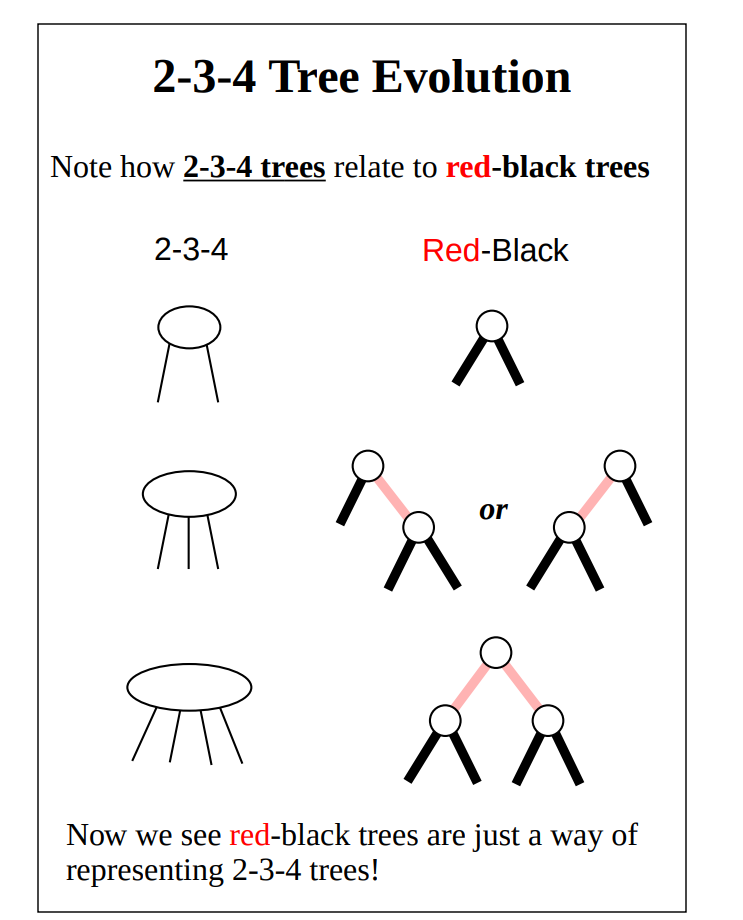
A red-black tree can be viewed as the binary-tree encoding of a 2-3-4 tree: red links group nodes into logical 3-nodes and 4-nodes.
Insertion fix-up
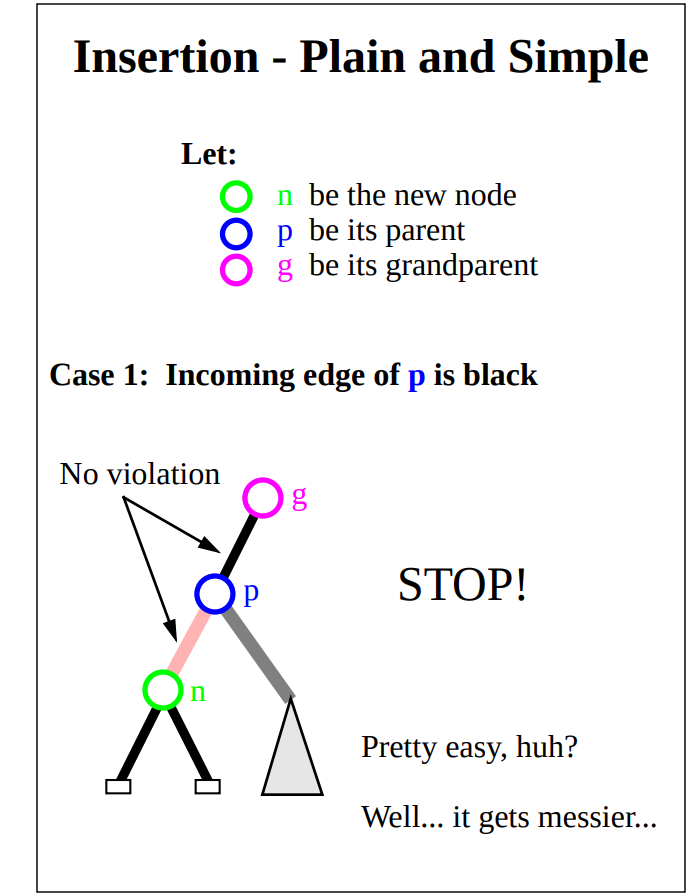
Insertion places a new leaf as red, then restores invariants by recoloring and/or rotating on the path to the root. Let $z$ be the inserted node, $p$ its parent, $g$ its grandparent, and $u$ its uncle ($p$’s sibling). Three cases cover all configurations (Purdue CS 251, lecture slides):
| Case | Condition | Action |
|---|---|---|
| 1 — Recolor | $u$ is red | Recolor $p$ and $u$ black, $g$ red; continue fix-up from $g$ |
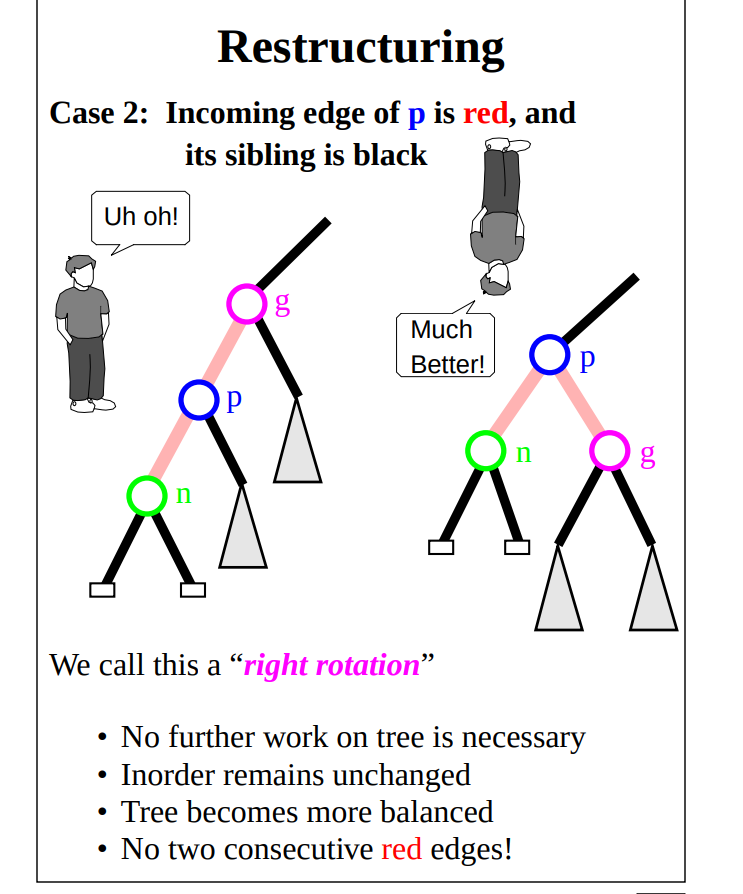
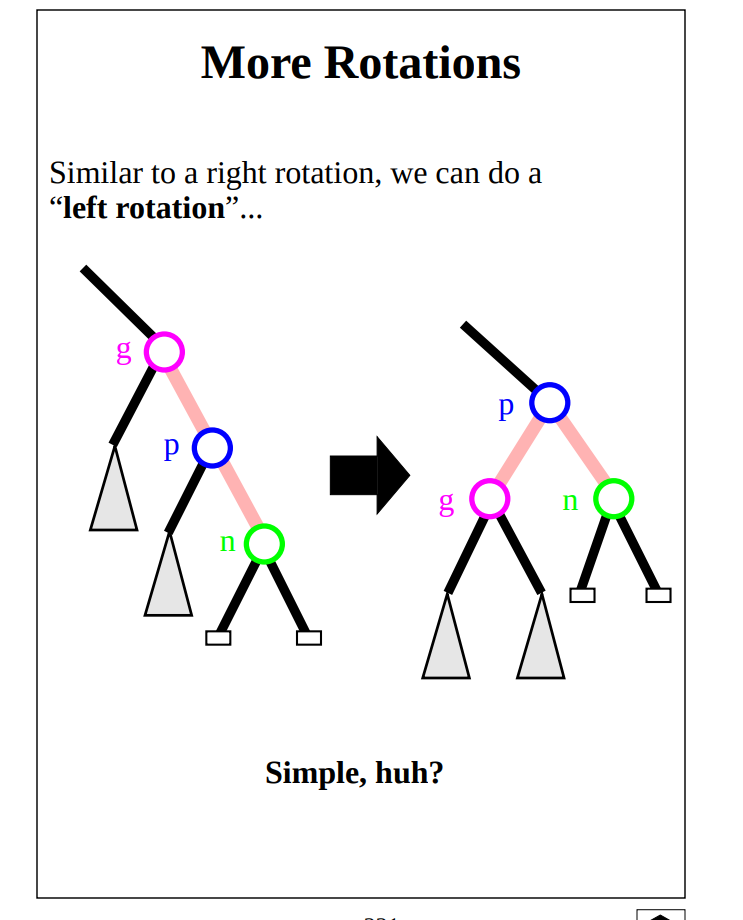
| 2 — Single rotation | $u$ is black; $z$ and $p$ are both left children or both right children of $g$ | Rotate at $g$; recolor; root black |
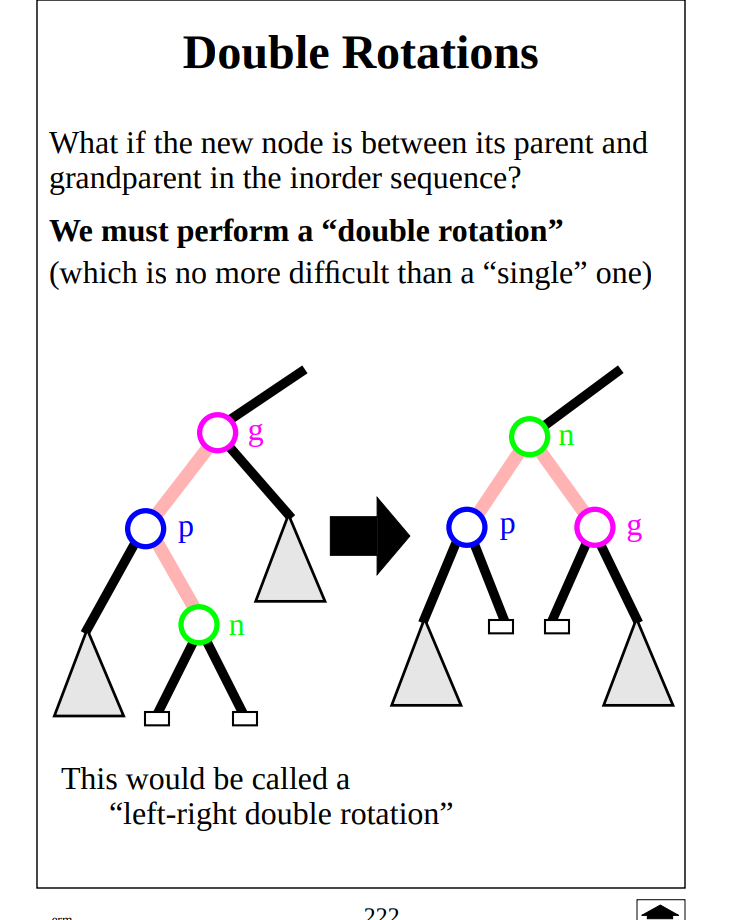
| 3 — Double rotation | $u$ is black; $z$ is an inner child (left-right or right-left) | Rotate at $p$, then rotate at $g$; recolor; root black |
Case 1 — no rotation
Case 2 — single rotation ($z$ and $p$ on the same side of $g$; uncle black)
Case 3 — double rotation ($z$ between $p$ and $g$)
Deletion fix-up mirrors insertion with additional cases when the removed node was black; the JDK TreeMap implementation encodes both insert and delete rebalance in balanceInsertion and balanceDeletion.
Summary
| Structure | Defining constraint | Storage | Typical use |
|---|---|---|---|
| Complete binary tree | Left-packed last level | Array, index formulas | Heap layout |
| Binary heap | Complete tree + heap order | Array | PriorityQueue, schedulers |
| BST | Left $<$ node $<$ right | Pointers or array | Ordered map (unbalanced) |
| Red-black tree | BST + five color invariants | Pointers | TreeMap, TreeSet, HashMap bins |