
Dubbo RPC Internals with Nacos Registry
Dubbo is an RPC framework. A service is defined as an ordinary interface, implemented in a provider process, and called from a consumer process as though it were a local object, with a registry telling the consumer where the provider is and a metadata service telling it what that interface looks like. Dubbo has implementations in Go, Python, PHP, Erlang, Rust, and Node.js, and this post covers the Java one.
1. Overview
As an RPC framework, Dubbo organises a cluster into four roles.
- A provider hosts the implementation. It declares which interfaces it serves and listens on a port to answer calls.
- A consumer calls those interfaces as if they were local. It keeps a local list of provider addresses and picks one per call.
- A registry holds addresses only. It knows which provider processes exist and tells each consumer when that list changes. It does not store interface definitions.
- A metadata service holds the definitions. Every provider exports one alongside its business services; a consumer asks it what an interface looks like — methods, parameter types, method-level settings — for a given revision.
The split between the last two is the change newer Dubbo made. Older versions stored everything about each interface in the registry, so the registry was large and any change meant rewriting a registration. From Dubbo 3 the definitions moved out to the metadata service, and the registry keeps only addresses plus a revision that points at the right definition. Adding an interface now changes that revision instead of churning every consumer’s address list.
The loop is short: provider registers, consumer subscribes, consumer receives addresses, consumer calls the provider directly. The registry is not in the call path, and the metadata service is consulted once per revision and then cached.
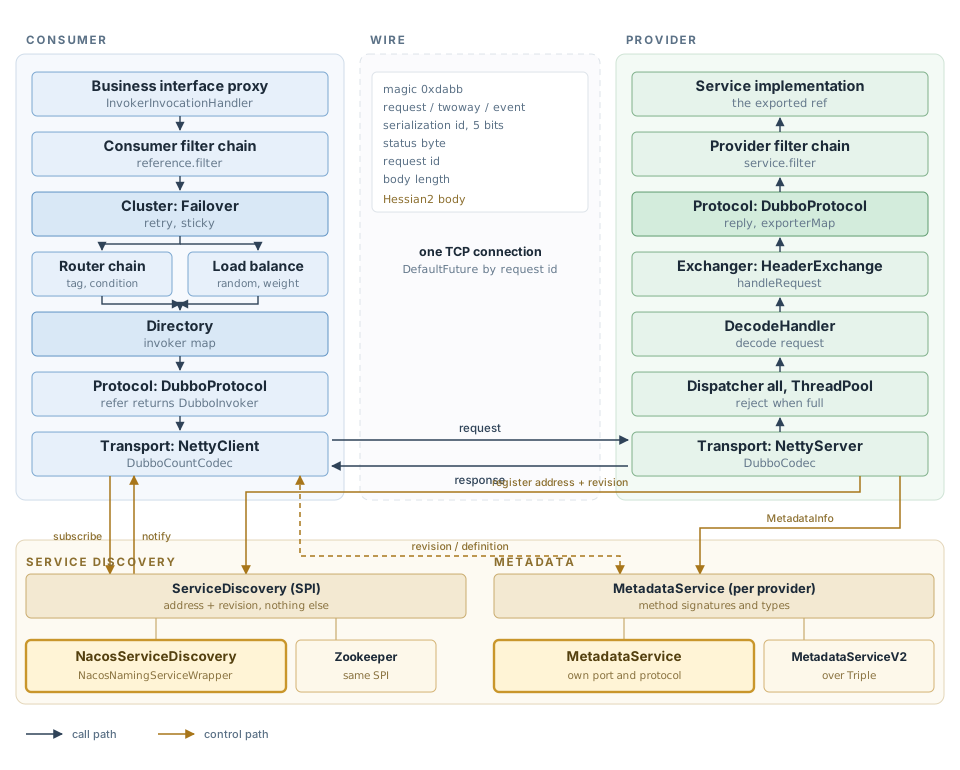
A minimal example
One shared interface module, so both sides compile against the same type:
public interface GreetingService {
    String greet(String name);
}
The provider implements it and exports the interface. The annotation is enough; the same result is available from XML or from the programmatic API.
@DubboService
public class GreetingServiceImpl implements GreetingService {
    public String greet(String name) {
        return "hello, " + name;
    }
}
dubbo:
  application:
    name: greeting-provider
  registry:
    address: nacos://127.0.0.1:8848
The consumer declares a field of the interface type and marks it for injection. It never constructs the implementation and never opens a socket.
@DubboReference
private GreetingService greetingService;

String reply = greetingService.greet("dubbo");
Three things happen behind that call. At startup the provider exported GreetingService and registered its address and revision with Nacos; the consumer subscribed to the provider’s application and got the address list back; and the call itself went from the injected proxy over a TCP connection to the provider’s port, where the implementation ran. The interface object the consumer holds is a proxy generated at startup, which is why a call looks like a local method call.
2. Extension architecture
Dubbo is structured around a microkernel and plugin design pattern. The framework core defines contracts as Service Provider Interfaces (SPIs) — Protocol, Exchanger, Transporter, Codec2, Serialization, ThreadPool, LoadBalance, StateRouterFactory, and Filter — and contains no hard-coded dependency on any concrete transport, serializer, or cluster strategy. Unlike java.util.ServiceLoader, which instantiates every declared provider eagerly from a flat list, Dubbo’s SPI combines five design patterns into a single container:
- Name-indexed lazy loading: implementations are declared as
name=classpairs in resource files and loaded only when that name is requested. - URL-driven late binding (Adaptive Proxy): every remote call is described by a
URLcarrying configuration parameters (protocol=dubbo,transporter=netty,serialization=hessian2,loadbalance=random). Because collaborators are wired at startup before any serviceURLexists, the container supplies a generated adaptive proxy that defers implementation lookup to call time by reading the parameter from the invocation’sURL. - Decorator composition (Wrapper): cross-cutting concerns such as filter chains, listener hooks, and reference counting are implemented as wrapper classes around the SPI interface and stacked automatically around every concrete instance.
- Rule-based chain assembly (Activation): ordered pipelines such as
FilterandStateRouterFactoryare selected as a group when@Activatepredicates match theURL, rather than looked up one name at a time. - Scoped IoC and lifecycle: extensions live inside a three-tier hierarchy (
FrameworkModel->ApplicationModel->ModuleModel) and receive collaborator SPIs through setter injection of adaptive instances.
@startuml
top to bottom direction
skinparam classAttributeIconSize 0

interface ExtensionAccessor {
  + getExtensionDirector(): ExtensionDirector
  + getExtensionLoader(Class<T>): ExtensionLoader<T>
  + getExtension(Class<T>, String): T
  + getAdaptiveExtension(Class<T>): T
}

abstract class ScopeModel implements ExtensionAccessor {
  - parent: ScopeModel
  - scope: ExtensionScope
  - classLoaders: Set<ClassLoader>
  - extensionDirector: ExtensionDirector
}
class FrameworkModel extends ScopeModel
class ApplicationModel extends ScopeModel
class ModuleModel extends ScopeModel

class ExtensionDirector implements ExtensionAccessor {
  - parent: ExtensionDirector
  - scope: ExtensionScope
  - extensionLoadersMap: ConcurrentMap<Class, ExtensionLoader>
  + getExtensionLoader(Class<T>): ExtensionLoader<T>
}

class ExtensionLoader<T> {
  - type: Class<T>
  - scopeModel: ScopeModel
  - cachedClasses: Holder<Map<String, Class>>
  - cachedInstances: ConcurrentMap<String, Holder<Object>>
  - cachedAdaptiveInstance: Holder<Object>
  - cachedWrapperClasses: Set<Class>
  + getExtension(String): T
  + getAdaptiveExtension(): T
  + getActivateExtension(URL, String, String): List<T>
}

interface ExtensionAccessorAware {
  + setExtensionAccessor(ExtensionAccessor)
}
interface ExtensionInjector extends ExtensionAccessorAware {
  + getInstance(Class<T>, String): T
}
class AdaptiveExtensionInjector implements ExtensionInjector
class SpiExtensionInjector implements ExtensionInjector
class ScopeBeanExtensionInjector implements ExtensionInjector
class SpringExtensionInjector implements ExtensionInjector

ScopeModel *-- ExtensionDirector
ExtensionDirector *-- ExtensionLoader
ScopeModel --o ExtensionLoader
ExtensionLoader ..> ExtensionInjector
@enduml
Both ScopeModel and ExtensionDirector implement ExtensionAccessor, exposing a uniform entry point (getExtensionLoader, getExtension, getAdaptiveExtension) at every tier of the container.
public interface ExtensionAccessor {
    ExtensionDirector getExtensionDirector();

    default <T> ExtensionLoader<T> getExtensionLoader(Class<T> type) {
        return getExtensionDirector().getExtensionLoader(type);
    }

    default <T> T getExtension(Class<T> type, String name) {
        ExtensionLoader<T> extensionLoader = getExtensionLoader(type);
        return extensionLoader != null ? extensionLoader.getExtension(name) : null;
    }

    default <T> T getAdaptiveExtension(Class<T> type) {
        ExtensionLoader<T> extensionLoader = getExtensionLoader(type);
        return extensionLoader != null ? extensionLoader.getAdaptiveExtension() : null;
    }
}
An extension point is declared by annotating an interface with @SPI, whose value sets the default implementation name and whose scope sets instance visibility (APPLICATION when omitted):
@Documented
@Retention(RetentionPolicy.RUNTIME)
@Target({ElementType.TYPE})
public @interface SPI {
    String value() default "";
    ExtensionScope scope() default ExtensionScope.APPLICATION;
}
The ExtensionScope controls which ScopeModel owns the ExtensionLoader and what state an instance may reach. FRAMEWORK-scoped extensions (Protocol, Serialization) share one loader on the root FrameworkModel across the JVM; APPLICATION-scoped extensions (RegistryFactory) isolate state per application while sharing across its modules; MODULE-scoped extensions (Filter) instantiate per module; and SELF creates a dedicated instance per owner. ExtensionDirector.getExtensionLoader enforces these boundaries by resolving in three steps:
ExtensionLoader<T> loader = extensionLoadersMap.get(type);   // 1. local cache
if (loader == null && scope == ExtensionScope.SELF) {
    loader = createExtensionLoader0(type);                    //    SELF never inherits
}
if (loader == null && this.parent != null) {
    loader = this.parent.getExtensionLoader(type);            // 2. delegate to parent scope
}
if (loader == null) {
    loader = createExtensionLoader(type);                     // 3. create at owning scope
}
Each ExtensionLoader<T> discovers implementations by scanning three classpath directories in order of decreasing priority:
META-INF/dubbo/internal/: framework built-ins.META-INF/dubbo/: user or third-party extensions, permitted to override lower-priority entries.META-INF/services/:ServiceLoadercompatibility.
Each file is named after the fully qualified interface and contains name=class lines, such as dubbo=org.apache.dubbo.rpc.protocol.dubbo.DubboProtocol. While reading the file, the loader classifies each class without instantiating it: a class annotated @Adaptive becomes the single cachedAdaptiveClass; a class whose constructor takes the SPI interface itself goes into cachedWrapperClasses; all remaining classes are indexed by name as ordinary implementations, with any @Activate metadata recorded alongside them. Duplicate names within the same priority tier fail at startup.
private void loadClass(..., Map<String, Class<?>> extensionClasses, ..., Class<?> clazz, String name, boolean overridden) {
    if (clazz.isAnnotationPresent(Adaptive.class)) {
        cacheAdaptiveClass(clazz, overridden);         // -> cachedAdaptiveClass
    } else if (isWrapperClass(clazz)) {
        cacheWrapperClass(clazz);                      // -> cachedWrapperClasses
    } else {
        String[] names = NAME_SEPARATOR.split(name);
        cacheActivateClass(clazz, names[0]);           // -> cachedActivates
        for (String n : names) {
            cacheName(clazz, n);
            saveInExtensionClass(extensionClasses, clazz, n, overridden); // -> cachedClasses
        }
    }
}
When a concrete name is resolved through getExtension(name), createExtension instantiates the target class, runs injectExtension across public setters (querying AdaptiveExtensionInjector across SpiExtensionInjector, ScopeBeanExtensionInjector, and SpringExtensionInjector, skipping unresolved setters and @DisableInject, and supplying ScopeModelAware / ExtensionAccessorAware callbacks), applies matching wrappers, and invokes Lifecycle.initialize() on the outermost object. For multi-element pipelines rather than single named targets, getActivateExtension(url, key, group) evaluates @Activate(group, value, before, after, order) against the URL and merges explicit additions or removals from the URL parameter named by key (service.filter on provider, reference.filter on consumer).
public T getExtension(String name, boolean wrap) {
    if ("true".equals(name)) {
        return getDefaultExtension();
    }
    String cacheKey = wrap ? name : name + "_origin";
    final Holder<Object> holder = getOrCreateHolder(cacheKey);
    Object instance = holder.get();
    if (instance == null) {
        synchronized (holder) {
            instance = holder.get();
            if (instance == null) {
                instance = createExtension(name, wrap);
                holder.set(instance);
            }
        }
    }
    return (T) instance;
}

private T createExtension(String name, boolean wrap) {
    Class<?> clazz = getExtensionClasses().get(name);
    T instance = (T) extensionInstances.get(clazz);
    if (instance == null) {
        extensionInstances.putIfAbsent(clazz, createExtensionInstance(clazz));
        instance = (T) extensionInstances.get(clazz);
        instance = postProcessBeforeInitialization(instance, name);
        injectExtension(instance);
        instance = postProcessAfterInitialization(instance, name);
    }

    if (wrap && cachedWrapperClasses != null) {
        List<Class<?>> wrapperClassesList = new ArrayList<>(cachedWrapperClasses);
        wrapperClassesList.sort(WrapperComparator.COMPARATOR);
        Collections.reverse(wrapperClassesList);
        for (Class<?> wrapperClass : wrapperClassesList) {
            if (matchesWrapper(wrapperClass, name)) {
                instance = (T) wrapperClass.getConstructor(type).newInstance(instance);
                instance = postProcessBeforeInitialization(instance, name);
                injectExtension(instance);
                instance = postProcessAfterInitialization(instance, name);
            }
        }
    }
    initExtension(instance);
    return instance;
}

private T injectExtension(T instance) {
    for (Method method : instance.getClass().getMethods()) {
        if (!isSetter(method) || method.isAnnotationPresent(DisableInject.class)) {
            continue;
        }
        Class<?> pt = method.getParameterTypes()[0];
        if (ReflectUtils.isPrimitives(pt)) {
            continue;
        }
        String property = getSetterProperty(method);
        Object object = injector.getInstance(pt, property);
        if (object != null) {
            method.invoke(instance, object);
        }
    }
    return instance;
}
Example: Adaptive and Wrapper
package com.example.spi;

import org.apache.dubbo.common.URL;
import org.apache.dubbo.common.extension.Adaptive;
import org.apache.dubbo.common.extension.SPI;

@SPI("stripe")
public interface PaymentGateway {
    @Adaptive("gateway")
    String pay(URL url, int amountCents);
}
package com.example.spi;

import org.apache.dubbo.common.URL;

public class StripeGateway implements PaymentGateway {
    @Override
    public String pay(URL url, int amountCents) {
        return "Stripe charged " + amountCents + " cents";
    }
}

public class PaypalGateway implements PaymentGateway {
    @Override
    public String pay(URL url, int amountCents) {
        return "PayPal charged " + amountCents + " cents";
    }
}
package com.example.spi;

import org.apache.dubbo.common.URL;

public class LoggingPaymentWrapper implements PaymentGateway {
    private final PaymentGateway delegate;

    public LoggingPaymentWrapper(PaymentGateway delegate) {
        this.delegate = delegate;
    }

    @Override
    public String pay(URL url, int amountCents) {
        System.out.println("[Before] paying " + amountCents);
        String receipt = delegate.pay(url, amountCents);
        System.out.println("[After]  result = " + receipt);
        return receipt;
    }
}
META-INF/dubbo/com.example.spi.PaymentGateway:
stripe=com.example.spi.StripeGateway
paypal=com.example.spi.PaypalGateway
logging=com.example.spi.LoggingPaymentWrapper
ExtensionLoader<PaymentGateway> loader = ApplicationModel.defaultModel()
        .getExtensionLoader(PaymentGateway.class);

PaymentGateway gateway = loader.getAdaptiveExtension();

URL url1 = URL.valueOf("test://localhost/order");
gateway.pay(url1, 500);

URL url2 = URL.valueOf("test://localhost/order?gateway=paypal");
gateway.pay(url2, 1200);
[Before] paying 500
[After]  result = Stripe charged 500 cents
[Before] paying 1200
[After]  result = PayPal charged 1200 cents
2.1 Protocol
Protocol is the outermost extension and the one that defines the other two verbs of the framework: export turns an invoker into something reachable, refer turns a URL into an invoker that can call a remote service. Its default is dubbo; tri, grpc, and rest2 are alternatives registered beside it.
@SPI(value = "dubbo", scope = ExtensionScope.FRAMEWORK)
public interface Protocol {
    @Adaptive <T> Exporter<T> export(Invoker<T> invoker) throws RpcException;
    @Adaptive <T> Invoker<T> refer(Class<T> type, URL url) throws RpcException;
    int getDefaultPort();
}
Both methods are @Adaptive, so the extension name is read from url.getProtocol(). One protocolSPI reference therefore serves both a registry:// URL and a dubbo:// URL: the first dispatches to RegistryProtocol, which wraps a registry and delegates the export, the second to DubboProtocol, which owns the socket.
@startuml
top to bottom direction
skinparam classAttributeIconSize 0

interface Protocol {
  + getDefaultPort(): int
  + export(Invoker): Exporter
  + refer(Class, URL): Invoker
}
abstract class AbstractProtocol implements Protocol {
  # Map<String, Exporter> exporterMap
  # ConcurrentMap<String, ProtocolServer> serverMap
  # protocolBindingRefer(Class, URL): Invoker
}
class DubboProtocol extends AbstractProtocol
class TripleProtocol extends AbstractProtocol
class InjvmProtocol extends AbstractProtocol
class RegistryProtocol implements Protocol

interface Invoker {
  + getInterface(): Class
  + invoke(Invocation): Result
}
interface Exporter

DubboProtocol *-- Exporter
DubboProtocol ..> Invoker
@enduml
Protocol is also the interface that carries the most wrappers. ProtocolFilterWrapper inserts the filter chain, ProtocolListenerWrapper adds exporter and invoker listeners, ProtocolSerializationWrapper installs the serializer allow-list, and InvokerCountWrapper maintains reference counts. Because these are wrappers rather than implementations, DubboProtocol contains none of that logic.
2.2 Exchanger
Exchanger sits between the protocol and the transport, and it is where request/response semantics enter. The transport moves bytes and knows nothing about correlation; the exchanger adds request identity, two-way versus one-way, event frames, and futures.
@SPI(value = HeaderExchanger.NAME, scope = ExtensionScope.FRAMEWORK)
public interface Exchanger {
    @Adaptive ExchangeServer bind(URL url, ExchangeHandler handler);
    @Adaptive ExchangeClient connect(URL url, ExchangeHandler handler);
}
HeaderExchanger is the only implementation. bind wraps the handler as HeaderExchangeHandler inside the transport’s server, connect wraps the channel as HeaderExchangeClient. HeaderExchangeHandler.handleResponse routes a Response to DefaultFuture.received, the single point where a waiting call is completed, and HeaderExchangeClient owns the heartbeat and reconnect timers.
@startuml
top to bottom direction
skinparam classAttributeIconSize 0

interface Exchanger {
  + bind(URL, ExchangeHandler): ExchangeServer
  + connect(URL, ExchangeHandler): ExchangeClient
}
class HeaderExchanger implements Exchanger

interface ExchangeServer
class HeaderExchangeServer implements ExchangeServer

interface ExchangeChannel {
  + request(Object, int): CompletableFuture
}
interface ExchangeClient extends ExchangeChannel
class HeaderExchangeClient implements ExchangeClient {
  - idleTimeout: int
  + request(Object): CompletableFuture
}
class HeaderExchangeHandler {
  + received(Channel, Object)
  + handleRequest(ExchangeChannel, Request)
}
class DefaultFuture {
  - FUTURES: Map<Long, DefaultFuture>
  + received(Channel, Response)
}

HeaderExchanger ..> HeaderExchangeServer
HeaderExchanger ..> HeaderExchangeClient
HeaderExchangeHandler ..> DefaultFuture
@enduml
2.3 Transporter
Transporter is the network implementation: it opens server sockets and client connections. The name is chosen by server for binding and client for connecting, both falling back to transporter, with netty as the default.
@SPI(value = "netty", scope = ExtensionScope.FRAMEWORK)
public interface Transporter {
    @Adaptive({SERVER_KEY, TRANSPORTER_KEY}) RemotingServer bind(URL url, ChannelHandler handler);
    @Adaptive({CLIENT_KEY, TRANSPORTER_KEY}) Client connect(URL url, ChannelHandler handler);
}
NettyTransporter returns a NettyServer or a NettyClient; the state and behaviour live in AbstractServer/AbstractClient, which handle bind retry, port detection, channel bookkeeping, and the connection listener set, while the subclass builds only the Netty ServerBootstrap. The SPI name netty maps to the Netty 4 module; the Netty 3 module registers as netty3.
@startuml
top to bottom direction
skinparam classAttributeIconSize 0

interface Transporter {
  + bind(URL, ChannelHandler): RemotingServer
  + connect(URL, ChannelHandler): Client
}
class NettyTransporter implements Transporter

interface RemotingServer
abstract class AbstractServer implements RemotingServer {
  # url: URL
  # handler: ChannelHandler
  + send(Object)
  # doOpen()
  # doClose()
}
class NettyServer extends AbstractServer {
  - bootstrap: ServerBootstrap
  - bossGroup: EventLoopGroup
  - workerGroup: EventLoopGroup
  # initServerBootstrap(NettyServerHandler)
}

interface Client
abstract class AbstractClient implements Client {
  # connectLock: ReentrantLock
  + reconnect()
  + send(Object)
}
class NettyClient extends AbstractClient

NettyTransporter ..> NettyServer
NettyTransporter ..> NettyClient
@enduml
2.4 Codec2
Codec2 converts between a ChannelBuffer and a message object. It is a separate extension from the protocol so that the framing can be reused: the dubbo protocol’s codec also serves the telnet path through inheritance.
@SPI(scope = ExtensionScope.FRAMEWORK)
public interface Codec2 {
    @Adaptive({CODEC_KEY}) void encode(Channel channel, ChannelBuffer buffer, Object message) throws IOException;
    @Adaptive({CODEC_KEY}) Object decode(Channel channel, ChannelBuffer buffer) throws IOException;
    enum DecodeResult { NEED_MORE_INPUT, SKIP_SOME_INPUT }
}
The adaptive key is codec, but the transport does not require it: AbstractEndpoint.getChannelCodec falls back to the protocol name when the parameter is absent, which is how dubbo:// resolves DubboCountCodec with no configuration. decode returning NEED_MORE_INPUT is the contract that lets a partial frame stay in the buffer instead of being parsed twice.
@startuml
top to bottom direction
skinparam classAttributeIconSize 0

interface Codec2 {
  + encode(Channel, ChannelBuffer, Object)
  + decode(Channel, ChannelBuffer): Object
}
abstract class AbstractCodec implements Codec2
class TransportCodec extends AbstractCodec
class TelnetCodec extends TransportCodec
class ExchangeCodec extends TelnetCodec {
  # HEADER_LENGTH: int = 16
  # MAGIC: short = 0xdabb
  + encode(Channel, ChannelBuffer, Object)
  + decode(Channel, ChannelBuffer): Object
}
class DubboCodec extends ExchangeCodec {
  # encodeRequestData(...)
  # decodeBody(...)
}
class DubboCountCodec implements Codec2 {
  - codec: DubboCodec
  + decode(Channel, ChannelBuffer): Object
}

DubboCountCodec *-- DubboCodec
@enduml
2.5 Serialization
Serialization is the body format, and it is the one extension chosen per request rather than per connection. Its two methods return stream wrappers rather than byte arrays, so a large argument can be written without materialising it.
@SPI(scope = ExtensionScope.FRAMEWORK)
public interface Serialization {
    byte getContentTypeId();
    String getContentType();
    @Adaptive ObjectOutput serialize(URL url, OutputStream output) throws IOException;
    @Adaptive ObjectInput deserialize(URL url, InputStream input) throws IOException;
}
getContentTypeId is constrained to five bits because the dubbo header stores it there. The implementations registered in this tree are hessian2 and fastjson2; others exist in separate modules, and DefaultSerializationExceptionWrapper wraps whichever is selected to normalise exception handling. Selection order is prefer.serialization, then serialization, then the framework default.
@startuml
top to bottom direction
skinparam classAttributeIconSize 0

interface Serialization {
  + getContentTypeId(): byte
  + getContentType(): String
  + serialize(URL, OutputStream): ObjectOutput
  + deserialize(URL, InputStream): ObjectInput
}
class Hessian2Serialization implements Serialization
class FastJson2Serialization implements Serialization
class DefaultSerializationExceptionWrapper implements Serialization
class DefaultSerializationSelector {
  - DEFAULT_REMOTING_SERIALIZATION: String
  + getDefaultRemotingSerialization(): String
}

DefaultSerializationExceptionWrapper o-- Serialization
DefaultSerializationSelector ..> Serialization
@enduml
2.6 ThreadPool
ThreadPool decides how a decoded request reaches business code. Its single method returns a java.util.concurrent.Executor configured from the URL.
@SPI(value = "fixed", scope = ExtensionScope.FRAMEWORK)
public interface ThreadPool {
    @Adaptive({THREADPOOL_KEY}) Executor getExecutor(URL url);
}
Four implementations differ only in the queue and the sizing: fixed uses a fixed worker count with a SynchronousQueue by default, cached allows growth and idle reclamation, limited grows to a maximum and then queues, and eager hands work to a new thread before queuing. All four share AbortPolicyWithReport as the rejection handler, which is what produces the SERVER_THREADPOOL_EXHAUSTED_ERROR response instead of a silent drop. The pool is owned by DefaultExecutorRepository, not by the protocol, so one executor serves every service on a port.
@startuml
top to bottom direction
skinparam classAttributeIconSize 0

interface ThreadPool {
  + getExecutor(URL): Executor
}
class FixedThreadPool implements ThreadPool
class CachedThreadPool implements ThreadPool
class LimitedThreadPool implements ThreadPool
class EagerThreadPool implements ThreadPool
class AbortPolicyWithReport

class DefaultExecutorRepository {
  - data: ConcurrentMap<String, ExecutorService>
  + createExecutorIfAbsent(URL): ExecutorService
  + getExecutor(URL): ExecutorService
}

FixedThreadPool ..> AbortPolicyWithReport
DefaultExecutorRepository ..> ThreadPool
@enduml
2.7 LoadBalance
LoadBalance picks one invoker from the candidates routing left behind.
@SPI(RandomLoadBalance.NAME)
public interface LoadBalance {
    @Adaptive("loadbalance") <T> Invoker<T> select(List<Invoker<T>> invokers, URL url, Invocation invocation);
}
Six implementations: random, roundrobin, leastactive, shortestresponse, consistenthash, and adaptive. All six extend AbstractLoadBalance, which supplies the weight calculation including the warm-up ramp. The method-level key means a single service can use different strategies per method, and the lookup happens per call rather than at refer time.
@startuml
top to bottom direction
skinparam classAttributeIconSize 0

interface LoadBalance {
  + select(List, URL, Invocation): Invoker
}
abstract class AbstractLoadBalance implements LoadBalance {
  + select(List, URL, Invocation): Invoker
  # doSelect(List, URL, Invocation): Invoker
  # getWeight(Invoker, Invocation): int
}
class RandomLoadBalance extends AbstractLoadBalance
class RoundRobinLoadBalance extends AbstractLoadBalance
class LeastActiveLoadBalance extends AbstractLoadBalance
class ShortestResponseLoadBalance extends AbstractLoadBalance
class ConsistentHashLoadBalance extends AbstractLoadBalance
class AdaptiveLoadBalance extends AbstractLoadBalance
@enduml
2.8 StateRouterFactory
Routing narrows the candidate list before load balancing sees it, and in this version the live interface is StateRouterFactory rather than the older RouterFactory, which is kept only for compatibility.
@SPI
public interface StateRouterFactory {
    <T> StateRouter<T> getRouter(Class<T> interfaceClass, URL url);
}
Factories registered in this tree are condition, tag, script-app, app, service, provider-app, standard-mesh-rule, and mock. A router factory is not named by a call-site parameter: RouterChain.buildSingleChain collects them with getActivateExtension(url, ROUTER_KEY), so which routers exist is decided by the URL conditions on each factory. getRouter is itself @Adaptive on the protocol key, which matters when a factory has several internal variants.
@startuml
top to bottom direction
skinparam classAttributeIconSize 0

interface StateRouterFactory {
  + getRouter(Class, URL): StateRouter
}
abstract class CacheableStateRouterFactory implements StateRouterFactory {
  - cache: ConcurrentMap<String, StateRouter>
  + getRouter(Class, URL): StateRouter
}
class ConditionStateRouterFactory extends CacheableStateRouterFactory
class TagStateRouterFactory extends CacheableStateRouterFactory
class ScriptStateRouterFactory extends CacheableStateRouterFactory

interface StateRouter {
  + route(BitList, URL, Invocation): BitList
}
abstract class AbstractStateRouter implements StateRouter {
  # url: URL
  # enabled: boolean
  + route(BitList, URL, Invocation): BitList
}
class ConditionStateRouter extends AbstractStateRouter

class RouterChain {
  - stateRouters: List<StateRouter>
  + route(URL, BitList, Invocation): List
  + buildSingleChain(Class, URL): SingleRouterChain
}

ConditionStateRouterFactory ..> ConditionStateRouter
RouterChain o-- StateRouter
RouterChain ..> StateRouterFactory
@enduml
2.9 Filter
Filter is the extension with the most implementations, and the only one applied twice per call — once on the consumer side and once on the provider side.
@SPI(scope = ExtensionScope.MODULE)
public interface Filter extends BaseFilter {}
A filter is a pair of callbacks, not a single method: invoke runs before the next node, and the Listener methods onResponse and onError run after it. Eighteen are registered in the core module, among them echo, generic, token, accesslog, classloader, context, exception, timeout, and tps. Selection is entirely by @Activate: the consumer chain takes group consumer filtered by the reference.filter parameter, the provider chain takes group provider filtered by service.filter, and order comes from the annotation’s order. A filter therefore never appears at a call site by name.
@startuml
top to bottom direction
skinparam classAttributeIconSize 0

interface BaseFilter {
  + invoke(Invoker, Invocation): Result
}
interface Filter extends BaseFilter
interface Listener {
  + onResponse(Result, Invoker, Invocation)
  + onError(Throwable, Invoker, Invocation)
}

abstract class ListenableFilter implements Filter {
  - nextListener: Listener
  + invoke(Invoker, Invocation): Result
}
class ContextFilter implements Filter, Listener
class ExceptionFilter implements Filter, Listener
class TimeoutFilter implements Filter, Listener
class TokenFilter implements Filter
class AccessLogFilter implements Filter

class DefaultFilterChainBuilder {
  + buildInvokerChain(Invoker, String, String): Invoker
}

DefaultFilterChainBuilder ..> Filter
@enduml
3. RPC implementation
A call has to be described before it can be made, and Dubbo describes it with a URL. Not merely an address: the URL carries the interface, the version and group, the timeout, the serializer, the thread pool, and the load balancer, so one flat string is enough to configure an invocation.
dubbo://10.0.0.7:20880/org.apache.dubbo.GreetingService
  ?interface=org.apache.dubbo.GreetingService
  &version=1.0.0
  &group=blue
  &timeout=3000
  &serialization=hessian2
  &threadpool=limited
  &loadbalance=random
Parameters may be method-specific. getMethodParameter(method, "timeout", 1000) first looks for methodName.timeout, then timeout, then returns the default, which is how one service can carry per-method timeouts and retries in a single flat URL.
Both ends of a call reduce every interface to the same small set of types. The figure shows how they relate; the sections that follow take each in turn.
@startuml
top to bottom direction
skinparam classAttributeIconSize 0

interface Protocol {
  int getDefaultPort()
  Exporter export(Invoker)
  Invoker refer(Class, URL)
}
class DubboProtocol implements Protocol
class RegistryProtocol implements Protocol

interface Invoker {
  Class getInterface()
  Result invoke(Invocation)
}
class DubboInvoker implements Invoker
interface ClusterInvoker extends Invoker
class FailoverClusterInvoker implements ClusterInvoker

interface Exporter
interface Directory {
  List list(Invocation)
}
class RegistryDirectory implements Directory
class ServiceDiscoveryRegistryDirectory implements Directory

interface Cluster {
  Invoker join(Directory)
}
class FailoverCluster implements Cluster

interface LoadBalance {
  Invoker select(List, URL, Invocation)
}

FailoverCluster ..> FailoverClusterInvoker
FailoverClusterInvoker o-- Directory
FailoverClusterInvoker ..> LoadBalance
DubboProtocol *-- Exporter
@enduml
3.1 Export: the provider runtime
Export begins in ServiceConfig, which builds one URL per protocol configuration and per registry, then hands the URL to the configured proxy factory and to the adaptive Protocol.
Invoker<?> invoker = proxyFactory.getInvoker(ref, interfaceClass, url);
Exporter<?> exporter = protocolSPI.export(invoker);
proxyFactory is JavassistProxyFactory by default. getInvoker does not use reflection: it obtains a generated Wrapper for the service class and produces an AbstractProxyInvoker whose doInvoke calls the generated invokeMethod with the argument array. The provider-side invocation therefore costs a virtual dispatch plus generated argument casting, not Method.invoke.
The URL passed to export is a registry://... URL, so the adaptive dispatch reaches RegistryProtocol.export. That method performs three distinct actions, in order:
doLocalExportexports the service through the real protocol (dubbo://...), producing the local exporter that owns the server socket.registry.register(...)publishes the record: a service instance under application-level discovery, or a provider URL under the interface-level compatibility mode.- For the interface-level mode only, it subscribes to
configuratorsoverride rules for the provider URL, so a later configuration change re-exports the service with new parameters. The application-level path handles configuration through the revision instead.
Local export descends through the protocol wrappers and reaches DubboProtocol.export:
String key = serviceKey(url);                       // group/path:version:port
DubboExporter<T> exporter = new DubboExporter<>(invoker, key, exporterMap);
openServer(url);
openServer keeps one server per host:port in serverMap, so all services sharing a port share a single Netty server; server.reset(url) applies URL changes to the existing server. createServer binds through Exchangers.bind(url, requestHandler), which resolves the Exchanger SPI (header by default), whose HeaderExchanger.bind wraps the handler as DecodeHandler(HeaderExchangeHandler(handler)) and delegates to Transporters.bind — NettyServer with the DubboCountCodec on the pipeline. The EventLoop and ChannelPipeline mechanics underneath are those of Netty; Dubbo adds one codec and one handler chain on top of a standard bootstrap.
The exporterMap key is what the provider uses to route an incoming request. AbstractProtocol.serviceKey composes group/path:version:port, with the port included so two services with the same interface on different ports do not collide.
3.2 Provider-side dispatch and threading
An arriving frame is decoded on the Netty I/O thread into a Request whose payload is a DecodeableRpcInvocation; the argument bytes are not yet deserialized. The handler chain installed by ChannelHandlers.wrap is:
MultiMessageHandler -> HeartbeatHandler -> Dispatcher(all) -> DecodeHandler -> HeaderExchangeHandler
AllChannelHandler.received submits a ChannelEventRunnable to the business thread pool, so DecodeHandler — and therefore argument deserialization — runs on a business thread, not on the event loop. decode.in.io.thread=false is the default and exists to keep long deserialization off the I/O threads.
HeaderExchangeHandler.handleRequest then calls the ExchangeHandler.reply implemented inside DubboProtocol:
Invocation inv = (Invocation) message;
Invoker<?> invoker = inv.getInvoker() == null ? getInvoker(channel, inv) : inv.getInvoker();
RpcContext.getServiceContext().setRemoteAddress(channel.getRemoteAddress());
Result result = invoker.invoke(inv);
return result.thenApply(Function.identity());
getInvoker extracts path, version, and group from the invocation attachments, rebuilds the service key with the local port, and looks it up in exporterMap. A miss produces a RemotingException naming the key and the channel pair, which the caller observes as a “not found exported service” error rather than a timeout. On a hit the invocation is stamped with the provider’s ServiceModel, which is what lets the subsequent filter chain and the generated wrapper resolve methods and switch the context class loader.
The reply is completed asynchronously: HeaderExchangeHandler attaches a completion stage that writes a Response with status OK on success, or status 70 (SERVICE_ERROR) with the exception text. Because the Result may complete on a different thread than the one that received the request, the response write is not tied to the business thread that ran the service method.
The thread pool itself is the ThreadPool extension selected by the threadpool parameter. Its SPI default is fixed, which is also what a provider gets when nothing is configured: threads (default 200) fixed-size workers, SynchronousQueue when queues=0 (the default), and AbortPolicyWithReport as the rejection handler. cached is the default for client URLs, because a consumer’s executor services replies and callbacks rather than business methods; limited and eager are also available. Saturation is not silent: the rejection policy throws, and AllChannelHandler.sendFeedback converts that into a Response with status 100 (SERVER_THREADPOOL_EXHAUSTED_ERROR) for two-way requests, so the consumer receives an immediate server-side rejection instead of waiting for its timeout.
3.3 Shutdown
DubboProtocol participates in DubboGracefulShutdown. The server sends a read-only event to every connected channel; the consumer’s HeaderExchangeHandler records the event on the channel and marks the corresponding client unavailable, so the directory stops selecting new invocations toward it while in-flight requests complete. The server then waits for the configured shutdown timeout before closing.
3.4 Refer: the consumer side
ReferenceConfig builds the consumer URL, then calls the adaptive protocol with the registry URL:
invoker = protocolSPI.refer(interfaceClass, registryUrl);
return (T) proxyFactory.getProxy(invoker, ProtocolUtils.isGeneric(generic));
Dispatch reaches RegistryProtocol.refer, which resolves the registry (the registry:// wrapper is unwrapped by InterfaceCompatibleRegistryProtocol.getRegistryUrl, turning registry://host:port?registry=nacos into nacos://host:port), builds a consumer URL, and creates the migration invoker. The application-level cluster invoker is produced by cluster.join(directory, true) over a ServiceDiscoveryRegistryDirectory, which subscribes to the application names the interface maps to:
directory.setRegisteredConsumerUrl(urlToRegistry);
if (directory.isShouldRegister()) {
    registry.register(directory.getRegisteredConsumerUrl());
}
directory.buildRouterChain(urlToRegistry);
directory.subscribe(toSubscribeUrl(urlToRegistry));
The subscription carries only address and revision information, because that is all the registry holds; the interface definitions arrive separately through MetadataService and are attached to each InstanceAddressURL before the invoker is built.
The final object returned to the application is a JDK dynamic proxy (JdkProxyFactory) or a generated one (JavassistProxyFactory, the default, which falls back to JDK proxies when code generation fails). Both attach an InvokerInvocationHandler:
RpcInvocation rpcInvocation = new RpcInvocation(serviceModel, method.getName(),
        invoker.getInterface().getName(), protocolServiceKey,
        method.getParameterTypes(), args);
return InvocationUtil.invoke(invoker, rpcInvocation);
InvocationUtil.invoke stores the consumer URL in RpcContext, calls invoker.invoke(rpcInvocation), and converts the Result back to a return value with recreate(), which rethrows the provider’s exception on the caller thread. toString, hashCode, equals, and $destroy are intercepted before this point so they never reach the network.
3.5 Directory refresh
ServiceDiscoveryRegistryDirectory.notify is the boundary between registry data and invokers.
flowchart LR
    A["notify(urls)"] --> B["instance urls, address + revision"]
    B --> C{"single empty:// url?"}
    C -->|"yes"| D["forbid, destroy all invokers"]
    C -->|"no"| E["distinct, drop duplicates"]
    E --> F["reuse invokers whose url is unchanged"]
    F --> G["refer new instances"]
    G --> H["swap urlInvokerMap atomically"]
    H --> I["refresh router chain"]
Conversion is incremental. Provider URLs already present in the previous map with unchanged parameters are reused, so a notification that adds one instance does not rebuild every client connection. URLs that disappeared are destroyed. The map swap is a single volatile write, and list(invocation) reads under a read lock into a clone before applying routers, so an in-flight call never observes a half-built map.
The empty:// protocol is the explicit “no providers” signal: a single such URL sets the directory to forbidden and destroys all invokers, so callers fail immediately with “no provider available”. An ordinary empty list is not treated as the same event — the directory keeps the previous addresses and logs it as empty protection, because an empty notification is far more often a transient registry or network fault than a real scale-to-zero.
3.6 Cluster invocation
Cluster is also an SPI, default failover. FailoverClusterInvoker.doInvoke is the default execution strategy:
int len = calculateInvokeTimes(methodName);        // retries + 1, default 3 attempts
for (int i = 0; i < len; i++) {
    if (i > 0) { copyInvokers = list(invocation); checkInvokers(copyInvokers, invocation); }
    Invoker<T> invoker = select(loadbalance, invocation, copyInvokers, invoked);
    invoked.add(invoker);
    try {
        return invokeWithContext(invoker, invocation);
    } catch (RpcException e) {
        if (e.isBiz()) throw e;                    // business exception: never retried
        le = e;
    }
}
Three properties follow from this loop. The candidate list is re-fetched before each retry, so a retry can use a provider registered after the first failure. The invoked list is passed to select, which reselects when the load balancer returns an address already tried in this call. Business exceptions are rethrown immediately — retrying a method that already executed would duplicate its side effects, which is why only framework-level RpcExceptions are failover-eligible.
select adds two refinements on top of the load balancer. With sticky=true it reuses the last successful invoker for the same method while it remains available. And doSelect invalidates an invoker found unavailable (availablecheck, default true) so that subsequent calls skip it until the transport recovers.
Load balancing is random by default, weighted: weights are read from each provider URL (weight, default 100) and scaled down during the first ten minutes of a provider’s life (warmup), so a freshly started instance does not receive its full share while its JIT is still cold. The weighted selection uses a cumulative prefix array with binary search for more than four candidates, and falls back to uniform selection when all weights are equal. roundrobin, leastactive, shortestresponse, consistenthash, and adaptive are available by name.
Filters bracket the whole consumer call. ProtocolFilterWrapper.refer builds the consumer chain from the reference.filter @Activate extensions, and AbstractCluster.join additionally wraps the cluster invoker in the ClusterFilter chain selected by the same key with group consumer. ConsumerContextFilter (order Integer.MIN_VALUE) propagates attachments to the provider and RouterSnapshotFilter records the routing decision for diagnostics. The provider chain is assembled the same way from service.filter with group provider: ContextFilter restores incoming attachments into the server-side RpcContext, ExceptionFilter decides how an exception is wrapped before it becomes a Response, and TimeoutFilter logs a warning when the TIME_COUNTDOWN attachment shows the caller’s budget already expired while the method was running.
3.7 Frame layout
The protocol layer on both sides reduces to one frame format. ExchangeCodec fixes a 16-byte header for both directions, followed by a serialized body.
| Offset | Size | Content |
|---|---|---|
| 0 | 2 | Magic 0xdabb |
| 2 | 1 | Bit 7: request; bit 6: two-way; bit 5: event; bits 0–4: serialization id |
| 3 | 1 | Status, meaningful in responses only |
| 4 | 8 | Request id |
| 12 | 4 | Body length |
| 16 | var | Serialized body |
The request flag in bit 7 and the serialization id in the low five bits of byte 2 give a reader everything needed to classify the frame and pick a body codec before any deserialization. A request sets bit 7; a response leaves it clear and fills byte 3 with a status code. The status byte is present but ignored in requests, so the fixed layout is symmetric and cheap to parse. Responses carry 20 (OK), 30 (CLIENT_TIMEOUT), 35 (CHANNEL_INACTIVE), 40 (BAD_REQUEST), 50 (BAD_RESPONSE), 60 (SERVICE_NOT_FOUND), 70 (SERVICE_ERROR), 90 (CLIENT_ERROR), or 100 (SERVER_THREADPOOL_EXHAUSTED_ERROR).
Requests are encoded by DubboCodec.encodeRequestData, which writes a fixed sequence into the serialized stream:
protocol version (UTF) | service name (UTF) | service version (UTF) |
method name (UTF) | parameter type descriptor (UTF) | arguments | attachments
The service name is taken from the interface attachment with the path attachment as fallback. The parameter descriptor is a JVM type descriptor string (Ljava/lang/String;IZ) rather than a serialized Class[]; the provider resolves the Method from its own service model, so a consumer compiled against the same interface can invoke it without transmitting class metadata. Attachments (trace ids, timeouts, tags) travel in the same body, so the invocation context is carried by the protocol rather than by a side channel.
Responses are typed by a leading byte: value, null, exception, and each with attachments. Attachments on the response are omitted for peers older than protocol version 2.0.2, detected by parsing the version string from the request.
DubboCountCodec decodes in a loop, accumulating messages until the buffer is exhausted or decoding returns NEED_MORE_INPUT, rewinding the reader index in the latter case. A single decode call therefore yields one MultiMessage holding every complete frame in the buffer, and MultiMessageHandler at the head of the handler chain dispatches each element in turn, isolating a failure in one message from the rest of the batch. One TCP read carrying several small requests costs one decode call, not one per read event.
Payload size is enforced by checkPayload against the payload parameter, default 8 MiB, on both encode and decode. Exceeding it on the response path is converted into a BAD_RESPONSE frame so the consumer fails immediately rather than waiting for a timeout.
Serialization is negotiated per request, not per connection. DubboCodec.getSerialization checks the Invocation for a serialization id attachment and, when present, uses that codec id; otherwise it resolves UrlUtils.serializationOrDefault(url), which tries prefer.serialization in order, then serialization, then the framework default — hessian2 unless DUBBO_DEFAULT_SERIALIZATION overrides it. On the provider, the AppResponse carries its Invocation, so the reply is encoded with the same id the request used. Because that id occupies the low five bits of the header, the receiver needs no out-of-band agreement, and one connection can carry requests encoded with different serializers.
3.8 Request/response correlation and timeouts
The RPC layer is synchronous in appearance but asynchronous in structure. DubboInvoker.doInvoke builds a Request with twoWay=true, then:
CompletableFuture<AppResponse> appResponseFuture =
        currentClient.request(request, timeout, executor).thenApply(AppResponse.class::cast);
AsyncRpcResult result = new AsyncRpcResult(appResponseFuture, inv);
HeaderExchangeChannel.request creates a DefaultFuture before sending, registers it in a static FUTURES map keyed by request id, and arms a HashedWheelTimer timeout task. When a Response arrives, HeaderExchangeHandler.handleResponse calls DefaultFuture.received, which removes the entry, cancels the timeout task, and completes the future. An id with no live future — a response that arrived after its timeout — is logged and discarded.
A late response is therefore not an error path in the transport; it is simply dropped. The consequence is that a timed-out request may still execute on the provider, which is why the fault-tolerance policy treats timeouts as retryable only under the caller’s explicit configuration, and why the retry loop excludes business exceptions.
Timeout values compose before the call. RpcUtils.calculateTimeout honours a TIME_COUNTDOWN attachment (used for nested calls that must fit inside the caller’s remaining budget), otherwise reads methodName.timeout then timeout, defaulting to 1000 ms. When a countdown is present, or when enable-timeout-countdown is set on the method, the resolved value is written into a TIMEOUT_ATTACHMENT_KEY attachment so the provider can apply the same budget.
Connection loss is handled explicitly. DefaultFuture.closeChannel walks the channels for uncompleted futures, waits up to the configured close timeout for a response, and then synthesizes a CHANNEL_INACTIVE response, so a broken connection fails fast instead of consuming the RPC timeout.
3.9 Keepalive and reconnection
HeaderExchangeClient owns two timer tasks per client. HeartbeatTimerTask sends an event request when neither a read nor a write has occurred within heartbeat (default 60 s); HeartbeatHandler answers heartbeat requests on the I/O thread, without entering the business pool. ReconnectTimerTask reconnects a channel that is not connected, and also one whose last read is older than the idle timeout, which defaults to three heartbeat intervals. getCloseTimeout enforces the corresponding invariant: the close timeout may not be shorter than twice the heartbeat interval, and the idle timeout may not be either.
One client per provider address is the default: connections=0 selects shared clients (shareconnections, default 1), which are reference counted (ReferenceCountExchangeClient) so that two services on the same port share one connection and closing one does not close the socket. connections=n with n>0 instead creates n dedicated clients per service, round-robined by DubboInvoker. lazy=true defers the TCP connect to the first call.
3.10 One invocation across the boundary
sequenceDiagram
    participant App as Application
    participant Px as Proxy
    participant Cl as FailoverClusterInvoker
    participant Dir as RegistryDirectory
    participant Inv as DubboInvoker
    participant Ch as NettyClient channel
    participant Srv as NettyServer
    participant Ex as Provider dispatch

    App->>Px: method call
    Px->>Cl: invoke RpcInvocation
    Cl->>Dir: list invocation
    Dir-->>Cl: routed provider invokers
    Cl->>Cl: select via LoadBalance
    Cl->>Inv: invoke invocation
    Inv->>Ch: Request id, twoWay, via DefaultFuture
    Ch->>Srv: 16-byte header and Hessian2 body
    Srv->>Srv: decode header, dispatch to business pool
    Srv->>Ex: decoded Invocation
    Ex->>Ex: exporterMap lookup by serviceKey
    Ex->>Ex: provider filter chain, service method
    Ex-->>Ch: Response id, status=20, value
    Ch->>Inv: DefaultFuture.received completes
    Inv-->>Cl: AsyncRpcResult
    Cl-->>Px: Result
    Px-->>App: recreate returns value
The provider filter chain runs inside invoker.invoke(inv) on the business thread, so the service key resolution, the context class loader switch, and the filters all precede the business method, while the response is written from the completion callback that HeaderExchangeHandler attaches to the returned stage — on the business thread for a synchronous service method, and on whichever thread completes the future otherwise.
4. The registry
The registry answers one question: which provider processes are running and where do they listen. It holds no interface definitions, only an address and a revision per instance.
NacosServiceDiscovery extends AbstractServiceDiscovery, which extends AbstractRegistry, which FailbackRegistry builds on. The layering is inherited from the interface-level registry that predates application-level discovery, and it is still where the useful mechanics live: AbstractRegistry maintains the registered/subscribed/notified maps and a local disk cache, FailbackRegistry retries failed operations, and NacosServiceDiscovery maps Dubbo concepts onto Nacos naming.
4.1 The address model
At application level a Nacos service name is the application name, and one instance represents one provider process:
// NacosServiceDiscovery.doRegister
Instance instance = toInstance(serviceInstance);   // ip, port, metadata = revision, storage-type, endpoints
service.registerInstance(instance.getServiceName(), group, instance);
The instance metadata is deliberately small. dubbo.metadata.revision identifies the interface definitions the process currently exports, dubbo.metadata.storage-type says where a consumer should resolve that revision, and dubbo.endpoints lists the protocol/port pairs. Nothing describes a single interface. A provider deploying five interfaces produces one registration, and adding a sixth changes the revision rather than the address list.
The registry group defaults to DEFAULT_GROUP and is overridable by nacos.group. Names containing $ — nested interfaces from generated stubs — are rewritten to ___ before reaching the Nacos client, because Nacos restricts service-name characters.
4.2 Subscription
flowchart TD
    A["doSubscribe(url, listener)"] --> B["resolve interface to application"]
    B --> C["ServiceNameMapping lookup"]
    C --> D["subscribe application name"]
    D --> E["Nacos EventListener per app"]
    E --> F["onEvent: RegistryNotifier coalesces"]
    F --> G["getInstances: filter enabled"]
    G --> H["build URLs from revision and endpoints"]
    H --> I["registry.notify -> Directory refresh"]
ServiceDiscoveryRegistry.doSubscribe first resolves the interface to a set of application names, then registers one ServiceInstancesChangedListener per application. NacosServiceDiscovery.addServiceInstancesChangedListener maps each application to a single Nacos EventListener, shared by every interface that application serves — so a consumer of three interfaces from one application holds one subscription, not three.
Two behaviours matter here. Instances with enabled=false are dropped before addresses are built. And an empty notification is not treated as a scale-to-zero: ServiceDiscoveryRegistryDirectory keeps the previous address list and logs it as empty protection, because an empty notification is far more often a transient Nacos fault than a real teardown.
The mapping from interface to application is not in Nacos naming. ServiceNameMapping maintains it (with provided-by on the consumer URL and a metadata-center mapping), and ServiceDiscoveryRegistry.doSubscribe consults the mapping before subscribing; with no mapping it stops and waits for the mapping listener, because a consumer cannot name an application it has never been told about. The Nacos client side of that model is covered in Nacos service and configuration management.
4.3 Coalescing, failure recovery, and local cache
RegistryNotifier bounds the cost of a flapping provider set. The first ten notifications are delivered immediately (DEFAULT_DELAY_EXECUTE_TIMES = 10); afterwards the notifier enforces the delay-notification window (default 5000 ms) and keeps only the most recent payload, comparing a timestamp so that a superseded task produces no notification. A burst of registrations at deployment time therefore yields one directory refresh instead of one per instance.
FailbackRegistry handles transport-level failures with a HashedWheelTimer. register, unregister, subscribe, and unsubscribe each catch exceptions, throw immediately when check=true (so a bad configuration fails fast at startup), and otherwise record a task that is retried every retry.period (default 5000 ms) until it succeeds. SkipFailbackWrapperException bypasses the retry when retrying cannot succeed.
AbstractRegistry persists every notified address set into a local properties file at ~/.dubbo/dubbo-registry-{application}-{registry-address}.cache. The file is loaded into memory at construction. Its purpose is the failure path: when doSubscribe throws, FailbackRegistry.subscribe calls getCacheUrls, which prefers the in-memory notified map and falls back to the file, and if it finds entries it notifies the listener with them before logging the failure — so the consumer starts from the last known provider list rather than an empty directory. Writes are serialized through lastCacheChanged and written asynchronously unless save.file=true, and file-cache=false disables the mechanism entirely.
APPLICATION_FIRST is the consumer-side default for the migration rule. In a configuration that still publishes both levels — register-mode=all, the provider default for a plain nacos:// URL — the application-level invoker is preferred and the interface-level one remains available as a fallback, which is why RegistryProtocol.refer returns a MigrationInvoker holding up to two cluster invokers and switching between them by rule:
| Step | Selection |
|---|---|
APPLICATION_FIRST (default) | Application-level, falling back to interface-level when its address count is below the threshold; a promotion percentage below 100 sends only that fraction of calls to the application-level invoker |
FORCE_APPLICATION | Always the application-level invoker, destroying the interface-level one |
FORCE_INTERFACE | Always the interface-level invoker, the compatibility mode |
5. MetadataService
The metadata service answers the other question: what does that interface look like. It is an ordinary RPC service exported by every provider, so a consumer reaches it the same way it reaches a business service, without going through the registry again.
5.1 The service itself
MetadataService is a small fixed interface. It exposes getMetadataInfo(revision) and getMetadataInfos(), plus getServiceDefinition(serviceKey) for a single interface. Because it is an ordinary service, it is exported through the same ServiceConfig machinery as business services: ConfigurableMetadataServiceExporter builds a ServiceConfig for it with its own protocol and port (metadata-service-protocol, metadata-service-port) and exports it on startup. A consumer refers it through MetadataUtils.referMetadataService, which builds a URL from the coordinates in the instance metadata and calls it like any other remote service.
The definition returned is a MetadataInfo: the set of services the provider exports, each with its interface name, version, group, protocol, and method signatures with parameter type descriptors.
5.2 Resolving the revision
dubbo.metadata.revision is the link back to the interface definitions. It is a digest computed by MetadataInfo.calRevision over the application name and the description of every exported service, so it changes whenever the set or shape of those services changes. A consumer reads the revision from the instance and resolves it via the provider’s MetadataService. AbstractServiceDiscovery.getRemoteMetadata performs that resolution behind a revision-keyed cache, retrying three times with a one-second pause before giving up with an empty MetadataInfo. The cache is what keeps the per-revision fetch off the steady-state path.