
Java Stream internals
java.util.stream.Stream is the public face of Java 8’s functional-style aggregate operations. Under the hood it is not a data structure — it is a lazy pipeline of linked stages backed by a Spliterator source. Intermediate operations such as filter and map only extend the pipeline; computation begins when a terminal operation such as collect or forEach triggers evaluation. This document traces the OpenJDK implementation centered on Stream, its pipeline machinery, and how elements flow from source to result.
1. Overview
The java.util.stream package implements Stream, IntStream, LongStream, and DoubleStream — all backed by the same pipeline skeleton (ReferencePipeline / *Pipeline):
BaseStream— common lifecycle API (sequential,parallel,spliterator,close)AbstractPipeline— linked list of pipeline stages; owns evaluation logicPipelineHelper— abstract view of a pipeline segment used during terminal evaluationSink— per-stage consumer chain that pushes elements through operationsTerminalOp— encapsulates a terminal operation’s sequential/parallel executionSpliterator— external iterator/splitter abstraction for the data source
A typical call like list.stream().filter(p).map(f).collect(toList()) builds a four-stage pipeline (source → filter → map → terminal) without touching any elements until collect runs.
2. Architecture
The design separates declaration (building the pipeline) from execution (traversing the source). Public methods on Stream delegate to package-private pipeline classes and operation factories.
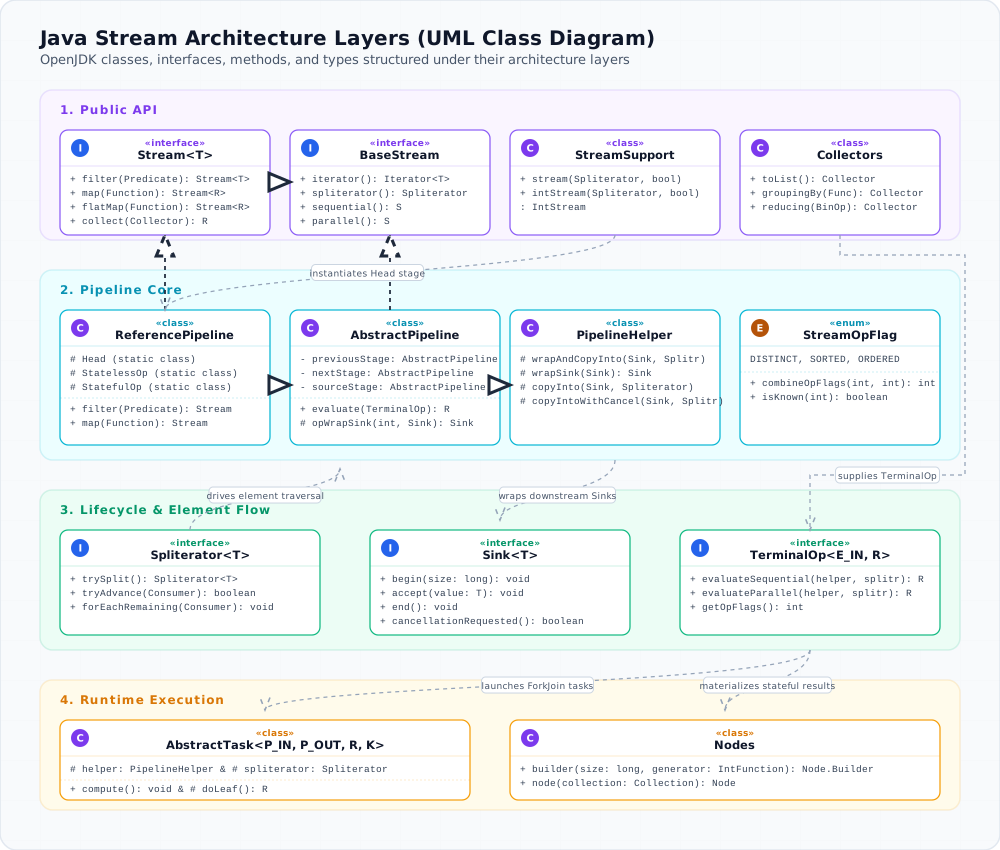
2.1 Pipeline lifecycle
- Creation —
StreamSupport.stream(spliterator, parallel)constructs aReferencePipeline.Head(the source stage). - Chaining — Each intermediate operation appends a new
AbstractPipelinestage via thepreviousStage/nextStagelinks and marks the upstream stage aslinkedOrConsumed. - Terminal trigger — A terminal method calls
AbstractPipeline.evaluate(TerminalOp), which obtains the sourceSpliterator, then dispatches toevaluateSequentialorevaluateParallel. - Traversal —
PipelineHelper.wrapSinkbuilds a chainedSinkfrom the terminal sink back to the source;wrapAndCopyIntodrives the spliterator to push elements through every stage.
For sequential pipelines without stateful intermediate operations, the framework fuses all stages into a single pass — filter, map, and reduce can run with minimal intermediate buffering.
For parallel pipelines with stateful operations (sorted, distinct, limit in some cases), the pipeline is split into segments at each stateful stage; each segment is evaluated separately and its output becomes the next segment’s input (§4.5). Sequential pipelines keep a single fused pass (§4.4).
3. Structure
3.1 Class hierarchy
@startuml
interface "BaseStream<T, S>" as BaseStream {
    + iterator()
    + spliterator()
    + sequential()
    + parallel()
    + close()
}

interface "Stream<T>" as Stream {
    + filter(Predicate)
    + map(Function)
    + collect(Collector)
    + reduce(BinaryOperator)
}

abstract class "PipelineHelper<P_OUT>" as PipelineHelper {
    + wrapAndCopyInto()
    + wrapSink()
    + copyInto()
}

abstract class "AbstractPipeline<E_IN, E_OUT, S>" as AbstractPipeline {
    - previousStage
    - nextStage
    - sourceStage
    - combinedFlags
    + evaluate(TerminalOp)
    + wrapSink(Sink)
    + copyInto(Sink, Spliterator)
}

abstract class "ReferencePipeline<P_IN, P_OUT>" as ReferencePipeline {
    + filter()
    + map()
    + collect()
}

abstract class "ReferencePipeline.StatelessOp<E_IN, E_OUT>" as StatelessOp {
    # opWrapSink()
}

abstract class "ReferencePipeline.StatefulOp<E_IN, E_OUT>" as StatefulOp {
    # opEvaluateParallel() : Node<E_OUT>
}

class "SortedOps.OfRef<T>" as SortedOfRef

class "DistinctOps.Ref<T>" as DistinctRef

class "SliceOps.Ref<T>" as SliceRef

class "WhileOps.TakeWhileRef<T>" as TakeWhileRef

class "WhileOps.DropWhileRef<T>" as DropWhileRef

class "ReferencePipeline.Head<E_IN, E_OUT>" as Head

interface "Sink<T>" as Sink {
    + begin(long)
    + accept(T)
    + end()
    + cancellationRequested()
}

interface "TerminalOp<E_IN, R>" as TerminalOp {
    + evaluateSequential()
    + evaluateParallel()
    + getOpFlags()
}

interface "TerminalSink<T, R>" as TerminalSink

interface "AccumulatingSink<T, R, K>" as AccumulatingSink {
    + combine(K)
}

interface "Collector<T, A, R>" as Collector {
    + supplier()
    + accumulator()
    + combiner()
    + finisher()
    + characteristics()
}

class "Collectors" as Collectors {
    + {static} toList()
    + {static} toSet()
    + {static} groupingBy()
    + {static} reducing()
}

abstract class "ReduceOps.ReduceOp<T, R, S>" as ReduceOp {
    + makeSink()
}

class "ForEachOps.ForEachOp" as ForEachOp
class "FindOps.FindOp" as FindOp
class "MatchOps.MatchOp" as MatchOp

BaseStream <|.. Stream
Stream <|.. ReferencePipeline
PipelineHelper <|-- AbstractPipeline
BaseStream <|.. AbstractPipeline
AbstractPipeline <|-- ReferencePipeline
ReferencePipeline <|-- StatelessOp
ReferencePipeline <|-- StatefulOp
ReferencePipeline <|-- Head

StatefulOp <|-- SortedOfRef
StatefulOp <|-- DistinctRef
StatefulOp <|-- SliceRef
StatefulOp <|-- TakeWhileRef
StatefulOp <|-- DropWhileRef

Sink <|.. TerminalSink
AccumulatingSink <|.. TerminalSink

TerminalOp <|.. ReduceOp
TerminalOp <|.. ForEachOp
TerminalOp <|.. FindOp
TerminalOp <|.. MatchOp

TerminalSink <|.. ForEachOp

ReduceOp ..> AccumulatingSink : makeSink() returns S
Collectors ..> Collector : factory methods
Stream ..> Collector : collect(Collector)
Stream ..> TerminalOp : evaluate via ReduceOps / ForEachOps / …
ReduceOp ..> Collector : makeRef(Collector)\nwraps supplier/accumulator/combiner
@enduml
Terminal operations are not pipeline stages — they are created at evaluation time by factory classes. collect(Collector) builds a ReduceOps.ReduceOp whose ReducingSink implements AccumulatingSink: the collector’s supplier initializes state, accumulator accepts each element, and combiner merges partial results across parallel workers. ReferencePipeline applies the collector’s finisher after evaluate returns. Other terminals use sibling ops: ForEachOps (side-effect), FindOps (findFirst / findAny), MatchOps (anyMatch / allMatch / noneMatch); reduce and count also route through ReduceOps.ReduceOp with different sinks.
Stateful intermediates extend ReferencePipeline.StatefulOp; IntPipeline, LongPipeline, and DoublePipeline mirror the same StatelessOp / StatefulOp nesting for primitive streams. Factory classes SortedOps, DistinctOps, SliceOps, and WhileOps supply the concrete subclasses shown (SliceOps and DistinctOps use anonymous classes for reference streams). gather (GathererOp) is stateful via opIsStateful() but extends ReferencePipeline directly, not StatefulOp. Parallel materialization via Node is covered in §4.5.
3.2 Pipeline stage linking
Each AbstractPipeline instance is one stage. Stages form a doubly-linked list (previousStage / nextStage) from source to terminal:
flowchart LR
    Head["ReferencePipeline.Head\n(source spliterator)"]
    Filter["StatelessOp: filter"]
    Map["StatelessOp: map"]
    Terminal["TerminalOp: collect"]

    Head --> Filter --> Map --> Terminal
3.3 Parallel execution runtime
Every stream parallel task is ultimately a ForkJoinTask. CountedCompleter extends ForkJoinTask and overrides exec() to delegate to compute(); AbstractTask implements that split/fork/leaf logic. A terminal op such as ReduceOp.evaluateParallel() constructs the root task and blocks on invoke() until the tree completes:
// ReduceOps.java
return new ReduceTask<>(this, helper, spliterator).invoke().get();
@startuml
class "ForkJoinPool" as FJP {
    + {static} commonPool()
}

abstract class "ForkJoinTask<V>" as ForkJoinTask {
    + invoke()
    + fork()
    + join()
    # exec()
    + getRawResult()
}

class "CountedCompleter<R>" as CountedCompleter {
    + compute()
    + fork()
    + tryComplete()
    + setPendingCount(n)
    # exec() → compute()
}

abstract class "AbstractTask<P_IN, P_OUT, R, K>" as AbstractTask {
    - spliterator
    - targetSize
    - leftChild
    - rightChild
    - localResult
    + compute()
    + doLeaf()
    + makeChild()
    + onCompletion()
    + getRawResult()
}

abstract class "AbstractShortCircuitTask" as ShortCircuitTask {
    - sharedResult
    - canceled
    + shortCircuit()
}

class "ReduceTask" as ReduceTask {
    + doLeaf()
    + onCompletion()
}

class "FindTask" as FindTask
class "MatchTask" as MatchTask
class "CollectorTask" as CollectorTask
class "SliceTask" as SliceTask

ForkJoinTask <|-- CountedCompleter
CountedCompleter <|-- AbstractTask
AbstractTask <|-- ShortCircuitTask
AbstractTask <|-- ReduceTask
AbstractTask <|-- CollectorTask
ShortCircuitTask <|-- FindTask
ShortCircuitTask <|-- MatchTask
ShortCircuitTask <|-- SliceTask

interface "TerminalOp<E_IN, R>" as TerminalOp {
    + evaluateParallel()
}

interface "AccumulatingSink" as AccumulatingSink {
    + combine()
    + get()
}

ReduceTask --> TerminalOp : evaluateParallel creates root
ReduceTask ..> AccumulatingSink : doLeaf → sink;\nonCompletion → combine
ForkJoinTask ..> FJP : fork() → pool queue;\ncaller thread runs invoke()
@enduml
| Task type | Extends | Used for |
|---|---|---|
ReduceTask | AbstractTask | reduce, collect, count |
FindTask | AbstractShortCircuitTask | findFirst, findAny |
MatchTask | AbstractShortCircuitTask | anyMatch, allMatch, noneMatch |
CollectorTask | AbstractTask | parallel Nodes.collect (stateful segment materialization) |
SliceTask | AbstractShortCircuitTask | ordered parallel skip / limit barriers |
Target leaf size ≈ estimateSize() / (parallelism × 4) — over-partitioned so idle workers can steal forked tasks. The calling thread runs the root task inline via invoke() → doExec(); sibling subtasks are fork()’d into ForkJoinPool.commonPool() for work-stealing. ReduceTask.doLeaf() runs the same fused wrapSink chain as sequential mode on its sub-spliterator; onCompletion() walks up the tree calling AccumulatingSink.combine() on sibling partial results.
4. Implementation Details
4.1 Stream creation and intermediate ops
StreamSupport.stream wraps a spliterator in ReferencePipeline.Head and records source flags. Intermediate methods such as filter append a StatelessOp stage — they do not process elements:
// StreamSupport.java
public static <T> Stream<T> stream(Spliterator<T> spliterator, boolean parallel) {
    return new ReferencePipeline.Head<>(spliterator,
            StreamOpFlag.fromCharacteristics(spliterator), parallel);
}

// ReferencePipeline.java — filter (representative intermediate op)
return new StatelessOp<>(this, StreamShape.REFERENCE, StreamOpFlag.NOT_SIZED) {
    Sink<P_OUT> opWrapSink(int flags, Sink<P_OUT> sink) {
        return new Sink.ChainedReference<>(sink) {
            public void accept(P_OUT u) {
                if (predicate.test(u)) downstream.accept(u);
            }
        };
    }
};
Each new stage links via previousStage / nextStage and marks upstream linkedOrConsumed = true.
4.2 The Sink protocol and short-circuit
Sink<T> extends Consumer<T> with begin → accept → end. At evaluation time wrapSink builds a fused chain terminal-inward:
final <P_IN> Sink<P_IN> wrapSink(Sink<E_OUT> sink) {
    for (AbstractPipeline p = AbstractPipeline.this; p.depth > 0; p = p.previousStage)
        sink = p.opWrapSink(p.previousStage.combinedFlags, sink);
    return (Sink<P_IN>) sink;
}
Pipeline stages are static declaration; sinks drive execution in one pass ($O(1)$ intermediate memory).
Short-circuit. Ops like findFirst, anyMatch, limit inject StreamOpFlag.IS_SHORT_CIRCUIT. Then copyInto uses forEachWithCancel — polling cancellationRequested() before each tryAdvance instead of bulk forEachRemaining:
do { } while (!(cancelled = sink.cancellationRequested()) && spliterator.tryAdvance(sink));
Sink.ChainedReference delegates cancellationRequested() downstream. Terminal sinks set cancel state in accept:
// FindOps — findFirst
public void accept(T value) { if (!hasValue) { hasValue = true; this.value = value; } }
public boolean cancellationRequested() { return hasValue; }

// SliceOps — limit(n)
public boolean cancellationRequested() { return m == 0 || downstream.cancellationRequested(); }
Non-short-circuit pipelines never pay the per-element poll. Parallel short-circuit ops use AbstractShortCircuitTask to cancel sibling ForkJoin workers once any leaf finds a result.
4.3 Terminal evaluation
Every terminal method creates a TerminalOp and calls evaluate, which consumes the stream and dispatches sequential or parallel:
final <R> R evaluate(TerminalOp<E_OUT, R> terminalOp) {
    linkedOrConsumed = true;
    return isParallel()
           ? terminalOp.evaluateParallel(this, sourceSpliterator(terminalOp.getOpFlags()))
           : terminalOp.evaluateSequential(this, sourceSpliterator(terminalOp.getOpFlags()));
}

final <P_IN> void copyInto(Sink<P_IN> wrappedSink, Spliterator<P_IN> spliterator) {
    if (!StreamOpFlag.SHORT_CIRCUIT.isKnown(getStreamAndOpFlags())) {
        wrappedSink.begin(spliterator.getExactSizeIfKnown());
        spliterator.forEachRemaining(wrappedSink);
        wrappedSink.end();
    } else {
        copyIntoWithCancel(wrappedSink, spliterator);
    }
}
Parallel reduce / collect submit a ReduceTask that splits the spliterator, runs wrapAndCopyInto(makeSink(), chunk) per leaf, and merges via AccumulatingSink.combine() in onCompletion. See §3.3 for the ForkJoin task hierarchy.
4.4 Stateful intermediate operators
In the JDK, opIsStateful() is true only for stages that extend *Pipeline.StatefulOp. Every other intermediate (filter, map, flatMap, peek, mapToInt, boxed, …) is a stateless StatelessOp:
| Operation | Stream types | Why stateful |
|---|---|---|
sorted | all | needs the full input (or a materialized segment) before emitting in order |
distinct | Stream only | must observe elements to suppress duplicates |
skip / limit | all | global position / bound; limit is also short-circuit (IS_SHORT_CIRCUIT) |
takeWhile | all | predicate boundary; short-circuit (IS_SHORT_CIRCUIT) |
dropWhile | all | must skip a prefix before the first element that fails the predicate |
gather | Stream only (22+) | custom Gatherer may hold combiner state; currently always stateful |
Sequential evaluation. A stateful stage does not split the pipeline on its own. evaluateSequential still drives one wrapSink chain from source spliterator to terminal sink — the same fusion as stateless ops. The difference is that each stateful stage’s opWrapSink installs a buffering sink that holds local state across the begin → accept → end protocol:
sorted—acceptfills an array orArrayList;endsorts and pushes elements downstream (sized streams pre-allocate frombegin(size)).distinct— aSet(or adjacent-duplicate elimination whenSORTEDis already known) suppresses repeats before forwarding.skip/limit— counters in the sink chain;limitalso participates in short-circuit cancellation (§4.2).takeWhile/dropWhile— a small state machine in the sink decides when to start or stop forwarding.gather— delegates to theGatherer’s integrator/finisher sinks.
Memory cost is per-stage buffering (e.g. sorted may hold the entire stream), but traversal is still one sequential pass over the source spliterator. Parallel evaluation cannot fuse across a stateful boundary — §4.5.
4.5 Parallel stateful operations
When isParallel() && hasAnyStateful(), sourceSpliterator() materializes barriers before the terminal op runs. General parallel splitting and merging follow §3.3; stateful ops are the reason a parallel pipeline may execute multiple passes instead of one fused ReduceTask over the original source.
StatefulOp and Node. Each StatefulOp implements opEvaluateParallel(PipelineHelper, Spliterator, IntFunction) and returns a Node — an immutable ordered container, not a pipeline stage. The usual pattern is to parallel-collect the upstream segment via helper.evaluate(spliterator, flatten, generator) (which calls Nodes.collect and runs a CollectorTask tree), transform the result (sort, dedupe, slice), then hand off node.spliterator() to the next segment. For example, SortedOps.OfRef collects into a Node, flattens to an array when flatten == true, runs Arrays.parallelSort, and returns Nodes.node(array).
A Node is either a leaf (getChildCount() == 0) or an internal node with children. Leaves wrap existing storage without copying when possible:
ArrayNode— backs anObject[]or primitive array (OfInt/OfLong/OfDoublevariants).CollectionNode— holds aCollectionreference.EmptyNode— zero elements.
Internal nodes are ConcNode instances (extending AbstractConcNode): a binary tree whose shape mirrors the parallel CollectorTask fork/join tree. Nodes.conc(left, right) merges sibling partial results; count() on an internal node is the sum of its children. When flatten == true, Nodes.flatten collapses a ConcNode tree into a single ArrayNode in parallel — stateful ops that need random access (e.g. sorting) request this.
During collection, Node.Builder implementations act as Sinks that accumulate elements: FixedNodeBuilder pre-allocates a sized array (when SUBSIZED and exact size are known); SpinedNodeBuilder grows dynamically. Each CollectorTask leaf calls helper.wrapAndCopyInto(builder, chunk).build(); onCompletion combines siblings with ConcNode::new.
@startuml
interface "Sink<T>" as Sink {
    + begin(long)
    + accept(T)
    + end()
}

interface "Node<T>" as Node {
    + spliterator()
    + count()
    + asArray()
    + forEach()
    + getChildCount()
    + getChild(i)
}

interface "Node.Builder<T>" as NodeBuilder {
    + build() : Node
}

interface "Node.OfInt" as OfInt
interface "Node.OfLong" as OfLong
interface "Node.OfDouble" as OfDouble

class "Nodes.ArrayNode<T>" as ArrayNode
class "Nodes.CollectionNode<T>" as CollectionNode
class "Nodes.EmptyNode" as EmptyNode
abstract class "Nodes.AbstractConcNode<T>" as AbstractConcNode
class "Nodes.ConcNode<T>" as ConcNode

class "Nodes.FixedNodeBuilder<T>" as FixedBuilder
class "Nodes.SpinedNodeBuilder<T>" as SpinedBuilder

class "Nodes" as Nodes {
    + {static} collect()
    + {static} node(T[])
    + {static} conc()
    + {static} builder()
}

Node <|.. ArrayNode
Node <|.. CollectionNode
Node <|.. EmptyNode
Node <|.. OfInt
Node <|.. OfLong
Node <|.. OfDouble
AbstractConcNode <|-- ConcNode
ConcNode ..|> Node

Sink <|.. NodeBuilder
NodeBuilder <|.. FixedBuilder
NodeBuilder <|.. SpinedBuilder
FixedBuilder --|> ArrayNode
SpinedNodeBuilder ..|> Node

Nodes ..> ArrayNode : node(array)
Nodes ..> ConcNode : conc(left, right)
Nodes ..> NodeBuilder : builder()

abstract class "StatefulOp<E_IN, E_OUT>" as StatefulOp {
    + opEvaluateParallel() : Node
}

StatefulOp ..> Node : returns
StatefulOp ..> Nodes : via helper.evaluate()
@enduml
Segmentation runs inside sourceSpliterator(), called before the terminal op:
if (isParallel() && hasAnyStateful()) {
    int depth = 1;
    for (AbstractPipeline u = sourceStage, p = sourceStage.nextStage, e = this; u != e; u = p, p = p.nextStage) {
        if (p.opIsStateful()) {
            depth = 0;
            spliterator = p.opEvaluateParallelLazy(u, spliterator);  // u = upstream segment helper
        }
        p.depth = depth++;
        p.combinedFlags = StreamOpFlag.combineOpFlags(p.sourceOrOpFlags, u.combinedFlags);
    }
}
depth rewiring. After preparation, wrapSink only includes stages with depth > 0. For parallel().filter().sorted().map().collect():
| Stage | depth | Role |
|---|---|---|
| filter | 1 | consumed inside sorted.opEvaluateParallel |
| sorted | 0 | barrier — excluded from terminal wrapSink |
| map | 1 | only op in terminal segment |
Per-op strategies (all call parallel collect on upstream segment first when materializing):
sorted—helper.evaluate()→Node→Arrays.parallelSortdistinct(ordered) — parallel collect intoLinkedHashSet; unordered may use lazyDistinctSpliteratorskip/limit— cheapSliceSpliteratorif unordered+subsized; elseSliceTaskfull materializationtakeWhile(ordered) —TakeWhileTaskmaterializes upstream; unordered usesUnorderedWhileSpliterator.TakingdropWhile(ordered) —DropWhileTaskmaterializes upstream; unordered usesUnorderedWhileSpliterator.Droppinggather— always materializes viaopEvaluateParallel(no lazy parallel path yet)
Example parallel().filter().sorted().map().collect(): sorted parallel-collects+filters into a Node, sorts it, returns a spliterator; terminal ReduceTask splits that sorted output and runs only the map sink per leaf.
flowchart LR
    subgraph Seg1["Segment 1"]
        S1["source"] --> F1["filter"]
    end
    ST["sorted → Node"]
    subgraph Seg2["Segment 2"]
        M1["map"] --> T1["collect"]
    end
    F1 --> ST --> M1
Worked example: parallel().filter().sorted().map().collect(toList())
Consider a List<String> with 10,000 elements. The pipeline stages link as:
Head → filter(p) → sorted() → map(f) → collect(toList())
When collect runs on the map stage, execution happens in three phases:
Phase 1 — sourceSpliterator() prepares segments
evaluate() calls sourceSpliterator() before evaluateParallel. The loop hits the stateful sorted stage (p) with upstream helper filter (u):
// Inside sorted.opEvaluateParallel(filterHelper, listSpliterator)
T[] data = filterHelper.evaluate(spliterator, true, generator).asArray(generator);
Arrays.parallelSort(data, comparator);
return Nodes.node(data).spliterator();
What runs here:
filterHelper.evaluate— parallelNodes.collect/CollectorTasktree splits the list spliterator across ForkJoin workers.- Each leaf calls
filterHelper.wrapAndCopyInto(sink, chunk)— a fused sink chain of Head → filter only (sortedhasdepth = 0, so it is not in this chain). - Partial
Nodetrees merge into one flat array of filtered elements. Arrays.parallelSortsorts the entire array on the common pool.- Return value replaces
spliteratorwith a spliterator over the sortedNode.
Then sourceSpliterator assigns depths: sorted.depth = 0, map.depth = 1.
Phase 2 — terminal ReduceTask on segment 2
new ReduceTask<>(ReduceOps.makeRef(collector), mapStage, sortedNodeSpliterator).invoke();
The spliterator now describes sorted output, not the original list. ReduceTask splits it again:
| Worker | trySplit chunk | wrapSink chain | Partial result |
|---|---|---|---|
| W1 | elements 0–2499 | map(f) → list sink | List fragment A |
| W2 | elements 2500–4999 | map(f) → list sink | List fragment B |
| … | … | … | … |
Only map appears in wrapSink — filter and sorted already ran in phase 1.
Phase 3 — merge
Internal ReduceTask nodes call onCompletion: sibling list fragments combine via the collector’s combiner until one List is returned.
sequenceDiagram
    participant Collect as collect() on map stage
    participant SrcSpl as sourceSpliterator()
    participant Filter as filter (helper u)
    participant Sorted as sorted (stateful p)
    participant FJP as ForkJoinPool
    participant Reduce as ReduceTask

    Collect->>SrcSpl: prepare spliterator
    SrcSpl->>Sorted: opEvaluateParallelLazy(filter, listSpliterator)

    Sorted->>FJP: filterHelper.evaluate — split list
    loop each leaf chunk
        FJP->>Filter: wrapAndCopyInto(filterSink, chunk)
    end
    FJP-->>Sorted: Node of filtered elements
    Sorted->>Sorted: Arrays.parallelSort(node)
    Sorted-->>SrcSpl: spliterator over sorted Node
    SrcSpl->>SrcSpl: sorted.depth=0, map.depth=1

    Collect->>Reduce: evaluateParallel(map, sortedSpliterator)
    loop each leaf chunk
        Reduce->>Reduce: wrapAndCopyInto(mapSink, chunk)
    end
    Reduce->>Reduce: combine partial lists
    Reduce-->>Collect: final List
Contrast — no stateful op: parallel().filter().map().collect() skips phase 1 entirely. One ReduceTask splits the original list spliterator once; each leaf runs filter → map → list sink in a single fused pass.
Two stateful ops: parallel().distinct().sorted().collect() runs two barriers inside sourceSpliterator:
distinct.opEvaluateParallelLazy→Node/ spliterator of unique elements (ordered: fullLinkedHashSetmaterialization).sorted.opEvaluateParallelLazy→ parallel-collects that output, sorts, returns new spliterator.- Terminal
collectruns on segment 3 only.
Each barrier is a complete parallel pass; memory holds the intermediate Node until the next segment finishes.