
Spring Cloud Gateway
Spring Cloud Gateway aims to provide a simple, yet effective way to route to APIs and provide cross cutting concerns to them such as : Security, monitoring/metrics, and resiliency.
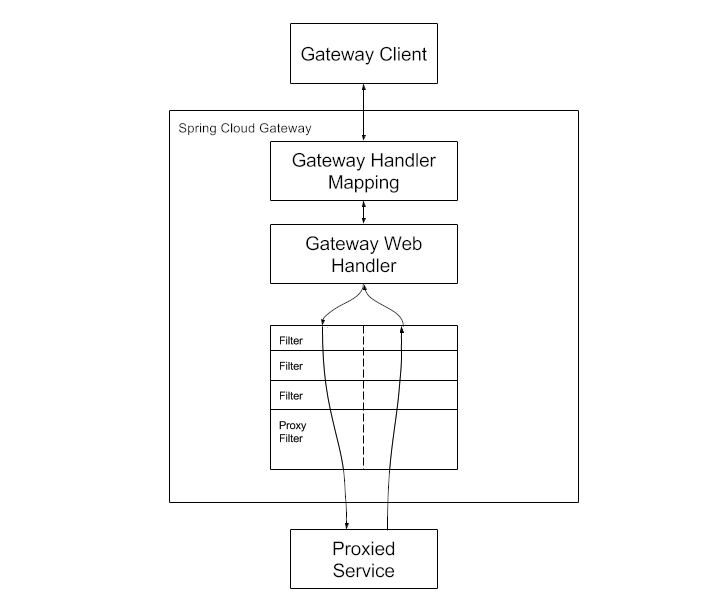
Clients make requests to gateway, Gateway Handler Mapping matches request to a route, then request is sent to Gateway Web Handler. Handler runs the request through pre and post filter chains that are specific to the request.
Reactor Netty Transmission
Spring Cloud Gateway is built on top of Spring WebFlux and utilizes Reactor Netty as its default network communication engine. Under the hood, Reactor Netty acts as both the Inbound HTTP Server and the Outbound HTTP Client, providing fully non-blocking, event-driven, and backpressure-aware request forwarding.
1. Transmission Flow Architecture
When a request passes through the gateway, Reactor Netty manages the socket data at two distinct boundaries: the inbound client-facing connection and the outbound downstream-facing connection.
sequenceDiagram
    autonumber
    actor Client
    participant Server as Reactor Netty HttpServer
    participant Gateway as FilteringWebHandler (WebFlux)
    participant RouteFilter as NettyRoutingFilter
    participant ClientNetty as Reactor Netty HttpClient
    participant Downstream as Downstream Service

    Client->>Server: HTTP Request (Headers & Body stream)
    Server->>Gateway: Dispatch ServerWebExchange
    Note over Gateway: Execute PRE Filters
    Gateway->>RouteFilter: NettyRoutingFilter
    RouteFilter->>ClientNetty: Initialize Outbound request
    Note over RouteFilter, ClientNetty: Bridge Inbound body Publisher directly to HttpClient
    ClientNetty->>Downstream: Stream Request Body (Non-blocking & backpressured)
    Downstream->>ClientNetty: Stream Response (Headers & Body stream)
    ClientNetty->>RouteFilter: Return response connection
    RouteFilter->>Gateway: Store connection in Exchange attributes
    Note over Gateway: Execute POST Filters
    Gateway->>Server: NettyWriteResponseFilter
    Server->>Client: Stream Response Body back to Client
2. Core Transmission Filters
Spring Cloud Gateway orchestrates this transmission lifecycle using two core global filters:
A. NettyRoutingFilter (Outbound Request)
The NettyRoutingFilter executes during the PRE phase of the filter chain. It is responsible for making the outbound proxy request using Reactor Netty’s HttpClient:
- Obtain HttpClient: It uses the autowired Reactor Netty
HttpClientinstance. - Build Request: It extracts routing information (URI, headers, HTTP method) from the inbound
ServerWebExchange. - Bridge Inbound to Outbound: It reads the inbound request body as a reactive
Flux<DataBuffer>and pipes it directly into the outbound client:// Conceptual bridging in NettyRoutingFilter HttpClient.ResponseReceiver<?> responseReceiver = client .headers(headers -> ...) .request(method) .uri(routeUri) .send((request, outbound) -> { // Streams inbound request body directly to outbound socket return outbound.send(exchange.getRequest().getBody() .map(dataBuffer -> { // Map Spring DataBuffer to Netty ByteBuf return dataBuffer.asByteBuffer(); })); }); - Capture Response: The resulting downstream response is captured as a Netty
HttpClientResponseconnection and stored as a request attribute (ServerWebExchangeUtils.CLIENT_RESPONSE_CONN_ATTR) to be processed by post-filters.
B. NettyWriteResponseFilter (Inbound Response)
The NettyWriteResponseFilter executes during the POST phase of the filter chain. It retrieves the downstream connection from the exchange attributes and writes the response body back to the client:
- Retrieve Connection: Retrieves the Reactor Netty outbound connection containing the downstream response.
- Write Response Headers: Copies response status code and headers from the downstream response to the client’s
HttpServerResponse. - Stream Response Body: Streams the response body publisher (
ByteBufFlux) directly back to the client socket:// Conceptual response writing Connection connection = exchange.getAttribute(CLIENT_RESPONSE_CONN_ATTR); return exchange.getResponse().writeWith( connection.inbound().receive().asDataStream() );
3. Benefits of Using Reactor Netty for Gateway Routing
- Zero-Copy Request Forwarding: By utilizing Netty’s direct memory buffers, request/response streams can be routed from the client socket to the downstream server with minimal copying in Java heap memory.
- End-to-End Backpressure: If a downstream service slows down, the
HttpClientoutbound write buffer fills up. This signals backpressure upstream through the filter chain, tellingHttpServerto toggleautoReadtofalseon the client socket. This prevents heap allocation bloat during high-traffic surges. - Shared EventLoop Resources: By default, Spring Boot configures the inbound
HttpServerand outboundHttpClientto share the same EventLoop thread pool (ReactorResourceFactory). This minimizes thread context switching and maximizes CPU cache efficiency.