
JVM Internals - G1 garbage collector
HotSpot memory management places Java objects in the heap and reclaims them when they become unreachable. Mutators allocate; a garbage collector discovers live objects from GC roots, frees or relocates storage, and returns space so allocation can continue. On modern JDKs the collector that does this by default is G1 (Garbage-First).
1. Overview
A Java process uses several native memory domains. The Java heap holds ordinary instances and arrays—the memory new draws from and that garbage collection manages. Metaspace holds class metadata outside that heap. Thread stacks, the code cache, and direct buffers are further pools; they are not reclaimed by the same young/old collectors that service object allocation.
For heap objects the contract is reachability: a thread obtains storage, initializes the object (header and klass pointer), and any path still reachable from GC roots (locals, statics, JNI handles, and similar) keeps the object alive. When no such path remains, the collector may reuse the storage. HotSpot collectors are typically generational: most objects die in a young area (Eden, then Survivor); survivors are tenured into an old area that is reclaimed less often.
Which collector HotSpot selects when none is named on the command line depends on the JDK version (and, historically, on whether the machine looked “server-class”):
| JDK | Ergonomic default (no -XX:+Use*GC) |
|---|---|
| 5–8 | Parallel on server-class machines; Serial on client / constrained machines |
| 9–26 | G1 on server-class machines (JEP 248); Serial when treated as constrained (typically one CPU or under about 1792 MB of memory) |
| 27+ | G1 in all environments (JEP 523) |
G1 partitions that Java heap into equally sized regions—contiguous ranges of virtual memory that are the unit of both allocation and reclaim. At any moment a region is free, or assigned as Eden, Survivor, Old, or Humongous. Young and old generations are therefore sets of regions, typically noncontiguous in address order, rather than one Eden slab and one Old slab. Region size is chosen at startup from the maximum heap (on the order of 2048 regions, between 1 MB and an ergonomic 32 MB, hard max 512 MB on 64-bit), or set with G1HeapRegionSize.
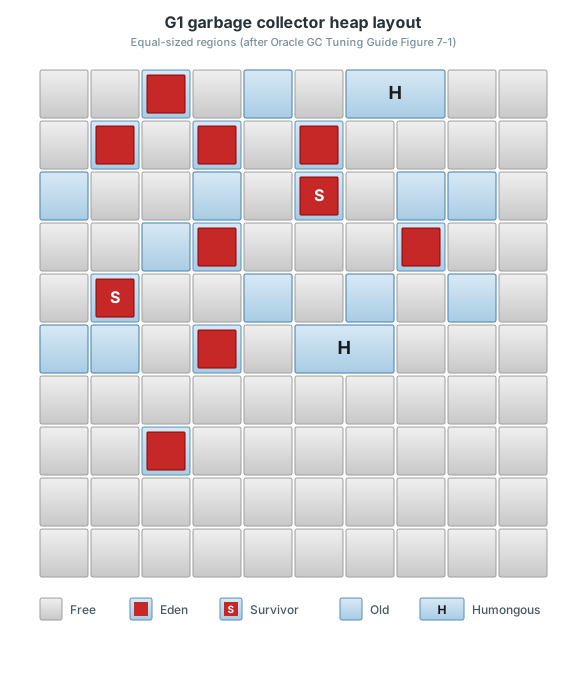
G1 meets a pause-time goal (default 200 ms, MaxGCPauseMillis) by evacuating live objects from a chosen collection set and by marking the old generation concurrently. Mutators allocate into regions; the GC cycle then marks, evacuates, and frees them back for reuse.
2. Memory allocation
A mutator thread allocates objects and writes references, so it mutates the object graph. The collector traces that graph and reclaims storage. A Java new is mutator allocation: the thread asks MutatorAllocRegion for Eden space for an object that did not exist before. During evacuation the collector copies an existing object into a SurvivorGCAllocRegion or an OldGCAllocRegion while the mutator is stopped at a safepoint.
The heap is a sequence of equal G1HeapRegions. Each region is a range of HeapWords from _bottom to _end, and _top is its bump pointer. A thread’s TLAB is a subrange of the current Eden region: the thread bumps the TLAB _top, and the region _top moves only when a new TLAB, or an allocation outside any TLAB, is taken from the region.
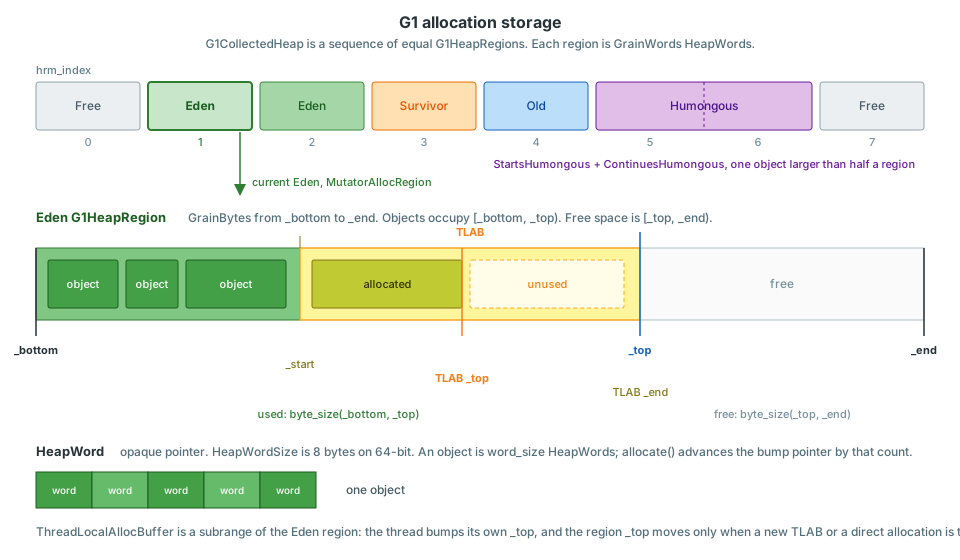
HotSpot routes mutator allocation through MemAllocator, a StackObj that lives for one allocation on the current thread. It stores Thread* _thread (must be Thread::current()) so the fast path can reach that thread’s TLAB without repeatedly calling Thread::current(), and so slow-path bookkeeping (bytes allocated, sampling) stays on the right thread. allocate() reserves the raw words through the three paths below, then calls the subclass initialize to finish the object. CollectedHeap selects the subclass from the kind of object:
ObjAllocator, fromobj_allocate, zeroes the body and installs the header. This constructs an ordinary instance.ObjArrayAllocator, fromarray_allocate, stores_lengthbefore the class identity, so a concurrent collector can parse the array as soon as the header is published. It covers object arrays and type arrays._do_zeroselects whether the elements are cleared.ClassAllocator, fromclass_allocate, stores thejava.lang.Classmirror’soop_sizebefore the class identity.StackChunkAllocator, used when freezing a virtual-thread stack, installs the chunk’s size, bottom, and sp, and leaves the stack payload unzeroed.
G1 uses these classes directly. ZGC and Shenandoah substitute ZObjArrayAllocator and ShenandoahObjArrayAllocator for ObjArrayAllocator.
Each Thread owns a ThreadLocalAllocBuffer (_tlab). Under G1, heap entry points land on G1CollectedHeap, which owns the region table (G1HeapRegionManager) and the current allocating regions (G1Allocator). Mutator traffic goes through MutatorAllocRegion into a live Eden G1HeapRegion; GC evacuation uses sibling alloc regions for Survivor and Old.
@startuml
skinparam classAttributeIconSize 0

class Thread {
  ThreadLocalAllocBuffer _tlab
}

class ThreadLocalAllocBuffer {
  HeapWord* _start
  HeapWord* _top
  HeapWord* _end
  size_t _refill_waste_limit
  allocate(size)
}

class MemAllocator <<StackObj>> {
  Thread* _thread
  Klass* _klass
  size_t _word_size
  mem_allocate_inside_tlab_fast()
  mem_allocate_inside_tlab_slow()
  mem_allocate_outside_tlab()
  {abstract} initialize(HeapWord* mem)
  allocate()
}
class ObjAllocator {
  initialize(HeapWord* mem)
}
class ObjArrayAllocator {
  int _length
  bool _do_zero
  initialize(HeapWord* mem)
}
class ClassAllocator {
  initialize(HeapWord* mem)
}
class StackChunkAllocator {
  size_t _stack_size
  initialize(HeapWord* mem)
  allocate()
}

abstract class CollectedHeap {
  {abstract} allocate_new_tlab(...)
  {abstract} mem_allocate(word_size)
}

class G1CollectedHeap {
  G1HeapRegionManager _hrm
  G1Allocator* _allocator
  allocate_new_tlab(...)
  mem_allocate(word_size)
  attempt_allocation(...)
  humongous_obj_allocate(...)
}

class G1Allocator {
  MutatorAllocRegion* _mutator_alloc_regions
  SurvivorGCAllocRegion* _survivor_gc_alloc_regions
  OldGCAllocRegion _old_gc_alloc_region
  attempt_allocation(...)
}

class G1AllocRegion {
  G1HeapRegion* _alloc_region
  attempt_allocation(...)
  {abstract} allocate_new_region(...)
}

class MutatorAllocRegion {
  G1HeapRegion* _retained_alloc_region
}

class SurvivorGCAllocRegion
class OldGCAllocRegion

class G1HeapRegionManager {
  G1FreeRegionList _free_list
  allocate_free_region(...)
}

class G1HeapRegion {
  G1HeapRegionType _type
  HeapWord* _bottom
  HeapWord* _top
  HeapWord* _end
}

MemAllocator <|-- ObjAllocator
MemAllocator <|-- ObjArrayAllocator
MemAllocator <|-- ClassAllocator
MemAllocator <|-- StackChunkAllocator
Thread *-down- ThreadLocalAllocBuffer : _tlab
ThreadLocalAllocBuffer -down- MemAllocator : used by\n(Thread::current)
MemAllocator ..> ThreadLocalAllocBuffer : fast / refill
MemAllocator ..> G1CollectedHeap : allocate_new_tlab\nor mem_allocate

CollectedHeap <|-- G1CollectedHeap
G1CollectedHeap *-- G1HeapRegionManager : _hrm
G1CollectedHeap *-- G1Allocator : _allocator
G1Allocator *-- MutatorAllocRegion : per NUMA node
G1Allocator *-- SurvivorGCAllocRegion
G1Allocator *-- OldGCAllocRegion
G1AllocRegion <|-- MutatorAllocRegion
G1AllocRegion <|-- SurvivorGCAllocRegion
G1AllocRegion <|-- OldGCAllocRegion
G1AllocRegion o-- G1HeapRegion : _alloc_region
G1HeapRegionManager o-- G1HeapRegion : free / used
G1CollectedHeap ..> G1Allocator : attempt_allocation
MutatorAllocRegion ..> G1HeapRegionManager : new Eden region
@enduml
MemAllocator::mem_allocate tries the TLAB, then a refill, then one object from the heap. A null result from either TLAB step falls through; -XX:-UseTLAB skips both TLAB steps.
// memAllocator.cpp
HeapWord* MemAllocator::mem_allocate(Allocation& allocation) const {
  // 1. UseTLAB: bump the current TLAB. Success returns the object.
  //    The object does not fit, or UseTLAB is false: continue.
  if (UseTLAB) {
    HeapWord* mem = mem_allocate_inside_tlab_fast();
    if (mem != nullptr) {
      return mem;
    }
  }

  // 2. Anything after this point may block at a safepoint. Checked in debug builds.
  DEBUG_ONLY(allocation._thread->check_for_valid_safepoint_state());

  // 3. UseTLAB: refill the TLAB and place the object in the new buffer.
  //    A null return means "do not use a TLAB for this object": continue.
  if (UseTLAB) {
    HeapWord* mem = mem_allocate_inside_tlab_slow(allocation);
    if (mem != nullptr) {
      return mem;
    }
  }

  // 4. One object from the shared heap. The thread's TLAB, if any, is left as it is.
  return mem_allocate_outside_tlab(allocation);
}
TLAB fast path. allocate returns the old _top when the object fits, and null when it does not.
// memAllocator.cpp
HeapWord* MemAllocator::mem_allocate_inside_tlab_fast() const {
  return _thread->tlab().allocate(_word_size);
}

// threadLocalAllocBuffer.inline.hpp
inline HeapWord* ThreadLocalAllocBuffer::allocate(size_t size) {
  HeapWord* obj = top();
  // 1. end() - top() is large enough: publish the new top and return the old one.
  if (pointer_delta(end(), obj) >= size) {
    set_top(obj + size);
    return obj;
  }
  // 2. The object does not fit. The TLAB is unchanged.
  return nullptr;
}
TLAB refill. Four exits: the sampling retry succeeds, the leftover space is too large to discard, no legal TLAB can hold the object, or the heap cannot give a new TLAB. The last three return null so mem_allocate uses the outside-TLAB path. allocate_new_tlab does not run a GC.
// memAllocator.cpp
HeapWord* MemAllocator::mem_allocate_inside_tlab_slow(Allocation& allocation) const {
  HeapWord* mem = nullptr;
  ThreadLocalAllocBuffer& tlab = _thread->tlab();

  // 1. JVMTI allocation sampling pulls end() back to the sample point, so the fast path
  //    can fail while the real TLAB still has room. Restore that end and retry once.
  if (JvmtiExport::should_post_sampled_object_alloc()) {
    tlab.set_back_allocation_end();
    mem = tlab.allocate(_word_size);
    if (mem != nullptr) {
      return mem;
    }
  }

  // 2. Leftover space is above the waste limit (initially desired_size / TLABRefillWasteFraction).
  //    Keep this TLAB. record_slow_allocation raises the limit so the same size does not
  //    take this branch on every later call. Caller allocates this object outside the TLAB.
  if (tlab.free() > tlab.refill_waste_limit()) {
    tlab.record_slow_allocation(_word_size);
    return nullptr;
  }

  // 3. The remainder is small enough to discard. Record it and retire the TLAB,
  //    which fills the gap with a dummy object.
  tlab.record_refill_waste();
  _thread->retire_tlab();

  // 4. compute_size returns 0 when the object plus the alignment reserve is larger than
  //    the maximum TLAB. A humongous object, larger than half a G1 region, takes this branch.
  size_t new_tlab_size = tlab.compute_size(_word_size);
  if (new_tlab_size == 0) {
    return nullptr;
  }

  // 5. Ask the heap for a new TLAB of any size between min_tlab_size and new_tlab_size.
  //    Failure does not collect; the caller retries through mem_allocate_outside_tlab,
  //    which is allowed to stop for a GC.
  size_t min_tlab_size = ThreadLocalAllocBuffer::compute_min_size(_word_size);
  mem = Universe::heap()->allocate_new_tlab(
      min_tlab_size, new_tlab_size, &allocation._allocated_tlab_size);
  if (mem == nullptr) {
    return nullptr;
  }

  // 6. ZeroTLAB clears the new buffer. ZapTLAB fills it with badHeapWordVal except the
  //    header, so a concurrent collector does not parse the unallocated tail as an object.
  //    Neither flag: the buffer is left uninitialized.
  if (ZeroTLAB) {
    Copy::zero_to_words(mem, allocation._allocated_tlab_size);
  } else if (ZapTLAB) {
    size_t hdr_size = oopDesc::header_size();
    Copy::fill_to_words(mem + hdr_size, allocation._allocated_tlab_size - hdr_size, badHeapWordVal);
  }

  // 7. Install the buffer as this thread's TLAB and bump its top past this object.
  _thread->fill_tlab(mem, _word_size, allocation._allocated_tlab_size);
  return mem;
}
Under G1 the refill asks the mutator alloc region for Eden space and passes allow_gc as false:
// g1CollectedHeap.cpp
HeapWord* G1CollectedHeap::allocate_new_tlab(size_t min_size,
                                             size_t requested_size,
                                             size_t* actual_size) {
  // A humongous request never reaches here; mem_allocate_inside_tlab_slow returned null at step 4.
  assert(!is_humongous(requested_size), "we do not allow humongous TLABs");
  // No collection. Null means the Eden region could not supply the TLAB.
  return attempt_allocation(min_size, requested_size, actual_size, false /* allow_gc */);
}
Outside the TLAB. This is step 4 of mem_allocate: -XX:-UseTLAB, a TLAB kept because its remainder is too large to discard, an object that cannot fit in any TLAB, or a refill that the heap refused. The current TLAB is not retired here.
// memAllocator.cpp
HeapWord* MemAllocator::mem_allocate_outside_tlab(Allocation& allocation) const {
  allocation._allocated_outside_tlab = true;
  // 1. One object from the heap. G1 may stop for a GC on this call.
  HeapWord* mem = Universe::heap()->mem_allocate(_word_size);
  // 2. Still no space: the caller reports allocation failure.
  if (mem == nullptr) {
    return mem;
  }

  // 3. Count the bytes on the thread and on the heap sampler. The TLAB statistics are unchanged.
  size_t size_in_bytes = _word_size * HeapWordSize;
  _thread->incr_allocated_bytes(size_in_bytes);
  _thread->heap_sampler().inc_outside_tlab_bytes(size_in_bytes);
  return mem;
}
G1’s mem_allocate splits that request. A humongous object takes whole regions. Anything smaller is one block from the mutator region, and this call is allowed to collect:
// g1CollectedHeap.cpp
HeapWord* G1CollectedHeap::mem_allocate(size_t word_size) {
  // 1. Larger than half a region: one or more free regions, not the current Eden region.
  if (is_humongous(word_size)) {
    return attempt_allocation_humongous(word_size);
  }
  // 2. Otherwise a single block, min size equal to the object. allow_gc is true,
  //    so a failed attempt can run an evacuation pause and retry.
  size_t dummy = 0;
  return attempt_allocation(word_size, word_size, &dummy, true /* allow_gc */);
}

// g1CollectedHeap.hpp
static bool G1CollectedHeap::is_humongous(size_t word_size) {
  return word_size > _humongous_object_threshold_in_words;
}
3. Safepoint
A safepoint is a stretch of time in which every Java thread is stopped in a state the VM can account for. Its stack can be walked, and it is not changing the heap. The VM thread is the only thread that opens and closes a safepoint. While the safepoint is held, that thread runs one VM operation.
G1 uses a safepoint for every stop-the-world pause: a young collection, a mixed collection, Remark, Cleanup, and a full collection. Concurrent marking and card refinement are not safepoints. Those threads keep running beside the mutators and only yield for as long as a safepoint is open.
A Java thread is not halted at an arbitrary instruction. It notices an armed poll at a method return, a loop back-edge, or a return from native code, and then blocks. A thread already blocked on a monitor, or still inside native code, is left there; it is not allowed back into Java until the safepoint ends. An allocation that fits in the TLAB or the current Eden region does not request a safepoint. The slow path of allocation does: it posts a VM operation and waits, and that operation is what opens the safepoint.
3.1 Mechanism
The caller posts a VM_Operation and waits. The VM thread opens the safepoint, runs that operation, and closes the safepoint. Opening it stops the threads that must yield, then arms every Java thread’s poll and waits until they are safe.
// The caller blocks in wait_until_executed until the VM thread finishes the operation.
void VMThread::execute(VM_Operation* op) {
  Thread* t = Thread::current();
  if (t->is_VM_thread()) {
    op->set_calling_thread(t);
    ((VMThread*)t)->inner_execute(op);
    return;
  }
  if (!op->doit_prologue()) {
    return;
  }
  op->set_calling_thread(t);
  wait_until_executed(op);
  op->doit_epilogue();
}

// VM thread only: open a safepoint, run the operation, then close it.
void VMThread::inner_execute(VM_Operation* op) {
  assert(Thread::current()->is_VM_thread(), "Must be the VM thread");
  _cur_vm_operation = op;

  bool end_safepoint = false;
  if (_cur_vm_operation->evaluate_at_safepoint() &&
      !SafepointSynchronize::is_at_safepoint()) {
    SafepointSynchronize::begin();
    end_safepoint = true;
  }

  evaluate_operation(_cur_vm_operation);

  if (end_safepoint) {
    SafepointSynchronize::end();
  }
  _cur_vm_operation = nullptr;
}
// VM thread: yield suspendible GC threads, arm every poll, wait until no Java thread is running.
void SafepointSynchronize::begin() {
  assert(Thread::current()->is_VM_thread(), "Only VM thread may execute a safepoint");

  Universe::heap()->safepoint_synchronize_begin();
  Threads_lock->lock();

  int nof_threads = Threads::number_of_threads();
  _waiting_to_block = nof_threads;

  jlong safepoint_limit_time = 0;
  int initial_running = 0;
  arm_safepoint();
  synchronize_threads(safepoint_limit_time, nof_threads, &initial_running);
  assert(_waiting_to_block == 0, "No thread should be running");

  _state = _synchronized;
}

// G1: the marker and refinement threads wait out this safepoint.
void G1CollectedHeap::safepoint_synchronize_begin() {
  SuspendibleThreadSet::synchronize();
}

// Publish this safepoint and arm the local poll of every Java thread.
void SafepointSynchronize::arm_safepoint() {
  _wait_barrier->arm(static_cast<int>(_safepoint_counter + 1));
  AtomicAccess::release_store(&_safepoint_counter, _safepoint_counter + 1);

  OrderAccess::storestore();
  _state = _synchronizing;

  OrderAccess::storestore();
  for (JavaThreadIteratorWithHandle jtiwh; JavaThread* cur = jtiwh.next(); ) {
    SafepointMechanism::arm_local_poll(cur);
  }
  OrderAccess::fence();
}

// Armed polling word (low bit) and armed polling page for one thread.
void SafepointMechanism::arm_local_poll(JavaThread* thread) {
  thread->poll_data()->set_polling_word(_poll_word_armed_value);
  thread->poll_data()->set_polling_page(_poll_page_armed_value);
}
@startuml
skinparam classAttributeIconSize 0

class VMThread {
  execute(VM_Operation)
  inner_execute(VM_Operation)
}

class VM_Operation {
  doit()
  evaluate_at_safepoint()
}

class SafepointSynchronize {
  {static} _state : SynchronizeState
  {static} _waiting_to_block : int
  {static} begin()
  {static} end()
  {static} block(JavaThread)
}

class SafepointMechanism {
  arm_local_poll(JavaThread)
  should_process(JavaThread)
}

class JavaThread {
  poll_data()
}

VMThread ..> VM_Operation : evaluate_operation
VMThread ..> SafepointSynchronize : begin / end
SafepointSynchronize ..> SafepointMechanism : arm each local poll
SafepointMechanism ..> JavaThread : polling word and page
JavaThread ..> SafepointSynchronize : block
@enduml
3.2 Blocking user threads
The VM thread does not preempt a user thread, and the user thread does not call SafepointSynchronize by name. Between checks it keeps running, even after the poll is armed. It looks only at these points, all on its own thread:
- A loop back-edge or a return in the interpreter or in compiled code. The interpreter return is
TemplateTable::_return: it reads this thread’s polling word and, if the poll bit is set, callsInterpreterRuntime::at_safepointon this thread. - The return from that slow path into Java.
transition_from_vmcallsprocess_if_requested_with_exit_check. - The return from native code.
transition_from_nativeandJavaThread::check_special_condition_for_native_transmake the same call.
process_if_requested calls SafepointSynchronize::block only when that local poll is armed.
// User-thread entry. A return bytecode on this thread tests the poll.
// The armed poll calls InterpreterRuntime::at_safepoint before the frame is removed.
void TemplateTable::_return(TosState state) {
  transition(state, state);

  Label no_safepoint;
  __ testb(Address(r15_thread, JavaThread::polling_word_offset()), SafepointMechanism::poll_bit());
  __ jcc(Assembler::zero, no_safepoint);
  __ call_VM(noreg, CAST_FROM_FN_PTR(address, InterpreterRuntime::at_safepoint));
  __ bind(no_safepoint);
}

// JRT_ENTRY. The destructor runs on this same thread as the call returns to Java.
class ThreadInVMfromJava : public ThreadStateTransition {
  ThreadInVMfromJava(JavaThread* thread, bool check_asyncs = true) : ThreadStateTransition(thread), _check_asyncs(check_asyncs) {
    transition_from_java(thread, _thread_in_vm);
  }
  ~ThreadInVMfromJava() {
    transition_from_vm(_thread, _thread_in_Java, _check_asyncs);
  }
};

// Interpreter back-edge or return. The x86 poll tests this thread's polling word.
// A set poll bit jumps to the slow path, which calls InterpreterRuntime::at_safepoint.
void MacroAssembler::safepoint_poll(Label& slow_path, bool at_return, bool in_nmethod) {
  if (at_return) {
    cmpptr(in_nmethod ? rsp : rbp, Address(r15_thread, JavaThread::polling_word_offset()));
    jcc(Assembler::above, slow_path);
    return;
  }
  testb(Address(r15_thread, JavaThread::polling_word_offset()), SafepointMechanism::poll_bit());
  jcc(Assembler::notZero, slow_path);
}

// JRT_ENTRY wraps the call in ThreadInVMfromJava. Its destructor returns to Java.
JRT_ENTRY(void, InterpreterRuntime::at_safepoint(JavaThread* current))
JRT_END

// ~ThreadInVMfromJava calls this. This is the user thread's safepoint check.
static inline void transition_from_vm(JavaThread* thread, JavaThreadState to, bool check_asyncs = true) {
  assert(thread->thread_state() == _thread_in_vm, "coming from wrong thread state");
  if (to == _thread_in_Java) {
    SafepointMechanism::process_if_requested_with_exit_check(thread, check_asyncs);
    thread->set_thread_state(to);
  }
}

// Returning from native code takes the same check on this thread.
static inline void transition_from_native(JavaThread* thread, JavaThreadState to, bool check_asyncs = true) {
  assert(thread->thread_state() == _thread_in_native, "coming from wrong thread state");
  thread->set_thread_state_fence(_thread_in_vm);
  SafepointMechanism::process_if_requested_with_exit_check(thread, to != _thread_in_Java ? false : check_asyncs);
  thread->set_thread_state(to);
}

void JavaThread::check_special_condition_for_native_trans(JavaThread* thread) {
  assert(thread->thread_state() == _thread_in_native_trans, "wrong state");
  thread->set_thread_state(_thread_in_vm);
  SafepointMechanism::process_if_requested_with_exit_check(thread, true /* check asyncs */);
}

// Armed local poll: this is the call that reaches SafepointSynchronize::block.
void SafepointMechanism::process_if_requested(JavaThread* thread, bool allow_suspend, bool check_async_exception) {
  thread->check_possible_safepoint();
  if (local_poll_armed(thread)) {
    process(thread, allow_suspend, check_async_exception);
  }
}

// User thread: a global safepoint is open, so block until it ends.
void SafepointMechanism::process(JavaThread* thread, bool allow_suspend, bool check_async_exception) {
  bool need_rechecking;
  do {
    if (global_poll()) {
      OrderAccess::loadload();
      SafepointSynchronize::block(thread);
    }
    StackWatermarkSet::on_safepoint(thread);
    need_rechecking = thread->handshake_state()->has_operation() &&
                      thread->handshake_state()->process_by_self(allow_suspend, check_async_exception);
  } while (need_rechecking);
  update_poll_values(thread);
}

// Compiled poll fault. Enter the VM, handle the poll, return to Java.
void SafepointSynchronize::handle_polling_page_exception(JavaThread* thread) {
  assert(thread->thread_state() == _thread_in_Java, "should come from Java code");
  thread->set_thread_state(_thread_in_vm);
  thread->safepoint_state()->handle_polling_page_exception();
  thread->set_thread_state(_thread_in_Java);
}

// Return poll and loop-backedge poll both reach process, which calls block.
void ThreadSafepointState::handle_polling_page_exception() {
  JavaThread* self = thread();
  address real_return_addr = self->saved_exception_pc();
  nmethod* nm = CodeCache::find_blob(real_return_addr)->as_nmethod();

  if (nm->is_at_poll_return(real_return_addr)) {
    SafepointMechanism::process_if_requested_with_exit_check(self, true /* check asyncs */);
  } else {
    set_at_poll_safepoint(true);
    SafepointMechanism::process_if_requested_with_exit_check(self, false /* check asyncs */);
    set_at_poll_safepoint(false);
  }
}

// The stop: stack is walkable, state is _thread_blocked, wait on the barrier.
void SafepointSynchronize::block(JavaThread* thread) {
  JavaThreadState state = thread->thread_state();
  thread->frame_anchor()->make_walkable();

  uint64_t safepoint_id = SafepointSynchronize::safepoint_counter();
  thread->safepoint_state()->set_safepoint_id(safepoint_id);
  OrderAccess::storestore();
  thread->set_thread_state_fence(_thread_blocked);

  _wait_barrier->wait(static_cast<int>(safepoint_id));

  OrderAccess::loadstore();
  thread->set_thread_state(state);
  thread->safepoint_state()->reset_safepoint_id();
}
// VM thread spins until every Java thread is safepoint-safe.
int SafepointSynchronize::synchronize_threads(jlong safepoint_limit_time, int nof_threads, int* initial_running) {
  int still_running = nof_threads;
  ThreadSafepointState* tss_head = nullptr;
  ThreadSafepointState** p_prev = &tss_head;
  for (JavaThreadIteratorWithHandle jtiwh; JavaThread* cur = jtiwh.next(); ) {
    ThreadSafepointState* cur_tss = cur->safepoint_state();
    if (thread_not_running(cur_tss)) {
      --still_running;
    } else {
      *p_prev = cur_tss;
      p_prev = cur_tss->next_ptr();
    }
  }
  *p_prev = nullptr;
  *initial_running = still_running;
  if (still_running <= 0) {
    return 1;
  }

  int iterations = 1;
  int64_t start_time = os::javaTimeNanos();
  do {
    p_prev = &tss_head;
    ThreadSafepointState* cur_tss = tss_head;
    while (cur_tss != nullptr) {
      if (thread_not_running(cur_tss)) {
        --still_running;
        *p_prev = nullptr;
        ThreadSafepointState* tmp = cur_tss;
        cur_tss = cur_tss->get_next();
        tmp->set_next(nullptr);
      } else {
        *p_prev = cur_tss;
        p_prev = cur_tss->next_ptr();
        cur_tss = cur_tss->get_next();
      }
    }
    if (still_running > 0) {
      back_off(start_time);
    }
    iterations++;
  } while (still_running > 0);
  return iterations;
}

// True once this thread has left the running state, or was already safe.
bool SafepointSynchronize::thread_not_running(ThreadSafepointState* cur_state) {
  if (!cur_state->is_running()) {
    return true;
  }
  cur_state->examine_state_of_thread(SafepointSynchronize::safepoint_counter());
  return !cur_state->is_running();
}

// A stable safepoint-safe state (blocked, or in native) counts the thread stopped.
void ThreadSafepointState::examine_state_of_thread(uint64_t safepoint_count) {
  JavaThreadState stable_state;
  if (!SafepointSynchronize::try_stable_load_state(&stable_state, _thread, safepoint_count)) {
    return;
  }
  if (safepoint_safe_with(_thread, stable_state)) {
    account_safe_thread();
  }
}

// One fewer thread for begin to wait on.
void ThreadSafepointState::account_safe_thread() {
  SafepointSynchronize::decrement_waiting_to_block();
  _safepoint_safe = true;
}
// VM thread: disarm polls and let yielding GC threads resume.
void SafepointSynchronize::end() {
  assert(Thread::current()->is_VM_thread(), "Only VM thread can execute a safepoint");
  disarm_safepoint();
  Universe::heap()->safepoint_synchronize_end();
}

// Clear the global state, mark each thread running again, wake the barrier.
void SafepointSynchronize::disarm_safepoint() {
  _state = _not_synchronized;
  AtomicAccess::release_store(&_safepoint_counter, _safepoint_counter + 1);

  for (JavaThreadIteratorWithHandle jtiwh; JavaThread* current = jtiwh.next(); ) {
    current->safepoint_state()->restart();
  }
  Threads_lock->unlock();
  _wait_barrier->disarm();
}

// G1: the marker and refinement threads may run again.
void G1CollectedHeap::safepoint_synchronize_end() {
  SuspendibleThreadSet::desynchronize();
}
4. GC cycle
G1 alternates a Young-Only phase with a Space-Reclamation phase, cycling through the same sequence of phases. Full GC is the backup when evacuation cannot free enough space.
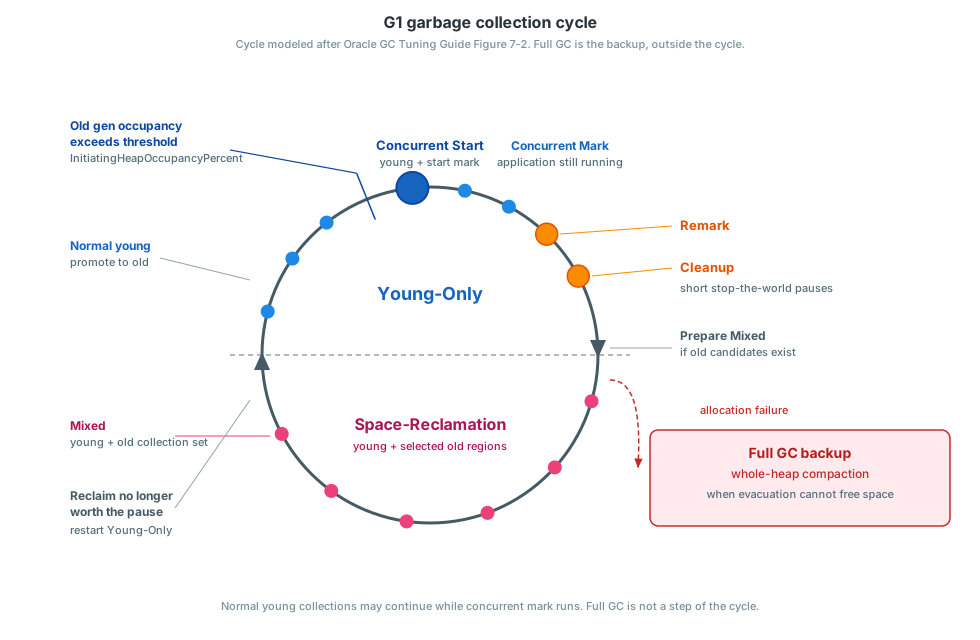
Every step of the cycle runs on dedicated GC threads. A mutator that needs a collection never collects by itself: it posts a VM operation and blocks. Every pause runs on the VM thread together with the GC Thread pool (ParallelGCThreads); between pauses, the marker and refinement threads drive their own worker pools through marking and card refinement.
Collection is event-driven. When an ordinary allocation cannot find space in Eden, attempt_allocation_slow asks for a collection pause with the cause _g1_inc_collection_pause:
// g1CollectedHeap.cpp — the mutator cannot refill Eden
HeapWord* G1CollectedHeap::attempt_allocation_slow(uint node_index, size_t word_size, bool allow_gc) {
  uint gc_count_before;
  {
    MutexLocker x(Heap_lock);
    // Retry under the lock in case another thread changed the region while we waited.
    result = _allocator->attempt_allocation_locked(node_index, word_size);
    if (result != nullptr) {
      return result;
    }
    gc_count_before = total_collections();   // remember the GC count for the pause
  }

  bool succeeded;
  result = do_collection_pause(word_size, gc_count_before, &succeeded,
                               GCCause::_g1_inc_collection_pause);
  if (succeeded) {
    return result;   // the pause freed space; the mutator allocates from it
  }
}
do_collection_pause does not collect: it posts a VM operation and the mutator blocks until it completes:
// g1CollectedHeap.cpp — on the allocating mutator
HeapWord* G1CollectedHeap::do_collection_pause(size_t word_size,
                                               uint gc_count_before,
                                               bool* succeeded,
                                               GCCause::Cause gc_cause) {
  VM_G1CollectForAllocation op(word_size, gc_count_before, gc_cause);
  VMThread::execute(&op);   // the allocating mutator blocks here
}
On the VM thread, the operation performs the pause and then settles the allocation that requested it:
// g1VMOperations.cpp — on the VM thread
void VM_G1CollectForAllocation::doit() {
  G1CollectedHeap* g1h = G1CollectedHeap::heap();
  GCCauseSetter x(g1h, _gc_cause);
  // Try a partial collection of some kind.
  g1h->do_collection_pause_at_safepoint(_word_size);

  if (_word_size > 0) {
    // An allocation had been requested. Do it, eventually trying a stronger kind of GC.
    _result = g1h->satisfy_failed_allocation(_word_size);
  }
}
Inside the pause, the VM thread decides the kind of pause, runs the collection, and schedules the next step of the cycle when the collector state calls for it:
// g1CollectedHeap.cpp — on the VM thread
void G1CollectedHeap::do_collection_pause_at_safepoint(size_t allocation_word_size) {
  policy()->decide_on_concurrent_start_pause();
  bool should_start_concurrent_mark_operation = collector_state()->is_in_concurrent_start_gc();

  G1YoungCollector collector(gc_cause(), allocation_word_size);
  collector.collect();
  _collector_state = collector.next_state();   // the state the next pause reads

  if (should_start_concurrent_mark_operation) {
    // This pause is the Concurrent Start: start the marking cycle.
    start_concurrent_cycle(collector.concurrent_operation_is_full_mark());
  }
}
The steps divide into two parts, following the two halves of the cycle:
Young-Only (upper half)
Normal young collections repeat in this half, promoting survivors into Old, and the marking work that later enables old evacuation runs between them. No old region is evacuated here.
- Young promotion — normal young collections evacuate Eden and Survivor regions and promote aged objects into Old; they repeat until non-young occupancy crosses the initiating threshold (
G1IHOP). - Concurrent Start — a young pause that snapshots the roots and starts marking the old generation.
- Concurrent Mark — marking runs beside the mutators; normal young collections may continue.
- Remark — a short stop-the-world pause that drains the remaining marking work.
- Cleanup — a short stop-the-world pause that accounts live data and selects the old regions worth evacuating.
Space-Reclamation (lower half)
Mixed collections repeat in this half, each evacuating young regions plus some of the old regions marking identified. When further old reclaim is no longer worth the pause, the cycle restarts Young-Only.
- Prepare Mixed — if Cleanup found old candidates, the entry step from the upper half; the mixed collection set is prepared.
- Mixed — mixed pauses evacuate young regions plus selected old regions, and the emptied regions return to the free list.
- Restart Young-Only — back to the upper half: the cycle starts over.
Full GC is not a step of the cycle: it is the backup that compacts the whole heap when evacuation cannot free enough space.
Each step is triggered either by an allocation that failed or by the step before it. The figure groups the steps in the pool that executes them and draws the calls between the pools as a state machine:
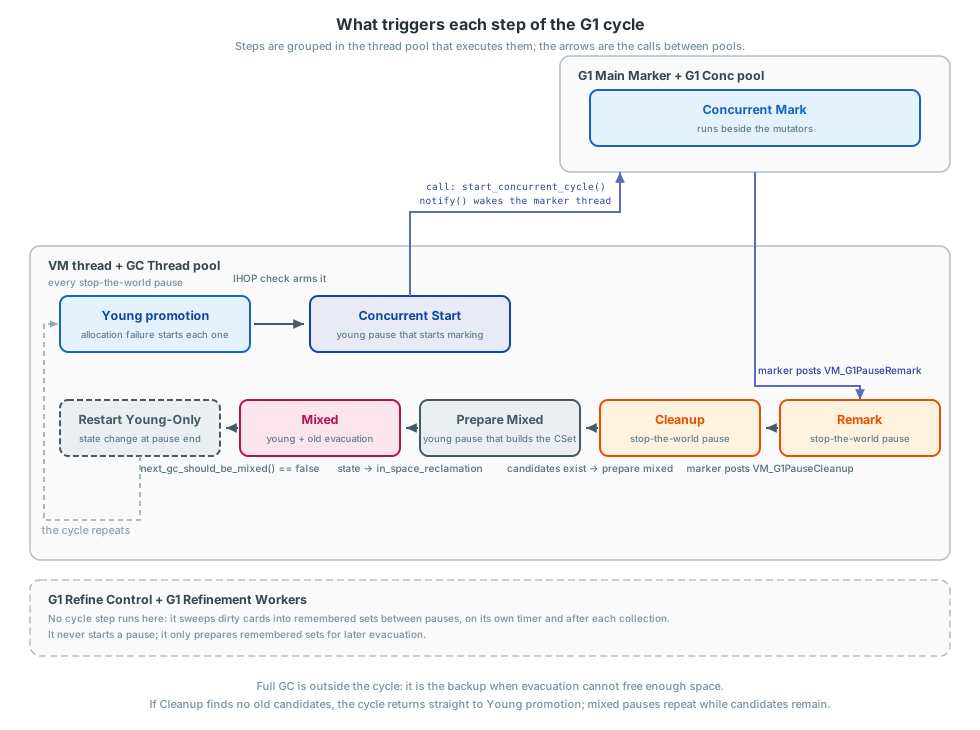
The cycle trades one long pause for many short ones. Every young and mixed collection is a stop-the-world pause, so the cycle contains many of them, but each is kept short: the pause-time target (MaxGCPauseMillis, 200 ms by default) steers how much work a pause may take, while the expensive graph work—marking and remembered-set maintenance—runs concurrently between pauses.
The sections below cover the mechanisms in turn: young promotion (§4.2), concurrent marking with its Remark and Cleanup pauses (§4.3), evacuation (§4.4), freeing emptied regions (§4.5), and the old threshold check that decides when the cycle restarts (§4.6).
4.1 GC threads
A collection is executed by a small set of native threads with strict roles. HotSpot separates them into drivers and worker pools:
- A driver is one named thread that owns the control flow of one GC job. It runs the serial parts—deciding, selecting, switching phases—and blocks while the parallel part of a phase runs.
- A worker never decides anything. It takes one slice of the task its driver posted, runs
work(worker_id), and goes back to sleep.
Every pool is a WorkerThreads object and every unit of parallel work is a WorkerTask. G1 has exactly three driver/pool pairs:
| Driver (class) | Its pool | Worker threads | Default count | Parallel work |
|---|---|---|---|---|
VM thread (VMThread) | G1CollectedHeap::_workers | GC Thread#0… | ParallelGCThreads | prepare and evacuate the collection set, post-evacuate cleanup, Remark work |
G1 Main Marker (G1ConcurrentMarkThread) | G1ConcurrentMark::_concurrent_workers | G1 Conc#0… | ConcGCThreads | root-region scan, mark the object graph, rebuild and scrub, clear bitmap |
G1 Refine Control (G1ConcurrentRefineThread) | G1ConcurrentRefineThreadControl::_workers | G1 Refinement Workers#0… | G1ConcRefinementThreads | sweep dirty card tables into remembered sets |
The architecture follows one rule: one pool, one driver. A pool runs at most one task at a time, and only its own driver calls run_task on it. There is no work stealing between pools and no shared queue to arbitrate—which is why the pool code is this small.
The worker counts. All three counts are ergonomic and fixed before the pools are created:
ParallelGCThreads— the CPU count up to 8, plus 5/8 of the remaining CPUs (WorkerPolicy::calc_parallel_worker_threads). 16 CPUs give 8 + 8×5/8 = 13.ConcGCThreads = (ParallelGCThreads + 2) / 4(g1Arguments.cpp).G1ConcRefinementThreads = MIN2(ParallelGCThreads, flag_max)(g1Arguments.cpp).
These are ceilings, not thread counts. With UseDynamicNumberOfGCThreads (default true) each pool creates one worker at startup and grows up to the ceiling on demand:
// workerThread.cpp
void WorkerThreads::initialize_workers() {
  const uint initial_active_workers = UseDynamicNumberOfGCThreads ? 1 : _max_workers;
  if (set_active_workers(initial_active_workers) != initial_active_workers) {
    vm_exit_during_initialization();
  }
}

uint WorkerThreads::set_active_workers(uint num_workers) {
  // Create the missing workers on demand.
  while (_created_workers < num_workers) {
    WorkerThread* const worker = create_worker(_created_workers);
    ...
    _workers[_created_workers] = worker;
    _created_workers++;
  }
  _active_workers = MIN2(_created_workers, num_workers);
}
The number used for a given phase is chosen from the number of Java threads and the heap size (WorkerPolicy::calc_default_active_workers) and is logged, for example as Using 4 workers of 13 for evacuation.
@startuml
skinparam classAttributeIconSize 0

abstract class NamedThread
class VMThread
abstract class ConcurrentGCThread
class G1ConcurrentMarkThread
class G1ConcurrentRefineThread
class WorkerThread

NamedThread <|-- VMThread
NamedThread <|-- WorkerThread
NamedThread <|-- ConcurrentGCThread
ConcurrentGCThread <|-- G1ConcurrentMarkThread
ConcurrentGCThread <|-- G1ConcurrentRefineThread

class WorkerTask <<abstract>> {
  {abstract} work(worker_id)
}
class WorkerThreads {
  run_task(WorkerTask*)
}
class WorkerTaskDispatcher {
  coordinator_distribute_task(...)
  worker_run_task()
}

WorkerThreads *-- "N" WorkerThread
WorkerThreads *-- WorkerTaskDispatcher

class G1CollectedHeap {
  WorkerThreads* _workers
}
class G1ConcurrentMark {
  G1ConcurrentMarkThread* _cm_thread
  WorkerThreads* _concurrent_workers
}
class G1ConcurrentRefine {
  G1ConcurrentRefineThreadControl _thread_control
}
class G1ConcurrentRefineThreadControl {
  G1ConcurrentRefineThread* _control_thread
  WorkerThreads* _workers
}

G1CollectedHeap *-- "1" WorkerThreads : _workers\nGC Thread
G1ConcurrentMark *-- "1" WorkerThreads : _concurrent_workers\nG1 Conc
G1ConcurrentMark *-- G1ConcurrentMarkThread : _cm_thread
G1ConcurrentRefine *-- G1ConcurrentRefineThreadControl
G1ConcurrentRefineThreadControl *-- "1" WorkerThreads : _workers\nG1 Refinement Workers
G1ConcurrentRefineThreadControl *-- G1ConcurrentRefineThread : _control_thread

VMThread ..> G1CollectedHeap : run_task during a pause
G1ConcurrentMarkThread ..> G1ConcurrentMark : run_task during marking
G1ConcurrentRefineThread ..> G1ConcurrentRefine : run_task during refinement
@enduml
The driver-to-pool handoff. WorkerThreads::run_task is a synchronous call: the driver returns from it only after every worker has finished the task. The protocol lives in WorkerTaskDispatcher.
// workerThread.cpp — called on the driver; returns when the task is done
void WorkerThreads::run_task(WorkerTask* task) {
  _dispatcher.coordinator_distribute_task(task, _active_workers);
}

// workerThread.cpp — driver side
void WorkerTaskDispatcher::coordinator_distribute_task(WorkerTask* task, uint num_workers) {
  // 1. Publish the task and how many workers must report done.
  _task = task;
  _not_finished.store_relaxed(num_workers);
  // 2. Wake that many workers.
  _start_semaphore.signal(num_workers);
  // 3. Block until the last worker signals back. The phase ends here.
  _end_semaphore.wait();
  ...
}

// workerThread.cpp — worker side, called in a loop
void WorkerTaskDispatcher::worker_run_task() {
  // 1. Park until a task is dispatched. This is what idle workers do.
  _start_semaphore.wait();
  // 2. Claim the next dense id, in wake-up order: 0, 1, ..., n-1.
  const uint worker_id = _started.fetch_then_add(1u);
  WorkerThread::set_worker_id(worker_id);
  // 3. Enter the task's GC id and run this worker's slice.
  GCIdMark gc_id_mark(_task->gc_id());
  _task->work(worker_id);
  // 4. Report done; the last worker out wakes the driver.
  const uint not_finished = _not_finished.sub_then_fetch(1u);
  if (not_finished == 0) {
    _end_semaphore.signal();
  }
}

// workerThread.cpp — the entire life of a worker
void WorkerThread::run() {
  while (true) {
    _dispatcher->worker_run_task();
  }
}
@startuml
autonumber
skinparam maxMessageSize 150
participant "Driver\n(one thread)" as D
participant "WorkerTaskDispatcher" as P
participant "Worker #0 .. #n-1" as W

D -> P : run_task(task)
P -> P : _task = task\n_not_finished = n
P ->> W : _start_semaphore.signal(n)
P -> P : _end_semaphore.wait()\n(driver blocked)
W -> W : worker_id = _started++\nwork(worker_id)
W -> P : _not_finished--\nlast worker: _end_semaphore.signal()
P --> D : run_task returns\n(driver continues)
@enduml
Three properties follow from this protocol:
run_taskis a join. The driver cannot run ahead of the workers, and the next phase cannot start until the driver starts it.- Worker ids are dense and reassigned on every task (
0..n-1, in wake-up order). Task code uses the id to index per-worker state, so that state needs no locking. No code assumes that a particular OS thread always gets a particular id. - A task can run with fewer workers than the ceiling.
run_taskwakes only_active_workers; a driver may also request a specific count for a small job (run_task(task, num_workers)), like the root-region scan, which uses one worker per remaining root region.
4.1.1 GC Thread pool: the VM thread’s workers
The GC Thread pool does the stop-the-world work of a collection. Its workers evacuate live objects out of the collection set during young and mixed pauses, and run the passes around the copy: preparing the regions before evacuation and cleaning up after it.
Scheduling. The pool is idle between pauses and never starts a phase on its own. Its trigger is always a GC VM operation: a mutator whose allocation failed posts VM_G1CollectForAllocation; the marker thread posts VM_G1PauseRemark or VM_G1PauseCleanup for the concurrent cycle’s stop-the-world parts; explicit and periodic collection requests post theirs. The poster blocks until the operation has run.
G1 creates this pool once, during heap initialization, with the parallel GC thread count as its ceiling:
// g1CollectedHeap.cpp
jint G1CollectedHeap::initialize() {
  _workers = new WorkerThreads("GC Thread", ParallelGCThreads);
  _workers->initialize_workers();
}
The VM thread is the pool’s only driver: the serial logic of a pause runs on it, and the copies run on the pool. A Java thread that cannot satisfy an allocation does not collect by itself. It builds a VM operation, hands it to the VM thread, and blocks:
// The allocating thread blocks until the VM thread has finished the operation.
void VMThread::execute(VM_Operation* op) {
  Thread* t = Thread::current();
  if (t->is_VM_thread()) {
    op->set_calling_thread(t);
    ((VMThread*)t)->inner_execute(op);
    return;
  }
  if (!op->doit_prologue()) {
    return;
  }
  op->set_calling_thread(t);
  wait_until_executed(op);
  op->doit_epilogue();
}

// VM thread: stop every Java thread, run doit, then release the safepoint.
void VMThread::inner_execute(VM_Operation* op) {
  assert(Thread::current()->is_VM_thread(), "Must be the VM thread");
  _cur_vm_operation = op;

  bool end_safepoint = false;
  if (_cur_vm_operation->evaluate_at_safepoint() &&
      !SafepointSynchronize::is_at_safepoint()) {
    SafepointSynchronize::begin();
    end_safepoint = true;
  }
  evaluate_operation(_cur_vm_operation);
  if (end_safepoint) {
    SafepointSynchronize::end();
  }
  _cur_vm_operation = nullptr;
}

// One young or mixed pause, then the allocation that requested it retries.
void VM_G1CollectForAllocation::doit() {
  G1CollectedHeap* g1h = G1CollectedHeap::heap();
  GCCauseSetter x(g1h, _gc_cause);
  g1h->do_collection_pause_at_safepoint(_word_size);
  if (_word_size > 0) {
    _result = g1h->satisfy_failed_allocation(_word_size);
  }
}

// Build the young collector and run it. Start marking only if this pause is a Concurrent Start.
void G1CollectedHeap::do_collection_pause_at_safepoint(size_t allocation_word_size) {
  policy()->decide_on_concurrent_start_pause();
  bool should_start_concurrent_mark_operation = collector_state()->is_in_concurrent_start_gc();

  G1YoungCollector collector(gc_cause(), allocation_word_size);
  collector.collect();
  _collector_state = collector.next_state();

  if (should_start_concurrent_mark_operation) {
    start_concurrent_cycle(collector.concurrent_operation_is_full_mark());
  }
}

// Serial setup, then one run_task per parallel phase. The VM thread waits inside each run_task.
void G1YoungCollector::collect() {
  set_young_collection_default_active_worker_threads();
  complete_root_region_scan();
  policy()->record_young_collection_start();

  pre_evacuate_collection_set(evacuation_info);
  G1ParScanThreadStateSet per_thread_states(_g1h, workers()->active_workers(), collection_set(), &_evac_failure_regions);

  bool may_do_optional_evacuation = collection_set()->num_optional_regions() != 0;
  evacuate_initial_collection_set(&per_thread_states, may_do_optional_evacuation);
  if (may_do_optional_evacuation) {
    evacuate_optional_collection_set(&per_thread_states);
  }
  post_evacuate_collection_set(evacuation_info, &per_thread_states);

  _next_state = policy()->record_young_collection_end(_concurrent_operation_is_full_mark, evacuation_alloc_failed(), _allocation_word_size);
}

// Driver side of every parallel phase: return only after the workers finish.
Tickspan G1YoungCollector::run_task_timed(WorkerTask* task) {
  Ticks start = Ticks::now();
  workers()->run_task(task);
  return Ticks::now() - start;
}

// A batched task asks for its own worker count, then the same run_task.
void G1CollectedHeap::run_batch_task(G1BatchedTask* cl) {
  uint num_workers = MAX2(1u, MIN2(cl->num_workers_estimate(), workers()->active_workers()));
  cl->set_max_workers(num_workers);
  workers()->run_task(cl, num_workers);
}

// Before the copy: flush thread-local buffers, choose the collection set, then one prepare task.
void G1YoungCollector::pre_evacuate_collection_set(G1EvacInfo* evacuation_info) {
  G1PreEvacuateCollectionSetBatchTask cl;
  G1CollectedHeap::heap()->run_batch_task(&cl);

  calculate_collection_set(evacuation_info, policy()->max_pause_time_ms());
  if (collector_state()->is_in_concurrent_start_gc()) {
    concurrent_mark()->pre_concurrent_start(_gc_cause);
  }
  ref_processor_stw()->start_discovery(false /* always_clear */);
  allocator()->init_gc_alloc_regions(evacuation_info);
  rem_set()->prepare_for_scan_heap_roots();
  _g1h->collection_set()->prepare_for_scan();

  G1PrepareEvacuationTask g1_prep_task(_g1h);
  run_task_timed(&g1_prep_task);
}

// The copy: merge remembered-set roots, then one evacuate task on the pool.
void G1YoungCollector::evacuate_initial_collection_set(G1ParScanThreadStateSet* per_thread_states,
                                                      bool has_optional_evacuation_work) {
  rem_set()->merge_heap_roots(true /* initial_evacuation */);
  const uint num_workers = workers()->active_workers();
  G1RootProcessor root_processor(_g1h, num_workers > 1 /* is_parallel */);
  G1EvacuateRegionsTask g1_par_task(_g1h, per_thread_states, task_queues(), &root_processor,
                                    num_workers, has_optional_evacuation_work);
  run_task_timed(&g1_par_task);
  rem_set()->complete_evac_phase(has_optional_evacuation_work);
}

// Optional old regions, only while the pause budget remains.
void G1YoungCollector::evacuate_next_optional_regions(G1ParScanThreadStateSet* per_thread_states) {
  G1EvacuateOptionalRegionsTask task(per_thread_states, task_queues(), workers()->active_workers());
  run_task_timed(&task);
}

// After the copy: references, weak oops, then two cleanup tasks on the pool.
void G1YoungCollector::post_evacuate_collection_set(G1EvacInfo* evacuation_info,
                                                    G1ParScanThreadStateSet* per_thread_states) {
  process_discovered_references(per_thread_states);
  G1STWIsAliveClosure is_alive(_g1h);
  G1KeepAliveClosure keep_alive(_g1h);
  WeakProcessor::weak_oops_do(workers(), &is_alive, &keep_alive, phase_times()->weak_phase_times());
  allocator()->release_gc_alloc_regions(evacuation_info);
  post_evacuate_cleanup_1(per_thread_states);
  post_evacuate_cleanup_2(per_thread_states, evacuation_info);
}

void G1YoungCollector::post_evacuate_cleanup_1(G1ParScanThreadStateSet* per_thread_states) {
  G1PostEvacuateCollectionSetCleanupTask1 cl(per_thread_states, &_evac_failure_regions);
  _g1h->run_batch_task(&cl);
}

void G1YoungCollector::post_evacuate_cleanup_2(G1ParScanThreadStateSet* per_thread_states,
                                               G1EvacInfo* evacuation_info) {
  G1PostEvacuateCollectionSetCleanupTask2 cl(per_thread_states, evacuation_info, &_evac_failure_regions);
  _g1h->run_batch_task(&cl);
}
The classes behind one evacuation task:
@startuml
skinparam classAttributeIconSize 0

abstract class WorkerTask {
  {abstract} work(worker_id)
}
abstract class G1EvacuateRegionsBaseTask {
  G1ParScanThreadStateSet* _per_thread_states
  G1ScannerTasksQueueSet* _task_queues
  TaskTerminator _terminator
  work(worker_id)
  evacuate_live_objects(pss, worker_id)
}
class G1EvacuateRegionsTask {
  G1RootProcessor* _root_processor
  scan_roots(pss, worker_id)
}
class G1ParScanThreadStateSet {
  state_for_worker(worker_id)
}
class G1ParScanThreadState {
  G1PLABAllocator* _plab_allocator
  AgeTable _age_table
  G1ScannerTasksQueue* _task_queue
  trim_queue()
  steal_and_trim_queue(queues)
}
class G1PLABAllocator {
  allocate(dest, word_sz)
}
class G1RootProcessor {
  evacuate_roots(pss, worker_id)
}
class TaskTerminator {
  offer_termination()
}

WorkerTask <|-- G1EvacuateRegionsBaseTask
G1EvacuateRegionsBaseTask <|-- G1EvacuateRegionsTask
G1EvacuateRegionsBaseTask *-- G1ParScanThreadStateSet : _per_thread_states
G1EvacuateRegionsBaseTask *-- TaskTerminator : _terminator
G1EvacuateRegionsTask o-- G1RootProcessor : _root_processor
G1ParScanThreadStateSet *-- "n" G1ParScanThreadState : per worker
G1ParScanThreadState *-- G1PLABAllocator : _plab_allocator
@enduml
The worker side of the main task shows what each worker does—the same three steps for all of them, with no shared mutable state except the work queues:
// One worker. Private scan state, then roots, then the copy loop.
void G1EvacuateRegionsBaseTask::work(uint worker_id) {
  start_work(worker_id);
  {
    ResourceMark rm;
    G1ParScanThreadState* pss = _per_thread_states->state_for_worker(worker_id);
    pss->set_ref_discoverer(_g1h->ref_processor_stw());
    if (_pinned_regions_recorded.compare_set(false, true)) {
      record_pinned_regions(pss, worker_id);
    }
    scan_roots(pss, worker_id);
    evacuate_live_objects(pss, worker_id);
  }
  end_work(worker_id);
}

// Roots of the initial collection set: thread stacks, heap roots, code roots.
void G1EvacuateRegionsTask::scan_roots(G1ParScanThreadState* pss, uint worker_id) {
  _root_processor->evacuate_roots(pss, worker_id);
  _g1h->rem_set()->scan_heap_roots(pss, worker_id, G1GCPhaseTimes::ScanHR, G1GCPhaseTimes::ObjCopy, _has_optional_evacuation_work);
  _g1h->rem_set()->scan_collection_set_code_roots(pss, worker_id, G1GCPhaseTimes::CodeRoots, G1GCPhaseTimes::ObjCopy);
}

// Drain this worker's queue, steal from the others, stop when every queue is empty.
void G1ParEvacuateFollowersClosure::do_void() {
  G1ParScanThreadState* const pss = par_scan_state();
  pss->trim_queue();
  do {
    pss->steal_and_trim_queue(queues());
  } while (!offer_termination());
}

bool G1ParEvacuateFollowersClosure::offer_termination() {
  return (terminator() == nullptr) ? true : terminator()->offer_termination();
}
Copying uses the private G1ParScanThreadState (and inside it the G1PLABAllocator), so the allocation path needs no locks; load balancing happens only when a worker exhausts its own queue and steals from a peer (G1ParEvacuateFollowersClosure). The VM thread stays parked in _end_semaphore.wait() and wakes for the next serial decision.
@startuml
autonumber
skinparam maxMessageSize 160
participant "Java thread" as JT
participant "VM thread" as VM
participant "GC Thread pool" as W

JT -> VM : VMThread::execute(VM_G1CollectForAllocation)\n(caller blocks in wait_until_executed)
VM -> VM : SafepointSynchronize::begin()\nall Java threads stop
VM -> VM : G1YoungCollector::collect()\nserial phases
VM ->> W : workers()->run_task(G1EvacuateRegionsTask)
W -> W : work(worker_id): scan roots,\ncopy live objects, steal queues
W --> VM : all workers finished
VM -> VM : post-evacuate phases\n(more run_task calls)
VM --> JT : safepoint ends; allocation retried
@enduml
A mixed collection uses the same machine; only the collection set is bigger. Remark and Cleanup, the two stop-the-world parts of the concurrent cycle, also travel through this pair: the marker thread asks the VM thread for the pause, and remark() dispatches its own parallel work—reference processing, region liveness, selection for rebuild—to the GC Thread pool.
4.1.2 G1 Conc pool: G1 Main Marker’s workers
The G1 Conc pool walks the object graph beside the mutators. Its workers start from the roots captured at Concurrent Start and mark every live object in the old generation while the application keeps allocating and storing references.
Scheduling. The pool runs only during a concurrent cycle, which the VM thread starts at the end of a Concurrent Start pause:
// g1CollectedHeap.cpp — the VM thread schedules a cycle
void G1CollectedHeap::start_concurrent_cycle(bool concurrent_operation_is_full_mark) {
  MutexLocker x(G1CGC_lock, Mutex::_no_safepoint_check_flag);
  if (concurrent_operation_is_full_mark) {
    _cm->start_full_concurrent_cycle();   // prepare the cycle (§4.3)
  } else {
    _cm->start_undo_concurrent_cycle();
  }
  G1CGC_lock->notify();   // wake the marker thread
}
The marker thread sleeps on G1CGC_lock, so the notify is what wakes it to run the cycle and dispatch the parallel phases to this pool.
The pool is created together with the marker thread, capped by ConcGCThreads:
// g1ConcurrentMark.cpp
void G1ConcurrentMark::fully_initialize() {
  _cm_thread = new G1ConcurrentMarkThread(this);
  _max_concurrent_workers = ConcGCThreads;
  _concurrent_workers = new WorkerThreads("G1 Conc", _max_concurrent_workers);
  _concurrent_workers->initialize_workers();
}
The marker thread is the pool’s only driver: it owns the cycle’s control flow and dispatches every parallel phase. It spends most of its time asleep on G1CGC_lock, and wakes from the notify that starts a cycle:
// g1ConcurrentMarkThread.cpp
void G1ConcurrentMarkThread::run_service() {
  while (wait_for_next_cycle()) {
    ...
    if (state() == FullCycleMarking) {
      concurrent_mark_cycle_do();
    } else {
      concurrent_undo_cycle_do();
    }
    ...
  }
}
concurrent_mark_cycle_do is a fixed list of phases: scan root regions, mark loop, rebuild and scrub, cleanup, clear bitmap. The parallel phases run on _concurrent_workers, driven by the marker thread.
The classes behind one mark cycle:
@startuml
skinparam classAttributeIconSize 0

abstract class WorkerTask {
  {abstract} work(worker_id)
}
class G1CMConcurrentMarkingTask {
  work(worker_id)
}
class G1ConcurrentMark {
  G1CMBitMap _mark_bitmap
  G1CMMarkStack _global_mark_stack
  G1CMTaskQueueSet* _task_queues
  task(worker_id)
}
class G1CMTask {
  G1CMBitMap* _mark_bitmap
  G1CMTaskQueue* _task_queue
  do_marking_step(...)
}
class G1CMTaskQueue
class G1CMTaskQueueSet
class G1CMBitMap

WorkerTask <|-- G1CMConcurrentMarkingTask
G1CMConcurrentMarkingTask ..> G1ConcurrentMark : task(worker_id)
G1ConcurrentMark *-- "n" G1CMTask : _tasks
G1ConcurrentMark *-- G1CMTaskQueueSet : _task_queues
G1ConcurrentMark *-- G1CMBitMap : _mark_bitmap
G1CMTask *-- G1CMTaskQueue : _task_queue
G1CMTask ..> G1CMBitMap : marks live objects
@enduml
The core is the root walk:
// g1ConcurrentMark.cpp — called by the marker thread
void G1ConcurrentMark::mark_from_roots() {
  G1CMConcurrentMarkingTask marking_task(this);
  _concurrent_workers->run_task(&marking_task);   // marker thread blocks here
}
Each G1 Conc worker owns a G1CMTask with a private mark stack and follows references concurrently with the mutators. Workers join the suspendible thread set, so a pause can suspend them at a safe point and resume them afterwards (G1CMConcurrentMarkingTask::work).
Remark and Cleanup are the exception: the marker thread does not run them. It submits a VM operation and waits, which hands the pause to the other driver/pool pair:
// g1ConcurrentMarkThread.cpp
bool G1ConcurrentMarkThread::subphase_remark() {
  VM_G1PauseRemark op;
  VMThread::execute(&op);   // marker thread blocks; VM thread runs the pause
}
So a concurrent cycle uses both pairs: G1 Main Marker + G1 Conc for everything that runs beside the mutators, and the VM thread + GC Thread for the two stop-the-world phases. When Cleanup is done the marker thread clears the bitmap, ends the cycle, and goes back to sleep.
4.1.3 G1 Refinement Workers: G1 Refine Control’s workers
The G1 Refinement Workers turn dirty cards into remembered-set entries. Each worker sweeps a slice of the dirty card table and records the references it finds into the remembered sets of the target regions, so a later evacuation pause can use them.
Scheduling. Refinement is demand-driven: there is no wake-up per dirty card, and a sweep runs only while enough cards are pending. The control thread sleeps on a timed wait and re-evaluates when it wakes; the end of every collection also activates it, so refinement resumes right after a pause:
// g1ConcurrentRefineThread.cpp — the control thread's idle wait
bool G1ConcurrentRefineThread::wait_for_work() {
  MonitorLocker ml(notifier(), Mutex::_no_safepoint_check_flag);
  if (!requested_active() && !should_terminate()) {
    ml.wait(cr()->adjust_threads_wait_ms());   // timed: wake up and re-check
  }
  cr()->record_thread_adjustment_needed();
  return !should_terminate();
}

// g1ConcurrentRefineThread.cpp — explicit wake-up, called after a collection
void G1ConcurrentRefineThread::activate() {
  MonitorLocker ml(&_notifier, Mutex::_no_safepoint_check_flag);
  if (!_requested_active || should_terminate()) {
    _requested_active = true;
    ml.notify();
  }
}
Refinement has its own pool as well, created next to the control thread when refinement is enabled:
// g1ConcurrentRefine.cpp
jint G1ConcurrentRefineThreadControl::initialize(G1ConcurrentRefine* cr) {
  _control_thread = create_refinement_thread();
  _workers = new WorkerThreads("G1 Refinement Workers", max_num_threads());
  _workers->initialize_workers();
}
The control thread is the pool’s only driver: it does the serial work of a cycle and dispatches the sweeps. Its main loop alternates between waiting for work and refining:
// g1ConcurrentRefineThread.cpp
void G1ConcurrentRefineThread::run_service() {
  while (wait_for_work()) {                       // timed wait while idle
    ...
    if (cr()->adjust_num_threads_periodically()) {
      do_refinement();
    } ...
  }
}
do_refinement does the serial part on the control thread—swap the global, Java, and GC card tables, snapshot the heap—then hands the sweep to the pool:
// g1ConcurrentRefine.cpp
void G1ConcurrentRefine::run_with_refinement_workers(WorkerTask* task) {
  _thread_control.run_task(task, num_threads_wanted());
}
The classes behind one sweep:
@startuml
skinparam classAttributeIconSize 0

abstract class WorkerTask {
  {abstract} work(worker_id)
}
class G1ConcurrentRefineSweepTask {
  G1CardTableClaimTable* _scan_state
  G1ConcurrentRefineStats* _stats
  work(worker_id)
}
class G1RefineRegionClosure {
  G1CardTableClaimTable* _scan_state
  G1LocalRefineStats _per_worker_refine_data
  do_heap_region(r)
}
class G1CardTableClaimTable {
  has_unclaimed_cards(index)
  heap_region_iterate_from_worker_offset(...)
}
class G1RemSet {
  refine_card_concurrently(...)
}
class G1ConcurrentRefineStats

WorkerTask <|-- G1ConcurrentRefineSweepTask
G1ConcurrentRefineSweepTask *-- G1CardTableClaimTable : _scan_state
G1ConcurrentRefineSweepTask *-- G1ConcurrentRefineStats : _stats
G1ConcurrentRefineSweepTask ..> G1RefineRegionClosure : creates per worker
G1RefineRegionClosure ..> G1CardTableClaimTable : scans dirty cards
G1RefineRegionClosure ..> G1RemSet : refine_card_concurrently
@enduml
Each refinement worker claims whole regions from a shared claim table and scans their dirty cards:
// g1ConcurrentRefineSweepTask.cpp — worker side
void G1ConcurrentRefineSweepTask::work(uint worker_id) {
  G1RefineRegionClosure sweep_cl(worker_id, _scan_state);
  _scan_state->heap_region_iterate_from_worker_offset(&sweep_cl, worker_id, _max_workers);
  ...
}
Unlike the other pools this one usually runs far below its ceiling: num_threads_wanted() is computed from how many cards are pending (G1ConcurrentRefineThreadsNeeded), and the control thread re-evaluates it every ~50 ms. A sweep is also interruptible: when a safepoint request arrives the workers stop at a card boundary (SuspendibleThreadSet::should_yield) and the control thread resumes the sweep afterwards.
4.2 Young promotion
A young collection evacuates every Eden and Survivor region, and a live object is copied either to a Survivor region or into an Old region. Copying it to Old is promotion, and repeated promotion is what fills the old generation. The choice is the object’s age, stored in its markWord (4 bits, so age runs from 0 to 15), compared with the tenuring threshold computed at the start of the pause. Promotion is decided per object, not per region: an Eden region is dismantled object by object, and its live objects can split between Survivor and Old. An Eden object (age 0) goes straight to Old whenever the tenuring threshold is 0, and a worker whose Survivor refill failed promotes every object it copies afterwards, Eden objects included.
G1Policy keeps one AgeTable for the whole heap and one threshold. Each GC worker is a G1ParScanThreadState: it copies that threshold into a local field, copies objects through its own G1PLABAllocator (a per-worker buffer, the GC counterpart of a TLAB), and records the ages of objects it placed in Survivor in a local AgeTable. At the end of the pause those tables are merged, and the next pause’s threshold is computed from the merge.
@startuml
skinparam classAttributeIconSize 0

class G1Policy {
  uint _tenuring_threshold
  AgeTable _survivors_age_table
  update_survivors_policy()
  record_age_table(AgeTable*)
}

class AgeTable {
  size_t sizes[table_size]
  add(uint age, size_t oop_size)
  merge(AgeTable*)
  compute_tenuring_threshold(desired_survivor_size)
}

class G1ParScanThreadState {
  AgeTable _age_table
  uint _tenuring_threshold
  G1PLABAllocator* _plab_allocator
  next_region_attr(...)
  do_copy_to_survivor_space(...)
  flush_stats(...)
}

class G1PLABAllocator {
  plab_allocate(dest, word_sz, node_index)
  allocate(dest, word_sz, refill_failed, node_index)
}

class markWord {
  age()
  incr_age()
}

class G1HeapRegionAttr {
  is_young()
  set_old()
}

G1Policy *-- AgeTable : _survivors_age_table
G1ParScanThreadState *-- AgeTable : _age_table
G1ParScanThreadState *-- G1PLABAllocator
G1ParScanThreadState ..> G1Policy : threshold at start,\nage table at flush
G1ParScanThreadState ..> markWord : read age, incr_age
G1ParScanThreadState ..> G1HeapRegionAttr : Survivor or Old
@enduml
Where the copy goes. next_region_attr reads the age from the mark word already loaded for the copy (or from the displaced mark, when the header is inflated). A young object younger than the threshold keeps a young destination, which for a successful copy is a Survivor region. Anything else, including an object already in Old, is destined for Old.
// g1ParScanThreadState.cpp
G1HeapRegionAttr G1ParScanThreadState::next_region_attr(G1HeapRegionAttr const region_attr, markWord const m, uint& age) {
  if (region_attr.is_young()) {
    age = !m.has_displaced_mark_helper() ? m.age()
                                         : m.displaced_mark_helper().age();
    // Below the threshold: stay young, so the copy lands in Survivor.
    if (age < _tenuring_threshold) {
      return region_attr;
    }
  }
  // Young and old enough: promotion. Already old: old-to-old copy.
  return G1HeapRegionAttr::Old;
}
do_copy_to_survivor_space asks the PLAB allocator for that destination. If the PLAB is full, allocate_copy_slow refills it or allocates this one object directly. The words are then copied and the old object is forwarded to the copy. Only the worker that wins that race ages the copy. A copy that stayed young has its age incremented, capped at markWord::max_age (15), written back with incr_age, and added to the worker’s age table. A promotion does not age the object; it updates the old region’s block offset table instead, so the old region can be parsed.
// g1ParScanThreadState.cpp
oop G1ParScanThreadState::do_copy_to_survivor_space(G1HeapRegionAttr const region_attr,
                                                    oop const old,
                                                    markWord const old_mark) {
  uint age = 0;
  G1HeapRegionAttr dest_attr = next_region_attr(region_attr, old_mark, age);
  HeapWord* obj_ptr = _plab_allocator->plab_allocate(dest_attr, word_sz, node_index);
  // PLAB full: refill, or allocate this one object directly. Both can fail.
  if (obj_ptr == nullptr) {
    obj_ptr = allocate_copy_slow(&dest_attr, klass, word_sz, age, node_index);
  }
  Copy::aligned_disjoint_words(cast_from_oop<HeapWord*>(old), obj_ptr, word_sz);
  const oop obj = cast_to_oop(obj_ptr);
  const oop forward_ptr = old->forward_to_atomic(obj, old_mark, memory_order_relaxed);
  // This worker installed the forwarding pointer. Another worker already did: undo and return theirs.
  if (forward_ptr == nullptr) {
    if (dest_attr.is_young()) {
      if (age < markWord::max_age) {
        age++;
        obj->incr_age();
      }
      _age_table.add(age, word_sz);
    } else {
      update_bot_after_copying(obj, word_sz);
    }
  }
}
An Eden object is allocated at age 0. The first time it survives, the test sees age 0, the copy goes to Survivor, and the age stored there is 1. The age table therefore has no age-0 entry.
Survivor space exhausted. If the object does not fit in the Survivor PLAB, the worker tries to refill that PLAB and, failing that, allocates the one object directly in Survivor. When the refill itself failed and the direct allocation also fails, allocate_in_next_plab places this object in Old and sets the worker’s threshold to 0. Every later young object on that worker then fails age < _tenuring_threshold and is promoted, so the worker stops asking for a new Survivor region per object. An object that was simply too large for a PLAB does not change the threshold: the refill is never attempted, and only that object falls through to Old.
// g1ParScanThreadState.cpp
HeapWord* G1ParScanThreadState::allocate_in_next_plab(G1HeapRegionAttr* dest,
                                                      size_t word_sz,
                                                      bool previous_plab_refill_failed,
                                                      uint node_index) {
  if (dest->is_young()) {
    HeapWord* const obj_ptr = _plab_allocator->allocate(G1HeapRegionAttr::Old, word_sz,
                                                        &plab_refill_in_old_failed, node_index);
    // A failed Survivor refill means Survivor has no room. Promote from here on.
    if (previous_plab_refill_failed) {
      _tenuring_threshold = 0;
    }
    if (obj_ptr != nullptr) {
      dest->set_old();
    }
    return obj_ptr;
  }
}
Worker cleanup. One code step remains at the end of the pause: as each worker finishes its share, flush_stats retires its PLAB allocator and merges its age table into the policy’s table:
// g1ParScanThreadState.cpp — each worker, at the end of the pause
size_t G1ParScanThreadState::flush_stats(size_t* surviving_young_words, uint num_workers) {
  flush_numa_stats();
  _plab_allocator->flush_and_retire_stats(num_workers);
  // Merge this worker's AgeTable into the global one.
  _g1h->policy()->record_age_table(&_age_table);
  ...
}
The next threshold. At the start of the pause, before any copying, record_young_collection_start calls update_survivors_policy and then clears the age table. The desired Survivor space is TargetSurvivorRatio (default 50%) of the Survivor capacity, and that capacity is the young-list target divided by SurvivorRatio (default 8). compute_tenuring_threshold walks the age table from age 1 and stops at the first age whose running total exceeds that size. The threshold is that age, capped by MaxTenuringThreshold (default 15). AlwaysTenure forces the threshold to 0, so every young object is promoted immediately; NeverTenure sets it above the maximum age, so age alone never promotes.
// g1Policy.cpp — called from record_young_collection_start
void G1Policy::update_survivors_policy() {
  double max_survivor_regions_d = (double)young_list_target_length() / (double)SurvivorRatio;
  uint const desired_max_survivor_regions = ceil(max_survivor_regions_d);
  size_t const survivor_size = desired_survivor_size(desired_max_survivor_regions);
  _tenuring_threshold = _survivors_age_table.compute_tenuring_threshold(survivor_size);
}

// ageTable.cpp — AlwaysTenure and NeverTenure return
// MaxTenuringThreshold immediately. Otherwise sizes[] and the desired size are in words.
uint AgeTable::compute_tenuring_threshold(size_t desired_survivor_size) {
  size_t total = 0;
  uint age = 1;
  while (age < table_size) {
    total += sizes[age];
    // Including this age overflowed the desired Survivor space: this age promotes.
    if (total > desired_survivor_size) break;
    age++;
  }
  return age < MaxTenuringThreshold ? age : MaxTenuringThreshold;
}
Workers are constructed with that threshold. As each worker finishes, flush_stats merges its age table into G1Policy’s table through record_age_table. The pause that just ran recorded who survived; the next pause tenures against that record.
4.3 Concurrent mark
Young collections promote into Old and do not compact it. When non-young occupancy crosses the initiating threshold (G1IHOP, default 45% of the current heap, adapted while G1UseAdaptiveIHOP is on; §4.6), G1 schedules a Concurrent Start young collection: it still evacuates Eden/Survivor, and it starts concurrent marking of the old generation.
Concurrent Start is still an ordinary young collection—the same pause as Young-Only. Its root scan serves two purposes at once: it fixes up references for evacuation, and it feeds the marking bitmap the roots marking starts from. The pause also exists for the roots themselves: a running thread’s stack and registers change with every instruction, so only a stop-the-world point can take a consistent snapshot of them. Riding that snapshot on a pause that has to stop anyway is why the step is called Concurrent Start instead of a separate initial-mark pause. The same safepoint resets what the previous cycle left behind:
// g1ConcurrentMark.cpp — before evacuation, at the same safepoint
void G1ConcurrentMark::pre_concurrent_start(GCCause::Cause cause) {
  assert_at_safepoint_on_vm_thread();

  G1CollectedHeap::start_codecache_marking_cycle_if_inactive(true /* concurrent_mark_start */);
  ClassLoaderDataGraph::verify_claimed_marks_cleared(ClassLoaderData::_claim_strong);

  // serial: reset the marking state left by the previous cycle
  // parallel: per old region, take the top-at-mark-start (TAMS) boundary
  G1PreConcurrentStartTask cl(cause, this);
  G1CollectedHeap::heap()->run_batch_task(&cl);
}
The root scan runs with marking closures. create_root_closures checks the collector state and swaps the plain evacuation closures for marking ones:
// g1RootClosures.cpp — closure set for the pause's root scan
G1EvacuationRootClosures* G1EvacuationRootClosures::create_root_closures(G1CollectedHeap* g1h,
                                                                         G1ParScanThreadState* pss,
                                                                         bool process_only_dirty_klasses) {
  if (g1h->collector_state()->is_in_concurrent_start_gc()) {
    ...
    res = new G1ConcurrentStartMarkClosures<...>(g1h, pss);   // should_mark == true
  } else {
    res = new G1EvacuationClosures(g1h, pss, process_only_dirty_klasses);
  }
}
A reference into the collection set is evacuated as usual; a reference to a non-moving old object is marked in place, right there in the pause:
// g1OopClosures.inline.hpp — one root during the Concurrent Start pause
void G1ParCopyClosure<barrier, should_mark>::do_oop_work(T* p) {
  const G1HeapRegionAttr state = _g1h->region_attr(obj);
  if (state.is_in_cset()) {
    oop forwardee;
    markWord m = obj->mark();
    if (m.is_forwarded()) {
      forwardee = obj->forwardee(m);
    } else {
      forwardee = _par_scan_state->copy_to_survivor_space(state, obj, m);
    }
    RawAccess<IS_NOT_NULL>::oop_store(p, forwardee);   // into young: evacuate
  } else {
    ...
    if (should_mark) {
      mark_object(obj);   // into old: _cm->mark_in_bitmap(_worker_id, obj)
    }
  }
}
At the end of the pause, still inside the safepoint, the VM thread wakes the dedicated marker thread:
// g1ConcurrentMark.cpp
void G1ConcurrentMark::start_full_concurrent_cycle() {
  // 1. VM thread, still in the safepoint: begin weak-reference discovery for this cycle
  ReferenceProcessor* rp = _g1h->ref_processor_cm();
  rp->start_discovery(false /* always_clear */);

  // 2. turn on SATB queue recording on every thread
  SATBMarkQueueSet& satb_mq_set = G1BarrierSet::satb_mark_queue_set();
  satb_mq_set.set_active_all_threads(true, /* new active value */ false /* expected_active */);

  // 3. mark the cycle in progress; start_concurrent_cycle (§4.1.2) then
  //    notifies G1CGC_lock to wake the marker thread
  cm_thread()->start_full_cycle();
}
Marking uses snapshot-at-the-beginning (SATB). At Concurrent Start, G1 takes a virtual snapshot of liveness; a mutator pre-barrier logs the previous referent of a reference field into a thread-local SATB buffer before the store so objects live at mark start stay in the snapshot. The G1 Conc workers, driven by G1ConcurrentMarkThread, walk the object graph with the marking bitmap and drain those buffers while the application runs. Normal young collections, which are still VM-thread pauses, may continue until marking finishes.
Each G1 Conc worker takes its own G1CMTask, with a private mark stack, and steps the graph walk until the work is done:
// g1ConcurrentMark.cpp — one G1 Conc worker
void G1CMConcurrentMarkingTask::work(uint worker_id) {
  ResourceMark rm;
  SuspendibleThreadSetJoiner sts_join;   // a pause can suspend this worker
  G1CMTask* task = _cm->task(worker_id);
  task->record_start_time();
  do {
    task->do_marking_step(G1ConcMarkStepDurationMillis,
                          true  /* do_termination */,
                          false /* is_serial */);
    _cm->do_yield_check();               // yield if a pause was requested
  } while (!_cm->has_aborted() && task->has_aborted());
  task->record_end_time();
}
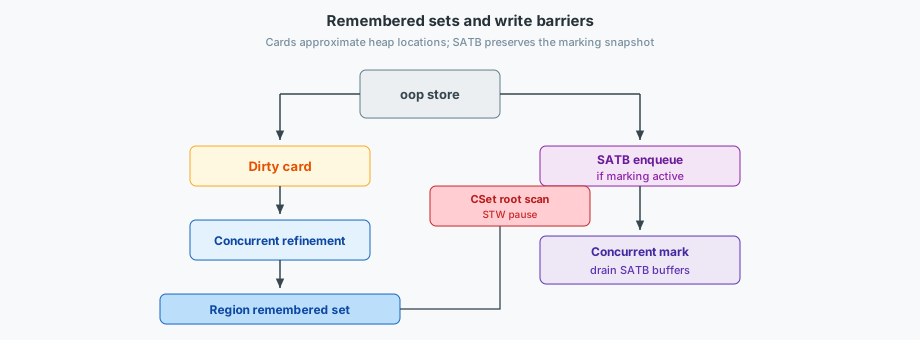
The marker thread then runs concurrent_mark_cycle_do, a fixed list of phases:
// g1ConcurrentMarkThread.cpp
void G1ConcurrentMarkThread::concurrent_mark_cycle_do() {
  // 1. this thread: scan roots of regions evacuated during Concurrent Start
  if (phase_scan_root_regions()) return;
  // 2. this thread drives the loop; G1 Conc workers run mark_from_roots
  if (phase_mark_loop()) return;
  // 3. this thread: rebuild remembered sets and scrub dead objects
  if (phase_rebuild_and_scrub()) return;
  if (phase_delay_to_keep_mmu_before_cleanup()) return;
  // 4. hand Cleanup to the VM thread
  if (phase_cleanup()) return;
  if (phase_clear_cld_claimed_marks()) return;
  // 5. this thread: clear the bitmap for the next cycle
  phase_clear_bitmap_for_next_mark();
}
Two STW pauses complete the analysis (the marker thread only requests them; the VM thread runs them, with the GC Thread workers):
- Remark — drains remaining SATB work, finishes reference processing related to marking, and may reclaim completely empty regions.
- Cleanup — accounts live data per old region, rebuilds remembered sets for collection-set candidates, and decides whether a Space-Reclamation (mixed) phase should follow.
Marking answers which old regions are sparse (or poorly connected) enough to be worth evacuating later. It does not by itself free those regions for mutator allocation.
4.4 Evacuation
G1 reclaims by evacuation: live objects in a collection set (CSet) are copied into free regions, and references (from roots and remembered sets) are updated to the new locations. The VM thread runs the pause. The GC Thread workers do the parallel copy. A young or mixed pause roughly: disconnect TLABs and select the CSet; merge heap roots and remembered sets for that CSet; copy objects; then post-evacuate cleanup.
The pause itself is one VM operation, run with every mutator stopped at the safepoint; the same operation covers a normal young collection and a mixed one, and only the collection set differs:
// g1VMOperations.cpp — runs on the VM thread
void VM_G1CollectForAllocation::doit() {
  G1CollectedHeap* g1h = G1CollectedHeap::heap();
  GCCauseSetter x(g1h, _gc_cause);
  // 1. VM thread: evacuate the collection set (young, or young plus old candidates)
  g1h->do_collection_pause_at_safepoint(_word_size);

  if (_word_size > 0) {
    // 2. the allocation that triggered the pause retries, and may escalate
    _result = g1h->satisfy_failed_allocation(_word_size);
  } else if (g1h->should_upgrade_to_full_gc()) {
    // 3. no regions left: this same VM thread continues into a full collection
    g1h->upgrade_to_full_collection();
  }
}
The pause that the operation runs has a fixed shape, beginning to end:
// g1YoungCollector.cpp — one young (or mixed) pause (setup elided)
void G1YoungCollector::collect() {
  policy()->record_young_collection_start();   // tenuring threshold, pause timers

  pre_evacuate_collection_set(...);            // retire TLABs, select the collection set

  G1ParScanThreadStateSet per_thread_states(...);
  bool may_do_optional_evacuation = collection_set()->num_optional_regions() != 0;
  // The parallel copy: scan roots and remembered sets, copy live objects.
  evacuate_initial_collection_set(&per_thread_states, may_do_optional_evacuation);

  if (may_do_optional_evacuation) {
    evacuate_optional_collection_set(&per_thread_states);   // mixed: remaining old candidates
  }
  post_evacuate_collection_set(..., &per_thread_states);    // refs, free CSet, free list

  _next_state = policy()->record_young_collection_end(...); // statistics, next state
}
Remembered sets (RSets) record approximate locations outside a region that may point into it (cards, by default 512-byte granules). Mutators dirty cards on reference stores. G1ConcurrentRefineThread and its workers turn those dirty cards into RSet entries, so the pause need not scan the entire old generation for pointers into the CSet.
Young-only collections put every Eden and Survivor region into the CSet. Surviving objects go to Survivor or, when aged out, to Old. No old region is evacuated—the common case while the Young-Only phase fills Old.
Mixed collections still evacuate all young regions, and add a budgeted number of old candidate regions chosen after marking (low live bytes, favorable connectivity). Policy spreads old reclaim across several mixed pauses (G1MixedGCCountTarget, default 8). Regions whose live bytes exceed G1MixedGCLiveThresholdPercent (default 85% of a region) stay out of the mixed CSet. Humongous objects are normally only dropped when dead, not moved, except in last-resort efforts.
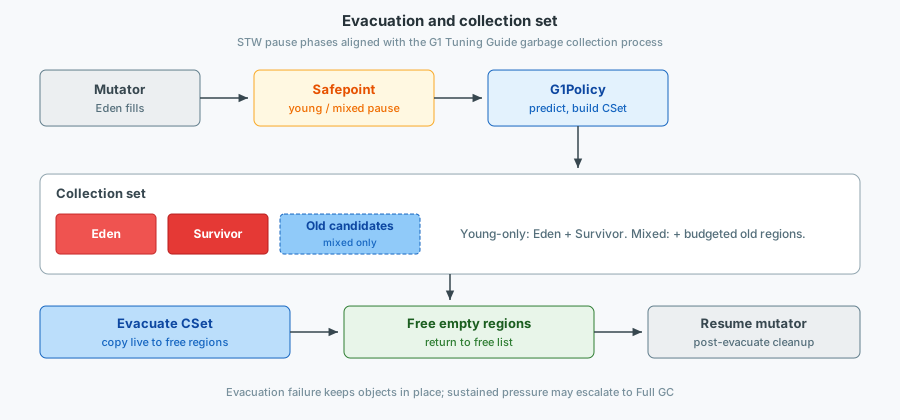
If destination space is insufficient, evacuation failure leaves objects in place and schedules those regions for later collection. Sustained failure may escalate to a Full GC—a whole-heap compacting STW that is not part of the cycle, but runs on the same VM thread:
// g1VMOperations.cpp
void VM_G1CollectFull::doit() {
  G1CollectedHeap* g1h = G1CollectedHeap::heap();
  GCCauseSetter x(g1h, _gc_cause);
  bool clear_all_soft_refs = _gc_cause == GCCause::_metadata_GC_clear_soft_refs ||
                             _gc_cause == GCCause::_wb_full_gc;
  // VM thread: compact the whole heap
  g1h->do_full_collection(size_t(0) /* allocation_word_size */,
                          clear_all_soft_refs,
                          false /* do_maximal_compaction */);
}
4.5 Free
After a successful evacuation, source regions in the CSet contain no live objects. G1 returns them to the free list: their type becomes Free, and the memory manager may later hand them out again as Eden, Survivor, Old, or Humongous destinations. That is the step that makes the gray cells in the heap layout reusable.
Freeing is the last parallel step of the pause. The free-set task has workers claim and clear the CSet regions:
// g1YoungGCPostEvacuateTasks.cpp
void G1PostEvacuateCollectionSetCleanupTask2::FreeCollectionSetTask::do_work(uint worker_id) override {
  FreeCSetClosure cl(_surviving_young_words, worker_id,
                     worker_stats(worker_id), _evac_failure_regions);
  _g1h->collection_set_par_iterate_all(&cl, &_claimer, worker_id);
  ...
}
Clearing a region resets its metadata, so nothing reads stale contents after reuse:
// g1CollectedHeap.cpp
void G1CollectedHeap::free_region(G1HeapRegion* hr, G1FreeRegionList* free_list) {
  // Reset region metadata to allow reuse.
  hr->hr_clear(true /* clear_space */);
  _policy->remset_tracker()->update_at_free(hr);
  if (free_list != nullptr) {
    free_list->add_ordered(hr);
  }
}
At the end of the pause, rebuild_free_region_list gathers every free region into the list the allocator draws from:
// g1CollectedHeap.cpp — end of the pause
void G1CollectedHeap::rebuild_free_region_list() {
  _hrm.rebuild_free_list(workers());
}
Completely empty regions can also appear without a full CSet evacuation—for example after Remark/Cleanup when marking finds a region with no live data, or when a dead humongous object is reclaimed. Those regions likewise become Free.
Policy keeps a fraction of the heap in reserve (G1ReservePercent) so evacuation always has destination space. Space-Reclamation (mixed) stops when further old evacuation would not free enough space worth the pause (G1HeapWastePercent, default 5%), and the cycle returns to Young-Only with a larger free pool for allocation.
| Lever | Default (typical) | Role in the cycle |
|---|---|---|
MaxGCPauseMillis | 200 | Bounds how large Eden and mixed CSets may be |
G1IHOP | 45 | Non-young occupancy, as a percent of the current heap, above which the next pause may be a Concurrent Start. Adapted when G1UseAdaptiveIHOP is on |
G1ReservePercent | 10 | Free regions held back for evacuation destinations |
G1MixedGCCountTarget | 8 | How many mixed pauses spread old freeing |
G1MixedGCLiveThresholdPercent | 85 | Skip dense old regions in the CSet |
G1HeapWastePercent | 5 | Stop mixed reclaim when little free space remains to gain |
Logs (-Xlog:gc* and -Xlog:gc+phases=debug) show pause kind, CSet composition, and whether regions were freed or evacuation failed. Building a debuggable HotSpot for stepping these paths is covered in JVM build and debug.
4.6 Old threshold check
Promotion fills Old, and young collections do not compact it. G1 therefore watches non-young occupancy (old regions plus humongous regions) and starts a concurrent marking cycle once that occupancy passes a threshold. The check does not start marking itself. It sets a flag, and the next young pause becomes a Concurrent Start.
G1IHOPControl owns the threshold. G1Policy::need_to_start_conc_mark compares the heap’s non-young occupancy with it. G1CollectorState carries the result as _initiate_conc_mark_if_possible, and decide_on_concurrent_start_pause reads that flag at the beginning of the next pause.
@startuml
skinparam classAttributeIconSize 0

class G1CollectedHeap {
  G1Policy* _policy
  G1CollectorState _collector_state
  non_young_occupancy_after_allocation(word_size)
  do_collection_pause_at_safepoint()
  attempt_allocation_humongous()
}

class G1Policy {
  G1IHOPControl* _ihop_control
  need_to_start_conc_mark(source, allocation_word_size)
  decide_on_concurrent_start_pause()
}

class G1IHOPControl {
  bool _is_adaptive
  double _initial_ihop_percent
  size_t _target_occupancy
  old_gen_threshold_for_conc_mark_start()
}

class G1CollectorState {
  bool _initiate_conc_mark_if_possible
  set_initiate_conc_mark_if_possible(bool)
  set_in_concurrent_start_gc()
  is_in_young_only_phase()
}

G1CollectedHeap *-- G1Policy
G1CollectedHeap *-- G1CollectorState
G1Policy *-- G1IHOPControl : _ihop_control
G1Policy ..> G1CollectedHeap : occupancy and collector state
@enduml
The threshold. With adaptive IHOP off, or before G1AdaptiveIHOPNumInitialSamples (default 3) completed cycles, the threshold is G1IHOP percent of the current heap. record_new_heap_size stores that heap size as _target_occupancy. With adaptive IHOP on and enough samples, the threshold is pulled earlier: the effective target (current heap, reduced by G1ReservePercent and G1HeapWastePercent) minus the space the cycle is predicted to consume before the first mixed collection. That prediction is three terms: old-generation allocation over the predicted cycle length, the peak extra humongous occupancy seen in past cycles, and the young generation expected to be alive at the first mixed collection.
// g1IHOPControl.cpp
size_t G1IHOPControl::old_gen_threshold_for_conc_mark_start() const {
  if (!_is_adaptive || !have_enough_data_for_prediction()) {
    return (size_t)(_initial_ihop_percent * _target_occupancy / 100.0);
  }

  size_t old_non_humongous_alloc_bytes =
      (size_t)(predict(&_marking_start_to_mixed_time_s) * predict(&_old_non_humongous_alloc_rate));
  size_t predicted_peak_extra_humongous_occupancy =
      predict(&_peak_extra_humongous_occupancy_in_mark_cycle);
  size_t needed_for_concurrent_cycle = _expected_young_gen_at_first_mixed_gc
                                     + old_non_humongous_alloc_bytes
                                     + predicted_peak_extra_humongous_occupancy;

  size_t target_heap_occupancy = effective_target_occupancy();
  return needed_for_concurrent_cycle < target_heap_occupancy
           ? target_heap_occupancy - needed_for_concurrent_cycle
           : 0;
}
The comparison. Non-young occupancy is the bytes in old and humongous regions, minus free space in the retained old allocation region. A humongous request is added, because that object will land in non-young regions; an ordinary allocation is not, because it lands in Eden. The check returns true only when occupancy is strictly above the threshold and the collector is still in the young-only phase. A cycle already in progress, or a mixed phase about to start, suppresses it.
// g1Policy.cpp — the outer overload refuses during a concurrent
// cycle or when a mixed phase is about to start, then calls this one.
bool G1Policy::need_to_start_conc_mark(const char* source,
                                       const G1CollectorState& state,
                                       size_t allocation_word_size) const {
  size_t marking_initiating_old_gen_threshold =
      _ihop_control->old_gen_threshold_for_conc_mark_start();
  size_t non_young_occupancy =
      _g1h->non_young_occupancy_after_allocation(allocation_word_size);

  if (non_young_occupancy > marking_initiating_old_gen_threshold) {
    return state.is_in_young_only_phase();
  }
  return false;
}
When it runs. At the end of a young collection, record_young_collection_end makes this check and sets _initiate_conc_mark_if_possible on the state the next pause will see. The marking does not start in that pause:
// g1Policy.cpp — end of the young pause
G1CollectorState G1Policy::record_young_collection_end(bool concurrent_operation_is_full_mark,
                                                       bool allocation_failure,
                                                       size_t allocation_word_size) {
  if (collector_state()->is_in_concurrent_start_gc()) {
    next_state.set_in_normal_young_gc();
  } else if (!about_to_start_mixed_phase() &&
             need_to_start_conc_mark("end of GC", next_state, allocation_word_size)) {
    // The flag the next pause reads.
    next_state.set_initiate_conc_mark_if_possible(true);
  }
}
At the beginning of the next pause, do_collection_pause_at_safepoint calls decide_on_concurrent_start_pause, which turns the flag into a Concurrent Start when the collector is still young-only and not about to start mixed collections. A user or metadata request sets the same flag through force_concurrent_start_if_outside_cycle, and only when no concurrent cycle is already running.
// g1Policy.cpp
void G1Policy::decide_on_concurrent_start_pause() {
  if (collector_state()->initiate_conc_mark_if_possible()) {
    if (!about_to_start_mixed_phase() && collector_state()->is_in_young_only_phase()) {
      // This pause evacuates the young generation and then starts marking.
      collector_state()->set_in_concurrent_start_gc();
    }
  }
}
A humongous allocation can cross the threshold between pauses. attempt_allocation_humongous runs the same check before allocating, and a true result requests a collection immediately, because one humongous object can consume many regions.
// g1CollectedHeap.cpp
HeapWord* G1CollectedHeap::attempt_allocation_humongous(size_t word_size) {
  if (is_init_completed() &&
      policy()->need_to_start_conc_mark("concurrent humongous allocation", word_size)) {
    try_collect(word_size, GCCause::_g1_humongous_allocation, collection_counters(this));
  }
}