
Java ConcurrentHashMap implementation
java.util.concurrent.ConcurrentHashMap is a highly concurrent, thread-safe hash table in the Java Collections Framework. It allows full concurrency of retrievals and high expected concurrency for updates. Unlike HashMap, it prohibits null keys and values to avoid the ambiguity of get(key) == null.
The design avoids table-wide locks: reads are lock-free via volatile fields; writes use CAS on empty bins and synchronized on the bin head; resizing is cooperative — threads that encounter a ForwardingNode help migrate bins rather than blocking.
1. Architecture
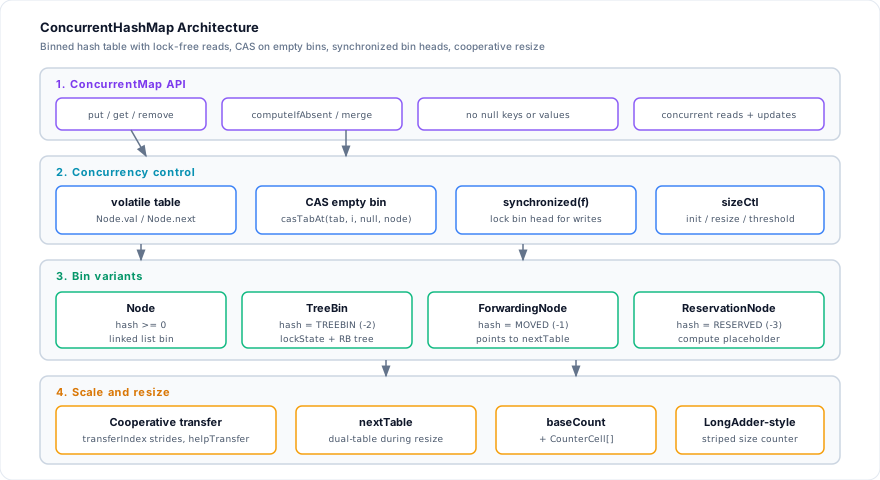
ConcurrentHashMap is a binned hash table like HashMap, but each bin can be a linked list, a TreeBin, a ForwardingNode during resize, or a ReservationNode during atomic compute operations. Negative hash values encode these special node roles.
| Layer | Role |
|---|---|
| ConcurrentMap API | put, get, remove, computeIfAbsent, merge — no null keys or values |
| Concurrency control | volatile table / Node.next / Node.val; CAS insert into empty bin; synchronized(f) on bin head for non-empty bins; sizeCtl coordinates init and resize |
| Bin variants | Node (list), TreeBin (tree + lockState), ForwardingNode (resize redirect), ReservationNode (compute placeholder) |
| Scale and resize | Cooperative transfer with nextTable and transferIndex strides; baseCount + CounterCell[] striped size counter |
1.1 Design overview
- Read (
get) — lock-free: loadtable, index the bin, walknextchain or traverse tree viaTreeBin.find. If the head is aForwardingNode, follownextTableto the new table. - Write to empty bin —
casTabAt(tab, i, null, new Node(...))inserts without locking. - Write to non-empty bin —
synchronized (f)on the bin head; double-check head unchanged, then insert/update/treeify inside the monitor. - Tree bin writes — outer
synchronized(f)serializes writers; innerTreeBin.lockStatecoordinates with lock-free readers (reader count CAS, or fallback to linked-list traversal). - Resize — initiating thread sets
sizeCtlnegative and buildsnextTable; other threads help viahelpTransfer, claiming strides fromtransferIndex. Each migrated slot gets aForwardingNodeso concurrent readers and writers redirect correctly. - Size tracking —
addCountstripes increments acrossCounterCell[](LongAdder-style) to avoid CAS contention on a single counter.
1.2 Nodes and bins
Node class hierarchy
All entries in the table are subclasses of the base Node<K,V> class. Unlike HashMap which uses a deeply nested inheritance model via LinkedHashMap, ConcurrentHashMap maintains a flat node hierarchy where specialized nodes inherit directly from Node<K,V>.
@startuml
interface "Map.Entry<K, V>" as Entry

class "ConcurrentHashMap.Node<K, V>" as Node implements Entry {
    ~ int hash
    ~ K key
    ~ volatile V val
    ~ volatile Node<K, V> next
}

class "ConcurrentHashMap.TreeNode<K, V>" as TreeNode extends Node {
    ~ TreeNode<K, V> parent
    ~ TreeNode<K, V> left
    ~ TreeNode<K, V> right
    ~ TreeNode<K, V> prev
    ~ boolean red
}

class "ConcurrentHashMap.TreeBin<K, V>" as TreeBin extends Node {
    ~ TreeNode<K, V> root
    ~ volatile TreeNode<K, V> first
    ~ volatile Thread waiter
    ~ volatile int lockState
}

class "ConcurrentHashMap.ForwardingNode<K, V>" as ForwardingNode extends Node {
    ~ Node<K, V>[] nextTable
}

class "ConcurrentHashMap.ReservationNode<K, V>" as ReservationNode extends Node {
}

class "ConcurrentHashMap<K, V>" as CHM {
    - volatile Node<K,V>[] table
    - volatile Node<K,V>[] nextTable
    - volatile long baseCount
    - volatile int sizeCtl
    - volatile int transferIndex
    - volatile CounterCell[] counterCells
}

CHM o-- Node : contains table of
@enduml
Special node hash codes
Specialized nodes are identified by negative values in their hash field, which are reserved for control purposes:
Node<K,V>: The standard node containing user key-value pairs (hash $\ge 0$).ForwardingNode<K,V>: Placed at the head of a bin during resizing (hash =MOVED=-1). It contains a reference to the new table array (nextTable).TreeBin<K,V>: Serves as the bin head and holds the root of a Red-Black Tree ofTreeNodes (hash =TREEBIN=-2).ReservationNode<K,V>: A transient placeholder node used during compute operations likecomputeIfAbsentto reserve the slot before the value is established (hash =RESERVED=-3).
Table and bin layout
The following diagram illustrates the structural layout of a ConcurrentHashMap with various bin states:
@startuml
skinparam handwritten false
skinparam monochrome false

object "ConcurrentHashMap" as chm {
    sizeCtl = 12
    baseCount = 5
}

map "table (Node<K,V>[])" as table {
    0 => Node 1
    1 => ForwardingNode
    2 => TreeBin
    3 => null
    ... => ...
}

chm --> table

package "Bin 0: Singly-Linked List" {
    object "Node 1" as n1 {
        hash = 96
        key = "KeyA"
        val = "ValA"
    }
    object "Node 2" as n2 {
        hash = 112
        key = "KeyB"
        val = "ValB"
        next = null
    }
    n1 --> n2 : next
}

package "Bin 1: Forwarded Slot (Resizing)" {
    object "ForwardingNode" as fwd {
        hash = -1 (MOVED)
        key = null
        val = null
        nextTable = Node[] (New Table)
    }
}

package "Bin 2: Treeified Slot (TreeBin & TreeNodes)" {
    object "TreeBin (Bin Head)" as tb {
        hash = -2 (TREEBIN)
        root = TreeNode (Root)
        first = TreeNode (Head)
    }
    object "TreeNode (Root)" as tr {
        red = false
        key = "KeyC"
    }
    object "TreeNode (Left)" as tl {
        red = true
        key = "KeyD"
    }
    tb --> tr : root
    tr --> tl : left
}

table::0 --> n1
table::1 --> fwd
table::2 --> tb
@enduml
2. Implementation
ConcurrentHashMap achieves high concurrency by avoiding table-wide locks — reads and writes use different paths, and locking is scoped to individual bins.
2.1 Lock-free get and putVal
get
Retrieval operations do not block and run completely lock-free.
- The
tablearray reference and thenextandvalfields of everyNodeare declaredvolatile. This guarantees that updates made by one thread are immediately visible to reader threads. - If a reader thread encounters a
ForwardingNode(hash =-1), the read is redirected to the new table array referenced by the node, ensuring seamless reads even during active resizing. - If a reader thread accesses a treeified bin, it can traverse the bin using the sequential
nextpointers ofTreeNodewithout needing to acquire a tree-lock.
putVal: CAS and synchronized bin head
Write operations (put, remove, replace) use a combination of CAS and localized monitor synchronization:
- CAS for Empty Bins:
- If the target bin index is empty (
tabAt(tab, i) == null), the thread attempts to insert the new node using a Compare-And-Swap (CAS) operation:if (casTabAt(tab, i, null, new Node<K,V>(hash, key, value))) break; // Node inserted without acquiring a lock - If the CAS succeeds, no lock is acquired, eliminating synchronization overhead for empty slots.
- If the target bin index is empty (
- Synchronized Bin Heads:
- If the bin is not empty, the thread locks the first node of the bin (
f) using Java’s built-in monitor synchronization:synchronized (f) { if (tabAt(tab, i) == f) { // Double-check to ensure head node hasn't changed // Perform insertion, update, or treeification } } - Only threads writing to the same bucket will contend for the lock. Threads writing to different buckets execute in parallel.
- The double-check
tabAt(tab, i) == fensures that the head node has not been removed, treeified, or relocated by a concurrent resize before the lock was acquired.
- If the bin is not empty, the thread locks the first node of the bin (
No null keys or values
Unlike HashMap, ConcurrentHashMap does not permit null keys or values.
In a concurrent map, allowing null values introduces an ambiguity: map.get(key) -> null could mean that the key maps to null, or that the key is not present in the map. In a single-threaded map, this is resolved using map.containsKey(key). In a concurrent map, the state of the map can change between the calls to get() and containsKey(), creating race conditions. To prevent this ambiguity, null keys and values are strictly prohibited.
2.2 TreeBin locking
When a bucket is treeified, the bin head becomes a TreeBin. lockState coordinates concurrent reads and writes:
WRITER = 1: Set when a thread is writing to or restructuring the tree (holding a write lock).WAITER = 2: Set when a thread is waiting to acquire the write lock.READER = 4: Used as a unit of increment/decrement to track active reader threads.
Reader count tracking
When a thread calls find(h, k) on a TreeBin:
- Acquisition: It checks if there are active writers or waiters (
(lockState & (WAITER|WRITER)) != 0). If the tree is stable, the thread attempts to increment the reader count byREADERusing CAS:If successful, it traverses the Red-Black Tree usingU.compareAndSetInt(this, LOCKSTATE, s, s + READER)findTreeNode(h, k). - Release: Once the read is complete, the thread decrements the reader count in the
finallyblock using an atomic add:If this thread was the last reader and a writer thread is waiting (U.getAndAddInt(this, LOCKSTATE, -READER)lockStatebecomesWAITER), it callsLockSupport.unpark(waiter)to wake up the waiting writer.
Why reads never block
This atomic increment and decrement of the reader count does not cause problems or bottlenecks in concurrent multiple reads:
- No Mutual Reader Blockage: Since
READERis represented by bit-fields aboveWRITERandWAITER(value 4, or0b100), multiple reader threads can increment the lock state concurrently without interfering with each other. If five threads read at the same time,lockStatesimply becomes20(5 * READER). They all traverse the tree in parallel. - Optimistic CAS Loop: The acquisition uses a CAS spin-loop. If multiple threads attempt to increment
lockStateconcurrently, the ones that fail the CAS will simply loop, read the updated state, and retry immediately. Since read registration is a simple, fast register update, spin contention is extremely short-lived. - Atomic Release: The release phase uses
U.getAndAddInt, which translates to a hardware-level atomic instruction (such asLOCK XADDon x86). This instruction never fails and is guaranteed by the hardware to update the count thread-safely without locks. - Zero-Blocking Fallback (Singly-Linked List Traversal): If a reader thread detects that a writer is active or waiting (
(lockState & (WAITER|WRITER)) != 0), or if it repeatedly fails to acquire the read lock due to extreme contention, it does not block or spin. Instead, it immediately bypasses the tree structure and traverses the bin using the sequential singly-linked list (nextpointers) maintained by theTreeNodeinstances. This fallback guarantees that reader threads never block under any circumstance, preserving the non-blocking read contract ofConcurrentHashMap.
Single waiter field
TreeBin.waiter is a single volatile Thread — not a queue — because the outer synchronized(f) on the bin head already serializes writers. At most one thread waits for active readers to finish.
Before any thread calls putTreeVal or removeTreeNode, it holds the monitor on the bin head:
synchronized (f) {
    if (tabAt(tab, i) == f) {
        // Delegate to putTreeVal or removeTreeNode
    }
}
Because of this outer synchronized block:
- At most one writer thread can ever execute code inside a specific
TreeBinat any time. - Consequently, there is never any contention between multiple writers trying to write to the same
TreeBinsimultaneously. - The only contention a writer thread faces is with active reader threads that are currently traversing the tree.
Writer lock flow
When the single writer thread enters putTreeVal or removeTreeNode, it must restructure the tree. To ensure reader threads do not read an unstable, partially restructured tree, the writer must wait for all active readers to exit.
- The writer calls
lockRoot():- It attempts to CAS
lockStatefrom0toWRITER(1). - If there are active readers,
lockStateis greater than 0 (a multiple ofREADER= 4). The CAS fails.
- It attempts to CAS
- The writer delegates to
contendedLock():- Since this is the only writer thread allowed in the
TreeBinblock, it is the only thread that will ever executecontendedLock(). - It sets the
WAITERbit (2) inlockStateand stores its own thread reference in thewaiterfield:U.compareAndSetReference(this, WAITERTHREAD, null, current); - It then parks itself using
LockSupport.park(this).
- Since this is the only writer thread allowed in the
- Waking the Writer:
- As reader threads finish their traversal, they decrement the reader count in
lockState. - The last reader thread to exit detects that the
WAITERbit is set and wakes up the single waiting writer:if (U.getAndAddInt(this, LOCKSTATE, -READER) == (READER|WAITER) && (w = waiter) != null) LockSupport.unpark(w);
- As reader threads finish their traversal, they decrement the reader count in
Because the outer monitor lock (synchronized(f)) guarantees that there is at most one writer thread per bin, it is physically impossible for multiple threads to wait in contendedLock() at the same time. A single waiter reference is therefore completely sufficient, and no waiting queue is required.
2.3 Cooperative resize
Resizing is multi-threaded: a thread that sees a ForwardingNode helps transfer bins via helpTransfer rather than blocking.
sizeCtl and transferIndex
sizeCtl: A multi-use control field:-1: Represents active table initialization.- Less than
-1: Represents active resizing. The value encodes a generation stamp in the higher 16 bits and the number of active helper threads in the lower 16 bits. - Positive value: Represents the next resize threshold (capacity $\times$ load factor).
transferIndex: Tracks the next block of bins to be migrated, starting from the old table capacityndown to0.
Stride migration
To avoid contention among threads helping with a resize, the migration work is divided into chunks called strides.
Old Table:
[ Bin N-1 ] ... [ Bin 0 ]
 ◄─────────────────────── (transferIndex moves from N down to 0)
   Thread A: Claims [Stride A]  |  Thread B: Claims [Stride B]
- Claiming a Stride:
- A thread claims a block of bins (with a minimum size of
MIN_TRANSFER_STRIDE = 16) by performing a CAS ontransferIndex:U.compareAndSetInt(this, TRANSFERINDEX, nextIndex, nextBound = (nextIndex > stride ? nextIndex - stride : 0)) - Once claimed, the thread is solely responsible for migrating bins in the range
[nextBound, nextIndex - 1].
- A thread claims a block of bins (with a minimum size of
- Transfer Mechanics:
- For each index
iin its stride:- If the bin is empty, the thread CASes a
ForwardingNode(fwd) into the slot. This blocks new writes at this index; any thread attempting to write will seefwdand join the resizing effort. - If the bin contains elements, the thread locks the bin head (
synchronized(f)) and splits it into low-index (ln) and high-index (hn) lists based on the bitwise check(hash & n) == 0.
- If the bin is empty, the thread CASes a
- For each index
- The “Last Run” Optimization:
- In a linked list bin, many nodes at the tail of the list may share the same destination index.
ConcurrentHashMaptraverses the list to find thelastRunnode—the node after which all subsequent nodes have the identical destination index.- The thread reuses the
lastRunnode and its descendants directly, avoiding node recreation. On average, only one-sixth of the nodes in a bin require allocation during doubling.
- Completion:
- Once a bin’s elements are written to the new table, the old slot is marked with the
ForwardingNode. - When a thread finishes its stride, it decrements the helper count in
sizeCtl. The last thread to finish the migration performs a final sweep and commits the new table.
- Once a bin’s elements are written to the new table, the old slot is marked with the
2.4 Size counting
A single global counter would bottleneck under contention. ConcurrentHashMap uses a LongAdder-style design:
baseCount and CounterCell
The counter consists of two components:
baseCount: A volatile long updated via CAS when there is no contention.counterCells: A volatile array ofCounterCellobjects, where each cell contains a volatilevaluefield. This array is lazily allocated and grown as contention increases.
                  [ Thread A ]        [ Thread B ]        [ Thread C ]
                       │                   │                   │
                 (CAS Success)       (CAS Failure)       (CAS Failure)
                       ▼                   │                   │
                [ baseCount ]              ▼                   ▼
                                    [ Cell 0 ]          [ Cell 1 ]  (inside counterCells)
addCount
- Uncontended Update:
- The thread attempts to update the global
baseCountusing CAS:U.compareAndSetLong(this, BASECOUNT, b = baseCount, s = b + x) - If this succeeds, the operation completes.
- The thread attempts to update the global
- Contended Update (Fallback):
- If
counterCellsis already allocated, or if thebaseCountCAS fails due to contention:- The thread maps to a specific index in the
counterCellsarray using a thread-local random probe:index = ThreadLocalRandom.getProbe() & (counterCells.length - 1) - It attempts to CAS the value of the cell at that index.
- If the cell is null, or if the cell CAS fails, the thread enters
fullAddCount()to initialize the array, allocate new cells, or resize the array.
- The thread maps to a specific index in the
- If
- Summation (
size()):- To calculate the total size,
ConcurrentHashMapsums thebaseCountand the values of all activeCounterCellinstances:final long sumCount() { CounterCell[] cs = counterCells; long sum = baseCount; if (cs != null) { for (CounterCell c : cs) { if (c != null) sum += c.value; } } return sum; } - This design localizes write contention to separate memory locations, ensuring that counting does not bottleneck map updates.
- To calculate the total size,
2.5 Concurrency summary
The concurrent state and locking strategies of ConcurrentHashMap can be summarized by the following operational modes:
| Operation | Target State | Concurrency Control | Complexity |
|---|---|---|---|
get | Any | Lock-Free volatile read / ForwardingNode redirection | $O(1)$ / $O(\log n)$ |
put | Empty slot | Lock-Free CAS on bin index | $O(1)$ |
put | Non-empty bin | Fine-grained synchronized lock on bin head node | $O(1)$ / $O(\log n)$ |
put | Resizing bin | Thread assists with transfer via helpTransfer | $O(1)$ / $O(\log n)$ |
size | N/A | Non-blocking sum of baseCount and counterCells | $O(\text{cells})$ |
Through this multi-layered approach—combining CAS, lock-free reads, synchronized bucket heads, cooperative resizing, and striping-based size counters—ConcurrentHashMap delivers high throughput and thread-safe operations under extreme multi-threaded workloads.