
java concurrency - Synchronizer Framework
ReentrantLock, Semaphore, and CountDownLatch look unrelated at the API level, but each holds a private Sync extends AbstractQueuedSynchronizer. The Sync subclass overrides tryAcquire / tryRelease and decides what state represents. AbstractQueuedSynchronizer (AQS) is the base class: it owns state, the CLH sync queue, acquire / release, and the nested ConditionObject.
1. Architecture
1.1 Design overview
A blocking synchronizer has two operations: acquire waits until state permits progress; release updates state and may wake waiters. In the JDK this splits across two classes:
| Class | Responsibility |
|---|---|
Sync extends AQS | Override tryAcquire* / tryRelease*; define what state means |
AbstractQueuedSynchronizer | Hold state, run the acquire / release loop, manage the CLH queue, park threads via LockSupport |
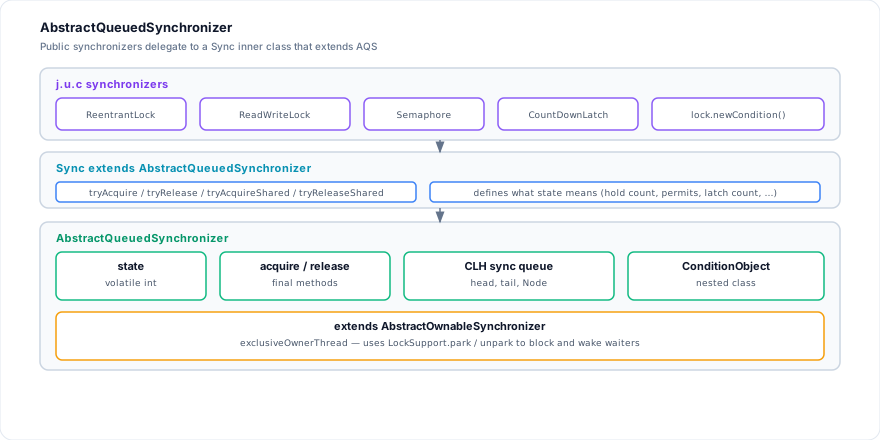
The diagram shows the call chain:
ReentrantLock,Semaphore, etc. — public API (lock,acquire,await).Sync— inner class that extends AQS and implements thetry*hooks.ReentrantLock.Synctreatsstateas hold count;Semaphore.Synctreats it as permit count.AbstractQueuedSynchronizer— whentryAcquirefails, AQS enqueues the thread on a CLH FIFO queue and blocks it withLockSupport.park. Onrelease, AQS callstryReleasethensignalNextto unpark a successor. Also containsConditionObjectforawait/signal, and extendsAbstractOwnableSynchronizerto track the exclusive owner thread.
AbstractQueuedLongSynchronizer is the same design with a long state field — used by ReentrantReadWriteLock.
Both modes share one sync queue; the node type records the mode:
| Mode | AQS API | Node class | Examples |
|---|---|---|---|
| Exclusive | acquire / release | ExclusiveNode | ReentrantLock, write lock |
| Shared | acquireShared / releaseShared | SharedNode | Semaphore, CountDownLatch.await, read lock |
CAS, memory fences, and the OS primitives behind park are covered in Synchronization.
1.2 AbstractQueuedSynchronizer
Every AQS-backed type holds a Sync extends AbstractQueuedSynchronizer (or AbstractQueuedLongSynchronizer) and overrides the hook methods:
@startuml
abstract class AbstractOwnableSynchronizer {
    transient Thread exclusiveOwnerThread
}

abstract class AbstractQueuedSynchronizer extends AbstractOwnableSynchronizer {
    transient volatile Node head
    transient volatile Node tail
    volatile int state
    + acquire(int arg)
    + release(int arg)
    + acquireShared(int arg)
    + releaseShared(int arg)
    # tryAcquire(int arg)
    # tryRelease(int releases)
    # tryAcquireShared(int arg)
    # tryReleaseShared(int releases)
}

abstract class Node {
    volatile Node prev
    volatile Node next
    Thread waiter
    volatile int status
}

class ExclusiveNode extends Node
class SharedNode extends Node
class ConditionNode extends Node {
    ConditionNode nextWaiter
}

AbstractQueuedSynchronizer "1" o-- "*" Node : sync queue
@enduml
State and hooks
state is read and written only through getState, setState, and compareAndSetState. Subclasses override hooks; callers never touch state directly:
| Mode | Acquire hook | Release hook | Result |
|---|---|---|---|
| Exclusive | tryAcquire(int arg) | tryRelease(int releases) | boolean; true when fully released |
| Shared | tryAcquireShared(int arg) | tryReleaseShared(int releases) | int: negative = fail; 0 = success; positive = success and others may proceed |
AbstractOwnableSynchronizer tracks exclusiveOwnerThread for exclusive syncs. When 32 bits are insufficient, AbstractQueuedLongSynchronizer provides the same API with a long state — used by ReentrantReadWriteLock.
Sync queue
On first contention AQS installs a dummy header; waiters link at tail via CAS:
private transient volatile Node head;
private transient volatile Node tail;
| Field | Role |
|---|---|
prev, next | CLH-variant links; enqueue uses prev; next may lag after cancellation |
waiter | Thread passed to LockSupport.unpark |
status | Bit flags: WAITING (1), COND (2), CANCELLED (0x80000000, negative) — see Cancellation |
ExclusiveNode and SharedNode
ExclusiveNode and SharedNode are empty subclasses of Node — no extra fields. AQS uses the type tag to decide which hook to call and which waiters to wake:
ExclusiveNode | SharedNode | |
|---|---|---|
| Created when | acquire(..., shared=false, ...) | acquire(..., shared=true, ...) |
| Fast-path hook | tryAcquire(arg) → boolean | tryAcquireShared(arg) >= 0 |
| Release path | release → signalNext(head) | releaseShared → signalNext(head) |
| After becoming head | stop | signalNextIfShared(node) — wake next shared waiter if still eligible |
| Queue inspection | getExclusiveQueuedThreads() | getSharedQueuedThreads() |
Enqueue picks the node type in the main acquire loop:
node = (shared) ? new SharedNode() : new ExclusiveNode();
Inside the loop, the same acquire(...) method branches on shared:
if (shared)
    acquired = (tryAcquireShared(arg) >= 0);
else
    acquired = tryAcquire(arg);
When a shared waiter succeeds and installs itself as the new head, AQS may propagate the wake to the next shared node — multiple readers can pass through without each needing a separate release:
if (acquired) {
    if (first) {
        node.prev = null;
        head = node;
        pred.next = null;
        node.waiter = null;
        if (shared)
            signalNextIfShared(node);   // only unparks if successor is SharedNode
        // ...
    }
    return 1;
}
signalNext wakes any successor; signalNextIfShared wakes only a SharedNode:
private static void signalNext(Node h) {
    Node s;
    if (h != null && (s = h.next) != null && s.status != 0) {
        s.getAndUnsetStatus(WAITING);
        LockSupport.unpark(s.waiter);
    }
}

private static void signalNextIfShared(Node h) {
    Node s;
    if (h != null && (s = h.next) != null &&
        (s instanceof SharedNode) && s.status != 0) {
        s.getAndUnsetStatus(WAITING);
        LockSupport.unpark(s.waiter);
    }
}
ConditionNode is a third node type, used on condition queues rather than the CLH sync queue (§1.3).
Acquire and release
Public entry points try the hook once, then delegate to the internal loop:
// exclusive — ReentrantLock.lock()
public final void acquire(int arg) {
    if (!tryAcquire(arg))
        acquire(null, arg, false, false, false, 0L);
}

// shared — Semaphore.acquire(), CountDownLatch.await()
public final void acquireShared(int arg) {
    if (tryAcquireShared(arg) < 0)
        acquire(null, arg, true, false, false, 0L);
}
The internal acquire(...) loop handles enqueue, park, and retry. Simplified flow:
for (;;) {
    // 1. If at queue head (or not yet enqueued), try the hook
    if (first || pred == null) {
        boolean acquired = shared
            ? (tryAcquireShared(arg) >= 0)
            : tryAcquire(arg);
        if (acquired) { /* set head, maybe signalNextIfShared */ return 1; }
    }
    // 2. Initialize queue on first contention
    if (tail == null)
        tryInitializeHead();
    // 3. Allocate ExclusiveNode or SharedNode
    else if (node == null)
        node = shared ? new SharedNode() : new ExclusiveNode();
    // 4. CAS onto tail, link prev
    else if (pred == null) { /* enqueue */ }
    // 5. Spin after unpark (postSpins)
    else if (first && spins != 0) { --spins; Thread.onSpinWait(); }
    // 6. Set WAITING on predecessor, then park
    else if (node.status == 0)
        node.status = WAITING;
    else {
        LockSupport.park(this);   // or parkNanos for timed acquire
        node.clearStatus();
    }
}
Release is symmetric and short — hook first, then unpark one successor:
public final boolean release(int arg) {
    if (tryRelease(arg)) {
        signalNext(head);
        return true;
    }
    return false;
}

public final boolean releaseShared(int arg) {
    if (tryReleaseShared(arg)) {
        signalNext(head);
        return true;
    }
    return false;
}
Interrupts and waking parked waiters
A contending thread that fails tryAcquire is enqueued on the CLH sync queue and enters the internal acquire(...) loop. The first waiter — the successor of head (head.next) — is the node that will invoke tryAcquire on the next eligible iteration. Blocking follows a two-phase protocol to prevent a lost signal between release and park (Dekker-style arrangement documented in the AQS source):
- Assign
node.status = WAITINGon one loop iteration, publishing the intent to block. - On a subsequent iteration, if acquisition still fails, invoke
LockSupport.park(this)(orparkNanosfor timed acquire).
signalNext atomically clears WAITING via getAndUnsetStatus(WAITING) and calls LockSupport.unpark(node.waiter) on the successor. While blocked, a waiter has Node.waiter bound to its thread and WAITING set on its node until park returns.
Delivery of Thread.interrupt() to a parked thread
At the API level, interruption is a status flag; at the JVM level, it unblocks a thread parked in a native wait.
- Interrupt request. Thread T invokes
target.interrupt(). The implementation setstarget.interrupted = trueand invokes the nativeinterrupt0(). - Native unpark. If target is blocked in a park or wait primitive,
interrupt0()unparks the underlying carrier thread, making it eligible for scheduling. The interrupting thread does not callLockSupport.unpark; the VM delivers the wake. - Return from
park. The blocked thread’sLockSupport.parkinvocation returns.LockSupportdoes not indicate whether the return was caused byunpark, interrupt, timeout, or spurious wakeup; callers must re-evaluate their blocking condition. - Interrupt status. Following an interrupt-induced return from
park, the target’s interrupted status remains set until it is observed and cleared (typically byThread.interrupted()).
An interrupt therefore unblocks a parked first waiter — or any sync-queue waiter — in the same operational sense as signalNext: the park call returns and execution resumes inside acquire(...). Interruption alone does not grant the synchronizer and does not dequeue the thread.
Post-wake processing in acquire(...)
Every return from park executes the same epilogue, irrespective of cause:
node.clearStatus();
if ((interrupted |= Thread.interrupted()) && interruptible)
    break;
Thread.interrupted() queries the current thread’s interrupted status and clears it, OR-ing the result into a local interrupted variable. The loop either continues (retry tryAcquire, reassign WAITING, re-park) or exits into cancelAcquire.
For the first waiter after a wake, the next iteration satisfies first == (head == pred) and therefore invokes tryAcquire / tryAcquireShared before blocking again. If the hook succeeds — for example, after a concurrent release — the node is promoted to head and acquisition completes. If the hook fails, including when the wake originated solely from an interrupt without a corresponding release, the thread reassigns WAITING and re-parks. Interruption alone does not satisfy acquisition.
| Entry point | interruptible | Outcome when interrupted during park |
|---|---|---|
acquire / acquireShared (lock(), Semaphore.acquire(), …) | false | Loop continues; thread remains enqueued; re-parks if tryAcquire fails |
acquireInterruptibly / acquireSharedInterruptibly (lockInterruptibly(), …) | true | Loop terminates; node marked CANCELLED; cleanQueue(); InterruptedException |
Timed tryAcquireNanos / tryAcquireSharedNanos | true | Same termination as interruptible acquire; timeout returns 0 |
Non-interruptible acquire and deferred interrupt restoration
When interruptible == false, interruption is not a loop-termination condition. If acquisition eventually succeeds at the queue head, AQS restores the interrupt status before returning:
if (acquired) {
    if (first) {
        // ... promote to head; signalNextIfShared ...
        if (interrupted)
            current.interrupt();
    }
    return 1;
}
This restoration follows from two contractual obligations that must hold simultaneously.
Obligation 1 — uninterruptible acquisition. Methods such as lock() and Semaphore.acquire() delegate to acquire(...) with interruptible = false. They must neither throw InterruptedException nor abort the wait in response to interrupt(). A thread that wakes from park due to interruption re-enters the loop and continues waiting until tryAcquire succeeds. Completion of acquisition is unconditional with respect to interruption.
Obligation 2 — preservation of interrupt status. Each park return invokes Thread.interrupted(), which atomically reads and clears the thread’s interrupted bit, recording the outcome in the local interrupted variable. Without subsequent restoration, a successful return from acquire would leave the interrupt request permanently unobservable: isInterrupted() would return false, and subsequent interruptible operations would not detect the prior interruption. The established convention for an uninterruptible method that internally uses an interruptible blocking primitive (park) is to accumulate interrupt observations during the wait, complete the operation, and restore the status before returning to the caller. The sample lock in the LockSupport specification implements the same protocol.
The call to current.interrupt() upon successful acquisition is deferred restoration, not generation of a new interrupt. It reinstates the interrupt request that was cleared during the wait, enabling the caller to observe and respond after lock() returns:
lock.lock();   // may restore interrupted status before return
try {
    if (Thread.currentThread().isInterrupted())
        return;
    // critical section
} finally {
    lock.unlock();
}
Contrast with interruptible acquire. lockInterruptibly() passes interruptible = true. An interrupt during park terminates the loop, cancels the node, and results in InterruptedException at the public API (with interrupt status cleared per the exception contract). Successful acquisition and interrupt-driven cancellation are mutually exclusive on that path; no restoration occurs on success because success implies the interrupt was not acted upon as a failure.
If cancelAcquire is invoked without acquisition and interrupted && !interruptible, the same restoration applies:
if (interrupted) {
    if (interruptible)
        return CANCELLED;
    else
        Thread.currentThread().interrupt();
}
The caller of lock() may therefore observe a set interrupted status after holding the lock, although lock() itself does not throw InterruptedException.
Interruptible acquire (interruptible == true). The break following Thread.interrupted() enters cancelAcquire: node.status = CANCELLED, node.waiter = null, and cleanQueue() unlinks cancelled nodes so successors remain reachable. The public method maps a negative return to InterruptedException. A first waiter cancelled on this path relinquishes its queue position; a subsequent release invokes signalNext on the next non-cancelled successor.
Interrupt wake compared with release wake
Both causes converge at the same park return site; acquire does not record the wake reason.
| Source | Mechanism | Effect on first waiter |
|---|---|---|
release → signalNext(head) | Clear successor WAITING; LockSupport.unpark(successor.waiter) | park returns; tryAcquire succeeds if tryRelease permitted acquisition |
Thread.interrupt() on waiter | Set interrupted status; interrupt0() unparks carrier | park returns; tryAcquire succeeds only if the synchronizer permits; otherwise re-park |
| Spurious wakeup | JVM may return from park without unpark or interrupt | Identical epilogue; condition re-evaluated; possible re-park |
Following a wake from release, the first waiter may execute up to postSpins iterations of Thread.onSpinWait before re-parking, reducing context-switch overhead when the releasing thread remains on-CPU. Interrupt-induced wakes follow the same spin path when applicable.
When signalNext encounters a cancelled successor, it may fail to unpark an eligible thread. Traversal in cleanQueue() unlinks cancelled nodes and unparks a relinked first waiter, preserving liveness.
Cancellation (CANCELLED)
CANCELLED is assigned the most significant bit so that status < 0 identifies a dead sync-queue node in a single comparison. A cancelled node remains linked until cleanQueue() unsplices it; it must never acquire the synchronizer.
When CANCELLED is set on the sync queue
cancelAcquire marks a node and triggers cleanup:
private int cancelAcquire(Node node, boolean interrupted, boolean interruptible) {
    if (node != null) {
        node.waiter = null;
        node.status = CANCELLED;
        if (node.prev != null)
            cleanQueue();
    }
    // ...
}
| Trigger | interruptible | Result |
|---|---|---|
Interrupt during acquireInterruptibly / tryAcquireNanos | true | CANCELLED return → InterruptedException or false |
Timed tryAcquire / tryAcquireShared expires | true | return 0 (timeout) |
Error / RuntimeException from tryAcquire in the loop | false | node cancelled; exception propagated |
Interrupt during non-interruptible acquire | false | node not cancelled; loop continues (§1.2 interrupt section) |
A waiting thread may also discover that its predecessor was cancelled:
if (pred.status < 0) {
    cleanQueue();   // unlink cancelled nodes from tail
    continue;
}
cleanQueue() walks from tail toward head, unsplicing nodes with status < 0 via CAS on prev/next. If the relinked node becomes the new first waiter (p.prev == null), it invokes signalNext(p) so a successor blocked behind cancelled nodes is not stranded. This complements signalNext(head), which skips cancelled successors that may still appear in a stale next pointer.
Condition waits and cancellation
Condition handling reuses Node.status but applies COND rather than CANCELLED for the primary wait protocol. A ConditionNode on the condition queue carries COND | WAITING; transfer to the sync queue clears COND and proceeds through normal acquire.
enableWait failure. If the lock is not held exclusively, or release fails, the node is marked CANCELLED and IllegalMonitorStateException is thrown — the thread never entered a valid wait:
node.status = CANCELLED; // lock not held or inconsistent
throw new IllegalMonitorStateException();
Interrupt or timeout while still on the condition queue. In await(), awaitNanos(), and related timed methods, the wait loop tests whether the node remains on the condition queue by atomically clearing and inspecting the COND bit:
if (interrupted |= Thread.interrupted()) {
    if (cancelled = (node.getAndUnsetStatus(COND) & COND) != 0)
        break;              // still on condition queue — abort wait
}
// else: interrupted after signal() already cleared COND and enqueued node
cancelled | Meaning | Subsequent action |
|---|---|---|
true | COND was present — thread not yet transferred by signal() | unlinkCancelledWaiters(node); reacquire; throw InterruptedException or return false on timeout |
false | signal() already ran — doSignal cleared COND and called enqueue | reacquire via sync queue; restore interrupt if interrupted after signal |
doSignal skips nodes whose COND bit was already cleared (for example, by a concurrent interrupt):
if ((first.getAndUnsetStatus(COND) & COND) != 0)
    enqueue(first);
unlinkCancelledWaiters. Removes condition-queue entries that no longer carry the COND flag — nodes aborted before transfer. The sync-queue CANCELLED marker is not used for this path; the node is simply unlinked from firstWaiter / lastWaiter.
reacquire. After any await variant, the thread re-enters the sync queue through non-interruptible acquire(node, savedState, …) — even following interruptible await(). Cancellation on the condition queue prevents reacquisition from starting; once signal() has enqueued the node, reacquisition follows the standard sync-queue protocol, including CANCELLED handling if the competitive acquire is interruptible (not the case for reacquire, which passes interruptible = false).
awaitUninterruptibly. Does not use the cancelled / COND abort path; the loop runs until canReacquire(node) — that is, until signal() has enqueued the node and links are consistent.
1.3 ConditionObject
ConditionObject is nested inside AQS and backs Lock.newCondition(). It reuses ConditionNode but maintains a separate condition queue (firstWaiter / lastWaiter), distinct from the CLH sync queue:
@startuml
interface Condition {
    + await()
    + awaitUninterruptibly()
    + awaitNanos(long nanosTimeout)
    + await(long time, TimeUnit unit)
    + awaitUntil(Date deadline)
    + signal()
    + signalAll()
}

abstract class Node {
    volatile Node prev
    volatile Node next
    Thread waiter
    volatile int status
}

class ConditionObject implements Condition {
    transient ConditionNode firstWaiter
    transient ConditionNode lastWaiter
}

interface ManagedBlocker {
    + block() : boolean
    + isReleasable() : boolean
}

class ConditionNode extends Node implements ManagedBlocker {
    ConditionNode nextWaiter
}

ConditionObject *-right- ConditionNode : condition queue
@enduml
await() (caller must hold the exclusive lock):
enableWait(node)— enqueue on the condition list, thenrelease(savedState).- Park (
ForkJoinPool.managedBlockorLockSupport.park) until signalled. reacquire(node, savedState)— competitiveacquire; may re-enter the sync queue.- Restore interrupt status if interrupted after a real signal.
signal() transfers nodes from the condition queue to the sync queue. The signalled thread does not run until it re-acquires the lock:
private void doSignal(ConditionNode first, boolean all) {
    while (first != null) {
        ConditionNode next = first.nextWaiter;
        if ((first.getAndUnsetStatus(COND) & COND) != 0) {
            enqueue(first);
            if (!all) break;
        }
        first = next;
    }
}
Unlike synchronized, each Condition instance has its own wait set rather than sharing one per monitor.
Interrupt and timeout handling on the condition queue — the COND bit, the local cancelled flag, and unlinkCancelledWaiters — are described in Cancellation (CANCELLED). In summary: abort while still on the condition queue unlinks the node and throws or returns failure after reacquire; interrupt after signal() defers to the sync-queue reacquire path with deferred interrupt restoration.
2. Implementation
2.1 LockSupport
AQS stores the waiting thread in Node.waiter and calls LockSupport.unpark from signalNext. Each thread holds at most one permit; park() consumes it or blocks. Parking is per-thread, not bound to a lock object. Short spins (postSpins, Thread.onSpinWait) before parking cut context switches when the releaser is still on-CPU.
2.2 Built-in synchronizers
| Class | AQS base | state meaning | Mode |
|---|---|---|---|
ReentrantLock | AbstractQueuedSynchronizer | hold count (0 = unlocked) | exclusive |
ReentrantReadWriteLock | AbstractQueuedLongSynchronizer | high 32 = reads, low 32 = writes | both |
Semaphore | AbstractQueuedSynchronizer | available permits | shared |
CountDownLatch | AbstractQueuedSynchronizer | countdown (0 = open) | shared |
CyclicBarrier | — (ReentrantLock + Condition) | count under lock | — |
FutureTask | — (own CAS state + WaitNode stack) | task lifecycle | — |
ReentrantLock
A reentrant mutual-exclusion lock: one thread holds it at a time, but the owner may acquire it again. It supports optional FIFO fairness, timed and interruptible acquire, and multiple condition variables on the same lock. Use it wherever synchronized is too limited — tryLock, fairness, or separate notFull / notEmpty waits on one buffer.
@startuml
interface Lock {
    + lock()
    + lockInterruptibly()
    + tryLock()
    + tryLock(long time, TimeUnit unit)
    + unlock()
    + newCondition() : Condition
}

interface Condition {
    + await()
    + signal()
    + signalAll()
}

class ConditionObject implements Condition

class ReentrantLock implements Lock {
    final Sync sync
}

abstract class Sync extends AbstractQueuedSynchronizer {
    + newCondition() : ConditionObject
}

class NonfairSync extends Sync
class FairSync extends Sync

ReentrantLock *-- Sync
Sync ..> ConditionObject : newCondition()
@enduml
lock.newCondition() returns a ConditionObject on the same Sync. A thread **await**s only while holding the lock; await releases the lock and waits on the condition queue; signal moves waiters back to the sync queue. One lock can have many conditions (e.g. notFull and notEmpty).
Fairness is not in AQS — it is chosen in the Sync subclass. The default constructor uses NonfairSync; new ReentrantLock(true) uses FairSync:
public ReentrantLock() {
    sync = new NonfairSync();
}

public ReentrantLock(boolean fair) {
    sync = fair ? new FairSync() : new NonfairSync();
}
NonfairSync skips the queue check, so a new thread can barge ahead of waiters:
final boolean initialTryLock() {
    Thread current = Thread.currentThread();
    if (compareAndSetState(0, 1)) {
        setExclusiveOwnerThread(current);
        return true;
    } else if (getExclusiveOwnerThread() == current) {
        setState(getState() + 1);
        return true;
    }
    return false;
}

protected final boolean tryAcquire(int acquires) {
    if (getState() == 0 && compareAndSetState(0, acquires)) {
        setExclusiveOwnerThread(Thread.currentThread());
        return true;
    }
    return false;
}
FairSync calls hasQueuedThreads() / hasQueuedPredecessors() before CAS:
final boolean initialTryLock() {
    Thread current = Thread.currentThread();
    int c = getState();
    if (c == 0) {
        if (!hasQueuedThreads() && compareAndSetState(0, 1)) {
            setExclusiveOwnerThread(current);
            return true;
        }
    } else if (getExclusiveOwnerThread() == current) {
        setState(++c);
        return true;
    }
    return false;
}

protected final boolean tryAcquire(int acquires) {
    if (getState() == 0 && !hasQueuedPredecessors() &&
        compareAndSetState(0, acquires)) {
        setExclusiveOwnerThread(Thread.currentThread());
        return true;
    }
    return false;
}
lock() always tries initialTryLock() before acquire(1), so a fair lock still takes the fast path when the queue is empty.
state is the reentrant hold count; exclusiveOwnerThread is the owner. tryRelease decrements and returns true at zero, which triggers signalNext:
protected final boolean tryRelease(int releases) {
    int c = getState() - releases;
    if (getExclusiveOwnerThread() != Thread.currentThread())
        throw new IllegalMonitorStateException();
    boolean free = (c == 0);
    if (free) setExclusiveOwnerThread(null);
    setState(c);
    return free;
}
ReentrantReadWriteLock
A read/write lock: many threads may hold the read lock together; the write lock excludes all readers and other writers. Both modes are reentrant. It fits read-heavy data — caches, config snapshots — where writes are infrequent but must see a consistent view.
@startuml
interface Lock {
    + lock()
    + unlock()
    + newCondition() : Condition
}

interface Condition {
    + await()
    + signal()
}

class ConditionObject implements Condition

interface ReadWriteLock {
    + readLock() : Lock
    + writeLock() : Lock
}

class ReentrantReadWriteLock implements ReadWriteLock {
    readerLock : ReadLock
    writerLock : WriteLock
    sync : Sync
}

class ReadLock implements Lock {
    sync : Sync
}

class WriteLock implements Lock {
    sync : Sync
}

abstract class "AbstractQueuedLongSynchronizer" as AQLS {
    volatile long state
}

abstract class Sync extends AQLS {
    + newCondition() : ConditionObject
    readHolds : ThreadLocalHoldCounter
    cachedHoldCounter : HoldCounter
}

class HoldCounter {
    count : int
}

class ThreadLocalHoldCounter

class NonfairSync extends Sync
class FairSync extends Sync

ReentrantReadWriteLock *-- ReadLock
ReentrantReadWriteLock *-- WriteLock
ReentrantReadWriteLock *-- Sync
WriteLock ..> ConditionObject : newCondition()
Sync ..> ConditionObject
note right of ReadLock : newCondition() throws\nUnsupportedOperationException
@enduml
Only writeLock().newCondition() is supported — await must release exclusive ownership. readLock().newCondition() throws UnsupportedOperationException.
SHARED_SHIFT = 32: low 32 bits hold write count, high 32 bits hold read count. ReadLock calls acquireShared; WriteLock calls acquire. Per-thread read recursion is tracked in ThreadLocalHoldCounter.
Semaphore
A counting semaphore tracks a pool of permits. acquire takes one and blocks when the pool is empty; release returns one. There is no owner — any thread may release. Typical uses are connection pools, rate limiters, and any cap of N concurrent workers.
@startuml
class Semaphore {
    final Sync sync
    + acquire()
    + release()
    + tryAcquire()
}

abstract class Sync extends AbstractQueuedSynchronizer {
    + nonfairTryAcquireShared(int) : int
}

class NonfairSync extends Sync
class FairSync extends Sync

Semaphore *-- Sync
@enduml
state holds available permits. NonfairSync subtracts via CAS with no queue check. FairSync returns -1 when hasQueuedPredecessors() is true, forcing the thread to enqueue:
// NonfairSync — barging allowed
protected int tryAcquireShared(int acquires) {
    for (;;) {
        int available = getState();
        int remaining = available - acquires;
        if (remaining < 0 || compareAndSetState(available, remaining))
            return remaining;
    }
}

// FairSync
protected int tryAcquireShared(int acquires) {
    for (;;) {
        if (hasQueuedPredecessors())
            return -1;
        int available = getState();
        int remaining = available - acquires;
        if (remaining < 0 || compareAndSetState(available, remaining))
            return remaining;
    }
}
CountDownLatch
A one-shot countdown latch starts at N. Threads await until countDown has been called N times; then every waiter is released at once. The count cannot be reset — use a new latch or a CyclicBarrier when the gate must fire again. Common pattern: wait for all workers to finish startup before processing begins.
@startuml
class CountDownLatch {
    final Sync sync
    + await()
    + countDown()
    + getCount() : int
}

class Sync extends AbstractQueuedSynchronizer {
    + getCount() : int
}

CountDownLatch *-- Sync
@enduml
state is the remaining count. await succeeds only when state == 0; the last countDown returns true from tryReleaseShared and wakes all waiters.
protected int tryAcquireShared(int acquires) {
    return (getState() == 0) ? 1 : -1;
}

protected boolean tryReleaseShared(int releases) {
    for (;;) {
        int c = getState();
        if (c == 0) return false;
        int nextc = c - 1;
        if (compareAndSetState(c, nextc))
            return nextc == 0;
    }
}
CyclicBarrier
A cyclic barrier synchronizes a fixed number of parties. Each calls await; when the last arrives, an optional action runs and everyone proceeds. The barrier then resets for the next round — suited to parallel algorithms that advance in lockstep phases. reset() or a broken barrier starts a fresh cycle.
@startuml
interface Condition {
    + await()
    + signalAll()
}

class ConditionObject implements Condition

class ReentrantLock {
    + newCondition() : Condition
}

class CyclicBarrier {
    ReentrantLock lock
    Condition trip
    int parties
    int count
    Generation generation
}

class Generation {
    boolean broken
}

CyclicBarrier *-- ReentrantLock
CyclicBarrier o-- Condition : trip
ReentrantLock ..> ConditionObject : newCondition()
note right of Condition
  trip: parties await here
  until count hits 0;
  last party signalAll()
  in nextGeneration()
end note
@enduml
Field trip is the condition all parties share. Under lock, each party decrements count; non-last threads trip.await(); the last thread runs the barrier action and trip.signalAll() in nextGeneration() to release everyone for the next cycle.
Fields and setup:
private final ReentrantLock lock = new ReentrantLock();
private final Condition trip = lock.newCondition();
Each party decrements count under lock. Non-last parties trip.await(); the last party runs barrierCommand, then nextGeneration() resets count and trip.signalAll() wakes everyone:
private void nextGeneration() {
    trip.signalAll();
    count = parties;
    generation = new Generation();
}

// inside dowait(), after lock.lock()
int index = --count;
if (index == 0) {          // last party — trip the barrier
    if (barrierCommand != null)
        barrierCommand.run();
    nextGeneration();
    return 0;
}
for (;;) {
    if (!timed)
        trip.await();      // wait for last party to signal
    else if (nanos > 0L)
        nanos = trip.awaitNanos(nanos);
    if (g != generation)     // woken by nextGeneration()
        return index;
}
FutureTask
A FutureTask wraps a Callable or Runnable, runs it on an executor, and exposes the result through Future. Callers block on get() until the task completes, fails, or is cancelled — the usual task type behind ExecutorService.submit.
@startuml
interface Future<V> {
    + get() : V
    + cancel(boolean) : boolean
}

interface Runnable
interface RunnableFuture<V> extends Runnable, Future

class FutureTask<V> implements RunnableFuture {
    volatile int state
    volatile WaitNode waiters
}

class WaitNode {
    Thread thread
    WaitNode next
}

FutureTask *-right- WaitNode
@enduml
Summary
| Piece | Role |
|---|---|
state + hooks | Subclass decides when acquire / release succeeds |
acquire / release | Template loop: try → enqueue → park → retry |
| CLH queue | FIFO waiters; fair mode checks hasQueuedPredecessors |
LockSupport | Per-thread park / unpark |
ConditionObject | Separate condition queue; signal enqueues onto sync queue |
| Concrete syncs | Thin wrappers mapping domain semantics onto state |
Every AQS-backed class wraps a Sync inner class: read how state is encoded, then read tryAcquire* / tryRelease*.