
Java Fork/Join Framework
The Fork/Join Framework (java.util.concurrent) supports structured parallelism: a problem is split recursively into subtasks that run in parallel, partial results are merged, and the caller waits for completion. Tasks are lightweight ForkJoinTask objects executed by a fixed pool of worker threads using work-stealing deques — not one thread per task. This document traces the OpenJDK implementation in ForkJoinPool, ForkJoinTask, and related classes.
1. Architecture
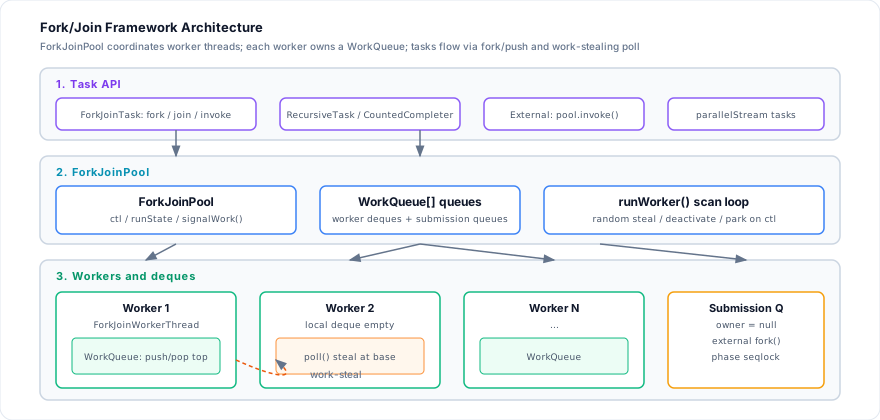
At the highest level, three layers cooperate:
| Layer | Role |
|---|---|
| Task API | ForkJoinTask subclasses (RecursiveTask, CountedCompleter, …) express recursive work via fork(), join(), and invoke() |
| ForkJoinPool | Owns WorkQueue[], tracks worker lifecycle in ctl, wakes or parks threads via signalWork() / runWorker() |
| Workers | Each ForkJoinWorkerThread has one deque; owners push/pop at top, idle workers steal from other queues at base |
External callers (non-FJ threads) submit through shared submission queues (owner == null); workers inside the pool push onto their own deque.
1.1 Programming model
Fork/join fits computations that are:
- Recursive — large tasks split into smaller subtasks until a base-case granularity is reached
- DAG-structured — completion dependencies are acyclic (
joinwaits only on tasks you forked) - Mostly non-blocking — workers should not block on I/O or locks; on
join()they run other available tasks instead of idling; unavoidable blocking usesForkJoinPool.ManagedBlocker(§4.3)
ForkJoinTask javadoc recommends a rough granularity of 100–10,000 basic steps per leaf task. Too large → poor parallelism; too small → queue and task allocation overhead dominates.
Starting a computation
| Goal | External caller (not in pool) | Inside an existing FJ computation |
|---|---|---|
| Run async | pool.execute(task) | task.fork() |
| Run and get result | pool.invoke(task) | task.invoke() |
Submit as Future | pool.submit(task) | task.fork() (tasks are Futures) |
invoke() is equivalent to fork(); join() but runs exec() on the current thread first before waiting:
// ForkJoinTask.java
public final V invoke() {
    doExec();
    return join();
}

final void doExec() {
    if (status >= 0) {
        boolean completed = false;
        try {
            completed = exec();   // subclass body
        } catch (Throwable rex) {
            trySetException(rex);
        }
        if (completed)
            setDone();
    }
}
fork() pushes the task onto a work queue — the current worker’s deque if the caller is a ForkJoinWorkerThread, otherwise the pool’s external submission queue (typically ForkJoinPool.commonPool()):
public final ForkJoinTask<V> fork() {
    // ...
    if (internal = (t = Thread.currentThread()) instanceof ForkJoinWorkerThread)
        q = wt.workQueue;
    else
        q = ForkJoinPool.common.externalSubmissionQueue(false);
    q.push(this, p, internal);
    return this;
}
2. Work-stealing
Each worker owns one WorkQueue — a circular deque with base (steal end) and top (owner end). OpenJDK CASes slots rather than indices so stolen entries are nulled for GC.
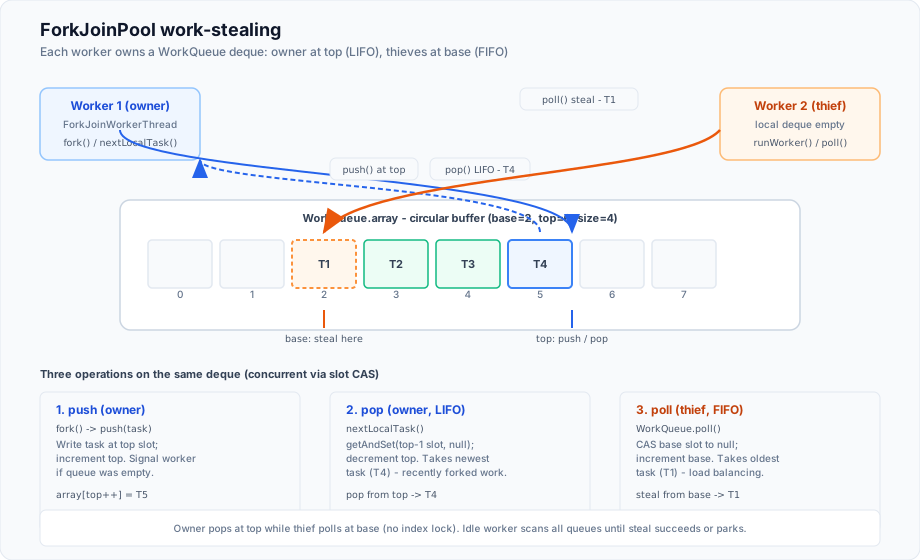
Owner push/pop at top (LIFO) — depth-first on recently forked work. Thief poll at base (FIFO) — oldest task for load balance. Both can run concurrently on the same deque via per-slot CAS.
2.1 Owner operations: push and pop
Push (owner or locked external caller) — no CAS on indices; owner-only:
// WorkQueue.push()
top = s + 1;
array[s & (cap - 1)] = task;   // internal: getAndSetReference (fenced)
if (room == 0) growArray(...);
if (queue was empty) pool.signalWork();
Pop (owner, default LIFO) — getAndSet slot to null, then decrement top:
// WorkQueue.nextLocalTask(fifo=0) — pop path
t = getAndSetReference(array, slotOffset((top - 1) & mask), null);
if (t != null) updateTop(top - 1);
LIFO pop keeps recently forked siblings on the same worker — depth-first, cache-friendly for recursive fork/join.
Local poll (owner, async/FIFO mode) — reads from base like a stealer, but without cross-thread contention:
// fifo != 0 path in nextLocalTask()
t = getAndSetReference(array, slotOffset(base & mask), null);
if (t != null) updateBase(base + 1);
2.2 Steal: poll from another queue
Only non-owners call poll(). Steal from base (FIFO — oldest task), CAS slot to null, then increment base:
// WorkQueue.poll() — simplified
t = getReferenceAcquire(array, slotOffset(base & mask));
if (t != null && compareAndSetReference(array, slot, t, null)) {
    updateBase(base + 1);
    return t;
}
// on null slot: spin (onSpinWait) if base stalled; retry or give up
Slot-based CAS lets owner pop and thief poll concurrent on the same deque without locking indices. Failed CAS or stall → thief tries another queue (bounded retries).
2.3 Task acquisition and execution
The same pool uses different acquire-and-run paths depending on who submits the work and whether the thread is already a worker. Two execution modes recur:
| Mode | Pattern | Used when |
|---|---|---|
| Burst | topLevelExec(task) → doExec() then nextLocalTask() until local deque empty | Worker’s main loop after scan-stealing |
| Single | one doExec() per acquired task | join() helping, external untracked polls |
| Inline | doExec() on the current thread, no queue | invoke(), invokeAll() |
// WorkQueue.topLevelExec() — burst mode
while (task != null) {
    task.doExec();              // may fork() subtasks onto this worker's deque
    task = nextLocalTask(fifo); // pop local work (LIFO at top) until empty
}
Entry points
| Entry | Thread | Acquire | Execute |
|---|---|---|---|
runWorker (idle worker) | FJ worker | Scan all queues; CAS-steal one task from q.base (pseudo-random order) | topLevelExec(stolen) |
fork() | FJ worker | push() onto own deque at top; not run yet | Picked up by caller’s topLevelExec / helpJoin / helpComplete via nextLocalTask() or targeted scan |
invoke() | FJ worker | doExec() inline first (no queue); unfinished work via join() | join() → helpJoin or helpComplete (single doExec per stolen task) |
join() on child | FJ worker | tryRemoveAndExec on local deque; then scan for tasks in the target’s steal chain | Single doExec() per helping steal — not topLevelExec |
join() on CountedCompleter | FJ worker | Pop downstream CountedCompleters from own top; then scan pool for eligible completers | Single doExec() per helping steal |
pool.execute() / external fork() | Non-FJ | push() onto submission queue (owner == null); signalWork() | Idle worker scan-steals → topLevelExec |
pool.invoke() | Non-FJ | Same submit as execute(); caller join() blocks on Aux after limited external help | Worker runs task via scan → topLevelExec; caller waits |
Worker idle loop (runWorker)
When a worker has no local work, it scans every queue (worker deques and submission queues) and CAS-steals from base:
// runWorker() — simplified
for (;;) {
    // local deque empty (drained by previous topLevelExec)
    scan all queues in pseudo-random order:
        CAS-steal one task from q.base
        if stolen:
            topLevelExec(task);   // burst: run + drain all local forks
            break scan              // re-poll same queue (temporal locality)
    if nothing stolen → deactivate(w);   // park on ctl waiter stack
}
The scan runs only when the local deque is empty — topLevelExec drained it on the previous iteration. That is why the loop looks like “steal first, clear local second”: local clearing is inside the burst after each steal, not as a separate pre-scan step. Depth-first behavior comes from fork() pushing onto the executing worker’s deque and nextLocalTask() popping before the next scan.
fork() vs invoke() inside a worker
// fork() — queue for later
q.push(this, pool, internal);   // own deque at top

// invoke() — run now, then wait
doExec();    // exec() on current thread first
return join();  // helpJoin / helpComplete if still incomplete
A common divide-and-conquer pattern forks one child and compute()s the other inline — equivalent to invoke() on one side without queueing it:
left.fork();
long right = new RightTask(...).compute();  // inline doExec path
return right + left.join();
join() helping (not the main loop)
When a worker blocks on join(), it must not idle. awaitDone() dispatches to helpJoin (plain tasks) or helpComplete (CountedCompleters). Each helping steal runs one doExec() — the waiter targets work that might unblock its join target, rather than draining its full local deque in burst mode.
External callers joining from a non-FJ thread get limited helping via pollScan(); if the target is still running elsewhere, they park on the task’s Aux list and the pool may compensate with a spare worker.
signalWork() wakes idle workers or starts new ones when a push makes a previously empty queue non-empty.
2.4 External submission queues
Tasks from non-FJ threads (pool.execute, fork() outside a worker) go to shared submission queues (owner == null), selected by ThreadLocalRandom probe. External push/pop require phase seqlock (tryLockPhase / unlockPhase) because submitters and workers contend. After push, signalWork() starts scanning.
| Queue type | owner | push/pop | steal |
|---|---|---|---|
| Worker deque | ForkJoinWorkerThread | owner only, no lock | any worker via poll() |
| Submission queue | null | seqlock | workers scan same way |
3. ForkJoinTask
Application code rarely subclasses ForkJoinTask directly. Three abstract styles cover most use cases:
@startuml
interface "Future<V>" as Future

abstract class "ForkJoinTask<V>" as FJT implements Future {
    - volatile int status
    - volatile Aux aux
    + fork()
    + join()
    + invoke()
    # exec()
    # getRawResult()
    # setRawResult(V)
}

class "Aux" as Aux {
    Thread thread
    Throwable ex
    Aux next
}

abstract class "RecursiveAction" as RA {
    # compute()
}

abstract class "RecursiveTask<V>" as RT {
    - V result
    # compute()
    # getRawResult()
}

abstract class "CountedCompleter<T>" as CC {
    - volatile int pending
    - CountedCompleter<?> completer
    + compute()
    + tryComplete()
    + onCompletion(CountedCompleter)
    # exec() → compute()
}

class "ForkJoinPool" as FJP {
    + {static} commonPool()
    - WorkQueue[] queues
    - volatile long ctl
    - volatile long runState
    - int parallelism
    + invoke(ForkJoinTask)
    + execute(ForkJoinTask)
}

class "ForkJoinWorkerThread" as FJWT {
    - ForkJoinPool pool
    - WorkQueue workQueue
}

class "WorkQueue" as WQ {
    ForkJoinWorkerThread owner
    ForkJoinTask<?>[] array
    int base
    int top
    volatile int phase
    + push(task, pool, internal)
    + nextLocalTask()
    + poll(pool)
}

FJT *-- Aux
FJT <|-- RA
FJT <|-- RT
FJT <|-- CC

FJP o-- WQ
FJWT o-- WQ
FJWT --> FJP : runs in
@enduml
| Base class | Returns result | Completion model |
|---|---|---|
RecursiveAction | Void | fork / join on children; exec() calls compute() and returns true |
RecursiveTask<V> | V via result field | Same split/join pattern as RecursiveAction |
CountedCompleter<T> | Optional via getRawResult() | Completion-driven: tryComplete() decrements pending count; onCompletion() merges when count hits zero |
3.1 Example: RecursiveTask
Classic divide-and-conquer — fork one half, compute the other on the current thread, then join():
class SumTask extends RecursiveTask<Long> {
    static final int THRESHOLD = 10_000;
    final int[] array;
    final int from, to;

    protected Long compute() {
        int len = to - from;
        if (len <= THRESHOLD) {
            long sum = 0;
            for (int i = from; i < to; i++) sum += array[i];
            return sum;
        }
        int mid = from + len / 2;
        SumTask left = new SumTask(array, from, mid);
        left.fork();
        long rightSum = new SumTask(array, mid, to).compute();
        return rightSum + left.join();
    }
}

long total = ForkJoinPool.commonPool().invoke(new SumTask(array, 0, array.length));
3.2 CountedCompleter
RecursiveTask (§3.1) coordinates children with fork() + join(). CountedCompleter uses a pending counter and a completer chain instead: children call tryComplete() when done; the parent runs onCompletion() when the counter is exhausted. There is no join() on individual children — only the root blocks, via invoke().
CountedCompleter overrides exec() to call compute() and return false (completion is signaled via tryComplete, not by returning from exec):
@Override
protected final boolean exec() {
    compute();
    return false;
}
Parallel Stream terminal ops use this style: AbstractTask extends CountedCompleter and splits a Spliterator in compute(), merging partial sinks in onCompletion().
Pending count
tryComplete() either decrements pending or, if already zero, runs onCompletion() and propagates to the completer:
public final void tryComplete() {
    CountedCompleter<?> a = this, s = a;
    for (int c;;) {
        if ((c = a.pending) == 0) {
            a.onCompletion(s);
            if ((a = (s = a).completer) == null) {
                s.quietlyComplete();
                return;
            }
        }
        else if (a.weakCompareAndSetPendingCount(c, c - 1))
            return;
    }
}
pending counts completion signals, not active children. Each task’s terminal tryComplete() in compute() consumes one signal. With two forks, setPendingCount(2) yields:
| Step | Source | Root pending |
|---|---|---|
| 1 | Root tryComplete() after fork | 2 → 1 |
| 2 | First child propagates | 1 → 0 (onCompletion deferred) |
| 3 | Second child propagates | 0 → onCompletion() |
Result retrieval: invoke() runs root compute(), then join() returns getRawResult(). Internal nodes store partial state merged in onCompletion(); only the root is joined.
Example: parallel array sum
Two-child fork with setPendingCount(2):
class SumTask extends CountedCompleter<Long> {
    static final int THRESHOLD = 10_000;
    final int[] array;
    final int lo, hi;
    long sum;
    SumTask leftChild, rightChild;

    SumTask(int[] array, int lo, int hi) {
        super(null);
        this.array = array; this.lo = lo; this.hi = hi;
    }

    SumTask(SumTask parent, int lo, int hi) {
        super(parent);
        this.array = parent.array;
        this.lo = lo; this.hi = hi;
    }

    @Override
    public void compute() {
        if (hi - lo > THRESHOLD) {
            int mid = (lo + hi) >>> 1;
            setPendingCount(2);
            leftChild = new SumTask(this, lo, mid);
            rightChild = new SumTask(this, mid, hi);
            leftChild.fork();
            rightChild.fork();
        } else {
            for (int i = lo; i < hi; i++)
                sum += array[i];
        }
        tryComplete();
    }

    @Override
    public void onCompletion(CountedCompleter<?> caller) {
        sum = leftChild.sum + rightChild.sum;
    }

    @Override
    public Long getRawResult() {
        return sum;
    }
}

long total = new SumTask(array, 0, array.length).invoke();
Tail-call style (parallel stream)
Stream parallel tasks (AbstractTask / ReduceTask): setPendingCount(1), fork one child, task = inline child — only leaves run doLeaf() + tryComplete(). Internal nodes complete via onCompletion() when both children finish.
// AbstractTask.compute()
while (sizeEstimate > sizeThreshold && (ls = rs.trySplit()) != null) {
    task.leftChild  = leftChild  = task.makeChild(ls);
    task.rightChild = rightChild = task.makeChild(rs);
    task.setPendingCount(1);
    taskToFork.fork();
    task = inlineChild;
    sizeEstimate = rs.estimateSize();
}
task.setLocalResult(task.doLeaf());
task.tryComplete();

// ReduceTask
protected S doLeaf() {
    return helper.wrapAndCopyInto(op.makeSink(), spliterator);
}
public void onCompletion(CountedCompleter<?> caller) {
    if (!isLeaf()) {
        S r = leftChild.getLocalResult();
        r.combine(rightChild.getLocalResult());
        setLocalResult(r);
    }
}
return new ReduceTask<>(this, helper, spliterator).invoke().get();
Example: array.length = 4, sizeThreshold = 1 (production uses getTargetSize() ≈ estimateSize / (parallelism × 4)).
flowchart TB
    R["[0,4) root"]
    A["[0,2) forked"]
    B["[2,4) internal\nno self tryComplete"]
    C["[0,1) forked"]
    D["[1,2) leaf"]
    E["[2,3) leaf"]
    F["[3,4) forked → leaf"]

    R --> A
    R --> B
    A --> C
    A --> D
    B --> E
    B --> F

    L0["leaf a[0]"]
    L1["leaf a[1]"]
    L2["leaf a[2]"]
    L3["leaf a[3]"]

    C --> L0
    D --> L1
    E --> L2
    F --> L3
Completion order (new ReduceTask(...).invoke().get()):
| Step | State |
|---|---|
| 1 | Leaves [0,1) [1,2) [2,3) [3,4) each doLeaf() + tryComplete() |
| 2 | [0,2) ← merge [0,1)+[1,2); [2,4) ← merge [2,3)+[3,4) |
| 3 | Root [0,4) ← merge [0,2)+[2,4) |
| 4 | invoke().get() → final result |
4. Pool scheduling and control
4.1 Worker scheduling and join
Workers loop: run a local task → try to steal → if idle, park on the pool’s waiter stack (ctl lower bits).
Join without blocking the pool
When a worker calls join() on an incomplete task, it must not stall the pool — other tasks may depend on progress. awaitDone() first tries helping:
private int awaitDone(boolean interruptible, long deadline) {
    // ...
    return (((s = (p == null) ? 0 :
              ((this instanceof CountedCompleter) ?
               p.helpComplete(this, q, internal) :
               !internal && ((ss = status) & NO_USER_HELP) != 0 ? ss :
               p.helpJoin(this, q, internal))) < 0)) ? s :
        awaitDone(internal ? p : null, s, interruptible, deadline);
}
helpJoin— worker runs other tasks from its deque or steals until the target task’sstatusbecomes negative (done)helpComplete— used forCountedCompleter; runs tasks known to be downstream of the waited-on completer- If helping exhausts available work and the target is still running elsewhere, the waiter registers in the task’s
Auxlinked list and parks onLockSupportuntilsetDone()signals it
External callers joining from a non-FJ thread may block on Aux after limited helping; the pool may compensate by temporarily adding a worker so parallelism is preserved.
Task status
ForkJoinTask.status is a single volatile int encoding completion (no separate “running” bit):
| Bits | Meaning |
|---|---|
| upper (sign) | DONE — task finished |
ABNORMAL | cancelled or exceptional |
THROWN | exception stored in aux |
| lower 16 | optional user tag (setForkJoinTaskTag) |
join() spins/helps while status >= 0, then returns getRawResult() or throws via reportException().
4.2 Pool control: ctl and runState
ForkJoinPool packs worker lifecycle into one volatile long ctl (four 16-bit subfields):
RC (bits 48–63): released workers — scanning but not queued on waiter stack
TC (bits 32–47): total workers
SS (bits 16–31): version / status of top waiting worker
ID (bits  0–15): poolIndex of top of Treiber stack of idle waiters
When sp = (int) ctl is non-zero, idle workers are stacked waiting for work. RC can be incremented with getAndAdd(RC_UNIT) when a blocked join ends — cheaper than CAS for that path. Multi-field updates use CAS.
runState is a separate versioned counter with lock bit RS_LOCK:
| Bit | Meaning |
|---|---|
STOP | pool terminating |
SHUTDOWN | terminate when quiescent |
CLEANED | queues cleared |
TERMINATED | fully stopped |
The pool dynamically adds, parks, or resumes workers to keep active threads near parallelism (default: Runtime.getRuntime().availableProcessors()). Spare threads beyond target parallelism are capped (default max spares: 256, via system property).
Common pool
ForkJoinPool.commonPool() is shared by:
ForkJoinTask.fork()/invoke()from non-FJ threadsCollection.parallelStream()andStream.parallel()
Common-pool threads are daemon threads, slowly reclaimed when idle and recreated on demand. Tuning via system properties:
java.util.concurrent.ForkJoinPool.common.parallelismjava.util.concurrent.ForkJoinPool.common.threadFactoryjava.util.concurrent.ForkJoinPool.common.exceptionHandlerjava.util.concurrent.ForkJoinPool.common.maximumSpares
4.3 ManagedBlocker
A ForkJoinWorkerThread that parks on a lock, condition, or I/O does not execute tasks from its deque and does not participate in join helping. If enough workers block simultaneously, effective parallelism falls below the pool’s target and the computation may stall. ForkJoinPool.ManagedBlocker is the supported extension for blocking inside a fork/join computation: the pool may compensate by activating a spare worker before the current thread enters block().
Interface contract
public static interface ManagedBlocker {
    boolean isReleasable();              // true if blocking is unnecessary
    boolean block() throws InterruptedException;  // block if needed; true when done
}
ForkJoinPool.managedBlock(ManagedBlocker blocker) repeatedly evaluates the blocker until completion:
- Call
isReleasable()— iftrue, exit (no block required). - Otherwise call
block()— which must be preceded by anisReleasable()that returnedfalse. - Exit when either method returns
true.
isReleasable() must be idempotent and cheap to retry — it may be invoked many times before block() runs. Implementations typically combine a non-blocking probe (tryLock, poll) with the condition that motivated blocking.
Unlike join(), managed blocking does not run arbitrary stolen tasks while waiting. Compensation (below) is the sole mechanism for preserving parallelism.
Compensation path
When the caller is a ForkJoinWorkerThread, managedBlock delegates to compensatedBlock:
public static void managedBlock(ManagedBlocker blocker) throws InterruptedException {
    if (t instanceof ForkJoinWorkerThread && (p = wt.pool) != null)
        p.compensatedBlock(blocker);
    else
        unmanagedBlock(blocker);   // plain spin/block loop, no compensation
}

private void compensatedBlock(ManagedBlocker blocker) throws InterruptedException {
    for (;;) {
        if (blocker.isReleasable()) break;
        if ((comp = tryCompensate(ctl)) >= 0) {
            try {
                done = blocker.block();
            } finally {
                if (comp > 0) getAndAddCtl(RC_UNIT);  // release compensation slot
            }
            if (done) break;
        }
    }
}
tryCompensate adjusts ctl to create or wake a spare worker so that, while the current worker is blocked in block(), the pool retains approximately parallelism active (unblocked) threads. After block() returns, the compensation count is restored in finally. If compensation cannot be obtained (pool at limits or terminating), the loop retries isReleasable() before attempting again.
For blocking code whose necessity cannot be determined statically, the pool also exposes explicit bookkeeping:
long post = pool.beginCompensatedBlock();  // tryCompensate; returns RC_UNIT or 0
try {
    // unknown blocking operation
} finally {
    pool.endCompensatedBlock(post);
}
External threads (not ForkJoinWorkerThread) invoke unmanagedBlock — a simple loop without compensation:
do {} while (!blocker.isReleasable() && !blocker.block());
Example: blocking queue take
The ForkJoinPool Javadoc pattern wraps a BlockingQueue.take():
class QueueTaker<E> implements ManagedBlocker {
    final BlockingQueue<E> queue;
    volatile E item = null;

    public boolean isReleasable() {
        return item != null || (item = queue.poll()) != null;
    }
    public boolean block() throws InterruptedException {
        if (item == null)
            item = queue.take();
        return true;
    }
}

// inside a ForkJoinTask running on a worker:
QueueTaker<E> taker = new QueueTaker<>(queue);
ForkJoinPool.managedBlock(taker);
return taker.item;
isReleasable() permits a fast exit when an element is already available; block() performs the blocking take() only after compensation is arranged.
JDK usage
Several j.u.c. components implement ManagedBlocker so blocking on a ForkJoin worker does not silently consume a parallelism slot:
| Class | Role |
|---|---|
AbstractQueuedSynchronizer.ConditionNode | ConditionObject.await on a worker parks via managedBlock |
LinkedTransferQueue.DualNode | SynchronousQueue / transfer-queue waits on FJ workers |
CompletableFuture.Signaller | async completion waits without starving the common pool |
Phaser.QNode | phase barrier wait |
SubmissionPublisher.BufferedSubscription | back-pressure wait on reactive streams |
DualNode.block() on a ForkJoinWorkerThread delegates to ForkJoinPool.managedBlock(this) instead of raw LockSupport.park, linking transfer-queue blocking to the compensation protocol.
Relation to join() compensation
Both join() external waiters and ManagedBlocker can trigger tryCompensate, but through different paths:
| Mechanism | While waiting | Parallelism preservation |
|---|---|---|
join() (FJ worker) | helpJoin / helpComplete — runs other tasks | helping first; Aux park + compensation if target runs elsewhere |
ManagedBlocker | only block() | compensation before block(); no helping |
ForkJoinTask javadoc requires ManagedBlocker (or a bounded number of blocked tasks) when fork/join tasks block on external synchronization — otherwise the pool cannot guarantee progress.
5. Design trade-offs
Strengths
- Near-linear speedup on CPU-bound, recursively decomposable work
- Very low task creation cost compared to
Thread - Join helping keeps workers busy without thread explosion
Constraints (from ForkJoinTask / ForkJoinPool contracts)
- Avoid blocking I/O and heavy synchronization inside
compute(); useForkJoinPool.managedBlock(ManagedBlocker)when blocking is unavoidable (§4.3) - Cyclic join dependencies deadlock — structure work as a DAG
CountedCompleterfits completion-tree merges (streams, async pipelines) better than naivejoinwhen subtasks vary widely in duration- External blocking joins may reduce effective parallelism unless the pool compensates
For parallel stream internals built on this framework, see Java Stream internals.