
Apache Flink internals - client job submission
Apache Flink is a distributed engine for continuous (and bounded) dataflow programs. A job is a graph of operators; the runtime places parallel tasks on TaskManagers, keeps operator state local to those tasks, and advances time with watermarks so windows and timers close at well-defined points.
1. Overview
Apache Flink is a distributed engine for continuous (and bounded) dataflow programs. A job is a graph of operators. The runtime places parallel tasks on workers, keeps operator state local to those tasks, and advances event time with watermarks so windows and timers close at well-defined points.
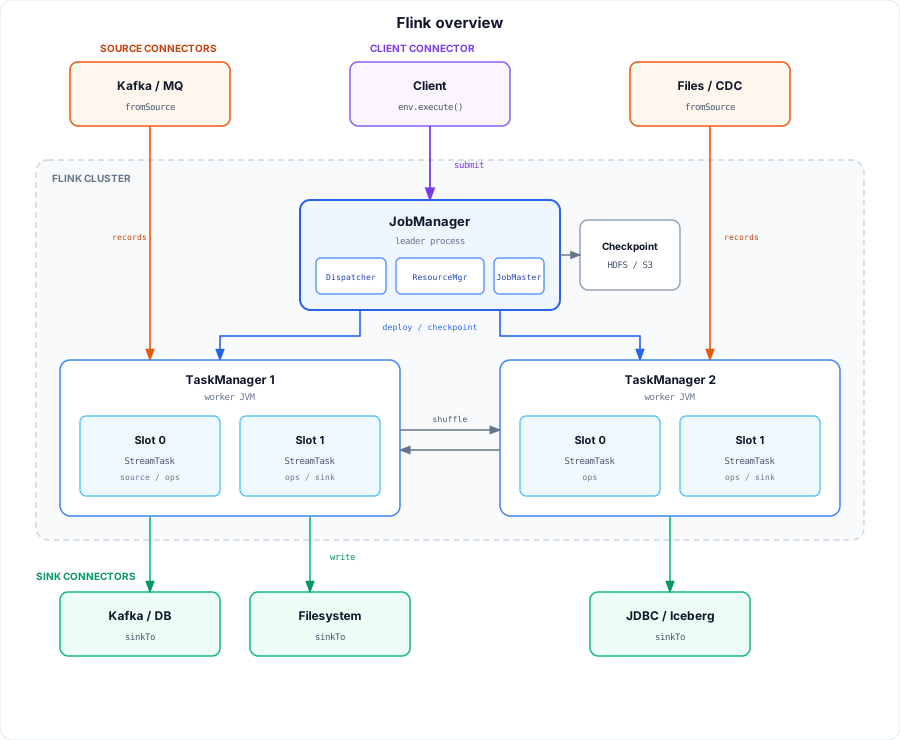
Default execution is streaming: records flow continuously and checkpoints snapshot state for recovery. The same operators can run in batch style (RuntimeExecutionMode.BATCH) when every input is bounded. Parallelism is per operator (or a job default): a logical operator with parallelism p becomes p subtasks that share no mutable state. Keyed state is partitioned by key group so rescale can move groups without rewriting every key.
Usage example
You build a pipeline with the DataStream API (StreamExecutionEnvironment) or the Table / SQL API—sources in, transforms, sinks out—then call execute (or submit a JAR) so the cluster runs the job until it is cancelled, fails past recovery, or finishes when all bounded inputs end. A typical job:
StreamExecutionEnvironment env = StreamExecutionEnvironment.getExecutionEnvironment();
env.enableCheckpointing(10_000);

env.fromSource(ordersSource, watermarkStrategy, "orders")
    .map(new ParseOrder())
    .keyBy(Order::getUserId)
    .window(TumblingEventTimeWindows.of(Duration.ofMinutes(1)))
    .aggregate(new CountPerUser())
    .sinkTo(kafkaSink);

env.execute("orders-per-minute");
Here Kafka (or another connector) is the source, keyed windows hold per-user counts in operator state, and another connector is the sink.
Cluster roles
That job is scheduled onto a Flink cluster with two process roles:
| Role | Responsibility |
|---|---|
| JobManager | Accepts jobs, builds the scheduling plan, coordinates checkpoints, recovers failures |
| TaskManager | Hosts task slots; runs one or more subtasks; holds keyed/operator state locally |
One JobManager is the leader for a given high-availability setup. The client submits to the JobManager. TaskManagers register slots with the ResourceManager; the JobMaster claims slots and deploys tasks into them. Source and sink connectors run inside those tasks—the JobManager never sees individual records. When operators repartition (for example after keyBy), TaskManagers exchange records over pipelined network buffers (shuffle). Checkpoints are triggered by the JobManager and acknowledged by the tasks.
2. Client job submission
User code does not schedule tasks. On the client, Flink records the pipeline and submits that plan:
- API
Transformations — each DataStream call appends a node to a list on the environment. StreamGraph—StreamGraphGeneratorturns that list intoStreamNode/StreamEdge(partitioners, exchange mode).- Submit — a
PipelineExecutorhands theStreamGraph(ExecutionPlan) to aClusterClient.RestClusterClientwrites that graph and uploads it. It does not build aJobGraph. - StreamGraph serialization — the plan is Java-serialized once, with the user JARs alongside. Records and state use Flink’s own
TypeSerializers, which the client fixes per stream while building the graph and ships inside it.
JobGraph compilation, the ExecutionGraph, and task deployment run on the cluster. That path is JobManager.
The stages below reuse the §1 orders-per-minute example, up to the graph the client actually sends:
API:     orders -> ParseOrder -> keyBy(userId) -> window -> aggregate -> kafkaSink
Stream:  [orders] --fwd--> [ParseOrder] --hash--> [window+agg] --fwd--> [kafkaSink]
2.1 StreamGraph generation
Building a StreamGraph is a two-phase procedure on the client. User code first accumulates API metadata; only an explicit getStreamGraph / execute turns that metadata into a graph. Nothing processes records yet—operator factories create runtime StreamOperators later, when tasks deploy on workers.
Procedures:
- API call (§2.1.1) — each
fromSource/map/keyBy/ … returns aDataStream(or related) handle and appends aTransformationtoStreamExecutionEnvironment’s list. - StreamGraph translation (§2.1.2) —
getStreamGraph/executehands that list toStreamGraphGenerator, which dispatches eachTransformationto aTransformationTranslatorthat writesStreamNodes /StreamEdges (fwd,hash, …).
2.1.1 API call
When user code writes a DataStream job, each call like fromSource, map, or keyBy looks like it builds a pipeline—but at this stage Flink only records what was requested. Every call returns a DataStream (or a close relative such as KeyedStream) for further chaining, and behind the scenes it adds a Transformation to a list on StreamExecutionEnvironment. That list is the real program so far; the DataStream objects are just convenient handles. No tasks run and no records move until the code later asks for a graph or calls execute.
@startuml

class StreamExecutionEnvironment {
  - transformations : List
  - parallelism : int
  + fromSource(Source, WatermarkStrategy, String) : DataStreamSource
  + addOperator(Transformation) : void
  + getParallelism() : int
  + getStreamGraph() : StreamGraph
}

class DataStream {
  # environment : StreamExecutionEnvironment
  # transformation : Transformation
  + getExecutionEnvironment() : StreamExecutionEnvironment
  + getTransformation() : Transformation
  + map(MapFunction) : SingleOutputStreamOperator
  + keyBy(KeySelector) : KeyedStream
  + transform(String, TypeInformation, StreamOperatorFactory) : SingleOutputStreamOperator
  + sinkTo(Sink) : DataStreamSink
}

class SingleOutputStreamOperator {
  + name(String) : SingleOutputStreamOperator
  + uid(String) : SingleOutputStreamOperator
  + setParallelism(int) : SingleOutputStreamOperator
}

class DataStreamSource

class KeyedStream {
  - keySelector : KeySelector
  - keyType : TypeInformation
  + window(WindowAssigner) : WindowedStream
  + reduce(ReduceFunction) : SingleOutputStreamOperator
}

class WindowedStream {
  - input : KeyedStream
  - windowAssigner : WindowAssigner
  + aggregate(AggregateFunction) : SingleOutputStreamOperator
  + reduce(ReduceFunction) : SingleOutputStreamOperator
}

class Transformation {
  # id : int
  # name : String
  # uid : String
  # parallelism : int
  # outputType : TypeInformation
  + getId() : int
  + getName() : String
  + getInputs() : List
  + getOutputType() : TypeInformation
  + getParallelism() : int
}

class OneInputTransformation {
  - input : Transformation
  - operatorFactory : StreamOperatorFactory
  + getOperatorFactory() : StreamOperatorFactory
  + getInputs() : List
}

class PartitionTransformation {
  - partitioner : StreamPartitioner
  - exchangeMode : StreamExchangeMode
  + getPartitioner() : StreamPartitioner
  + getExchangeMode() : StreamExchangeMode
  + getInputs() : List
}

class ReduceTransformation {
  - input : Transformation
  - reducer : ReduceFunction
  - keySelector : KeySelector
  - keyTypeInfo : TypeInformation
  + getReducer() : ReduceFunction
  + getKeySelector() : KeySelector
  + getInputs() : List
}

DataStream <|-- SingleOutputStreamOperator
DataStream <|-- KeyedStream
SingleOutputStreamOperator <|-- DataStreamSource

WindowedStream --> KeyedStream : holds

StreamExecutionEnvironment --> DataStream : fromSource / transforms
StreamExecutionEnvironment --> Transformation : owns list
DataStream --> Transformation : wraps
Transformation <|-- OneInputTransformation
Transformation <|-- PartitionTransformation
Transformation <|-- ReduceTransformation
KeyedStream ..> ReduceTransformation : reduce
@enduml
// DataStream.map: create a Transformation and register it on the env (no task yet)
public <R> SingleOutputStreamOperator<R> map(MapFunction<T, R> mapper) {
    return transform(
        "Map",
        getType().getTypeClass() /* simplified */,
        new OneInputTransformation<>(
            this.transformation,
            "Map",
            new MapOperatorFactory<>(mapper),
            TypeExtractor.getMapReturnTypes(mapper, getType()),
            parallelism));
}

protected <R> SingleOutputStreamOperator<R> transform(
        String operatorName,
        TypeInformation<R> outTypeInfo,
        OneInputTransformation<T, R> transformation) {
    // registers on StreamExecutionEnvironment.transformations
    getExecutionEnvironment().addOperator(transformation);
    return new SingleOutputStreamOperator<>(getExecutionEnvironment(), transformation);
}
For orders-per-minute, after the fluent chain the environment’s list holds transforms for orders, ParseOrder, keyBy(userId), window+aggregate, and kafkaSink—still only metadata.
2.1.2 StreamGraph translation
When user code calls execute (or getStreamGraph), the client turns the environment’s Transformation list into a StreamGraph. StreamGraphGenerator does not hard-code per-type instanceof logic for the common operators; it looks up a TransformationTranslator in translatorMap and delegates with a TransformationTranslator.Context (ContextImpl) that exposes the in-progress StreamGraph, already-translated parent node ids, and recursive transform(...). Each translator writes StreamNodes / StreamEdges (or a virtual partition node for keyBy) into the graph. Runtime StreamOperator instances are still not created here; factories on the nodes create them later when tasks deploy on workers.
@startuml

class StreamExecutionEnvironment {
  - transformations : List
  + getStreamGraph() : StreamGraph
  + execute(String) : JobClient
}

class StreamGraphGenerator {
  - transformations : List
  - translatorMap : Map
  + generate() : StreamGraph
  - transform(Transformation) : Collection
}

interface TransformationTranslator {
  + translateForStreaming(Transformation, Context) : Collection
  + translateForBatch(Transformation, Context) : Collection
}

interface "TransformationTranslator.Context" as Context {
  + getStreamGraph() : StreamGraph
  + getStreamNodeIds(Transformation) : Collection
  + getSlotSharingGroup() : String
  + transform(Transformation) : Collection
}

class ContextImpl {
  - streamGraphGenerator : StreamGraphGenerator
  - streamGraph : StreamGraph
  - slotSharingGroup : String
}

interface Pipeline

interface ExecutionPlan {
  + getJobID() : JobID
  + getName() : String
  + getJobType() : JobType
}

class StreamGraph {
  - streamNodes : Map
  - sources : Set
  - sinks : Set
  - virtualPartitionNodes : Map
  - virtualSideOutputNodes : Map
  + addOperator(int, String, StreamOperatorFactory, int) : void
  + addEdge(int, int, StreamPartitioner, StreamExchangeMode) : void
  + addVirtualPartitionNode(int, int, StreamPartitioner, StreamExchangeMode) : void
  + getSourceIDs() : Collection
  + getSinkIDs() : Collection
  + getJobGraph() : JobGraph
}

class StreamNode {
  - id : int
  - operatorName : String
  - parallelism : int
  - operatorFactory : StreamOperatorFactory
  - inEdges : List
  - outEdges : List
  - statePartitioners : KeySelector[]
  - stateKeySerializer : TypeSerializer
  + getOperatorFactory() : StreamOperatorFactory
  + getInEdges() : List
  + getOutEdges() : List
  + getStatePartitioners() : KeySelector[]
  + setStatePartitioners(KeySelector...) : void
}

interface StreamOperatorFactory {
  + createStreamOperator(Context) : StreamOperator
  + getStreamOperatorClass(ClassLoader) : Class
}

class SourceOperatorFactory
class SimpleOperatorFactory {
  - operator : StreamOperator
}
class SimpleUdfStreamOperatorFactory
class WindowOperatorFactory {
  - windowAssigner : WindowAssigner
  - trigger : Trigger
  - windowFunction : InternalWindowFunction
  - keySelector : KeySelector
}
class SinkWriterOperatorFactory

class StreamOperator
class StreamMap
class WindowOperator

class StreamEdge {
  - sourceId : int
  - targetId : int
  - partitioner : StreamPartitioner
  - exchangeMode : StreamExchangeMode
}

StreamExecutionEnvironment ..> StreamGraphGenerator : getStreamGraph()
StreamGraphGenerator --> TransformationTranslator : translatorMap
StreamGraphGenerator ..> StreamGraph : generate
StreamGraphGenerator ..> ContextImpl : creates per transform
Context <|.. ContextImpl
ContextImpl --> StreamGraphGenerator
ContextImpl --> StreamGraph
TransformationTranslator ..> Context : translate*(..., context)
Pipeline <|.. StreamGraph
ExecutionPlan <|.. StreamGraph
StreamGraph --> StreamNode : streamNodes
StreamGraph --> StreamNode : sources / sinks
StreamNode --> StreamOperatorFactory : operatorFactory
StreamOperatorFactory <|.. SourceOperatorFactory
StreamOperatorFactory <|.. SimpleOperatorFactory
StreamOperatorFactory <|.. WindowOperatorFactory
StreamOperatorFactory <|.. SinkWriterOperatorFactory
SimpleOperatorFactory <|-- SimpleUdfStreamOperatorFactory
SimpleUdfStreamOperatorFactory --> StreamMap : ParseOrder
WindowOperatorFactory --> WindowOperator : window+aggregate
StreamOperator <|-- StreamMap
StreamOperator <|-- WindowOperator
StreamNode --> StreamEdge : inEdges / outEdges
@enduml
// Client entry: build StreamGraph, then continue toward JobGraph / cluster
public JobClient execute(String jobName) throws Exception {
    StreamGraph streamGraph = getStreamGraph(); // clears transformations by default
    streamGraph.setJobName(jobName);
    return execute(streamGraph);
}

public StreamGraph getStreamGraph() {
    return getStreamGraph(true);
}

public StreamGraph getStreamGraph(boolean clearTransformations) {
    StreamGraph graph = new StreamGraphGenerator(transformations, /* config */).generate();
    if (clearTransformations) {
        transformations.clear();
    }
    return graph;
}

// StreamGraphGenerator: recurse from sinks, dispatch by Transformation class
private Collection<Integer> transform(Transformation<?> transform) {
    if (alreadyTransformed.containsKey(transform)) {
        return alreadyTransformed.get(transform);
    }
    TransformationTranslator<?, Transformation<?>> translator =
        translatorMap.get(transform.getClass());
    // e.g. OneInputTransformation -> OneInputTransformationTranslator
    //      PartitionTransformation -> PartitionTransformationTranslator
    Collection<Integer> ids = shouldExecuteInBatchMode
        ? translator.translateForBatch(transform, context)
        : translator.translateForStreaming(transform, context);
    alreadyTransformed.put(transform, ids);
    return ids;
}

// translatorMap (excerpt for orders-per-minute)
translatorMap.put(SourceTransformation.class, new SourceTransformationTranslator<>());
translatorMap.put(OneInputTransformation.class, new OneInputTransformationTranslator<>());
translatorMap.put(PartitionTransformation.class, new PartitionTransformationTranslator<>());
translatorMap.put(ReduceTransformation.class, new ReduceTransformationTranslator<>());
translatorMap.put(SinkTransformation.class, new SinkTransformationTranslator<>());
For orders-per-minute, translators produce this StreamGraph content:
Transformation                     Translator                              Graph effect
-------------------------------    ------------------------------------    ------------------------------------------
SourceTransformation(orders)       SourceTransformationTranslator          StreamNode orders
OneInputTransformation(ParseOrder) OneInputTransformationTranslator        StreamNode ParseOrder + fwd edge
PartitionTransformation(keyBy)     PartitionTransformationTranslator       virtual partition (no physical node)
OneInputTransformation(window+agg) OneInputTransformationTranslator        StreamNode window+aggregate + hash edge
SinkTransformation(kafkaSink)      SinkTransformationTranslator            StreamNode kafkaSink + fwd edge

StreamNodes:
  orders              SourceOperatorFactory
  ParseOrder          MapOperatorFactory
  window+aggregate    WindowOperatorFactory
  kafkaSink           SinkOperatorFactory

StreamEdges:
  orders           --fwd-->              ParseOrder
  ParseOrder       --hash(userId)-->     window+aggregate
  window+aggregate --fwd-->              kafkaSink
keyBy is handled by PartitionTransformationTranslator: it registers a virtual node so the downstream edge carries the hash partitioner—not a separate running operator.
2.2 Submit the StreamGraph
execute builds the StreamGraph, then a PipelineExecutor (chosen by execution.target) submits that object. Session and job executors obtain a ClusterClient and call submitJob(ExecutionPlan). RestClusterClient writes the StreamGraph to a temporary file and uploads it with the user jars. MiniClusterClient does the same hand-off into a local MiniCluster. Neither client compiles a JobGraph.
@startuml

interface Pipeline

class StreamGraph {
  - streamNodes : Map
  - sources : Set
  - sinks : Set
}

interface ExecutionPlan {
  + getJobID() : JobID
  + getName() : String
}

interface PipelineExecutor {
  + execute(Pipeline, Configuration, ClassLoader) : CompletableFuture
}

class LocalExecutor {
  - configuration : Configuration
  - miniClusterFactory : Function
  + execute(Pipeline, Configuration, ClassLoader) : CompletableFuture
}

abstract class AbstractSessionClusterExecutor {
  - clusterClientFactory : ClusterClientFactory
  - configuration : Configuration
  + execute(Pipeline, Configuration, ClassLoader) : CompletableFuture
}

class RemoteExecutor
class YarnSessionClusterExecutor
class KubernetesSessionClusterExecutor

abstract class AbstractJobClusterExecutor {
  - clusterClientFactory : ClusterClientFactory
  - configuration : Configuration
  + execute(Pipeline, Configuration, ClassLoader) : CompletableFuture
}

class YarnJobClusterExecutor

interface ClusterClient {
  + submitJob(ExecutionPlan) : CompletableFuture
  + getClusterId() : ClusterID
  + cancel(JobID) : CompletableFuture
}

class MiniClusterClient
class RestClusterClient

Pipeline <|.. StreamGraph
ExecutionPlan <|.. StreamGraph

PipelineExecutor <|.. LocalExecutor
PipelineExecutor <|.. AbstractSessionClusterExecutor
PipelineExecutor <|.. AbstractJobClusterExecutor

AbstractSessionClusterExecutor <|-- RemoteExecutor
AbstractSessionClusterExecutor <|-- YarnSessionClusterExecutor
AbstractSessionClusterExecutor <|-- KubernetesSessionClusterExecutor
AbstractJobClusterExecutor <|-- YarnJobClusterExecutor

ClusterClient <|.. MiniClusterClient
ClusterClient <|.. RestClusterClient

PipelineExecutor ..> StreamGraph : execute
LocalExecutor ..> MiniClusterClient : submitJob(StreamGraph)
RemoteExecutor ..> RestClusterClient : submitJob(StreamGraph)
YarnSessionClusterExecutor ..> RestClusterClient : submitJob(StreamGraph)
KubernetesSessionClusterExecutor ..> RestClusterClient : submitJob(StreamGraph)
YarnJobClusterExecutor ..> RestClusterClient : submitJob(StreamGraph)
RestClusterClient ..> StreamGraph : serialize ExecutionPlan
@enduml
// --- Step 1: user code / env.execute ---
public JobClient execute(String jobName) throws Exception {
    StreamGraph streamGraph = getStreamGraph();
    streamGraph.setJobName(jobName);
    return execute(streamGraph);
}

// --- Step 2: pick a PipelineExecutor (local / remote / yarn / k8s, …) ---
public JobClient executeAsync(StreamGraph streamGraph) throws Exception {
    PipelineExecutorFactory factory =
        executorServiceLoader.getExecutorFactory(configuration);
    return factory.getExecutor(configuration)
        .execute(streamGraph, configuration, userClassloader)
        .get();
}

// --- Step 3: submit the StreamGraph; no JobGraph on the client ---
StreamGraph streamGraph = PipelineExecutorUtils.getStreamGraph(pipeline, configuration);
streamGraph.serializeUserDefinedInstances();
return clusterClient.submitJob(streamGraph);

// RestClusterClient: write the StreamGraph bytes and POST them
public CompletableFuture<JobID> submitJob(ExecutionPlan executionPlan) {
    Path executionPlanFile = Files.createTempFile(
        "flink-executionPlan-" + executionPlan.getJobID(), ".bin");
    try (ObjectOutputStream out = new ObjectOutputStream(Files.newOutputStream(executionPlanFile))) {
        out.writeObject(executionPlan); // StreamGraph, not JobGraph
    }
    return sendRetriableRequest(/* ... */).thenApply(ignored -> executionPlan.getJobID());
}
The bytes in that file are Java serialization of the StreamGraph (§2.3). After the JobMaster restores the graph, it compiles a JobGraph. See JobManager.
2.3 StreamGraph serialization
A submitted job is serialized at two scales. The plan is serialized once: RestClusterClient writes the StreamGraph with ObjectOutputStream, uploads the user JARs beside it, and keeps every field that references user classes as a SerializedValue byte array until the JobMaster has a class loader for those JARs. The data is serialized continuously: every record that crosses a network edge, every entry of keyed state, and every checkpoint. For the data, Flink does not use Java serialization. It uses its own framework, in which a TypeInformation describes a type and creates a TypeSerializer that writes values of exactly that type into Flink’s buffers and state.
The StreamGraph is where the two scales meet. While the client builds the graph, it derives a TypeInformation for each stream and stores the resulting TypeSerializers in the StreamNodes, so the serializers travel inside the plan. Each advantage of the framework follows from that decision: the type of every stream is fixed on the client, before the job runs. Java serialization discovers the type from each object at runtime and writes a class descriptor into the bytes; a Flink serializer already knows the type, so it writes only field values, produces records that can be decoded one at a time, lets the runtime compare keys as bytes, and records enough about itself in checkpoints to check compatibility when the code changes.
@startuml

class StreamGraph {
  - executionConfig : ExecutionConfig
  - streamNodes : Map<Integer, StreamNode>
  - createSerializer(TypeInformation<T>) : TypeSerializer<T>
  + setOneInputStateKey(Integer, KeySelector, TypeSerializer) : void
}

class StreamNode {
  - typeSerializersIn : TypeSerializer[]
  - typeSerializerOut : TypeSerializer
  - stateKeySerializer : TypeSerializer
  - statePartitioners : KeySelector[]
}

abstract class "TypeInformation<T>" as TypeInformation {
  + createSerializer(SerializerConfig) : TypeSerializer<T>
}

class "PojoTypeInfo<T>" as PojoTypeInfo {
  - fields : PojoField[]
}

class "GenericTypeInfo<T>" as GenericTypeInfo {
  - typeClass : Class<T>
}

class "BasicTypeInfo<T>" as BasicTypeInfo

class SerializerConfig {
  + hasGenericTypesDisabled() : boolean
}

abstract class "TypeSerializer<T>" as TypeSerializer {
  + serialize(T, DataOutputView) : void
  + deserialize(DataInputView) : T
  + deserialize(T reuse, DataInputView) : T
  + snapshotConfiguration() : TypeSerializerSnapshot<T>
}

class "PojoSerializer<T>" as PojoSerializer
class "KryoSerializer<T>" as KryoSerializer
class StringSerializer

StreamGraph "1" *-- "N" StreamNode : streamNodes
StreamGraph ..> TypeInformation : createSerializer
StreamGraph --> SerializerConfig : via ExecutionConfig
StreamNode o-- TypeSerializer : in / out / stateKey
TypeInformation <|-- PojoTypeInfo
TypeInformation <|-- GenericTypeInfo
TypeInformation <|-- BasicTypeInfo
TypeInformation ..> TypeSerializer : creates
TypeSerializer <|-- PojoSerializer
TypeSerializer <|-- KryoSerializer
TypeSerializer <|-- StringSerializer
PojoTypeInfo ..> PojoSerializer : creates
GenericTypeInfo ..> KryoSerializer : creates
BasicTypeInfo ..> StringSerializer : STRING_TYPE_INFO
PojoSerializer o-- TypeSerializer : fieldSerializers
@enduml
2.3.1 Serializers are fixed at graph build
TypeExtractor derives the output type of each function from its generic signature: ParseOrder implements MapFunction<String, Order> gives Order, and returns(...) supplies the type when erasure hides it. A class that is public, has a public no-argument constructor, and exposes every field publicly or through a getter and setter becomes a PojoTypeInfo; other classes become a GenericTypeInfo. Basic types, tuples, rows, and Avro types have their own TypeInformation.
StreamGraph.addOperator turns the input and output types into serializers with the job’s SerializerConfig, and keyBy stores the key serializer on the keyed node:
setSerializers(vertexID, createSerializer(inTypeInfo), null, createSerializer(outTypeInfo));

private <T> TypeSerializer<T> createSerializer(TypeInformation<T> typeInfo) {
    return typeInfo != null && !(typeInfo instanceof MissingTypeInfo)
            ? typeInfo.createSerializer(executionConfig.getSerializerConfig())
            : null;
}

public void setOneInputStateKey(
        Integer vertexID, KeySelector<?, ?> keySelector, TypeSerializer<?> keySerializer) {
    StreamNode node = getStreamNode(vertexID);
    node.setStatePartitioners(keySelector);
    node.setStateKeySerializer(keySerializer);
}
The cluster therefore never inspects a record to learn its type. A task receives its serializers with its configuration and applies them to every element, and the field layout of a POJO is resolved once by reflection when the serializer is created, not once per record.
2.3.2 Compact, self-contained records
PojoSerializer writes one flags byte and then each field in name order, each preceded by a null marker. The class name is written only when the runtime object is an unregistered subclass of the declared type:
public void serialize(T value, DataOutputView target) throws IOException {
    // ... flags: IS_NULL, NO_SUBCLASS, IS_SUBCLASS, IS_TAGGED_SUBCLASS ...
    target.writeByte(flags);
    if ((flags & IS_SUBCLASS) != 0) {
        target.writeUTF(actualClass.getName());
    } else if ((flags & IS_TAGGED_SUBCLASS) != 0) {
        target.writeByte(subclassTag);
    }
    if ((flags & NO_SUBCLASS) != 0) {
        for (int i = 0; i < numFields; i++) {
            Object o = (fields[i] != null) ? fields[i].get(value) : null;
            if (o == null) {
                target.writeBoolean(true);
            } else {
                target.writeBoolean(false);
                fieldSerializers[i].serialize(o, target);
            }
        }
    }
    // ... subclass: delegate to the subclass serializer ...
}
For an Order with fields userId = "u1" and amount = 12.5, the record is 14 bytes: the flags byte NO_SUBCLASS; for amount, a null marker and the 8-byte IEEE 754 double; for userId, a null marker, the variable-length value length + 1 = 3, and the two characters u and 1 in one byte each.
Java serialization of the same object in a fresh ObjectOutputStream produces 86 bytes on JDK 25: a stream header, the class descriptor with the class name, serialVersionUID, and the name and type code of each field, and then the values. Inside one long stream, later objects of the same class refer back to the descriptor; measured over 1,000 objects this drops to about 19 bytes per object. That saving depends on the reader having seen the whole stream. Flink cannot rely on it: RecordWriter routes each record to one of many subpartitions and writes it as a length-prefixed block into network buffers, so there is no single stream whose descriptor table writer and reader share, and every keyed-state value is stored and read on its own. A TypeSerializer record is decodable alone because the metadata lives in the serializer, not in the bytes. On the network path, RecordWriter wraps each record in a SerializationDelegate, whose write calls the edge’s TypeSerializer, and prefixes the result with its length:
@startuml

class RecordWriter {
  # serializer : DataOutputSerializer
  + emit(T) : void
  + {static} serializeRecord(DataOutputSerializer, IOReadableWritable) : ByteBuffer
}

interface IOReadableWritable {
  + write(DataOutputView) : void
  + read(DataInputView) : void
}

class "SerializationDelegate<T>" as SerializationDelegate {
  - instance : T
  - serializer : TypeSerializer<T>
  + write(DataOutputView) : void
}

interface DataOutputView
class DataOutputSerializer

abstract class "TypeSerializer<T>" as TypeSerializer {
  + serialize(T, DataOutputView) : void
  + deserialize(T reuse, DataInputView) : T
}

class "PojoSerializer<T>" as PojoSerializer {
  - clazz : Class<T>
  - fields : Field[]
  - fieldSerializers : TypeSerializer<Object>[]
  - registeredClasses : LinkedHashMap<Class, Integer>
  - registeredSerializers : TypeSerializer[]
  + serialize(T, DataOutputView) : void
}

IOReadableWritable <|.. SerializationDelegate
DataOutputView <|.. DataOutputSerializer
RecordWriter *-- DataOutputSerializer
RecordWriter ..> SerializationDelegate : serializeRecord
SerializationDelegate --> TypeSerializer
TypeSerializer <|-- PojoSerializer
PojoSerializer o-- TypeSerializer : fieldSerializers
TypeSerializer ..> DataOutputView : writes to
@enduml
public static ByteBuffer serializeRecord(
        DataOutputSerializer serializer, IOReadableWritable record) throws IOException {
    serializer.setPositionUnsafe(4);
    record.write(serializer);
    serializer.writeIntUnsafe(serializer.length() - 4, 0);
    return serializer.wrapAsByteBuffer();
}
On the read side, TypeSerializer.deserialize(T reuse, DataInputView source) can fill an existing instance. With pipeline.object-reuse enabled (default false), the runtime passes the same instance for each record, which removes one allocation per element at the cost that a user function must not keep a reference to its input.
2.3.3 Work on serialized bytes
Because the key serializer is deterministic for a type, two equal keys produce equal bytes. The RocksDB state backend uses those bytes directly: SerializedCompositeKeyBuilder builds each state key as the key-group id prefix, then the serialized key, then the serialized namespace (for a window operator, the window). RocksDB stores and looks up entries by comparing bytes and never deserializes the key to find a value. The key-group prefix also makes every key group a contiguous byte range, which is the unit that checkpoints and rescaling assign to subtasks.
The batch runtime applies the same idea to sorting. A TypeComparator that supports normalized keys writes a fixed-length, byte-comparable prefix of each key into a MemorySegment (putNormalizedKey), and NormalizedKeySorter sorts records by comparing those prefixes in managed memory, deserializing only to break ties.
@startuml

class "SerializedCompositeKeyBuilder<K>" as SerializedCompositeKeyBuilder {
  - keySerializer : TypeSerializer<K>
  - keyOutView : DataOutputSerializer
  - keyGroupPrefixBytes : int
  - keySerializerTypeVariableSized : boolean
  + setKeyAndKeyGroup(K, int keyGroupId) : void
  + buildCompositeKeyNamespace(N, TypeSerializer<N>) : byte[]
}

class "NormalizedKeySorter<T>" as NormalizedKeySorter {
  - serializer : TypeSerializer<T>
  - comparator : TypeComparator<T>
  - sortIndex : ArrayList<MemorySegment>
  - recordBufferSegments : ArrayList<MemorySegment>
  - numKeyBytes : int
  + write(T) : boolean
  + compare(int, int) : int
  + swap(int, int) : void
}

abstract class "TypeSerializer<T>" as TypeSerializer {
  + serialize(T, DataOutputView) : void
}

abstract class "TypeComparator<T>" as TypeComparator {
  + supportsNormalizedKey() : boolean
  + getNormalizeKeyLen() : int
  + putNormalizedKey(T, MemorySegment, int, int) : void
  + compareSerialized(DataInputView, DataInputView) : int
}

class DataOutputSerializer
class MemorySegment

SerializedCompositeKeyBuilder --> TypeSerializer : keySerializer
SerializedCompositeKeyBuilder *-- DataOutputSerializer : key-group | key | namespace
NormalizedKeySorter --> TypeSerializer : record bytes
NormalizedKeySorter --> TypeComparator : normalized keys
NormalizedKeySorter o-- MemorySegment : sortIndex, records
TypeComparator ..> MemorySegment : putNormalizedKey
@enduml
2.3.4 Schema evolution of state
A long-running job is stopped with a savepoint, its code is changed, and it is restarted from that savepoint. The state bytes were written by the old serializer, so the new job must know whether it can still read them. Flink writes a TypeSerializerSnapshot with every piece of state: it records the serializer’s configuration, for a POJO the class and the snapshot of each field serializer. On restore, the new serializer’s snapshot calls resolveSchemaCompatibility with the old snapshot. The result is one of four types. COMPATIBLE_AS_IS means the new serializer reads the old bytes directly. COMPATIBLE_WITH_RECONFIGURED_SERIALIZER means the result carries a reconfigured serializer that is used instead. COMPATIBLE_AFTER_MIGRATION means the state backend reads every value with the old serializer, obtained from restoreSerializer() on the old snapshot, and writes it again with the new one. INCOMPATIBLE fails the restore.
@startuml

abstract class "TypeSerializer<T>" as TypeSerializer {
  + snapshotConfiguration() : TypeSerializerSnapshot<T>
}

interface "TypeSerializerSnapshot<T>" as TypeSerializerSnapshot {
  + getCurrentVersion() : int
  + writeSnapshot(DataOutputView) : void
  + readSnapshot(int, DataInputView, ClassLoader) : void
  + restoreSerializer() : TypeSerializer<T>
  + resolveSchemaCompatibility(TypeSerializerSnapshot<T> old) : TypeSerializerSchemaCompatibility<T>
}

class "PojoSerializerSnapshot<T>" as PojoSerializerSnapshot {
  - snapshotData : PojoSerializerSnapshotData<T>
  - serializerConfig : SerializerConfig
}

class "PojoSerializerSnapshotData<T>" as PojoSerializerSnapshotData {
  - pojoClassName : String
  - fieldSerializerSnapshots : LinkedOptionalMap<Field, TypeSerializerSnapshot>
}

class "TypeSerializerSchemaCompatibility<T>" as TypeSerializerSchemaCompatibility {
  - resultType : Type
  - reconfiguredNewSerializer : TypeSerializer<T>
  + isCompatibleAsIs() : boolean
  + isCompatibleAfterMigration() : boolean
  + isIncompatible() : boolean
  + getReconfiguredSerializer() : TypeSerializer<T>
}

enum Type {
  COMPATIBLE_AS_IS
  COMPATIBLE_AFTER_MIGRATION
  COMPATIBLE_WITH_RECONFIGURED_SERIALIZER
  INCOMPATIBLE
}

TypeSerializer ..> TypeSerializerSnapshot : snapshotConfiguration
TypeSerializerSnapshot ..> TypeSerializer : restoreSerializer
TypeSerializerSnapshot <|.. PojoSerializerSnapshot
PojoSerializerSnapshot *-- PojoSerializerSnapshotData
PojoSerializerSnapshotData o-- TypeSerializerSnapshot : per field
TypeSerializerSnapshot ..> TypeSerializerSchemaCompatibility : resolveSchemaCompatibility
TypeSerializerSchemaCompatibility --> Type
@enduml
For a POJO, adding or removing a field yields COMPATIBLE_AFTER_MIGRATION: the old serializer, restored from its snapshot, reads each value, and the new serializer writes it back; an added field keeps the value set by the no-argument constructor. A different POJO class or an incompatible field serializer, such as a changed field type, yields INCOMPATIBLE, and the job fails at restore time rather than reading corrupt values. Java serialization offers only the serialVersionUID check: without an explicit value, any change to the class changes the computed identifier and reading fails with InvalidClassException.
2.3.5 Kryo fallback for generic types
A type that does not qualify for a specialized TypeInformation becomes a GenericTypeInfo, whose serializer is KryoSerializer. Kryo handles arbitrary object graphs, but it writes class identity into the bytes, it is slower than a field-wise serializer, and its state cannot evolve under the snapshot rules above. Setting pipeline.generic-types: false makes GenericTypeInfo.createSerializer throw UnsupportedOperationException. Since createSerializer runs while the StreamGraph is built, the error appears on the client, at submission, naming the type that would have gone through Kryo.
public TypeSerializer<T> createSerializer(SerializerConfig config) {
    if (config.hasGenericTypesDisabled()) {
        throw new UnsupportedOperationException(
                "Generic types have been disabled in the ExecutionConfig and type "
                        + this.typeClass.getName() + " is treated as a generic type.");
    }
    return new KryoSerializer<T>(this.typeClass, config);
}
For orders-per-minute, the client places three kinds of serializer on the StreamGraph. The forward edge from orders to ParseOrder carries String with a StringSerializer; the two operators are usually chained, so those records are handed over as objects. The hash edge from ParseOrder to the window carries Order with a PojoSerializer, which writes every record into network buffers. The window-and-aggregate node has a StringSerializer as stateKeySerializer for userId, which forms the key bytes in RocksDB, and a serializer for the aggregate’s accumulator, derived from its TypeInformation, which writes the state values and their checkpoints.