
Lucene internals
Apache Lucene is the Java library behind each Elasticsearch shard’s on-disk store. This post walks how a Lucene index is laid out—segments, index types, and the in-memory reader—then runs a concrete query example: filter by created_date, aggregate qty. Grounded in git/lucene (Version.LATEST = 11.0.0, default write codec Lucene104; points remain Lucene90 / BKD).
Related: Elasticsearch generals, Elasticsearch cluster and indexes.
Packages referenced below live under lucene/lucene/core/ (document, index, codecs, search, store, util/bkd). Elasticsearch appears only where it maps dates and metric aggregations onto those APIs (DateFieldMapper, sum/avg aggregators).
1. Overview
Lucene is an embeddable library. Applications write with IndexWriter, open readers with DirectoryReader, and search with IndexSearcher over Query objects. Elasticsearch places one Lucene index behind each shard (Store → Directory, InternalEngine → IndexWriter). Cluster concerns are out of scope here; the subject is the per-shard Lucene index.
What this post covers
- Overview — subject, content map, invariants
- Architecture — concepts and worked documents; segment files; index types (with BKD); in-memory reader graph
- Query example —
created_daterange via points, thenqtyaggregation via doc values
Invariants to keep in mind
| Invariant | Meaning |
|---|---|
| Shared docID space | Inside one segment, postings, points, doc values, and stored fields name the same integers 0 .. maxDoc-1. |
| Field → type(s) | An IndexableField opts into one or more index types. A logical attribute may occupy several types; this post often uses one type per field for clarity. |
| Segment immutability | After flush, segment cores are immutable. Deletes are a separate live-docs layer (delGen), not in-place rewrites of postings or BKD. |
| Points vs doc values | Numeric/date ranges prune with BKD (PointValues.intersect). Sort and aggregations read columnar doc values. Dates are epoch-millis LongPoints, not a separate index family. |
| Reader ≠ heap copy | DirectoryReader.open builds a small object graph and maps files (typically MMapDirectory). It does not deserialize the whole index onto the Java heap. |
Out of scope: analysis chains and tokenizers in depth, BM25 formula detail, highlighters, and HNSW internals.
2. Architecture
2.1 Concepts and worked documents
Indexing begins with Document: an ordered collection of named IndexableField values. IndexWriter buffers documents per thread (DocumentsWriterPerThread / IndexingChain). On flush, field values are written into the index types selected by each field’s options. The unit of durability and search is the segment (SegmentCommitInfo plus codec files). Several segments under one Directory constitute the searchable index; merges (MergePolicy) rewrite sets of segments into fewer ones without changing the logical document model.
| Concept | Definition |
|---|---|
Document | Unit of indexing: ordered bag of IndexableFields |
IndexableField | Named value plus options (analyze, store, doc values, points, vectors, …) |
Term | Pair (field, bytes) in the inverted index (analyzed text or raw keyword bytes) |
| Segment | Immutable mini-index from a flush or merge: one SegmentCommitInfo and its codec files |
| Index type | One specialized on-disk structure over that segment’s docIDs (postings, BKD, doc values, …) |
| Codec | Pluggable formats that encode each index type; this tree’s default write name is Lucene104 |
The sections below use one worked segment _0 with two documents. The schema is minimal: each index type has a clear representative. Points has two fields (price and created_date) because both are 1D LongPoint BKDs and the query example needs a date range. Production mappings often dual-index the same name (for example LongPoint plus SortedNumericDocValuesField); that pattern is noted where relevant and avoided in the schema so file families stay distinct.
| Field | Lucene type | Index type | doc 0 | doc 1 |
|---|---|---|---|---|
status | StringField | inverted | published | draft |
price | LongPoint | points (BKD) | 42 | 100 |
created_date | LongPoint (epoch millis) | points (BKD) | 2024-01-15 | 2024-06-01 |
qty | SortedNumericDocValuesField | doc values | 3 | 10 |
id | StoredField | stored | doc-0 | doc-1 |
vec | KnnFloatVectorField (dim 3) | knn | [0.1, 0.2, 0.3] | [0.9, 0.1, 0.0] |
// 2024-01-15T00:00:00Z and 2024-06-01T00:00:00Z
static final long D0 = 1705276800000L;
static final long D1 = 1717200000000L;

Document d0 = new Document();
d0.add(new StringField("status", "published", Store.NO));
d0.add(new LongPoint("price", 42L));
d0.add(new LongPoint("created_date", D0));
d0.add(new SortedNumericDocValuesField("qty", 3L));
d0.add(new StoredField("id", "doc-0"));
d0.add(new KnnFloatVectorField("vec", new float[] {0.1f, 0.2f, 0.3f}));
writer.addDocument(d0);
// Document 1: status=draft, price=100, created_date=D1, qty=10, id=doc-1, vec=[0.9,0.1,0.0]
// flush/commit -> segment _0, maxDoc = 2
Section 2.2 places these values in files; 2.3 describes each index type; 2.4 shows the reader object graph over the same segment.
2.2 Segment on disk
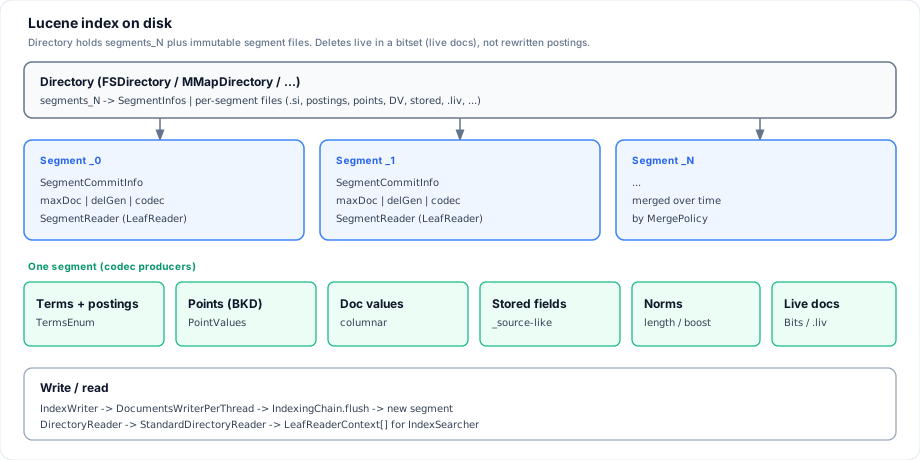
A Directory is the durable root: segments_N (SegmentInfos) lists live SegmentCommitInfo entries, and each segment owns a family of codec files. Soft deletes and updates are layered as live docs (and optionally doc-values updates) keyed by generation (delGen); the flushed postings and points cores are not rewritten until merge.
Write path (summary): IndexWriter → DocumentsWriterPerThread → IndexingChain → flush → new SegmentCommitInfo appended to SegmentInfos. Compaction is MergePolicy / MergeScheduler.
Example Directory after flushing the two documents into _0 (compound file disabled; Lucene104 / Lucene90-style names):
Directory/
  segments_1                 # SegmentInfos: SegmentCommitInfo _0, maxDoc=2
  _0.si                      # SegmentInfo, codec Lucene104
  _0.fnm                     # FieldInfos: status, price, created_date, qty, id, vec
  _0_Lucene104_0.tim/.tip    # terms dictionary (status)
  _0_Lucene104_0.doc         # postings for status
  _0.kdm / _0.kdi / _0.kdd   # points: separate BKD per field (price, created_date)
  _0.dvd / _0.dvm            # doc values: qty
  _0.fdt / _0.fdx            # stored: id
  _0_Lucene99_0.vec / ...    # knn: vec
  # no *.nvd / *.liv         # no norms; nothing deleted
| File family | Role on this segment |
|---|---|
segments_1, _0.si, _0.fnm | Commit list; segment identity; six field infos |
*.tim / *.tip / *.doc | Inverted: status:published → [0], status:draft → [1] |
*.kdm / *.kdi / *.kdd | Points: price (42/100); created_date (D0/D1) |
*.dvd / *.dvm | Doc values: qty = [3, 10] by docID |
*.fdt / *.fdx | Stored: id per document |
knn *.vec… | vec per document |
*.liv | Absent ⇒ liveDocs == null; both documents live |
2.3 Index types
A segment is a bundle of specialized indexes over the same docIDs. Matching, sorting, retrieval, and vector search attach to different types; they must not be conflated.
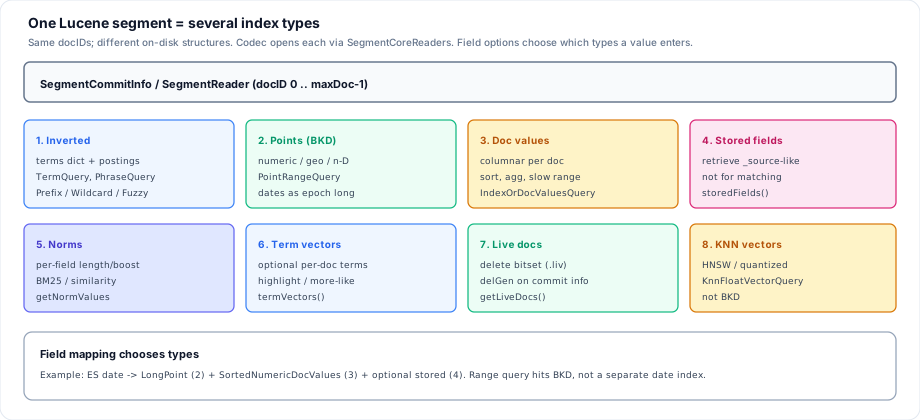
1. Inverted index — status
The inverted index maps terms to postings lists (PostingsFormat: *.tim / *.tip / *.doc). For StringField, the term bytes are the field value itself. Here published posts document 0 and draft posts document 1. TermQuery, Boolean combinations, and most multi-term queries execute against this structure.
2. Points index (BKD) — price and created_date
Points store fixed-width multi-dimensional values in a blocked k-d tree (BKD): BKDWriter / BKDReader, exposed by Lucene90PointsFormat as *.kdm (meta), *.kdi (inner index), and *.kdd (leaf blocks). Each points field has its own tree. LongPoint, IntPoint, geo types, and dates-as-epoch-millis all use this family. It is not a substitute for the inverted index.
Blocked k-d tree. A classical k-d tree alternates axis-aligned splits. Lucene stops recursion when a cell holds at most maxPointsInLeafNode points (default 512) and writes each leaf as a block of packed values plus docIDs. The tree is partially balanced: leaves are full except possibly one short leaf, and leaves may occupy the bottom two levels. A value exactly on a split boundary may land in either child.
Toy 2D example (leaf size 2). The algorithm is easiest to see in two dimensions with a tiny leaf capacity. Lucene’s default leaf size remains 512; only the numbers change.
| Point | Coordinates |
|---|---|
| A | (2, 2) |
| B | (2, 6) |
| C | (4, 8) |
| D | (6, 3) |
| E | (7, 7) |
| F | (9, 5) |
- Sort by x; cut at x = 5 → left
{A,B,C}, right{D,E,F}. - Left: sort by y; cut at y = 4 → L1
{A}, L2{B,C}. - Right: sort by y; cut at y = 6 → L3
{D,F}, L4{E}.
                    [split x=5]
                   /            \
           [split y=4]        [split y=6]
           /        \          /        \
        L1{A}     L2{B,C}   L3{D,F}    L4{E}
Range query [3, 7] × [3, 7] compares each cell’s bounding box to the query AABB:
| Cell | Relation | Action |
|---|---|---|
| Root | CROSSES | Descend |
| Left / right | CROSSES | Descend |
| L1, L2 | CROSSES | Test points → miss |
| L3 | CROSSES | Keep D, drop F |
| L4 | CROSSES | Keep E (leaf box is not ⊆ query) |
Hits: D, E. Fully outside cells are skipped; a fully inside cell would emit every docID in the subtree without testing coordinates. That pruning is PointValues.intersect.
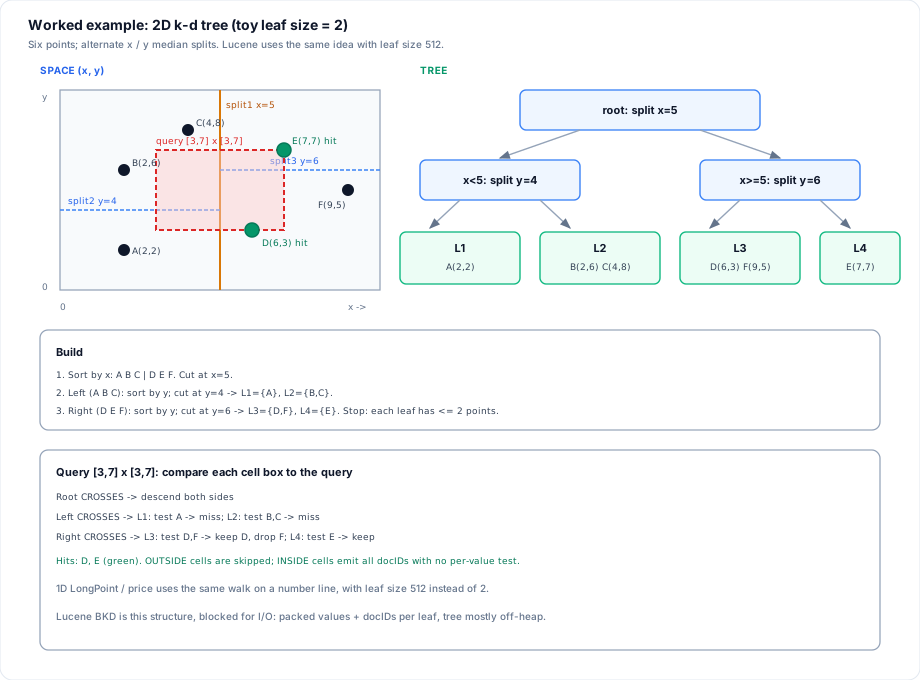
For 1D fields (price, created_date) the same process runs on a number line. Two values fit in one leaf under capacity 512.
BKDConfig | Role | Value for these fields |
|---|---|---|
numDims | Dimensions stored in leaf data | 1 |
numIndexDims | Dimensions used for inner splits (max 8) | 1 |
bytesPerDim | Width per dimension | 8 (sortable long) |
maxPointsInLeafNode | Leaf capacity | 512 |
BKDWriter finishes points into the three *.kd* files. Split selection is near-median per chosen dimension. Sort may spill to temporary files beyond maxMBSortInHeap (default 16 MB).
Intersect relations (used by PointRangeQuery):
| Relation | Meaning | Action |
|---|---|---|
CELL_OUTSIDE_QUERY | Cell misses the query | Skip subtree |
CELL_INSIDE_QUERY | Cell ⊆ query | visitDocIDs — accept all docs in the cell |
CELL_CROSSES_QUERY | Partial overlap | Recurse; at a leaf, visitDocValues tests each value |
Live documents are not filtered inside intersect; BulkScorer applies liveDocs afterward. estimatePointCount uses the same relations for cost-based choices such as IndexOrDocValuesQuery.
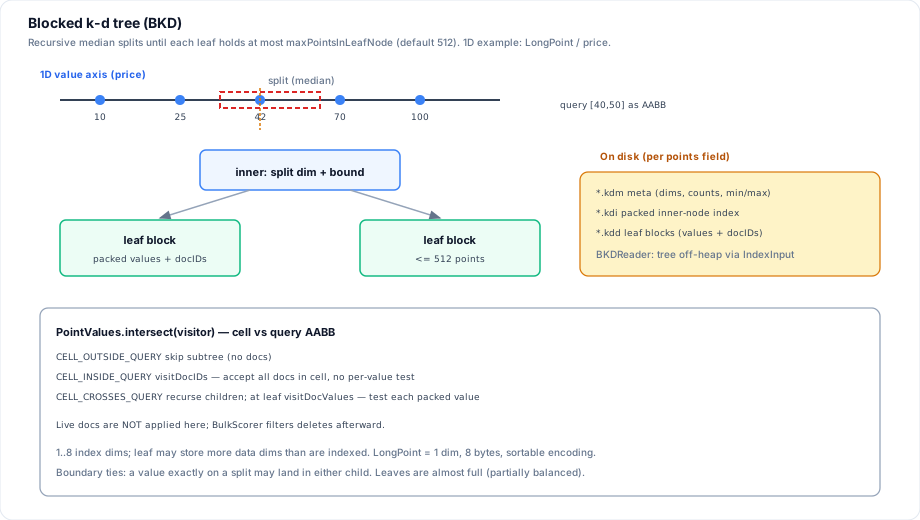
On the worked segment, price and created_date each have a 1D BKD. Section 3.2 runs LongPoint.newRangeQuery("created_date", …) for Q1 2024 and selects doc 0. Trees stay off-heap under BKDReader (IndexInput / mmap); the heap holds only small metadata (dims, counts, min/max).
3. Doc values — qty
Doc values are a columnar encoding by docID (*.dvd / *.dvm). Here qty is [3, 10]. Sort and aggregations iterate this column with advanceExact / nextValue. The schema does not also index qty as points.
4. Stored fields — id
Stored fields (*.fdt / *.fdx) hold values for retrieval only (storedFields().document). They do not participate in matching.
5–6. Norms and term vectors
Unused in this schema (StringField omits norms; term vectors off). Other field types (for example TextField with term vectors enabled) write *.nvd / term-vector files.
7. Live docs
Live docs are a segment-level bitset, not a field. After flush with no deletes there is no .liv file and getLiveDocs() returns null (all docIDs live). Deleting document 1 clears bit 1 for scorers; postings and points may still mention 1 until merge rewrites the cores.
8. KNN vectors — vec
Dense vectors live in the knn file family. KnnFloatVectorQuery searches that structure; it does not use the price or created_date BKD.
Invariant: docIDs 0 and 1 are identical across all types on _0.
2.4 Memory layout
Opening an index does not load every byte onto the Java heap. DirectoryReader.open constructs a heap object graph and opens IndexInputs. With MMapDirectory, file chunks are mapped via MemorySegment; the operating system pages bytes on touch.
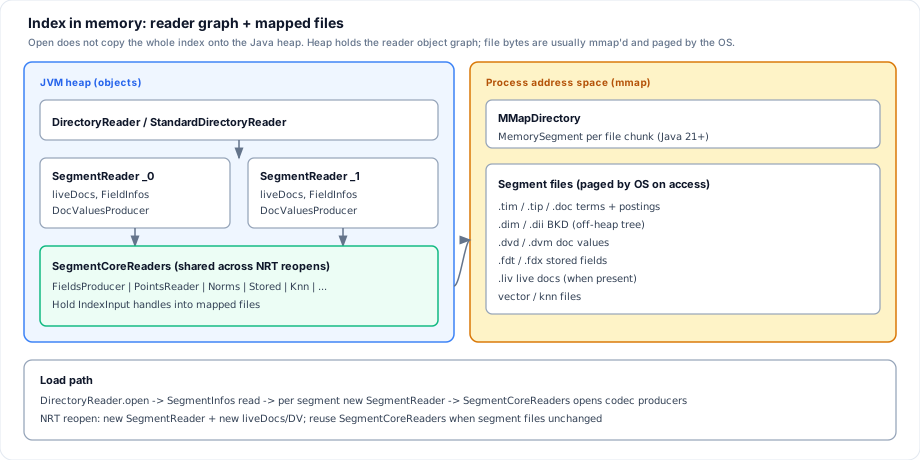
Type hierarchy. IndexReader is sealed into composite and leaf. Disk indexes open as StandardDirectoryReader (DirectoryReader). Its leaves are SegmentReader instances (CodecReader → LeafReader). Each SegmentReader holds per-open state (liveDocs, current FieldInfos, DocValuesProducer) and a reference-counted SegmentCoreReaders that owns immutable codec readers into mapped files. Near-real-time reopen may allocate a new SegmentReader (new live docs) while retaining the same core.
LeafReader as the search surface. IndexSearcher does not score through the composite API for postings access. It iterates reader.leaves(), and for each LeafReaderContext builds scorers in that leaf’s local docID space (0 .. maxDoc-1), remapping hits with ctx.docBase. A leaf is atomic: one segment, no children. Field access for matching and retrieval is through the leaf: terms / postings, getPointValues, doc-values getters, getLiveDocs, storedFields(), and searchNearestVectors. On _0: terms("status"), getPointValues("created_date") (and "price"), getSortedNumericDocValues("qty"), stored id, knn vec.
@startuml
skinparam classAttributeIconSize 0
skinparam shadowing false
skinparam class {
  BackgroundColor #ffffff
  BorderColor #94a3b8
}

abstract class IndexReader {
  refCount : AtomicInteger
  ---
  maxDoc() : int
  numDocs() : int
  storedFields() : StoredFields
  leaves() : List~LeafReaderContext~
}

abstract class CompositeReader
abstract class LeafReader {
  readerContext : LeafReaderContext
  ---
  getContext() : LeafReaderContext
  getCoreCacheHelper() : CacheHelper
  terms(field) : Terms
  postings(term) : PostingsEnum
  getPointValues(field) : PointValues
  getNumericDocValues(field) : NumericDocValues
  getSortedNumericDocValues(field) : SortedNumericDocValues
  getSortedDocValues(field) : SortedDocValues
  getNormValues(field) : NumericDocValues
  getLiveDocs() : Bits
  getFieldInfos() : FieldInfos
  getFloatVectorValues(field) : FloatVectorValues
  searchNearestVectors(...)
  getMetaData() : LeafMetaData
}
abstract class BaseCompositeReader {
  subReaders : LeafReader[]
}
abstract class DirectoryReader {
  directory() : Directory
}
class StandardDirectoryReader

abstract class CodecReader {
  getPostingsReader() : FieldsProducer
  getPointsReader() : PointsReader
  getDocValuesReader() : DocValuesProducer
  getFieldsReader() : StoredFieldsReader
  getVectorReader() : KnnVectorsReader
}
class SegmentReader {
  liveDocs : Bits
  fieldInfos : FieldInfos
  docValuesProducer : DocValuesProducer
  core : SegmentCoreReaders
  ---
  maxDoc() : int
  numDocs() : int
}

class SegmentCoreReaders {
  ref : AtomicInteger
  fields : FieldsProducer
  pointsReader : PointsReader
  fieldsReaderOrig : StoredFieldsReader
  knnVectorsReader : KnnVectorsReader
  normsProducer : NormsProducer
  coreFieldInfos : FieldInfos
}

class LeafReaderContext {
  ord : int
  docBase : int
  ---
  reader() : LeafReader
}

abstract class Directory
class MMapDirectory {
  mappings : MemorySegment
}

abstract class FieldsProducer
abstract class PointsReader
abstract class DocValuesProducer
abstract class StoredFieldsReader
abstract class KnnVectorsReader

IndexReader <|-- CompositeReader
IndexReader <|-- LeafReader
CompositeReader <|-- BaseCompositeReader
BaseCompositeReader <|-- DirectoryReader
DirectoryReader <|-- StandardDirectoryReader
LeafReader <|-- CodecReader
CodecReader <|-- SegmentReader
Directory <|-- MMapDirectory

StandardDirectoryReader "1" o-- "*" SegmentReader : leaves
LeafReader "1" *-- "1" LeafReaderContext : getContext()
DirectoryReader --> Directory : directory
SegmentReader *-- SegmentCoreReaders : core (shared)
SegmentReader --> DocValuesProducer : per-open / updates
SegmentCoreReaders --> FieldsProducer : status postings
SegmentCoreReaders --> PointsReader : price / created_date BKD
SegmentCoreReaders --> StoredFieldsReader : id
SegmentCoreReaders --> KnnVectorsReader : vec
@enduml
| Layer | Contents |
|---|---|
| Heap — composite | StandardDirectoryReader |
| Heap — leaf | SegmentReader: liveDocs, FieldInfos, DocValuesProducer |
| Heap — shared core | SegmentCoreReaders: FieldsProducer, PointsReader, stored, knn |
| Address space | mmap’d *.tim / *.kdd / *.dvd / *.fdt / knn files |
| Heap — metadata | FieldInfos; BKD min/max for points fields; terms metadata for status |
DirectoryReader.open(directory)
  -> read SegmentInfos (segments_1)
  -> new SegmentReader(_0)
       SegmentCoreReaders: FieldInfos + fields + points + stored + knn
       liveDocs; DocValuesProducer (qty)

StandardDirectoryReader
  leaves: [ SegmentReader(_0) ]
    maxDoc = 2, numDocs = 2, liveDocs = null
    fieldInfos = {status, price, created_date, qty, id, vec}
    core.points -> PointsReader   # price + created_date BKD off-heap
    docValues   -> qty [3, 10]
2.5 Package map
| Package | Role |
|---|---|
document | Field types: StringField, LongPoint, SortedNumericDocValuesField, … |
index | IndexWriter, DirectoryReader, SegmentReader, SegmentCoreReaders, PointValues |
codecs | Per-type formats (PostingsFormat, points, doc values, …) |
search | Query, IndexSearcher, PointRangeQuery, IndexOrDocValuesQuery |
util.bkd | BKDWriter / BKDReader / BKDConfig |
store | Directory, MMapDirectory, IndexInput |
3. Query example
On the worked segment, run the usual Elasticsearch pairing—filter then aggregate:
| Step | Workload | Field | Index type | Primary API |
|---|---|---|---|---|
| 3.2 | Inclusive range for Q1 2024 | created_date | Points (BKD) | LongPoint.newRangeQuery → PointValues.intersect |
| 3.3 | Sum (or avg) on matches | qty | Doc values | SortedNumericDocValues |
created_date is points-only in the schema; qty is doc-values-only. DateFieldMapper in Elasticsearch often also writes doc values for the date field (sorting and IndexOrDocValuesQuery); that is optional for the paths below.
3.1 Shared search entry
DirectoryReader.open(directory)
  -> IndexSearcher(reader)
  -> search(created_date_range_query, collector)   # ES also attaches qty agg collectors
       rewrite(query) -> createWeight(...)
       for each LeafReaderContext leaf:
         ScorerSupplier -> BulkScorer.score(..., acceptDocs = liveDocs)
         LeafCollector reads qty for matching local docIDs
acceptDocs is leaf.reader().getLiveDocs(). Query scoring respects deletes here; BKD intersect does not.
3.2 Range query on created_date
Intent: retain documents with created_date in [2024-01-01T00:00:00Z, 2024-03-31T23:59:59.999Z]. Only doc 0 (2024-01-15) matches; doc 1 (2024-06-01) does not.
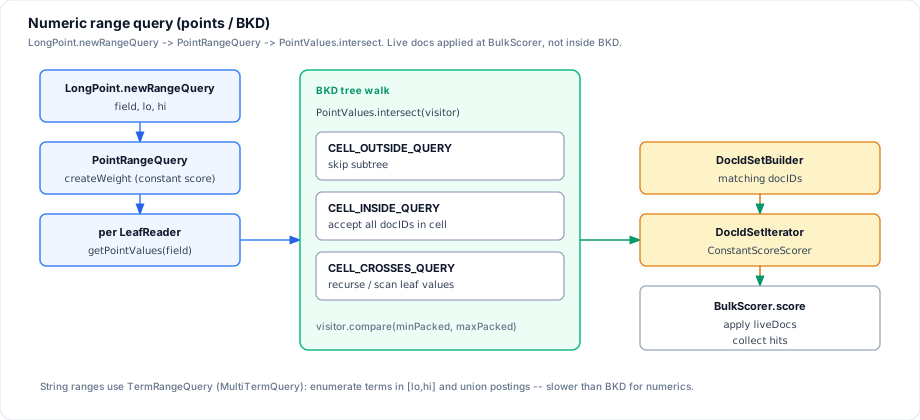
Construction. Bounds are sortable longs (epoch millis). Elasticsearch parses date-math or strings to those longs, then builds a points range:
long lo = 1704067200000L; // 2024-01-01T00:00:00Z
long hi = 1711929599999L; // 2024-03-31T23:59:59.999Z

Query q = LongPoint.newRangeQuery("created_date", lo, hi);
// PointRangeQuery: 1 dimension, 8 bytes per bound

// Optional production hybrid (requires DV on created_date):
new IndexOrDocValuesQuery(
    LongPoint.newRangeQuery("created_date", lo, hi),
    SortedNumericDocValuesField.newSlowRangeQuery("created_date", lo, hi));
IndexOrDocValuesQuery selects the points side when its estimated cost makes it a suitable lead iterator; otherwise it uses the doc-values range. bulkScorer() always uses the points side. A range on price is the same mechanism with a different field name and bounds.
Per-leaf execution
PointRangeQuery.createWeight
  -> ConstantScoreWeight.scorerSupplier(leaf)
       leaf.reader().getPointValues("created_date").intersect(visitor)
       -> DocIdSet of matching local docIDs
  -> BulkScorer.score(collector, acceptDocs)
| Relation | Action |
|---|---|
CELL_OUTSIDE_QUERY | Skip subtree |
CELL_INSIDE_QUERY | visitDocIDs |
CELL_CROSSES_QUERY | Recurse; at leaf, test packed millis |
The created_date BKD contains D0 (doc 0) and D1 (doc 1). Intersect for the Q1 window emits document 0 only. On dense single-valued leaves with a large estimated hit count, PointRangeQuery may invert the visit (mark non-matches, flip a bitset). Structure detail: section 2.3.
3.3 Aggregation on qty
Intent: after the date filter, compute a metric on qty for surviving documents—for example sum = 3. Aggregators do not read values from the created_date BKD. They advance the qty column for each matching docID.
for each LeafReaderContext leaf:
  SortedNumericDocValues dv = DocValues.getSortedNumeric(leaf.reader(), "qty")
  for each matching docID (from the created_date scorer / bitset):
    if (dv.advanceExact(doc)):
      for i in 0 .. dv.docValueCount()-1:
        accumulate(dv.nextValue())   # 3 for doc 0
| Surface | Role |
|---|---|
DocValues.getSortedNumeric(reader, "qty") | Per-leaf column iterator |
Lucene LongRangeFacetCounts / sandbox HistogramCollector | Facet-style aggregation over doc values |
ES SumAggregator / AvgAggregator | Metrics over fielddata (SortedNumericDoubleValues) |
ES NumericHistogramAggregator | Numeric bucketing over doc values |
With the Q1 filter, only doc 0 remains ⇒ sum(qty) = 3. A match-all query would yield 3 + 10 = 13. Points decided membership; doc values supplied measure.
BKD is organized for geometric pruning; doc values are organized for sequential and advanceExact access by docID. The worked schema assigns those roles to different fields so both file families appear explicitly.
3.4 Key types
| Type | Role |
|---|---|
LongPoint / PointRangeQuery | Date (or numeric) range construction and weight |
PointValues / BKDReader | intersect on created_date |
IndexOrDocValuesQuery | Optional choice between points and DV range |
IndexSearcher / Weight / BulkScorer | Per-leaf scoring and liveDocs |
SortedNumericDocValues | qty for aggregations |
ES DateFieldMapper | Date-math → epoch millis → LongPoint (+ optional DV) |
ES SumAggregator / AvgAggregator | Metric aggregations over fielddata |
Scope
Covered: how a Lucene index is organized (Directory, segments, index types, reader/mmap layout) and a query example on the worked segment—created_date range via points, qty aggregation via doc values. Not covered: analysis pipelines in depth, scoring formulas, highlighters, HNSW. Shard and cluster embedding: Elasticsearch cluster and indexes.