
Elasticsearch cluster network and indexes
Elasticsearch is a distributed search engine: clients speak HTTP, nodes form a TCP mesh, a master publishes ClusterState, and each data node stores Lucene-backed shard copies. This post covers cluster management (topology and TCP transport) and how an index is modeled and opened, from the tree under git/elasticsearch (server Version.CURRENT = 9.6.0 on main).
Related: Elasticsearch generals, Lucene internals.
Source grounding: server/ and modules/transport-netty4/.
1. Overview
Elasticsearch exposes one logical cluster to clients while spreading work and data across nodes.
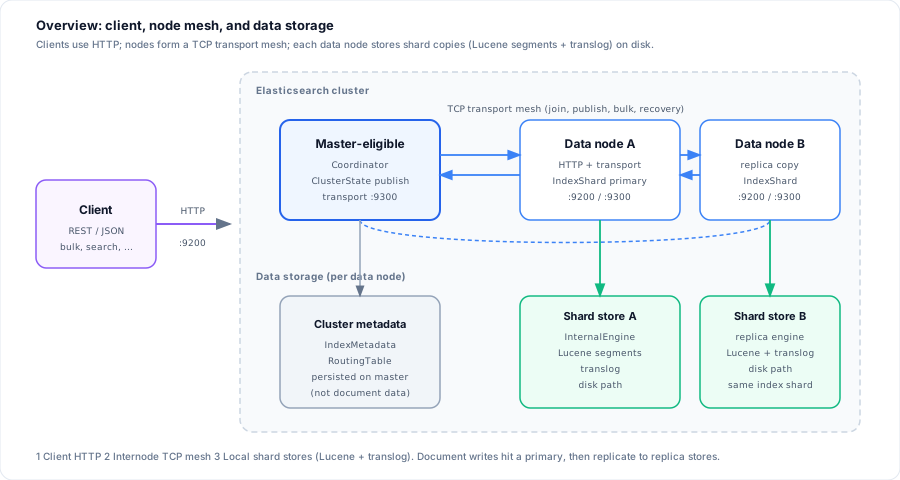
- Client → server — applications call the REST API over HTTP (
http.port, default9200-9300) to any node that accepts HTTP. - Server ↔ server — nodes keep a TCP transport mesh (
transport.port, default9300-9399) for discovery/join, cluster-state publish/commit, bulk replication, recovery, and search fan-out. - Data storage — each data node holds shard copies on disk (
InternalEngine: Lucene segments + translog). Cluster metadata (IndexMetadata,RoutingTable) describes placement; it is not the document store.
What this post covers
- Overview — client, node mesh, storage
- Cluster management — topology, class model, TCP transport channel types
- Indexes — architecture (metadata vs local shards) and implementation (create / open / document→shard routing)
Usage facts
- Creating or changing an index is a master
ClusterStateupdate (published onType.STATE). Data nodes materializeIndexService/IndexShardonly for copies assigned to them in the appliedRoutingTable. - Defaults:
index.number_of_shards= 1,index.number_of_replicas= 1 (replicas are dynamic; shard count is final after create). - Prefer this post for internals; use Elasticsearch generals for REST API and query JSON fields.
- Scope excludes X-Pack security, ingest pipelines in depth, aggregations internals, and the full allocation-decider catalog.
2. Cluster management
Cluster management is the control plane: cluster architecture (what is shared and who does what) and the TCP transport that carries membership and data-plane RPCs between nodes.
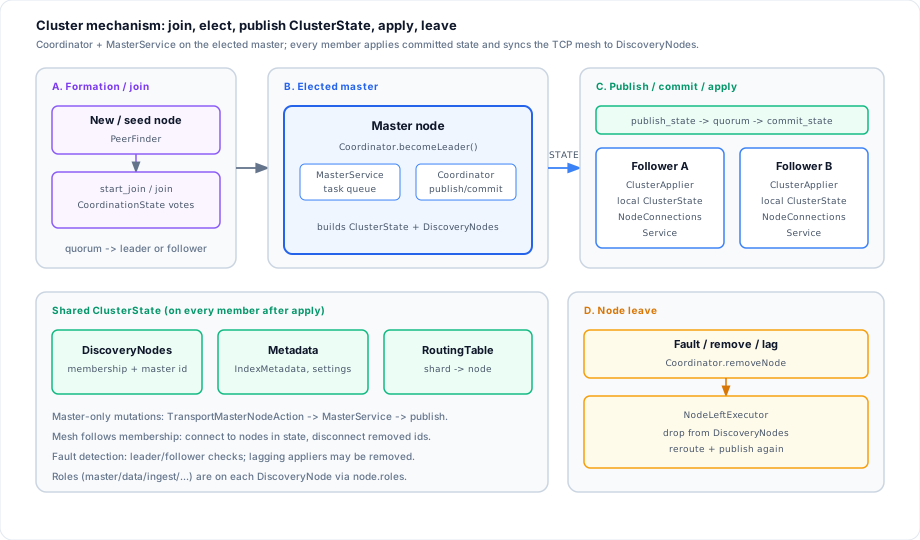
2.1 Cluster topology
Topology is the membership and placement view carried in ClusterState. Two different “characters” appear in that view: node roles (who may be master, hold data, or only coordinate) and shard-copy roles (primary vs replica on a data node).
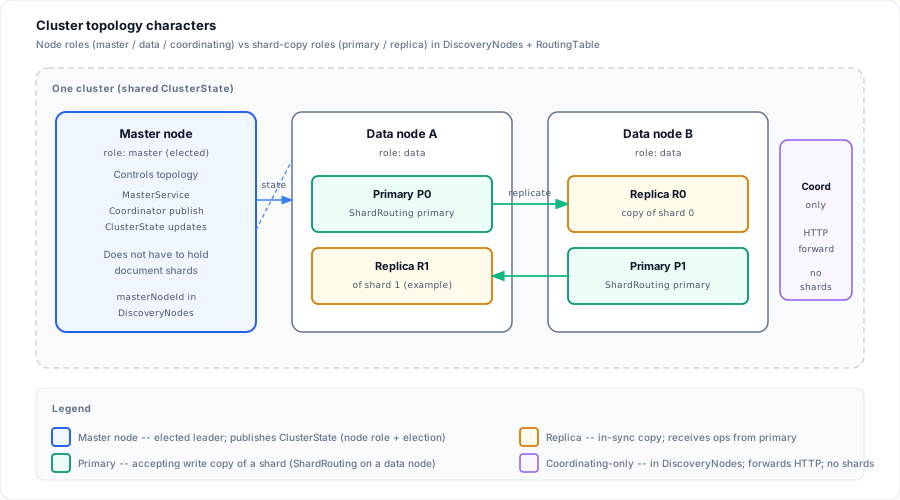
| Character | Kind | Where recorded | Duty |
|---|---|---|---|
| Master (elected) | Node | DiscoveryNodes.masterNodeId; node has master role | Runs MasterService / Coordinator publish; owns topology changes |
| Data node | Node | DiscoveryNode with data-capable role | Hosts one or more ShardRouting copies |
| Primary | Shard copy | ShardRouting (primary flag) on a data node | Accepts writes; replicates to in-sync replicas |
| Replica | Shard copy | ShardRouting (non-primary) on another data node | Applies primary’s operations; may serve reads |
| Coordinating-only | Node | In DiscoveryNodes without data/master/ingest | Accepts HTTP and forwards actions; not a shard target |
The same JVM can be both master-eligible and a data node (combined roles). Primary/replica are not node types—they are placements of a given shard id across data nodes in the RoutingTable.
| Topology facet | In ClusterState | Meaning |
|---|---|---|
| Node membership | DiscoveryNodes | Every live DiscoveryNode (id, address, roles) |
| Elected master | DiscoveryNodes.masterNodeId | Which member currently leads state publication |
| Index definitions | Metadata / IndexMetadata | Indexes and their settings (shard/replica counts, …) |
| Shard placement | RoutingTable / ShardRouting | Which node holds which primary or replica copy |
| Blocks | ClusterBlocks | Operations forbidden until topology is healthy |
The transport mesh is the wire that carries join, publish, and data RPCs; the topology itself is not a separate gossip map—it is the applied ClusterState on each JVM.
Every member process keeps a local copy of that state. Reads such as “who is master?” or “where is shard 2?” go through ClusterService.state() on that node (the last committed state the local ClusterApplierService applied). Nodes do not query a remote catalog for routine routing; they use their applied snapshot, which lags only until the next publish/commit.
2.2 Class model: how a node holds cluster info
On each node, ClusterService is the façade. It owns MasterService (active for state updates only while this node is the elected master) and ClusterApplierService (always applies committed states). ClusterApplierService retains the current ClusterState. That object aggregates topology: DiscoveryNodes of DiscoveryNode instances, Metadata, routing tables, and blocks.
@startuml
skinparam classAttributeIconSize 0
skinparam shadowing false
skinparam class {
  BackgroundColor #ffffff
  BorderColor #94a3b8
}

  class Node {
    clusterService : ClusterService
    coordinator : Coordinator
    nodeConnectionsService : NodeConnectionsService
    ---
    start()
  }

  class ClusterService {
    masterService : MasterService
    clusterApplierService : ClusterApplierService
    nodeName : String
    clusterName : ClusterName
    ---
    state() : ClusterState
    localNode() : DiscoveryNode
  }

  class MasterService {
    nodeName : String
    queuesByPriority
    clusterStatePublisher : ClusterStatePublisher
    ---
    createTaskQueue(...)
    publish(...)
  }

  class ClusterApplierService {
    state : AtomicReference~ClusterState~
    nodeName : String
    highPriorityStateAppliers
    clusterStateListeners
    ---
    state() : ClusterState
    onNewClusterState(...)
  }

  class Coordinator {
    masterService : MasterService
    joinHelper : JoinHelper
    peerFinder : PeerFinder
    coordinationState : CoordinationState
    applierState : ClusterState
    publicationHandler : PublicationTransportHandler
    nodeLeftQueue
    ---
    becomeLeader()
    becomeFollower(...)
    publish(...)
    removeNode(...)
  }

  class NodeConnectionsService {
    targetsByNode : Map~DiscoveryNode, ConnectionTarget~
    transportService : TransportService
    ---
    connectToNodes(...)
    disconnectFromNodesExcept(...)
  }

  class ClusterState {
    version : long
    stateUUID : String
    clusterName : ClusterName
    nodes : DiscoveryNodes
    metadata : Metadata
    routingTable : GlobalRoutingTable
    blocks : ClusterBlocks
    ---
    nodes() : DiscoveryNodes
    metadata() : Metadata
    routingTable() : RoutingTable
  }

  class DiscoveryNodes {
    nodes : Map~String, DiscoveryNode~
    masterNodes : Map~String, DiscoveryNode~
    dataNodes : Map~String, DiscoveryNode~
    masterNodeId : String
    localNodeId : String
    ---
    getMasterNode() : DiscoveryNode
    getLocalNode() : DiscoveryNode
    masterNodes() : Map
    dataNodes() : Map
  }

  class DiscoveryNode {
    nodeId : String
    nodeName : String
    address : TransportAddress
    roles : Set~DiscoveryNodeRole~
    attributes : Map~String, String~
    ---
    isMasterNode() : boolean
    canContainData() : boolean
    getRoles() : Set
  }

  class DiscoveryNodeRole {
    roleName : String
    roleNameAbbreviation : String
    canContainData : boolean
  }

  class Metadata {
    clusterUUID : String
    indices : Map~... IndexMetadata~
    coordinationMetadata : CoordinationMetadata
  }

  class IndexMetadata {
    index : Index
    numberOfShards : int
    numberOfReplicas : int
    primaryTerms : long[]
    settings : Settings
  }

  class GlobalRoutingTable {
    routingTables : Map~... RoutingTable~
  }

  class RoutingTable {
    indicesRouting : Map~String, IndexRoutingTable~
  }

  class ShardRouting {
    shardId : ShardId
    currentNodeId : String
    primary : boolean
    state : ShardRoutingState
    allocationId : AllocationId
  }

  class ClusterBlocks {
    global
    indices
  }

Node *-- ClusterService
Node *-- Coordinator
Node *-- NodeConnectionsService
ClusterService *-- MasterService
ClusterService *-- ClusterApplierService
Coordinator o-- MasterService
ClusterApplierService o-- ClusterState : applied state
MasterService ..> Coordinator : publisher
Coordinator ..> ClusterApplierService : commit / apply
ClusterApplierService ..> NodeConnectionsService : after apply

ClusterState *-- DiscoveryNodes
ClusterState *-- Metadata
ClusterState *-- GlobalRoutingTable
ClusterState *-- ClusterBlocks
DiscoveryNodes o-- "1..*" DiscoveryNode
DiscoveryNode o-- "*" DiscoveryNodeRole
Metadata o-- "*" IndexMetadata
GlobalRoutingTable *-- "*" RoutingTable
RoutingTable o-- "*" ShardRouting
@enduml
Invariant: after a successful apply, ClusterService.state().nodes() on every healthy member describes the same membership and master id (same version / stateUUID). Shard routing and metadata match that version. A node that has not yet applied a commit still serves from its previous applied state until commit catches up—or is removed if it lags too far.
2.3 TCP transport implementation
Internode traffic uses the TCP stack, not HTTP. Types and ownership:
@startuml
skinparam classAttributeIconSize 0
skinparam shadowing false

class TransportService {
  transport : Transport
  responseHandlers : ResponseHandlers
  ---
  sendRequest(...)
  registerRequestHandler(...)
}

class "TcpTransport" as TcpTransport {
  outboundHandler : OutboundHandler
  inboundHandler : InboundHandler
  ---
  openConnection(...)
  inboundMessage(...)
  sendRequest(...)
}

class Netty4Transport {
  ---
  initiateChannel(...)
  bind(...)
}

class OutboundHandler {
  ---
  sendRequest(requestId, action, request, ...)
  sendResponse(...)
}

class InboundHandler {
  requestHandlers
  ---
  messageReceived(...)
}

class NodeChannels {
  typeMapping : Map~Type, ConnectionTypeHandle~
  ---
  sendRequest(requestId, action, request, options)
}

class TcpChannel {
  ---
  sendMessage(...)
}

class ConnectionProfile {
  connections per Type
}

class "TransportRequestOptions.Type" as Type {
  RECOVERY
  BULK
  REG
  STATE
  PING
}

class RequestHandlerRegistry {
  action : String
  executor
  requestReader
  handler
}

class NodeConnectionsService {
  targetsByNode
  transportService : TransportService
  ---
  connectToNodes(...)
  disconnectFromNodesExcept(...)
}

class ClusterConnectionManager {
  ---
  getConnection(DiscoveryNode)
  openConnection(...)
}

TransportService o-- TcpTransport : transport
Netty4Transport --|> TcpTransport
TcpTransport *-- OutboundHandler
TcpTransport *-- InboundHandler
TcpTransport *-- NodeChannels : per peer
NodeChannels o-- TcpChannel
NodeChannels ..> Type
ConnectionProfile ..> Type
TcpTransport ..> ConnectionProfile
InboundHandler o-- RequestHandlerRegistry
TransportService ..> RequestHandlerRegistry : register
NodeConnectionsService o-- TransportService
NodeConnectionsService ..> ClusterConnectionManager
OutboundHandler ..> TcpChannel
@enduml
| Layer | Type | Role |
|---|---|---|
| Façade | TransportService | sendRequest, registerRequestHandler, handshake (internal:transport/handshake) |
| Engine | TcpTransport | Bind/connect, frame messages, map Type → TcpChannel |
| Netty | Netty4Transport | Concrete TCP (transport.port default 9300-9399) |
| Mesh | NodeConnectionsService / ClusterConnectionManager | Open/close peers to match applied DiscoveryNodes |
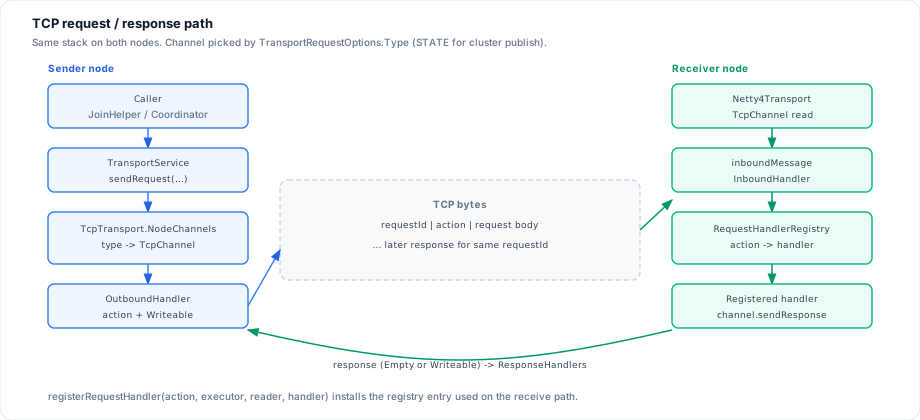
Send path. Caller → TransportService.sendRequest → connection’s NodeChannels selects a channel by TransportRequestOptions.Type → OutboundHandler writes requestId, action string, and Writeable body.
Receive path. Netty read → TcpTransport.inboundMessage → InboundHandler resolves RequestHandlerRegistry by action → deserialize request → run handler on its executor → channel.sendResponse. The sender matches the response via responseHandlers and the same requestId.
Channel selection is the options.type() lookup on the peer’s NodeChannels:
// TcpTransport.NodeChannels.sendRequest
TcpChannel channel = channel(options.type());
outboundHandler.sendRequest(node, channel, requestId, action, request, options, ...);
ConnectionProfile.buildDefaultConnectionProfile opens a separate pool of TCP sockets per type (counts from transport.connections_per_node.*). TCP is a single ordered byte stream: a large bulk or recovery transfer on a shared socket would delay small cluster-state or fault-detection messages (head-of-line blocking). Isolating types keeps latency-sensitive control traffic off bandwidth-heavy data paths. Roles that never send a type open zero sockets for it:
// ConnectionProfile.buildDefaultConnectionProfile (defaults: recovery=2, bulk=3, reg=6, state=1, ping=1)
builder.addConnections(connectionsPerNodeBulk, Type.BULK);
builder.addConnections(connectionsPerNodePing, Type.PING);
builder.addConnections(DiscoveryNode.isMasterNode(settings) ? connectionsPerNodeState : 0, Type.STATE);
builder.addConnections(DiscoveryNode.canContainData(settings) ? connectionsPerNodeRecovery : 0, Type.RECOVERY);
builder.addConnections(connectionsPerNodeReg, Type.REG);
Type.RECOVERY
Usage. Peer recovery copies Lucene files and replays translog ops from a source shard to a recovering target. Transfers are large and long-lived; they must not stall publish or search on the same peer link. Default 2 sockets per data node (transport.connections_per_node.recovery). Non-data nodes open 0.
// RemoteRecoveryTargetHandler
this.fileChunkRequestOptions = TransportRequestOptions.of(
    recoverySettings.internalActionTimeout(),
    TransportRequestOptions.Type.RECOVERY
);
this.translogOpsRequestOptions = TransportRequestOptions.of(
    recoverySettings.internalActionLongTimeout(),
    TransportRequestOptions.Type.RECOVERY
);
// later: transportService.sendRequest(..., fileChunkRequestOptions, ...)
Type.BULK
Usage. Primary → replica shard bulk writes (TransportShardBulkAction / TransportReplicationAction). Indexing volume is high; a few parallel sockets absorb concurrent bulk shards without sharing the STATE or PING pipes. Default 3 sockets (transport.connections_per_node.bulk).
// TransportShardBulkAction
private static final TransportRequestOptions TRANSPORT_REQUEST_OPTIONS = TransportRequestOptions.of(
    null,
    TransportRequestOptions.Type.BULK
);

@Override
protected TransportRequestOptions transportOptions() {
    return TRANSPORT_REQUEST_OPTIONS;
}
// TransportReplicationAction sends primary/replica requests with transportOptions
Type.REG
Usage. Default / general-purpose channel: discovery probes, most internal actions that omit an explicit type, and search fan-out. TransportRequestOptions.EMPTY and timeout(...) both use Type.REG. Default 6 sockets (transport.connections_per_node.reg)—the largest pool, for concurrent unrelated RPCs.
// TransportRequestOptions
public static final TransportRequestOptions EMPTY = new TransportRequestOptions(null, Type.REG);

// SearchTransportService (query / fetch phases)
transportService.sendRequest(node, action, request, TransportRequestOptions.EMPTY, handler);

// HandshakingTransportAddressConnector — single-channel probe profile
handshakeConnectionProfile = ConnectionProfile.buildSingleChannelProfile(
    Type.REG, connectTimeout, handshakeTimeout, TimeValue.MINUS_ONE, null, null
);
Type.STATE
Usage. Cluster-state publication and related coordination that must stay responsive while peers may be busy with bulk or recovery. Master-eligible nodes open 1 socket by default (transport.connections_per_node.state); other roles open 0. PublicationTransportHandler sends internal:cluster/coordination/publish_state on this type (no send timeout—acks may arrive late).
// PublicationTransportHandler
private static final TransportRequestOptions STATE_REQUEST_OPTIONS = TransportRequestOptions.of(
    null,
    TransportRequestOptions.Type.STATE
);

transportService.sendChildRequest(
    connection,
    PUBLISH_STATE_ACTION_NAME,
    new BytesTransportRequest(bytes, connection.getTransportVersion()),
    task,
    STATE_REQUEST_OPTIONS,
    handler
);
Type.PING
Usage. Lightweight fault-detection RPCs (LeaderChecker, FollowersChecker) so leader/follower liveness checks are not queued behind bulk or recovery frames. Default 1 socket (transport.connections_per_node.ping). Separate from TransportKeepAlive, which writes a wire-level keep-alive on every open TcpChannel on a schedule; Type.PING is the application-level channel class for coordination ping actions.
// LeaderChecker / FollowersChecker
private static final TransportRequestOptions PING_REQUEST_OPTIONS =
    TransportRequestOptions.of(null, Type.PING);

transportService.sendRequest(
    node,
    LEADER_CHECK_ACTION_NAME,  // or FOLLOWER_CHECK_ACTION_NAME
    request,
    PING_REQUEST_OPTIONS,
    handler
);
3. Indexes
An index is one logical namespace for documents. The cluster records its definition and shard placement in ClusterState; each data node that holds a copy runs a local IndexShard with a Lucene store. Document write and search paths assume that structure; this section covers the structure itself.
3.1 Architecture
Two planes share the same logical index:
| Plane | Home | Holds |
|---|---|---|
| ClusterState (master-authored) | IndexMetadata + IndexRoutingTable | Identity, settings, mappings, primary terms, in-sync allocation ids, which node holds which copy |
| Data plane (per data node) | IndicesService → IndexService → IndexShard | Lucene Directory, engine, recovery, primary/replica behavior for assigned copies only |
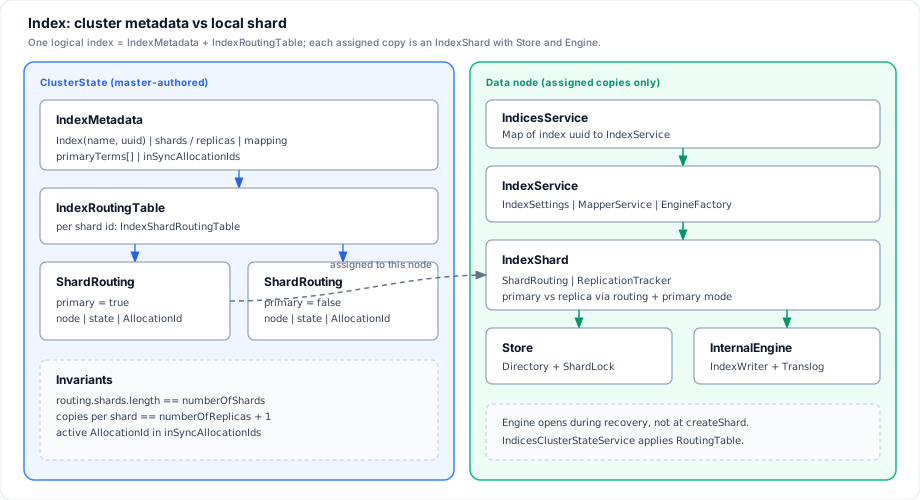
The index in ClusterState
Index is a value type (name, uuid). Equality uses both; after create, the UUID (setting index.uuid) is the stable key for maps and on-disk paths. Until a UUID is assigned, code may see the placeholder _na_.
IndexMetadata is the authoritative definition for that UUID:
| Field / aspect | Meaning |
|---|---|
index | Index(name, uuid) |
numberOfShards / numberOfReplicas | From index.number_of_shards (default 1, Final) and index.number_of_replicas (default 1, Dynamic). totalNumberOfShards = shards × (replicas + 1). |
primaryTerms[] | One long per shard id. Starts at unassigned (0); increments when a primary is assigned after a full restart or a replica is promoted. Any shard that can accept writes has term greater than 0. |
inSyncAllocationIds | Per shard id, the set of AllocationId strings for copies safe to promote or recover from. |
| Mapping / aliases / settings versions | mappingVersion, settingsVersion, aliasesVersion, plus overall version for change detection. |
state | OPEN or CLOSE (closed indexes keep metadata but do not host started shards for traffic). |
| Creation / compatibility | getCreationVersion() / getCompatibilityVersion() for N−1 and archive import checks. |
IndexRoutingTable holds one IndexShardRoutingTable per shard id 0 .. numberOfShards-1. Each group has exactly one primary ShardRouting and numberOfReplicas replica routings. A ShardRouting is one physical copy: assigned node (or none), primary flag, cluster state (UNASSIGNED → INITIALIZING → STARTED, or RELOCATING), recovery source (empty store, existing store, peer, snapshot, …), and AllocationId.
Invariants (routing validated against metadata): shards.length == numberOfShards; copies per shard id equal numberOfReplicas + 1; every active promotable copy’s allocation id ∈ that shard’s in-sync set.
The index on a data node
IndicesService keeps Map<uuid, IndexService> for indexes that have at least one local shard. One IndexService is shared by all local shards of that index: IndexSettings (live view of IndexMetadata settings), MapperService, analyzers, similarity, field-data / bitset caches, EngineFactory, and async tasks (global-checkpoint sync, retention-lease sync, translog trim). The shard map is Map<Integer, IndexShard> keyed by shard id—not every shard id exists on every node, only those the routing table assigns here.
ShardId is (Index, shardId) and identifies a logical shard; each copy on a node is a separate IndexShard instance with its own store path.
IndexShard
@startuml
skinparam classAttributeIconSize 0
skinparam shadowing false

class IndexShard {
  shardRouting : ShardRouting
  state : IndexShardState
  pendingPrimaryTerm : long
  path : ShardPath
  ---
  applyIndexOperationOnPrimary(...)
  applyIndexOperationOnReplica(...)
  updateShardState(...)
  startRecovery(...)
}

class Store {
  directory : Directory
  shardLock : ShardLock
}

class Engine {
  ---
  index(...)
  get(...)
  refresh(...)
}

class InternalEngine {
  IndexWriter
  Translog
  localCheckpointTracker
}

class ReplicationTracker {
  primaryMode
  inSyncAllocationIds
  globalCheckpoint
}

class IndexShardOperationPermits {
  ---
  block / acquire for ops
}

IndexShard *-- Store
IndexShard o-- Engine
InternalEngine --|> Engine
IndexShard *-- ReplicationTracker
IndexShard *-- IndexShardOperationPermits
IndexShard ..> ShardRouting
@enduml
An IndexShard is one local copy. Construction (IndexService.createShard) acquires a ShardLock, resolves or creates a ShardPath on disk, builds a Lucene Directory, wraps it in Store, and constructs IndexShard in state CREATED. The Engine reference stays empty until recovery opens InternalEngine (default) on store.directory() with an IndexWriter and a paired translog.
Two state axes must not be confused:
| Axis | Type | Where | Role |
|---|---|---|---|
| Cluster placement | ShardRouting.state() | ClusterState | Master’s view: unassigned / initializing / started / relocating |
| Local lifecycle | IndexShardState | JVM | This process’s shard object: created → recovering → post-recovery → started → closed |
Local lifecycle:
IndexShardState | Meaning |
|---|---|
CREATED | Object and store exist; no engine yet |
RECOVERING | markAsRecovering; engine opens; file/translog or peer recovery in progress |
POST_RECOVERY | Recovery finished; reads allowed; waiting for master to mark routing active |
STARTED | updateShardState saw active routing; serving normal traffic |
CLOSED | Shard closed / failed / removed |
Reads are allowed in POST_RECOVERY and STARTED. Writes are allowed in RECOVERING, POST_RECOVERY, and STARTED (replicas index during recovery; relocating primaries have additional rules). Operation admission goes through IndexShardOperationPermits so promotion and engine reset can block new ops briefly.
ReplicationTracker is the local view of the replication group: whether this copy is in primary mode, which allocation ids are in-sync, global checkpoint, and retention leases. Primaries drive the group; replicas apply ops with primary-assigned sequence numbers.
Primary vs replica use the same class. Gates are shardRouting.primary() and primary mode on the tracker:
- Primary —
applyIndexOperationOnPrimary(Engine.Operation.Origin.PRIMARY); activates primary mode when an initializing primary becomes started; receives master updates of in-sync sets into the tracker. - Replica — almost always peer-recovers from the current primary (
Type.RECOVERYchannels);applyIndexOperationOnReplica(Origin.REPLICA); on promotion, primary term increases, history may be adjusted, primary–replica resync runs, thenactivatePrimaryMode. - Demotion primary → replica on the same allocation is illegal (
updateShardStaterejects it).
3.2 Implementation
Create index (ClusterState only). HTTP/API create reaches the master as TransportCreateIndexAction → MetadataCreateIndexService.createIndex. The update task validates name/templates/settings, may use a temporary IndexService on the master to merge mappings, then builds IndexMetadata (OPEN) and RoutingTable.addAsNew / IndexRoutingTable.initializeAsNew: unassigned primary with empty-store recovery, unassigned replicas with peer recovery. allocationService.reroute assigns initializing shards. After publish/commit, every node applies the new metadata; only assigned data nodes open local objects. IndexMetadataUpdater (during allocation) fills in-sync ids as shards start and bumps primary terms on primary init/promotion.
TransportCreateIndexAction
  -> MetadataCreateIndexService.createIndex
       validate + build IndexMetadata
       RoutingTable.addAsNew / initializeAsNew
       allocationService.reroute("create-index")
  -> publish / commit ClusterState
  -> (optional) wait for active shards
Create IndexService / IndexShard. IndicesClusterStateService.applyClusterState reconciles local objects with the applied routing table. For each assigned initializing shard:
IndicesService.createIndex(IndexMetadata)     // once per uuid on this node
IndexService.createShard(routing, ...)
  nodeEnv.shardLock(shardId)
  ShardPath.loadShardPath | selectNewPathForShard
  DirectoryFactory.newDirectory(...)
  new Store(shardId, settings, directory, lock, ...)
  new IndexShard(routing, settings, path, store, engineFactory, ...)  // state = CREATED
  shards.put(shardId.id(), indexShard)
IndexShard.startRecovery(...)
  markAsRecovering -> RECOVERING
  EMPTY/EXISTING_STORE -> recoverFromStore -> open InternalEngine + translog
  PEER                  -> PeerRecoveryTargetService
  -> POST_RECOVERY when recovery completes
IndexShard.updateShardState(... active routing ...)
  -> STARTED; if primary, replicationTracker.activatePrimaryMode(localCheckpoint)
updateShardState is the ongoing applier hook: new ShardRouting, new primary term, in-sync set, and IndexShardRoutingTable. Same allocation only; term increase on a non-primary routing triggers promotion (block permits, bump pendingPrimaryTerm, resync, activate primary mode). Stale “shard started” messages against a still-recovering replica fail the shard rather than skipping to STARTED.
Shard a document on insert. Create-index fixes number_of_shards. Each index/update/delete must pick one shard id in 0 .. numberOfShards-1, then the coordinating node groups items by ShardId and sends a BulkShardRequest to that shard’s primary (TransportShardBulkAction on Type.BULK channels). Placement is not load-balancing: it is a deterministic hash of routing key → shard number.
On the bulk coordinator (BulkOperation), after resolving the concrete write index:
// BulkOperation — per DocWriteRequest in the bulk
IndexRouting indexRouting = concreteIndices.routing(concreteIndex); // IndexRouting.fromIndexMetadata(...)
docWriteRequest.preRoutingProcess(indexRouting);   // may auto-generate _id
int shardId = docWriteRequest.route(indexRouting); // -> IndexRouting.indexShard(...)
docWriteRequest.postRoutingProcess(indexRouting);
requestsByShard.computeIfAbsent(new ShardId(concreteIndex, shardId), ...).add(bulkItemRequest);
IndexRequest.route delegates to IndexRouting.indexShard. The default strategy (Unpartitioned) hashes _routing if set, otherwise _id (Murmur3), then maps the hash to a shard:
// IndexRouting.IdAndRoutingOnly.preProcess — id required before hash
if (indexRequest.id() == null) {
    indexRequest.autoGenerateId();  // or time-based id for some index modes
}

// IndexRouting.indexShard (IdAndRoutingOnly)
int shardId = shardId(id, routing);
return rerouteWritesIfResharding(shardId);

// IndexRouting.Unpartitioned
protected int shardId(String id, @Nullable String routing) {
    return routingFunction.shardNum(effectiveRoutingToHash(routing == null ? id : routing));
}

private static int effectiveRoutingToHash(String effectiveRouting) {
    return Murmur3HashFunction.hash(effectiveRouting);
}
RoutingFunction turns that hash into a shard id. Newer indexes use plain modulo on numberOfShards; older ones use routingNumShards / routingFactor so shard counts can grow via split while keeping document→shard affinity:
// RoutingFunction — chosen in IndexRouting.fromIndexMetadata by IndexVersion
// Modern:
Math.floorMod(hash, numberOfShards);

// Legacy (routingNumShards = numberOfShards * routingFactor, often for _split):
Math.floorMod(hash, routingNumShards) / routingFactor;
Variants (same IndexRouting façade):
| Strategy | When | Hash input |
|---|---|---|
Unpartitioned | Default | _routing or else _id |
Partitioned | index.routing_partition_size > 1 | Requires _routing; mixes hash(routing) + offset(hash(id)) so one routing key fans across a partition of shards |
ExtractFromSource | index.routing_path or time-series dimensions | Fields from the document source (not only _id) |
Optional _routing therefore pins related documents (e.g. same parent key) onto the same shard under the default strategy. With required routing in the mapping, missing _routing fails before a shard id is chosen (RoutingMissingException).
After grouping, each BulkShardRequest targets one primary; replication to in-sync replicas is a later step on that shard, not part of the hash.
Key types
| Type | Path (under server/.../java) | Role |
|---|---|---|
Index / ShardId | org/elasticsearch/index/ | Index identity; logical shard id |
IndexMetadata | org/elasticsearch/cluster/metadata/ | Authoritative settings, terms, in-sync sets |
IndexRoutingTable / ShardRouting | org/elasticsearch/cluster/routing/ | Placement and copy state in ClusterState |
IndexRouting / RoutingFunction | org/elasticsearch/cluster/routing/ | Document → shard id (hash / modulo) |
BulkOperation | org/elasticsearch/action/bulk/ | Group bulk items by ShardId for insert |
MetadataCreateIndexService | org/elasticsearch/cluster/metadata/ | Create-index cluster-state mutation |
IndicesClusterStateService | org/elasticsearch/indices/cluster/ | Apply routing → local create/update/remove |
IndicesService / IndexService | org/elasticsearch/indices/, org/elasticsearch/index/ | Node registry; per-index shared services + shard map |
IndexShard / IndexShardState | org/elasticsearch/index/shard/ | Local copy lifecycle and ops |
Store / InternalEngine / ReplicationTracker | …/store/, …/engine/, …/seqno/ | Directory, Lucene+translog, replication group |
Scope
This post covers cluster topology and how each node holds applied ClusterState, the internode TCP stack and per-type channels, how an index is represented in metadata versus opened as IndexService / IndexShard, and how insert traffic hashes documents onto shard ids. It does not cover the full primary→replica write pipeline, search execution trees, query DSL rewriting, aggregations, security plugins, or every allocation decider. For REST surface and query JSON fields, see Elasticsearch generals; for Lucene segment/writer detail, see Lucene internals.