
Redis Internals: Pub/Sub Architecture and Data Structures
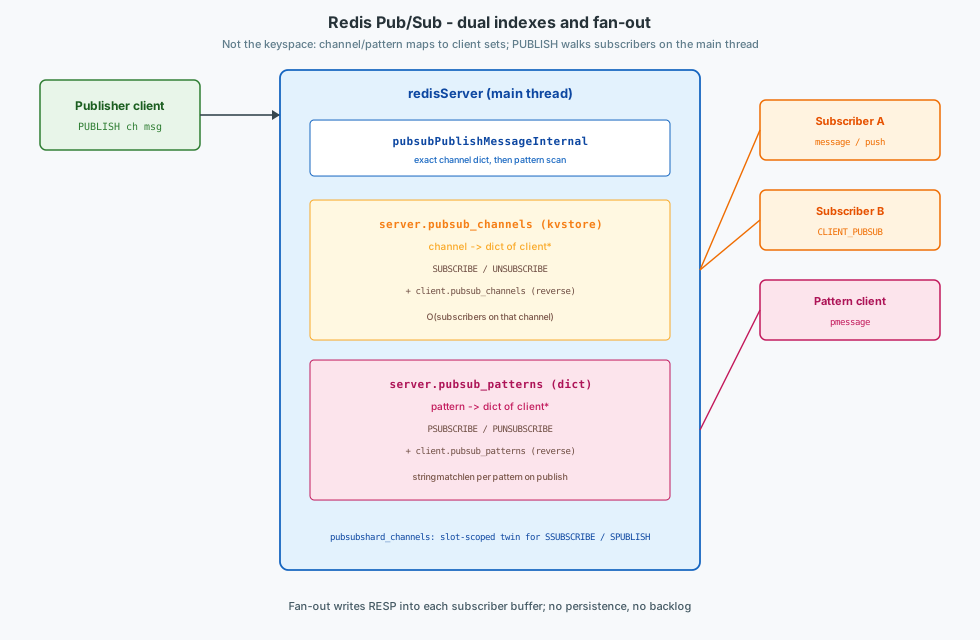
Redis Pub/Sub is an in-process fan-out over named channels and glob patterns. It is not the keyspace: messages are not stored as keys, have no TTL or RDB/AOF payload of their own, and are delivered only to clients that are subscribed at publish time. Delivery is best-effort (no server retry across disconnect). This post maps the structures, command paths, and delivery/security properties in git/redis (pubsub.c, fields on redisServer / client).
Related: Network / command path, Data types and encodings, Cluster bus gossip, Build from source.
1. Overview
| Concern | Behavior |
|---|---|
| Transport | Same RESP connection as other commands |
| Delivery | Push into each subscriber’s output buffer on the main thread |
| Durability | None — offline or late subscribers miss the message |
| Patterns | PSUBSCRIBE uses stringmatchlen against every pattern on each PUBLISH |
| Shard channels | SSUBSCRIBE / SPUBLISH use a slot-scoped twin of the channel index |
| Membership | Per node. Each process keeps only the clients connected to it in its own pubsub_channels / pubsub_patterns (and shard maps). Nodes do not sync or share subscriber lists. |
| Multi-node publish | PUBLISH propagates the message (channel + payload) on the cluster bus or REPL; every receiving node runs local fan-out against its client list only |
A client in Pub/Sub mode (RESP2) may only run subscription control commands plus PING / QUIT / RESET until it unsubscribes from everything. In a cluster, a subscriber is visible solely on the node that accepted its connection; other nodes learn nothing about that client until a published payload arrives and they deliver to whoever is subscribed locally.
flowchart LR
  Pub["PUBLISH / SPUBLISH"] --> Core["pubsubPublishMessageInternal"]
  Core --> Ch["pubsub_channels / pubsubshard_channels"]
  Core --> Pat["pubsub_patterns"]
  Ch --> SA["addReplyPubsubMessage"]
  Pat --> SB["addReplyPubsubPatMessage"]
  SA --> Out["subscriber reply buffers"]
  SB --> Out
2. Server implementation
Pub/Sub does not store messages. The server keeps who is listening in forward indexes on redisServer (channel or pattern → set of client*), installs those edges on subscribe, and on PUBLISH / SPUBLISH walks the matching sets to addReply* into each subscriber’s output buffer. Global and shard paths share pubsubtype; after local fan-out, cluster or replication may propagate the payload so peer processes run the same local publish against their own indexes.
/* server.h — redisServer */
kvstore *pubsub_channels;       /* channel → dict of client* */
dict *pubsub_patterns;          /* pattern → dict of client* */
kvstore *pubsubshard_channels;  /* per-slot channel → dict of client* */
unsigned int pubsub_clients;    /* clients with CLIENT_PUBSUB */
@startuml
!option handwritten true
skinparam class {
    BackgroundColor White
    BorderColor Black
    ArrowColor Black
}

struct redisServer {
  +pubsub_channels : kvstore*
  +pubsub_patterns : dict*
  +pubsubshard_channels : kvstore*
  +pubsub_clients : uint
}

struct client {
  +pubsub_channels : dict*
  +pubsub_patterns : dict*
  +pubsubshard_channels : dict*
  +flags : uint64_t
}

struct "dict (subscribers)" as SubDict {
  key : client*
  val : NULL
}

struct "dict (membership)" as MembDict {
  key : robj* channel_or_pattern
  val : NULL
}

redisServer --> SubDict : per channel / pattern
client --> MembDict : channels / patterns this client joined
SubDict ..> client : keys are client*
@enduml
flowchart TB
  subgraph server_maps["server forward indexes"]
    PC["pubsub_channels\nnews -> {A,B}"]
    PP["pubsub_patterns\nnews* -> {C}"]
  end
  subgraph client_maps["client reverse indexes"]
    A["A.pubsub_channels\n{news}"]
    B["B.pubsub_channels\n{news, sports}"]
    C["C.pubsub_patterns\n{news*}"]
  end
  PUB["PUBLISH news"] --> PC
  PUB --> PP
  PC --> A
  PC --> B
  PP --> C
/* pubsub.c — pubsubSubscribeChannel (sketch) */
/* 1) client.pubsub_channels[channel] = present */
/* 2) server.pubsub_channels[channel] → dictAdd(clients, c) */
/* 3) addReplyPubsubSubscribed(c, channel, type) */
markClientAsPubSub(c);
/* Complete PUBLISH path (sharded=0). SPUBLISH: skip patterns; shard bus peers only. */

/* ---- publisher node ---- */

/* 1. Command entry */
void publishCommand(client *c) {
    int receivers = pubsubPublishMessageAndPropagateToCluster(
                        c->argv[1], c->argv[2], /* sharded */ 0);
    /* 11. Standalone / primary→replica (no cluster): replicate the command */
    if (!server.cluster_enabled)
        forceCommandPropagation(c, PROPAGATE_REPL);
    /* 12. Reply: local receivers only */
    addReplyLongLong(c, receivers);
}

/* 2. Local first, then cluster bus */
int pubsubPublishMessageAndPropagateToCluster(robj *channel, robj *message,
                                              int sharded) {
    int receivers = pubsubPublishMessage(channel, message, sharded);
    /* → pubsubPublishMessageInternal(..., pubSubType | pubSubShardType) */
    if (server.cluster_enabled)
        clusterPropagatePublish(channel, message, sharded);  /* step 6+ */
    return receivers;
}

/* 3–5. Local fan-out into subscriber output buffers */
int pubsubPublishMessageInternal(robj *channel, robj *message, pubsubtype type) {
    int receivers = 0;
    unsigned int slot = 0;
    if (server.cluster_enabled && type.shard)
        slot = keyHashSlot(channel->ptr, sdslen(channel->ptr));

    /* 3. Exact: kvstoreDictFind → for each client* addReplyPubsubMessage */
    dictEntry *de = kvstoreDictFind(*type.serverPubSubChannels, slot, channel);
    if (de) { /* iterate dictGetVal(de); receivers++ */ }

    /* 4. SPUBLISH: return here (no patterns) */
    if (type.shard) return receivers;

    /* 5. PUBLISH patterns: for each server.pubsub_patterns entry,
     *    stringmatchlen; addReplyPubsubPatMessage; receivers++ */
    return receivers;
}

/* 6. Build bus message (channel_len + message_len + bulk bytes) */
clusterMsgSendBlock *clusterCreatePublishMsgBlock(robj *channel, robj *message,
                                                  uint16_t type) {
    /* type = CLUSTERMSG_TYPE_PUBLISH or CLUSTERMSG_TYPE_PUBLISHSHARD
     * memcpy channel then message into hdr->data.publish.msg.bulk_data */
    return /* msgblock */;
}

/* 7. Choose who gets the bus packet */
void clusterPropagatePublish(robj *channel, robj *message, int sharded) {
    clusterMsgSendBlock *msgblock;
    if (!sharded) {
        msgblock = clusterCreatePublishMsgBlock(channel, message,
                                                CLUSTERMSG_TYPE_PUBLISH);
        clusterBroadcastMessage(msgblock);           /* step 8 */
        clusterMsgSendBlockDecrRefCount(msgblock);
        return;
    }
    /* SPUBLISH */
    msgblock = clusterCreatePublishMsgBlock(channel, message,
                                            CLUSTERMSG_TYPE_PUBLISHSHARD);
    /* for each node in clusterGetNodesInMyShard (except MYSELF|HANDSHAKE):
     *     clusterSendMessage(node->link, msgblock);     step 9 */
    clusterMsgSendBlockDecrRefCount(msgblock);
}

/* 8. PUBLISH: every known cluster node except self */
void clusterBroadcastMessage(clusterMsgSendBlock *msgblock) {
    dictIterator di;
    dictEntry *de;
    dictInitSafeIterator(&di, server.cluster->nodes);
    while ((de = dictNext(&di)) != NULL) {
        clusterNode *node = dictGetVal(de);
        if (node->flags & (CLUSTER_NODE_MYSELF|CLUSTER_NODE_HANDSHAKE))
            continue;
        clusterSendMessage(node->link, msgblock);    /* step 9 */
    }
    dictResetIterator(&di);
}

/* 9. Write msgblock onto that node’s cluster bus link (async send buffer) */
void clusterSendMessage(clusterLink *link, clusterMsgSendBlock *msgblock);

/* ---- peer node (bus receive) ---- */

/* 10. Handler for CLUSTERMSG_TYPE_PUBLISH / PUBLISHSHARD */
void clusterHandlePublish(/* hdr */) {
    if (!sender) return;
    /* Skip object alloc if this node has zero Pub/Sub subscribers. */
    if ((type == CLUSTERMSG_TYPE_PUBLISH
         && serverPubsubSubscriptionCount() > 0)
     || (type == CLUSTERMSG_TYPE_PUBLISHSHARD
         && serverPubsubShardSubscriptionCount() > 0)) {
        /* rebuild channel, message from hdr->data.publish.msg.bulk_data */
        pubsubPublishMessage(channel, message,
                             type == CLUSTERMSG_TYPE_PUBLISHSHARD);
        /* → steps 3–5 again on THIS node’s indexes only */
    }
}

/* 13. Later on each node: event loop / I/O threads write(2) flush
 *     of subscriber reply buffers (not inside publishCommand). */
/* pubsub.c */
typedef struct pubsubtype {
    int shard;
    dict *(*clientPubSubChannels)(client*);
    int (*subscriptionCount)(client*);
    kvstore **serverPubSubChannels;
    robj **subscribeMsg;
    robj **unsubscribeMsg;
    robj **messageBulk;
} pubsubtype;

pubsubtype pubSubType = { /* SUBSCRIBE / PUBLISH ... */ };
pubsubtype pubSubShardType = { /* SSUBSCRIBE / SPUBLISH ... */ };
Two cluster nodes. Membership is local; nodes do not sync client lists.

  Node N1 (clients A, B)              Node N2 (client C)
  A: SUBSCRIBE news                   C: PSUBSCRIBE news*
  B: SUBSCRIBE news
     SUBSCRIBE sports

N1.pubsub_channels                    N2.pubsub_channels
┌─────────┬──────────┐                (empty for these channels)
│ "news"  │ { A, B } │
│ "sports"│ { B }    │
└─────────┴──────────┘
N1.pubsub_patterns (empty)            N2.pubsub_patterns
                                      ┌─────────┬──────┐
                                      │ "news*" │ { C }│
                                      └─────────┴──────┘
N1 does not know C.  N2 does not know A or B.
Publisher on N1:  PUBLISH news hello

N1 (command target) — pubsubPublishMessage on N1 only
  1) Exact: N1.pubsub_channels["news"] → { A, B }
       addReply* → A, B
  2) Patterns: N1.pubsub_patterns empty → no one
  receivers returned to publisher = 2   (local only; not C)
  3) clusterPropagatePublish → bus carries channel+payload to N2
     (not "A,B are subscribed"; only the message)

N2 (bus receive) — pubsubPublishMessage on N2 only
  1) Exact: N2.pubsub_channels["news"] missing → skip
  2) Patterns: "news*" matches "news" → { C }
       addReply* → C
  N2 never touches A or B

Per-client delivery:  A←N1,  B←N1,  C←N2
Publisher on N2:  PUBLISH sports goal

N2 local: no "sports" channel, no matching pattern → receivers 0
          still propagates payload to N1
N1 local: N1.pubsub_channels["sports"] → { B } → addReply* → B only
          N1 patterns do not match "sports"
UNSUBSCRIBE news from B (still on N1)
  → only N1.pubsub_channels["news"] becomes { A }
  → N2 unchanged
3. Client implementation
Each connected client carries the reverse membership needed for fast unsubscribe, disconnect cleanup, and subscribe-ack counts. The wire replies a subscriber consumes are produced by the server into that client’s output buffer; the client (or library) must parse them and, after faults, re-establish membership.
3.1 Per-client state
/* server.h — client */
dict *pubsub_channels;       /* set of channel robj* this client subscribed to */
dict *pubsub_patterns;       /* set of pattern robj* this client psubscribed to */
dict *pubsubshard_channels;  /* set of shard channel robj* */
| Field | Entry shape | Updated by |
|---|---|---|
c->pubsub_channels | key: channel robj*; value unused | SUBSCRIBE / UNSUBSCRIBE |
c->pubsub_patterns | key: pattern robj*; value unused | PSUBSCRIBE / PUNSUBSCRIBE |
c->pubsubshard_channels | key: shard channel robj* | SSUBSCRIBE / SUNSUBSCRIBE |
CLIENT_PUBSUB | flag on c->flags | set when first subscription is added; cleared when total count hits 0 |
Subscription count reported in subscribe acks is dictSize(c->pubsub_channels) + dictSize(c->pubsub_patterns) (plus shard dict for shard commands). The same channel robj (or an equivalent shared key after incrRefCount) appears in both the server map and each member’s client map.
For the two-node example in §2 (A, B on N1; C on N2):
client A (on N1)            client B (on N1)            client C (on N2)
pubsub_channels:            pubsub_channels:            pubsub_channels: (empty)
  { "news" }                  { "news", "sports" }      pubsub_patterns:
pubsub_patterns: (empty)    pubsub_patterns: (empty)      { "news*" }
flags: CLIENT_PUBSUB        flags: CLIENT_PUBSUB        flags: CLIENT_PUBSUB
| Operation | Client reverse index uses |
|---|---|
UNSUBSCRIBE ch for one client | Know membership; then delete that client from the channel’s server set |
| Client disconnect | Iterate c->pubsub_channels / pubsub_patterns / shard dict and remove the client from every server-side set |
| Subscribe ack count | dictSize of the client’s own dicts |
3.2 Client mode restriction
/* server.c — processCommand */
if ((c->flags & CLIENT_PUBSUB && c->resp == 2) &&
    /* not (P|S)SUBSCRIBE / (P|S)UNSUBSCRIBE / PING / QUIT / RESET */)
{
    rejectCommandFormat(c, "Can't execute '%s': only …");
}
RESP3 connections can use push messages while still issuing other commands more freely; RESP2 Pub/Sub mode is the classic restricted session.
3.3 Message wire shape
| Kind | RESP2 shape (conceptual) |
|---|---|
| Channel message | *3 / message / channel / payload |
| Pattern message | *4 / pmessage / pattern / channel / payload |
| Subscribe ack | *3 / subscribe / channel / count |
RESP3 uses push-style framing (addReplyPushLen) with the same logical fields. These are pushed into the subscriber’s buffer asynchronously relative to the publisher’s command; the subscriber’s client must read them as unsolicited (or push) traffic, not as replies to its own last command (aside from subscribe/unsubscribe acks and PING).
3.4 Reconnect, re-subscribe, and client heartbeats
There is no server-side reconnect or resubscribe. Membership does not survive the connection. After disconnect:
- Detect socket death (TCP error, library event).
- Reconnect.
- Issue
SUBSCRIBE/PSUBSCRIBE/SSUBSCRIBEagain for the same names. - Accept gap loss, or use another primitive (e.g. Streams) if loss is unacceptable.
Libraries such as Redisson (RTopic / RPatternTopic / RShardedTopic) perform reconnect and re-subscribe listeners automatically, but still document that messages published during absence are lost. Redisson’s reliable topic APIs use a different design when gap delivery matters.
PING while subscribed is allowed in RESP2 Pub/Sub mode; the server replies with a Pub/Sub-shaped PONG. That is useful as an application heartbeat because the server idle timeout does not cull CLIENT_PUBSUB clients (see §4.3). Client libraries often ping or rely on connection events and re-subscribe after reconnect.
Server:  no Pub/Sub idle timeout; tcp-keepalive + I/O failure + buffer limits
Client:  must detect socket death; may PING; must re-SUBSCRIBE after reconnect
4. Message delivery and security
Pub/Sub indexes only track who is subscribed. They do not protect messages in transit or after a fault. Delivery is best-effort; access can be restricted with ACL.
4.1 What PUBLISH actually guarantees
PUBLISH
  → for each subscriber: addReply*(output buffer)
  → return receivers (= how many clients were enqueued locally)
  → later: event loop write(2) / I/O thread flush
| Claim | True? |
|---|---|
| Message stored until consumed | No |
| Subscriber ACK / retry | No |
| Publisher reply = “client read it on the wire” | No — only “queued into that client’s buffer” |
| Offline / late subscriber receives it later | No |
TCP may retransmit packets while a connection remains up. That is not Redis Pub/Sub retry. Once the client connection is closed, its subscription entries are removed and any unflushed buffer is discarded.
4.2 Temporary network drop
| Event | Server state | Message fate |
|---|---|---|
| Brief packet loss, TCP session alive | Subscriptions remain | TCP may recover in-flight bytes |
| Connection reset / timeout / client free | client* removed from channel/pattern dicts; CLIENT_PUBSUB cleared if empty | Messages already only in that buffer are lost; later PUBLISH will not include this client |
Client reconnects without SUBSCRIBE | No membership | Sees nothing until it subscribes again |
Client reconnects and SUBSCRIBE again | New edges in both indexes | Still misses everything published during the gap |
sequenceDiagram
  participant S as Subscriber
  participant R as Redis
  participant P as Publisher
  S->>R: SUBSCRIBE news
  P->>R: PUBLISH news m1
  R-->>S: m1
  Note over S,R: network drop - connection closed
  R->>R: remove S from pubsub_channels
  P->>R: PUBLISH news m2
  Note over R: S not in map - m2 never queued for S
  S->>R: reconnect + SUBSCRIBE news
  P->>R: PUBLISH news m3
  R-->>S: m3
4.3 Availability detection (client and server)
Pub/Sub has no dedicated heartbeat protocol (no server-driven ping of subscribers, no per-message ACK). Liveness is inferred from the TCP connection and from a few Redis/client mechanisms that are not Pub/Sub-specific.
Server side
| Mechanism | Behavior for Pub/Sub clients |
|---|---|
Idle timeout (server.maxidletime) | Not applied. clientsCronHandleTimeout explicitly skips CLIENT_PUBSUB, so a quiet subscriber is not closed merely for idle time. |
tcp-keepalive (default 300 seconds in redis.conf) | On accept, connKeepAlive / anetKeepAlive enables SO_KEEPALIVE and sets per-socket TCP_KEEPIDLE = 300, TCP_KEEPINTVL ≈ 100, TCP_KEEPCNT = 3. This overrides the Linux system default idle of 7200 s (net.ipv4.tcp_keepalive_time) for Redis client fds only. Dead-peer detection is then on the order of minutes, not two hours. |
| Write / read errors | Failed socket I/O → freeClient / freeClientAsync; subscription indexes are cleared with the client. |
| Output buffer limits | Soft/hard limits may disconnect a slow subscriber (see §4.5). |
/* timeout.c — clientsCronHandleTimeout */
if (server.maxidletime &&
    !(c->flags & CLIENT_SLAVE) &&
    !mustObeyClient(c) &&
    !(c->flags & CLIENT_BLOCKED) &&
    !(c->flags & CLIENT_PUBSUB) &&  /* no idle timeout for Pub/Sub */
    (now - c->lastinteraction > server.maxidletime))
{
    freeClient(c);
}
Implication: a half-open TCP session can leave a subscriber in pubsub_channels until TCP keepalive (or the next failed write on PUBLISH) aborts the connection. Until then, PUBLISH may still count that client as a receiver and enqueue into a buffer that will never be read.
Client side
See §3.4: TCP errors, optional PING, and library reconnect/re-subscribe. There is no mutual “are you still interested in channel X?” exchange beyond the existence of the TCP session and optional client PING.
4.4 Transient path loss, TCP recovery, and when Redis frees the client
PUBLISH does not wait for subscriber acknowledgement. It enqueues with addReply* and returns receivers; the socket flush runs asynchronously (handleClientsWithPendingWrites / AE_WRITABLE → writeToClient). The server removes the client from Pub/Sub indexes only when the connection is reclaimed (freeClient / freeClientAsync), typically after a failed write or TCP abort—not during publishCommand itself.
PUBLISH
  → addReply* (subscriber remains in pubsub_channels)
  → return receivers
  → later flush via writeToClient
       → connection still valid → TCP delivers / retransmits as usual
       → connection dead on write → freeClientAsync → indexes cleared
/* networking.c — writeToClient (sketch) */
if (nwritten == -1) {
    if (connGetState(c->conn) != CONN_STATE_CONNECTED) {
        freeClientAsync(c);
        return C_ERR;
    }
}
Role of TCP under a temporary network interruption
Provided both endpoints remain up and the TCP connection control block is retained, TCP is designed to absorb short path disruptions: lost segments are retransmitted while the session stays ESTABLISHED. If the path is restored before the local stack aborts the connection, in-flight and not-yet-acknowledged data—including Pub/Sub payloads already accepted into the send path—can be delivered without Redis tearing down the subscription.
Under common defaults this abort budget is intentionally long relative to brief faults:
| Mechanism | Common default | Approximate time before the stack gives up on a silent peer |
|---|---|---|
| Active send / black-hole (data outstanding) | Linux net.ipv4.tcp_retries2 = 15 | Typically ~13–30 minutes (RTO-dependent) before abort |
| Idle connection | Redis tcp-keepalive 300 → TCP_KEEPIDLE=300, TCP_KEEPINTVL≈100, TCP_KEEPCNT=3 | First probe after 300 s; abort often on the order of ~5–10+ minutes if still unanswered |
Redis idle timeout | Skipped for CLIENT_PUBSUB | Does not accelerate free of a quiet subscriber |
Consequently, a temporary network interruption that recovers while client and server processes remain healthy, and while the TCP session has not been aborted, is ordinarily handled by TCP: the subscriber need not re-SUBSCRIBE, and pending traffic can complete. That is transport recovery, not a Redis Pub/Sub replay log—messages never accepted onto a live session are still outside this guarantee.
Same-cloud deployments
When publisher, Redis, and subscribers run inside the same cloud network (for example a single VPC / VNet, private addressing, no consumer-grade NAT on the path), the conditions that most often cut TCP sessions early—aggressive NAT idle timeouts, flaky edge middleboxes—are typically weaker or absent. Retransmission and Redis’s per-socket keepalive then dominate detection latency. Short regional blips that clear within the TCP give-up window are therefore more likely to leave Pub/Sub membership intact and to allow in-flight delivery to finish than paths that traverse the public Internet or carrier-grade NAT.
Same-cloud placement does not create durability: process crash, explicit RST, security-group or LB idle policy, or exhaustion of the retransmission/keepalive budget still ends the session and requires re-subscription, with no replay of the gap.
When Redis frees the client (timing)
| Condition at flush / probe time | Server behavior | Order-of-magnitude latency to freeClient* |
|---|---|---|
Socket already closed or RST observed | writeToClient fails → freeClientAsync | Milliseconds (same event-loop cycle as the failing flush, or one RTT) |
| Path black-holed; kernel accepted the send | TCP retransmits; Redis does not free yet | Until tcp_retries2 give-up (~13–30 min typical on Linux) unless the path recovers first |
| Peer gone; connection idle | Keepalive probes | ~5–10+ min with Redis tcp-keepalive 300 (then free on the resulting error) |
| Intermediary idle timeout (less common in tight same-cloud topologies) | Mapping dropped; next I/O fails | Tens of seconds to a few minutes (policy-specific) |
| Output buffer soft/hard limit | Redis disconnects the client | When the limit is exceeded (load-dependent) |
Transient path loss, session retained, path recovers
    → TCP retransmit succeeds → subscription kept; delivery can complete

Session aborted (RST, retries/keepalive exhausted, process death)
    → freeClient* → re-SUBSCRIBE required; gap not replayed
Until reclamation, the client may still appear in pubsub_channels and contribute to subsequent receivers counts. After reclamation, further publishes omit that client until it subscribes again.
4.5 Buffer and slow consumers
Even without a full disconnect, a subscriber can lose Pub/Sub traffic if its output buffer hits configured soft/hard limits: Redis may disconnect the client, which again drops membership and pending bytes. Fast publishers plus slow readers are a common failure mode for “I was subscribed but missed messages.”
4.6 Access control (who may pub/sub)
Delivery reliability is separate from authorization. Redis ACL can restrict which channels a user may publish to or subscribe to (resetchannels / channel patterns on the ACL selector; acl-pubsub-default controls the default). Revoking channel permissions can force affected Pub/Sub clients to disconnect. That limits who participates; it does not add persistence or retry.
Payload confidentiality (encryption) is likewise outside Pub/Sub: use TLS on the connection and/or encrypt at the application layer. Channel names and messages are otherwise plaintext RESP on the wire (or inside TLS).
4.7 Choosing a primitive
| Need | Fit |
|---|---|
| Low-latency fan-out, loss OK | Classic Pub/Sub |
| Auto re-subscribe after drop | Client library (e.g. Redisson RTopic) still lossy across the gap |
Faster dead-peer detection than TCP keepalive / tcp_retries2 | Client PING / library heartbeat; tune tcp-keepalive |
| Transient same-cloud blips with session intact | Ordinarily covered by TCP retransmission within the give-up window |
| No loss across disconnect / process death | Streams, lists/queues, or a reliable topic implementation — not plain PUBLISH |
| Topic | Summary |
|---|---|
| Server indexes | Channel/pattern → clients; fan-out and cluster/REPL payload propagate |
| Client state | Reverse membership, CLIENT_PUBSUB, wire push parse, re-subscribe after drop |
| Membership sync | None — each node knows only its connected subscribers |
| Publish | Local fan-out, then propagate payload; peers/replicas run local pubsubPublishMessage again |
| Shard | Parallel kvstore keyed by slot; SPUBLISH only to same-slot shard |
| Persistence | None for Pub/Sub messages |
| Delivery | Fire-and-forget; reconnect must re-SUBSCRIBE; gap messages lost |
| Liveness | No Pub/Sub idle timeout; tcp-keepalive (default 300s) + I/O errors; client may PING |
| Free after dead publish | Fast on RST (ms); black-hole ≈ tcp_retries2 (~13–30 min); idle ≈ keepalive (~5–10+ min). Transient path loss with session retained is normally recovered by TCP; same-cloud paths are typically more favorable. |
| Access | ACL channel rules; TLS/app crypto for confidentiality |