
Redis Storage Architecture and Data Type Implementations
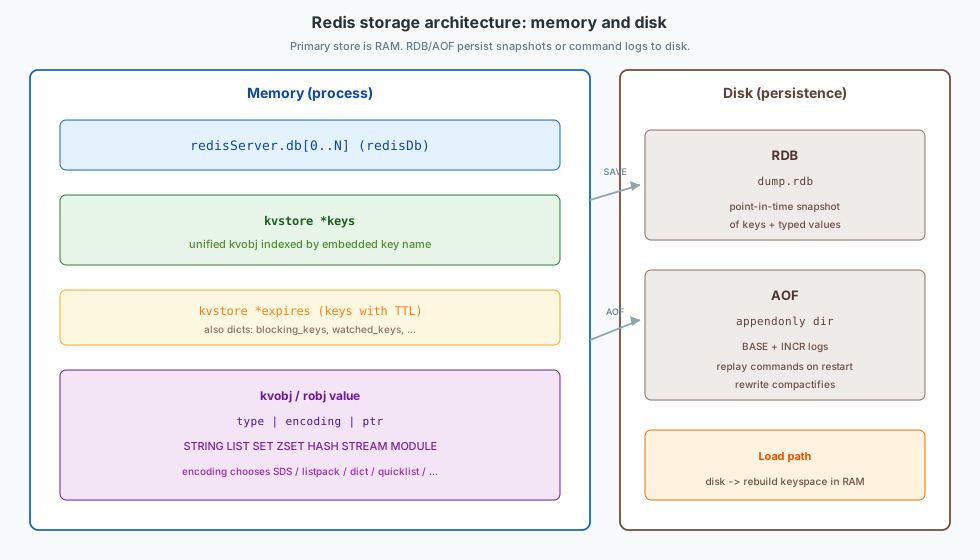
Redis stores the live keyspace in memory and may persist it to disk with RDB snapshots and AOF logs. In Cluster mode the keyspace is partitioned into 16384 hash slots before any local encoding applies. Each value is a typed object (robj / kvobj): type is the client-visible contract, and encoding is the concrete in-memory representation. This post describes the storage architecture (memory hierarchy—including Cluster hash slots—and disk persistence), then the per-type encodings and promotion rules (git/redis: cluster.h, db.c, object.*, rdb.c, aof.c, t_*.c).
Related: Network / command path, Pub/Sub, Cluster bus, Build from source.
1. Storage architecture
The server process is the authoritative store for live data. Ordinary command execution reads and writes the in-memory object graph; persistence reconstructs that graph after restart. Cluster hash-slot partitioning of the keyspace is described with kvstore in §1.1.4.
1.1 Memory hierarchy
The in-memory keyspace is a fixed hierarchy: redisServer owns an array of redisDb instances; each database owns a kvstore of dictionaries; each dictionary entry is a unified kvobj (robj with an embedded key). Command execution reads and writes only this graph. Persistence and replication reconstruct or copy it; they are not a second live store. In Cluster mode the keyspace kvstore is indexed by hash slot (§1.1.4); otherwise it uses a single dictionary.
| Layer | Structure | Role |
|---|---|---|
| Process | struct redisServer | Process-wide state; owns db[0..dbnum-1] |
| Database | redisDb | One logical database and its indexes |
| Keyspace | kvstore *keys | Array of dictionaries over unified kvobj entries; Cluster: one dictionary per hash slot |
| Expiry index | kvstore *expires | Same kvobj instances that carry a timeout |
| Hash table | dict | Power-of-two buckets, chaining, incremental rehash |
| Value | kvobj / robj | type, encoding, ptr; embedded key and optional metadata when iskvobj |
@startuml
!option handwritten true
skinparam class {
    BackgroundColor White
    BorderColor Black
    ArrowColor Black
}

struct redisServer {
  +db : redisDb*
  +dbnum : int
}

struct redisDb {
  +keys : kvstore*
  +expires : kvstore*
  +subexpires : estore*
  +blocking_keys : dict*
  +watched_keys : dict*
  +ready_keys : dict*
  +id : int
}

struct kvstore {
  +dicts : dict**
  +num_dicts : long long
  +num_dicts_bits : long long
  +key_count : unsigned long long
  +type : kvstoreType*
  +flags : int
}

struct dict {
  +ht : buckets
}

struct redisObject {
  +type : 4 bits
  +encoding : 4 bits
  +refcount
  +iskvobj : 1
  +metabits : 8
  +lru
  +ptr : void*
}

struct kvobj {
}

redisServer "1" *-- "N" redisDb : db
redisDb "1" *-- "1" kvstore : keys
redisDb "1" *-- "1" kvstore : expires
kvstore "1" *-- "num_dicts" dict : dicts
dict "1" --> "*" kvobj : entries
kvobj --|> redisObject : iskvobj + embedded key
@enduml
1.1.1 Usage
- Clients address keys on the currently selected
redisDb(default 0). Handlers resolvec->dband operate on that database’s in-memorykvobjgraph. On standalone instancesSELECTmay switch databases; Cluster keeps a single database and rejectsSELECTother than0. - RDB and AOF restore or log that graph; they are not consulted on the ordinary read/write path.
- Cluster hash-slot mapping, ownership, and redirection are part of the keyspace layer (§1.1.4).
1.1.2 Process layer: redisServer
server.c defines one global struct redisServer (server.h): process-wide configuration and runtime state. For the keyspace, the decisive members are db, a contiguous array of logical databases, and dbnum, the configured length of that array.
/* server.h — abbreviated */
struct redisServer {
    /* General */
    redisDb *db;
    /* ... */
    int dbnum;  /* Total number of configured DBs */
    /* ... */
};

/* server.c */
struct redisServer server; /* Server global state */
A client does not hold a private database. client.db points at the redisDb selected by SELECT (initially &server.db[0]).
/* server.h — abbreviated */
typedef struct client {
    redisDb *db;  /* Pointer to currently SELECTed DB. */
    /* ... */
} client;
Initialization allocates server.db and creates each database’s indexes. When cluster_enabled is set, every kvstore is created with CLUSTER_SLOT_MASK_BITS (14), so num_dicts == CLUSTER_SLOTS (16384):
/* server.c — abbreviated initialization */
server.db = zmalloc(sizeof(redisDb) * server.dbnum);

int slot_count_bits = 0;
int flags = KVSTORE_ALLOCATE_DICTS_ON_DEMAND;
if (server.cluster_enabled) {
    slot_count_bits = CLUSTER_SLOT_MASK_BITS;
    flags |= KVSTORE_FREE_EMPTY_DICTS;
}

for (int j = 0; j < server.dbnum; j++) {
    server.db[j].keys =
        kvstoreCreate(&kvstoreExType, &dbDictType,
                      slot_count_bits, flags);
    server.db[j].expires =
        kvstoreCreate(&kvstoreBaseType, &dbExpiresDictType,
                      slot_count_bits, flags);
    server.db[j].id = j;
}
Command handlers resolve keys through c->db.
1.1.3 Database layer: redisDb
redisDb (server.h) is one logical keyspace inside a single Redis process. Databases are numbered from 0 to dbnum - 1; that number is stored in id. They are not separate servers: they share memory, the event loop, persistence files, and replication. Isolation is only that keys in different redisDb instances do not collide by name.
/* server.h — abbreviated */
typedef struct redisDb {
    kvstore *keys;       /* The keyspace for this DB */
    kvstore *expires;    /* Timeout of keys with a timeout set */
    estore *subexpires;  /* Timeout of sub-keys (currently hashes) */
    dict *blocking_keys; /* Keys with clients waiting for data (BLPOP) */
    dict *ready_keys;    /* Blocked keys that received a PUSH */
    dict *watched_keys;  /* WATCHED keys for MULTI/EXEC CAS */
    int id;              /* Database ID */
    long long avg_ttl;   /* Average TTL, for stats */
    unsigned long expires_cursor; /* Cursor of the active expire cycle */
    /* ... stream / unblock-on-nokey indexes ... */
} redisDb;
| Field | Role |
|---|---|
keys | Authoritative keyspace; also carries key-size histogram metadata |
expires | Index of keys that have a timeout |
subexpires | Index of sub-key timeouts (currently hash fields) |
blocking_keys / ready_keys | Block and wake clients waiting on keys (e.g. BLPOP) |
watched_keys | Keys watched for MULTI / EXEC |
id | Database number for SELECT, persistence, replication, and notifications |
avg_ttl / expires_cursor | Expiry statistics and active-expire progress |
keys holds the payloads. The other containers are secondary indexes or coordination structures: they reference the same kvobj instances and do not duplicate values. Absolute expiry timestamps live in metadata attached to the object (§1.1.7), not as a separate map of timestamps alone.
How a client uses a database. Every connection holds client.db, a pointer into server.db[]. New clients start on database 0. Key commands (GET, SET, DEL, …), blocking indexes, and WATCH all resolve through that pointer; they never search other databases unless the command is explicitly cross-DB (MOVE, SWAPDB, FLUSHALL).
/* db.c */
int selectDb(client *c, int id) {
    if (id < 0 || id >= server.dbnum)
        return C_ERR;
    c->db = &server.db[id];
    return C_OK;
}
SELECT n only rebinds c->db. It does not copy keys. Out of range yields DB index is out of range. The configured count is databases (default 16, immutable after startup in config.c). URI form redis://host:port/n and redis-cli -n n select database n at connect time.
| Command / surface | Scope |
|---|---|
| Ordinary key commands | Current c->db only |
SELECT n | Switch current database (standalone) |
MOVE key n | Relocate one key from the current DB to DB n |
SWAPDB i j | Exchange the two redisDb structures for all clients |
FLUSHDB | Empty the current database |
FLUSHALL | Empty every database |
| RDB / AOF / replication | Emit SELECT (or RDB DB opcodes) when the stream changes database so replicas and reload see the same id |
| Keyspace notifications | Channel names include the database id (e.g. __keyspace@0__:…) |
Why deployments seldom leave DB 0. Multiple databases are a lightweight namespace inside one process, not tenancy. They share RAM and failure domains; a multi-key transaction cannot span databases; monitoring and ACL designs usually treat the instance as one unit. In practice most applications keep a single logical dataset on DB 0 and use key prefixes (or Cluster hash tags) for subdivision. Higher indexes appear mainly in legacy layouts, local test isolation, or rare “scratch” databases on standalone instances.
Cluster mode: only database 0. Redis Cluster does not partition by database index. On config load, if cluster_enabled is set and databases > 1, the server forces dbnum = 1 and logs a warning (config.c). SELECT with any id other than 0 is rejected:
/* db.c — selectCommand (abbreviated) */
if (server.cluster_enabled && id != 0) {
    addReplyError(c, "SELECT is not allowed in cluster mode");
    return;
}
Thus a Cluster node still uses the redisDb type and c->db, but the array length is one: every key lives in server.db[0], and horizontal partition is by hash slot (§1.1.4), not by database id.
1.1.4 Keyspace layer: kvstore and hash slots
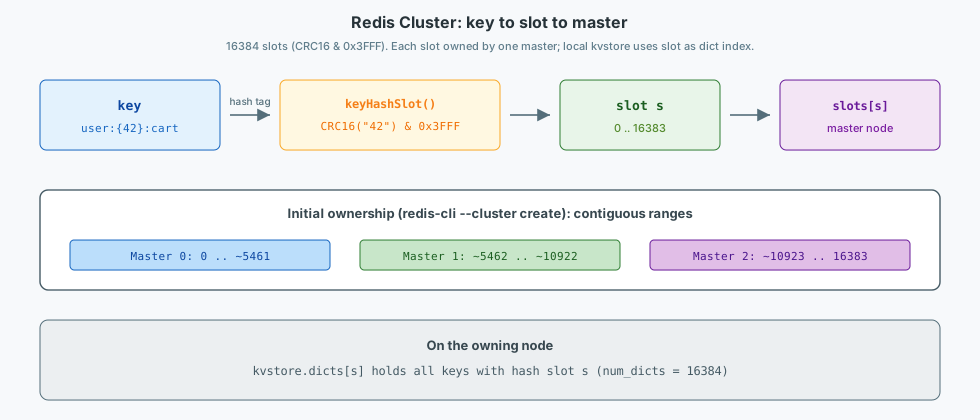
kvstore (kvstore.h, kvstore.c) is an array of dictionaries. Keys that share a dictionary index are stored together so scans, migration, and accounting can address one dictionary at a time. In standalone mode there is one dictionary. In Cluster mode the dictionary index is the key’s hash slot: each node stores only keys for slots it owns, and kvstore.dicts[s] holds the keys of slot \(s\).
Usage (Cluster).
- The hash slot of a key is a deterministic function of the key name (or of a non-empty hash tag
{…}). - Node ownership (the restriction most deployments notice): each command that names keys must run on the master that owns those keys’ slot. A wrong node replies
-MOVED(stable owner) or-ASK(migration). Cluster-aware clients (Jedis, Lettuce, Redisson,redis-cli -c) follow the redirect or compute the slot first, so operators mainly see automatic routing rather than errors. - Same-slot for multi-key (rarer in practice): a multi-key command is allowed only when every key hashes to the same slot id, not merely to slots owned by the same node. Distinct slot numbers yield
-CROSSSLOTeven if one master owns all of those slots. Clients usually avoid this by issuing per-key commands, or by co-locating keys with a shared{tag}. - Operators assign and transfer slot ownership with
CLUSTER ADDSLOTSandCLUSTER SETSLOT(and tools such asredis-cli --cluster create/reshard). Clients inspect the map withCLUSTER KEYSLOT,CLUSTER SLOTS, andCLUSTER NODES.
Command path: two checks. Before a handler runs, processCommand (server.c) calls getNodeByQuery. That function first requires every key in the request to share one slot; then it requires that slot’s owner to be this node:
/* server.c — processCommand (abbreviated) */
if (server.cluster_enabled && /* … */) {
    int error_code;
    clusterNode *n = getNodeByQuery(c, c->cmd, c->argv, c->argc,
        &c->slot, /* … */, &error_code);
    if (n == NULL || !clusterNodeIsMyself(n)) {
        clusterRedirectClient(c, n, c->slot, error_code);
        return C_OK; /* command not executed locally */
    }
}
Same-slot check (cluster.c). Distinct slots among the command’s keys yield CLUSTER_CROSSSLOT:
/* cluster.c — extractSlotFromKeysResult (abbreviated) */
int first_slot = INVALID_CLUSTER_SLOT;
for (int j = 0; j < keys_result->numkeys; j++) {
    int this_slot = keyHashSlot(/* key */);
    if (first_slot == INVALID_CLUSTER_SLOT)
        first_slot = this_slot;
    else if (first_slot != this_slot)
        return CLUSTER_CROSSSLOT;
}
/* cluster.c — getNodeByQuery (abbreviated) */
if (slot != thisslot) {
    *error_code = CLUSTER_REDIR_CROSS_SLOT;
    return NULL;
}
/* … later, if owner is not myself: */
if (n != myself && error_code) *error_code = CLUSTER_REDIR_MOVED;
Client-visible replies (clusterRedirectClient):
/* cluster.c — clusterRedirectClient (abbreviated) */
if (error_code == CLUSTER_REDIR_CROSS_SLOT) {
    addReplyError(c,
        "-CROSSSLOT Keys in request don't hash to the same slot");
} else if (error_code == CLUSTER_REDIR_MOVED ||
           error_code == CLUSTER_REDIR_ASK) {
    addReplyErrorSds(c, sdscatprintf(sdsempty(),
        "-%s %d %s:%d",
        (error_code == CLUSTER_REDIR_ASK) ? "ASK" : "MOVED",
        hashslot, /* host */, /* port */));
}
So the everyday restriction is which node may run the command (-MOVED / -ASK). The multi-key rule is stricter than node ownership: keys must share one slot number (-CROSSSLOT), even when several slots already live on that same master. The check compares keyHashSlot results only; it does not consult whether getNodeBySlot(a) == getNodeBySlot(b). Clients hide node routing for single-key traffic and often sidestep -CROSSSLOT by not sending multi-key commands across slot ids.
Multi-key commands. “Multi-key” means multiple Redis key names, not fields, members, or stream IDs. Families that can name more than one key in one invocation (and thus need one shared slot if sent as a single Cluster command):
| Family | Commands |
|---|---|
| Generic / string | DEL, UNLINK, EXISTS, TOUCH, MGET, MSET, MSETNX, MSETEX, COPY, RENAME, RENAMENX, LCS, BITOP, WATCH |
| List | BLPOP, BRPOP, LMPOP, BLMPOP, LMOVE, BLMOVE, RPOPLPUSH, BRPOPLPUSH |
| Set | SINTER, SUNION, SDIFF, SINTERCARD, SINTERSTORE, SUNIONSTORE, SDIFFSTORE, SMOVE |
| Sorted set | ZINTER, ZUNION, ZDIFF, ZINTERCARD, ZINTERSTORE, ZUNIONSTORE, ZDIFFSTORE, ZRANGESTORE, ZMPOP, BZMPOP, BZPOPMIN, BZPOPMAX |
| HyperLogLog | PFCOUNT, PFMERGE |
| Geospatial | GEOSEARCHSTORE; GEORADIUS / GEORADIUSBYMEMBER when STORE or STOREDIST supplies a destination key |
| Stream | XREAD, XREADGROUP when reading multiple stream keys |
| Scripting / functions | EVAL, EVALSHA, EVAL_RO, EVALSHA_RO, FCALL, FCALL_RO when numkeys > 1 |
| Dynamic key discovery | SORT / SORT_RO with key-bearing BY, GET, or STORE arguments; MIGRATE ... KEYS |
Example: MGET user:{42}:name user:{42}:email shares tag 42, so both keys map to one slot and can run as a single command. MGET a b returns -CROSSSLOT whenever keyHashSlot("a") != keyHashSlot("b"), even if both slots are assigned to the same master. Same-node ownership does not relax the rule; only the same slot id (or splitting into per-key GETs) does. HDEL hash field1 field2 remains single-key: fields are not Redis keys. Client libraries that implement mGet as separate GETs never hit this check for the logical batch.
/* kvstore.c — abbreviated */
struct _kvstore {
    int flags;
    kvstoreType *type;
    dictType dtype;
    dict **dicts;
    long long num_dicts;
    long long num_dicts_bits;
    list *rehashing;             /* dictionaries currently rehashing */
    int allocated_dicts;         /* number of allocated dicts */
    int non_empty_dicts;         /* number of non-empty dicts */
    unsigned long long key_count;
    unsigned long long bucket_count;
    fenwickTree *dict_sizes;     /* cumulative key frequencies by dict index */
    /* ... */
};
num_dicts is always a power of two:
/* kvstore.c */
kvs->num_dicts_bits = num_dicts_bits;
kvs->num_dicts = 1 << kvs->num_dicts_bits;
kvs->dicts = zcalloc(sizeof(dict *) * kvs->num_dicts);
| Mode | num_dicts_bits | num_dicts | Dictionary index |
|---|---|---|---|
| Standalone | 0 | 1 | Always 0 |
| Cluster | CLUSTER_SLOT_MASK_BITS (14) | 16384 (CLUSTER_SLOTS) | Hash slot of the key |
KVSTORE_ALLOCATE_DICTS_ON_DEMAND defers allocation of empty dictionaries. Cluster mode also sets KVSTORE_FREE_EMPTY_DICTS. rehashing lists dictionaries under incremental rehash; dict_sizes is a Fenwick tree of per-dictionary key counts used for size-weighted index selection when num_dicts > 1.
Key to hash slot. Redis Cluster defines 16384 hash slots (cluster.h). keyHashSlot returns the low 14 bits of CRC-16 over the bytes that participate in the hash:
/* cluster.h — keyHashSlot (abbreviated) */
static inline unsigned int keyHashSlot(const char *key, int keylen) {
    /* Locate a {...} hash tag; if absent or empty, hash the whole key. */
    /* ... */
    return crc16(/* tagged or full key */, /* len */) & 0x3FFF; /* 0 .. 16383 */
}
| Key form | Bytes hashed | Result |
|---|---|---|
No { / } | Entire key | Default |
{tag} with non-empty tag | Bytes between { and } | All keys with the same tag share one slot |
Empty {} or missing } | Entire key | Tag ignored |
Thus user:{42}:cart and user:{42}:orders both hash the substring 42 and share a slot; unrelated names generally do not.
When cluster_enabled is set, getKeySlot and calculateKeySlot (db.c) return keyHashSlot(...). Otherwise they return 0. Lookup uses that index and then searches the chosen dictionary:
/* db.c */
static kvobj *dbFindGeneric(kvstore *kvs, sds key) {
    dictEntry *de =
        kvstoreDictFind(kvs, getKeySlot(key), key);
    return de ? dictGetKey(de) : NULL;
}

kvobj *dbFind(redisDb *db, sds key) {
    return dbFindGeneric(db->keys, key);
}
A key with hash slot \(s\) is stored in dicts[s] on the node that owns slot \(s\).
Slot ownership. Ownership is configuration; it is independent of CRC-16. Each node records:
| Structure | Content |
|---|---|
clusterState.slots[s] | Owning clusterNode *, or NULL if the slot is unbound |
clusterNode.slots | 2048-byte bitmap (CLUSTER_SLOTS/8); bit \(s\) set means this node claims slot \(s\) |
Gossip header myslots | Same bitmap on the cluster bus, so peers refresh -MOVED targets |
clusterAddSlot(n, slot) fails if slots[slot] is already assigned; on success it sets the node’s bit and server.cluster->slots[slot] = n. In a healthy map exactly one master owns each slot.
redis-cli --cluster create assigns contiguous ranges of about \(16384 / N\) slots to each of \(N\) masters (clusterManagerCommandCreate), then issues CLUSTER ADDSLOTS. With three masters the ranges are approximately 0–5461, 5462–10922, and 10923–16383. Replica anti-affinity rearranges replica placement only. Resharding and failover change ownership (CLUSTER SETSLOT … MIGRATING|IMPORTING|NODE, clusterMoveNodeSlots); they do not change keyHashSlot.
| Server reply | Condition |
|---|---|
| Serve locally | This node owns the slot, or it is importing and the client sent ASKING |
-MOVED slot host:port | Another node is the stable owner |
-ASK slot host:port | Migration target for one request |
-CROSSSLOT | Keys map to more than one slot id (same owning node is not enough) |
-CLUSTERDOWN | Cluster state is not OK, or a required slot is unbound |
Invariants. Every key name maps to exactly one hash slot in 0..16383. A healthy cluster assigns every slot to exactly one master. Replicas replicate a master’s dataset; they do not hold an independent write-ownership bitmap for those slots. Gossip and discrete UPDATE messages propagate ownership bits; they do not recompute CRC-16.
1.1.5 Hash-table layer: dict
dict (dict.h) is Redis’s generic in-memory hash table: insert, delete, replace, find, and random selection; automatic resize; power-of-two bucket counts; collision resolution by chaining.
/* dict.h — abbreviated */
struct dict {
    dictType *type;
    dictEntry **ht_table[2];
    unsigned long ht_used[2];
    long rehashidx; /* -1 when not rehashing */
    unsigned pauserehash; /* >0 pauses rehashing */
    signed char ht_size_exp[2]; /* size = 1<<exp */
    int16_t pauseAutoResize;
    void *metadata[];
};
Behavior is parameterized by dictType. The source groups members as callbacks, opaque data, and flags. Callbacks are function pointers; flags alter entry layout:
/* dict.h — abbreviated; section comments from source */
typedef struct dictType {
    /* Callbacks */
    uint64_t (*hashFunction)(const void *key);
    void *(*keyDup)(dict *d, const void *key);
    void *(*valDup)(dict *d, const void *obj);
    int (*keyCompare)(dictCmpCache *cache, const void *key1, const void *key2);
    void (*keyDestructor)(dict *d, void *key);
    void (*valDestructor)(dict *d, void *obj);
    int (*resizeAllowed)(size_t moreMem, double usedRatio);
    /* ... rehashingStarted, rehashingCompleted, bucketChanged,
     *     dictMetadataBytes ... */

    /* Data */
    void *userdata;

    /* Flags */
    unsigned int no_value:1;       /* values unused; dict acts as a set */
    unsigned int keys_are_odd:1;   /* required for no_value pointer tagging */
    unsigned int force_full_rehash:1;

    /* Callbacks (continued) */
    const void *(*keyFromStoredKey)(const void *key); /* lookup key from stored object */
    void (*onDictRelease)(dict *d);
    /* ... prefetchEntryKey, prefetchEntryValue ... */
} dictType;
| Kind | Member | Role in the database keyspace |
|---|---|---|
| Callback | hashFunction | Hash the lookup key (dictSdsHash) |
| Callback | keyCompare | Compare lookup key to stored key (dictSdsCompareKV) |
| Callback | keyDestructor | Free the stored kvobj (dictDestructorKV) |
| Callback | keyFromStoredKey | Extract SDS from the stored kvobj (kvGetKey) |
| Flag | no_value | No separate value; the stored item is the unified kvobj |
| Flag | keys_are_odd | Pointer-tagging mode for direct-key buckets |
Two bucket tables support incremental rehashing: lookups may consult both ht_table[0] and ht_table[1], and ordinary operations advance rehashidx in small steps. Collision chains use dictEntry (next and key occupy the first two fields so the no-value layout can share the same prefix):
/* dict.c */
struct dictEntry {
    struct dictEntry *next;  /* Must be first */
    void *key;               /* Must be second */
    union {
        void *val;
        uint64_t u64;
        int64_t s64;
        double d;
    } v;
};
The database keyspace does not use a separate key/value pair in dictEntry. With no_value = 1, dictEntry.v is unused and the stored key is the unified kvobj. A lone key in a bucket may be stored without allocating a dictEntry (pointer tagging distinguishes entry pointers from direct keys).
dictEntry.key remains void * because dict is shared across Redis (SDS keys, hash fields, command tables, module maps, and so on). Polymorphism is provided by dictType callbacks, not by a typed pointer. For the keyspace, the lookup key from a command is an SDS string (Simple Dynamic String — Redis’s length-prefixed, binary-safe string type; see §2.1), while the stored key is a kvobj. keyFromStoredKey (kvGetKey) extracts the embedded SDS so hash and compare operate on the lookup form. dbDictType in server.c installs that configuration:
/* server.c — abbreviated */
dictType dbDictType = {
    /* Callbacks (positional) */
    dictSdsHash,          /* hashFunction */
    NULL,                 /* keyDup */
    NULL,                 /* valDup */
    dictSdsCompareKV,     /* keyCompare */
    dictDestructorKV,     /* keyDestructor */
    NULL,                 /* valDestructor */
    dictResizeAllowed,    /* resizeAllowed */
    /* Flags and later callbacks (designated) */
    .no_value = 1,                /* flag: unified kvobj, no separate value */
    .keys_are_odd = 0,            /* flag: kvobj pointer tagging mode */
    .keyFromStoredKey = kvGetKey, /* callback: SDS from stored kvobj */
};
1.1.6 Value layer: kvobj / robj
robj (struct redisObject in object.h) is the in-memory value container. It carries:
type— logical type (OBJ_STRING,OBJ_LIST,OBJ_SET,OBJ_ZSET,OBJ_HASH,OBJ_STREAM,OBJ_MODULE, …);encoding— concrete representation for that type (OBJ_ENCODING_*);lru— LRU clock, or LFU frequency and time when LFU eviction is enabled;refcount— lifetime management;ptr— payload (SDS, dict, quicklist, …).
kvobj is the same structure used as a database entry. When iskvobj is set, the allocation extends beyond struct redisObject:
- After the struct: the key SDS is embedded; for small strings the value SDS may follow the key.
- Before the struct: optional metadata regions (distinct from Cluster hash slots). Up to eight regions exist, each eight bytes. Presence is recorded only in the
metabitsfield (bit \(i\) means region \(i\) is attached). Region 0 holds the expiration timestamp; regions 1–7 are reserved for module key metadata. Attached regions precede theredisObjectheader with higher IDs at lower addresses.kvobjCreatereturns a pointer to that header; metadata bytes therefore sit at negative offsets from thekvobj *.
/* Allocation layout when metabits has regions 3 and 1 set (bit pattern 0b00001010): */
| 8B region 3 | 8B region 1 | redisObject | key-hdr-size (1) | SDS key | [optional SDS value] |
                                 ^
                                 kvobj* returned here
kvobjCreate sizes the allocation from keyMetaBits and the key length. The number of prepended regions is the popcount of the mask; each region is one uint64_t. The returned pointer skips those regions and addresses the redisObject header:
/* keymeta.h */
static inline uint32_t getNumMeta(uint16_t metabits) {
    /* Assumed expire is always first meta */
    return __builtin_popcount(metabits);
}

/* object.c — abbreviated kvobjCreate */
kvobj *kvobjCreate(int type, const sds key, void *ptr, uint32_t keyMetaBits) {
    size_t key_sds_len = sdslen(key);
    /* Large keys reserve an expire region even if EXPIRE is not set yet. */
    if (key_sds_len >= KEY_SIZE_TO_INCLUDE_EXPIRE_THRESHOLD)
        keyMetaBits |= KEY_META_MASK_EXPIRE;

    uint32_t sizeMetas = getNumMeta(keyMetaBits) * sizeof(uint64_t);

    char key_sds_type = sdsReqType(key_sds_len);
    size_t key_sds_size = sdsReqSize(key_sds_len, key_sds_type);

    size_t min_size = sizeof(robj);
    min_size += sizeMetas;
    min_size += 1 + key_sds_size; /* 1 byte: SDS header size of the embedded key */

    char *alloc = zmalloc(min_size);
    kvobj *kv = (kvobj *)(alloc + sizeMetas); /* skip metadata regions */
    /* ... fill type/encoding/ptr/refcount/iskvobj ... */
    kv->metabits = keyMetaBits;

    char *data = (void *)(kv + 1); /* bytes after the struct */
    *data++ = sdsHdrSize(key_sds_type);
    sdsnewplacement(data, key_sds_size, key_sds_type, key, key_sds_len);

    keyMetaResetValues(kv);
    return kv;
}
Accessors follow the same layout. Metadata region \(i\) is located by counting how many lower IDs are set in metabits and indexing that many uint64_ts before kv. The embedded key begins one byte (header size) after the struct:
/* object.c — abbreviated */
uint64_t *kvobjMetaRef(kvobj *kv, int metaId) {
    uint32_t bits = kv->metabits;
    if (likely(metaId == 0))
        return ((uint64_t *)kv) - 1; /* expire is always adjacent */

    uint32_t maskId = 1u << metaId;
    uint32_t lowerMask = maskId - 1u;
    int metaSlot = __builtin_popcount(bits & lowerMask);
    return ((uint64_t *)kv) - metaSlot - 1;
}

sds kvobjGetKey(const kvobj *kv) {
    unsigned char *data = (void *)(kv + 1);
    uint8_t hdr_size = *data;
    data += 1 + hdr_size;
    return (sds)data;
}
kvobjCreateEmbedString uses the same size formula and places the embedded value SDS after the key when the total fits a cache line (kvobjSet).
/* object.h */
struct redisObject {
    unsigned type:4;
    unsigned encoding:4;
    unsigned refcount : OBJ_REFCOUNT_BITS;
    unsigned iskvobj : 1;   /* 1 if this struct serves as a kvobj base */
    /* metabits and lru are Relevant only when iskvobj is set: */
    unsigned metabits :8;  /* Bitmap of metadata (+expiry) attached to this kvobj */
    unsigned lru:LRU_BITS; /* LRU time or LFU data */
    void *ptr;
};
typedef struct redisObject robj;   /* general-purpose object */
typedef struct redisObject kvobj;  /* key-value object; see layout above */
| Field | Meaning |
|---|---|
type | Logical type; command type checks use this field |
encoding | Current representation; may change without changing type |
ptr | Payload or inline integer |
refcount | Lifetime management; special values mark shared or stack objects |
lru | LRU clock, or LFU bits when LFU eviction is enabled |
metabits | Bitmap of which 8-byte metadata regions precede the struct; bit 0 denotes expiration |
On insertion, kvobjSet builds the database form and transfers or duplicates the payload. The EMBSTR path may embed key and value in one allocation when the total size fits a cache line:
/* object.c — abbreviated; EMBSTR branch of kvobjSet */
if (val->type == OBJ_STRING &&
    val->encoding == OBJ_ENCODING_EMBSTR) {
    size_t len = sdslen(val->ptr);
    size_t size = sizeof(kvobj);
    size += sdslen(key) + 3;
    size += 4 + len;

    if (size <= CACHE_LINE_SIZE)
        kv = kvobjCreateEmbedString(
            val->ptr, len, key, keyMetaBits);
    else
        kv = kvobjCreate(
            OBJ_STRING, key,
            sdsnewlen(val->ptr, len), keyMetaBits);
}
For other encodings, kvobjSet transfers or duplicates val->ptr, creates a kvobj, copies encoding and LRU fields, and decrements the previous value’s reference count. The resulting kvobj owns both the database key and the value representation.
1.1.7 Expiry index and metadata
Expiry is not a separate key-to-timestamp map inside db->expires. Redis stores the timestamp in metadata preceding the kvobj, then inserts that same object into the expiry index:
/* db.c — abbreviated */
kvobj *kv = dictGetKV(*keyLink);
kvobj *kvnew = kvobjSetExpire(kv, when);

/* Adding metadata may reallocate the object. */
if (kv != kvnew) {
    kvstoreDictSetAtLink(
        db->keys, slot, kvnew, &keyLink, 0);
    kv = kvnew;
}

/* Index the current kvobj among expiring keys. */
kvstoreDictAddRaw(db->expires, slot, kv, NULL);
If attaching expiry metadata reallocates the object, Redis updates keys before inserting into expires, so both indexes refer to one current kvobj.
1.1.8 Lookup and insertion
Read path:
client->db
  -> redisDb.keys
  -> kvstore.dicts[getKeySlot(key)]
  -> dict hash lookup
  -> stored kvobj
  -> kvobj.type / encoding / ptr
Insertion packages key and value, then stores the result under the key’s dictionary index:
/* db.c — abbreviated */
kvobj *dbAddInternal(redisDb *db, robj *key, robj **valref,
                     dictEntryLink *link,
                     const KeyMetaSpec *keymeta)
{
    int slot = getKeySlot(key->ptr);
    kvobj *kv = kvobjSet(key->ptr, *valref, keymeta->metabits);
    initObjectLRUOrLFU(kv);
    kvstoreDictSetAtLink(db->keys, slot, kv, link, 1);
    *valref = kv;
    return kv;
}
Further steps may attach expiry or module metadata, emit readiness and keyspace notifications, update size histograms, and account per-slot memory when Cluster mode is enabled.
Example: SET greeting hello
SET greeting hello
setCommand (t_string.c) builds a string object for hello and calls setKey / dbAdd* so the key is inserted into the selected database’s keys kvstore.
| Step | Location | Effect |
|---|---|---|
| 1 | server.db[0] | Default database (SELECT 0) |
| 2 | db->keys | kvstore with one dictionary in standalone mode |
| 3 | dicts[0] | dbDictType stores the kvobj as a no-value dictionary key; comparison extracts the embedded key greeting |
| 4 | kvobj | type = OBJ_STRING; for this short pair, key and EMBSTR value share one allocation |
@startuml
!option handwritten true
skinparam object {
    BackgroundColor White
    BorderColor Black
    ArrowColor Black
}

object "redisDb id=0" as db {
  keys = kvstore*
}

object "kvstore keys" as kvs {
  num_dicts = 1
  dicts[0] = dict*
}

object "dict" as d {
  no_value = 1
  stored key = kvobj*
  lookup key = "greeting"
}

object "kvobj" as kv {
  type = OBJ_STRING
  encoding = EMBSTR
  key = "greeting"
  ptr -> SDS "hello"
}

db *-- kvs
kvs *-- d
d *-- kv : unified stored item
@enduml
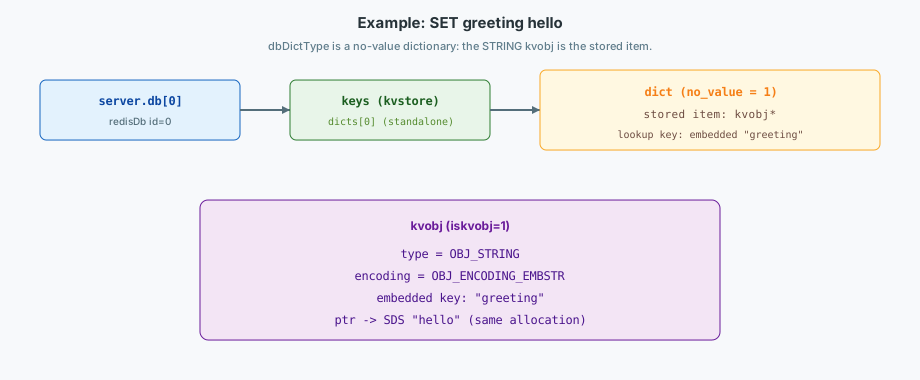
OBJECT ENCODING greeting reports embstr. A small integer such as SET n 1 may use encoding = INT instead of SDS. SET with EX or PX attaches expiration metadata and registers the same kvobj in db->expires.
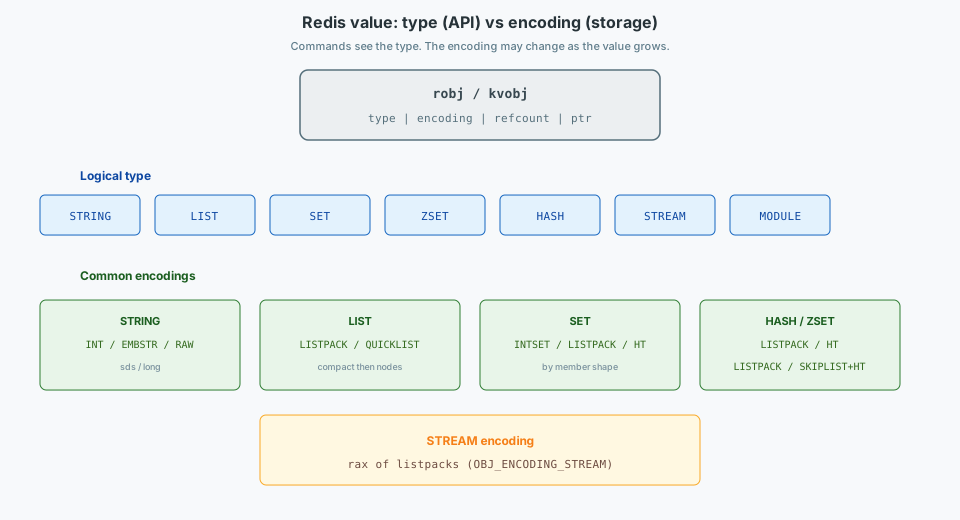
type (API) | Representative commands | Encodings in this tree |
|---|---|---|
OBJ_STRING | SET, GET, INCR | INT, EMBSTR, RAW |
OBJ_LIST | LPUSH, LRANGE | LISTPACK, QUICKLIST |
OBJ_SET | SADD, SINTER | INTSET, LISTPACK, HT |
OBJ_ZSET | ZADD, ZRANGE | LISTPACK, SKIPLIST (+ dict) |
OBJ_HASH | HSET, HGETALL | LISTPACK, LISTPACK_EX, HT |
OBJ_STREAM | XADD, XREAD | STREAM (rax of listpacks) |
OBJ_MODULE | module APIs | module-defined |
1.2 Disk persistence
| Mechanism | On-disk form | Contents | Load behavior |
|---|---|---|---|
| RDB | Snapshot file (e.g. dump.rdb) | Serialized keys and typed values at a point in time | Rebuild the keyspace from the snapshot |
| AOF | Directory of BASE and INCR files | Log of write commands, plus rewrite output | Replay commands to reconstruct memory |
| RDB and AOF | Both configured | On restart AOF is preferred when present; RDB remains useful for replicas and backups | See INFO persistence and configuration |
RDB (rdb.c) walks the keyspace and writes type-tagged encodings, including legacy ziplist forms that are converted on load. AOF (aof.c) appends to an in-memory aof_buf and flushes according to appendfsync; rewrite produces a compact BASE that reflects current data. Neither path is the hot read path: commands always operate on the in-memory kvobj.
Replication transmits a base dataset to replicas using RDB (and related channels). That is a network use of the snapshot format, not a second storage model.
1.3 Boundaries
- Pub/Sub messages are not keys; they do not appear in
keys, RDB, or AOF as values (see Pub/Sub). - Disk files are durable copies or logs; they do not maintain a live object graph beside RAM.
- Cluster hash-slot indexing and ownership are covered under the keyspace layer (§1.1.4); gossip that spreads the ownership map is Cluster bus. Each node stores only the keys for slots it owns, with the same memory and disk design as standalone.
2. Data type implementations
Clients do not select an encoding. Redis begins with a compact representation and promotes when entry count, element size, or integer-only constraints are violated. The logical type remains unchanged. Promotion thresholds below are the defaults from config.c (overridable) unless noted otherwise.
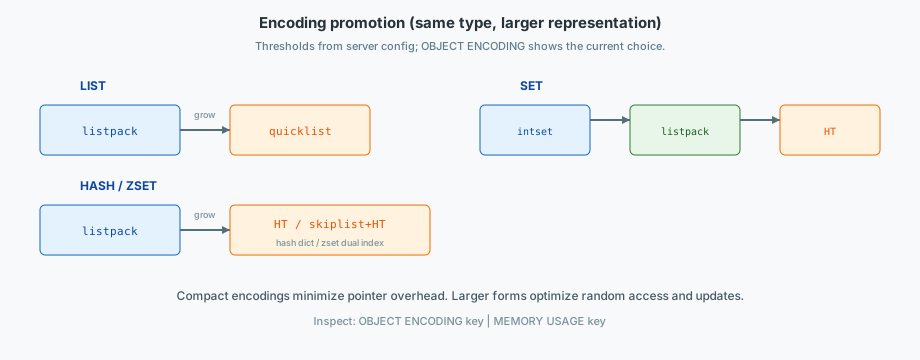
2.1 String
OBJ_STRING (t_string.c). Client operations:
| Kind | Commands |
|---|---|
| Write | SET, SETNX, SETEX, PSETEX, MSET, MSETNX, APPEND, GETSET / SET GET |
| Read | GET, MGET, GETRANGE, STRLEN, GETDEL, GETEX |
| Integer / float | INCR, INCRBY, INCRBYFLOAT, DECR, DECRBY |
| Bit / substring | SETBIT, GETBIT, BITCOUNT, BITOP, BITPOS, BITFIELD, SETRANGE |
String keys and values are built on SDS (Simple Dynamic String), Redis’s dynamic string library (sds.h / sds.c). An sds value is typed as char * and points at the character buffer (buf), not at the header. The header sits immediately before that pointer and stores used length (len), allocated capacity (alloc), and a flags byte that encodes the header width. The buffer is always null-terminated, so it remains usable as a C string, yet sdslen is O(1) and the payload may contain embedded \0 bytes (binary-safe).
/* Memory for one SDS string (sdshdr8 example): */
| len | alloc | flags | buf ... '\0' |
                      ^
                      sds pointer (typedef char *sds)
/* sds.h */
typedef char *sds;

struct __attribute__ ((__packed__)) sdshdr8 {
    uint8_t len;         /* used length of buf */
    uint8_t alloc;       /* allocated capacity, excluding header and '\0' */
    unsigned char flags; /* low 3 bits: header type (8/16/32/64) */
    char buf[];
};
/* sdshdr16 / sdshdr32 / sdshdr64 widen len and alloc for longer strings. */
Redis selects the smallest header type that fits the length (sdsReqType). That same SDS representation is used for database key names embedded in kvobj, for OBJ_STRING payloads (EMBSTR / RAW), and for many other string-like keys throughout the server.
| Encoding | Payload | Condition |
|---|---|---|
INT | long in ptr | Value admits integer encoding |
EMBSTR | Object header and SDS in one allocation | Length ≤ OBJ_ENCODING_EMBSTR_SIZE_LIMIT (44) |
RAW | Separate SDS allocation | Larger strings, or strings mutated in place |
Promotion and limits (object.c, t_string.c):
- Shared integers occupy
0 .. OBJ_SHARED_INTEGERS-1(10000) and avoid per-key allocations. EMBSTRis used only while length ≤ 44 and the string is not mutated in place.- Growth, append, or in-place mutation promotes
EMBSTR(or a formerINTthat no longer fits) toRAW. INCRprefers integer encoding when the result remains an integer.
EMBSTR keeps the SDS bytes in the same allocation as the kvobj / robj. RAW stores ptr as a separately allocated SDS.
2.2 List
OBJ_LIST (t_list.c). Client operations:
| Kind | Commands |
|---|---|
| Push / pop ends | LPUSH, RPUSH, LPUSHX, RPUSHX, LPOP, RPOP, LMPOP |
| Blocking | BLPOP, BRPOP, BLMPOP, BRPOPLPUSH / BLMOVE, LMOVE |
| Access / mutate | LINDEX, LSET, LINSERT, LREM, LTRIM, LRANGE |
| Length / position | LLEN, LPOS |
| Encoding | Structure |
|---|---|
LISTPACK | Single contiguous listpack |
QUICKLIST | Doubly linked list of listpack nodes (quicklist.c); interior nodes may be LZF-compressed |
A list value is a sequence of elements. While it stays compact, Redis stores that sequence as one listpack (listpack.h / listpack.c): a contiguous byte array of string or integer entries. When the structure grows past the configured fill limit, t_list.c converts through listTypeTryConversion* into a quicklist whose nodes each hold a listpack (or a plain/LZF-compressed buffer). End operations remain O(1); mid-list access walks nodes.
Why quicklist
Redis lists are often used as queues (LPUSH/RPOP, BLPOP, …), so the hot path is the ends, not middle insert. Lists still expose mid-list commands (LINDEX, LSET, LINSERT, LREM, LTRIM, LRANGE, LPOS), but those are not why quicklist exists.
A single contiguous listpack is already a problem for end updates once it grows:
lpPrepend(used byLPUSH) inserts after the 6-byte header and mustmemmoveevery existing entry.- Growth also reallocates one ever-larger buffer.
- So even a pure queue on one giant listpack would copy O(list size) bytes on each push at the head.
A classical doubly linked list of elements (adlist) makes both ends O(1) without copying neighbors, but wastes memory on per-element pointers.
Quicklist is the hybrid for that queue-shaped workload: a doubly linked list of small listpacks. LPUSH / LPOP usually touch only head; RPUSH / RPOP only tail. When the head node is full (per list-max-listpack-size, default -2 ≈ 8 KiB), Redis links a new head node instead of shifting the whole list. Mutation may still memmove inside one node, but that cost is bounded by the fill limit. Interior nodes can be LZF-compressed (list-compress-depth) because a queue rarely touches them. Very large single elements use a PLAIN node so they do not inflate a packed neighbor listpack.
Mid-list commands still work by walking nodes and operating inside one listpack; they remain more expensive than end ops, and that is expected. Quicklist’s primary win is keeping end operations cheap and memory compact as the list grows—not making middle mutation free.
Listpack layout
A listpack is a single allocation with a fixed header, zero or more entries, and a terminating LP_EOF byte:
| total-bytes (4) | num-elements (2) | entry … entry | EOF (0xFF) |
|<-------- LP_HDR_SIZE = 6 -------->|
/* listpack.c */
#define LP_HDR_SIZE 6       /* 32-bit total length + 16-bit element count */
#define LP_EOF 0xFF

unsigned char *lpNew(size_t capacity) {
    unsigned char *lp = lp_malloc(
        capacity > LP_HDR_SIZE+1 ? capacity : LP_HDR_SIZE+1);
    lpSetTotalBytes(lp, LP_HDR_SIZE+1);
    lpSetNumElements(lp, 0);
    lp[LP_HDR_SIZE] = LP_EOF;
    return lp;
}
Each entry is self-describing: an encoding byte (and optional length bytes), the payload, then a backlen — a reverse-encoded length of the whole entry so lpPrev can walk backward without a separate index:
| encoding [+ len] | payload | backlen |
Integers that fit use a compact integer encoding (7-bit through 64-bit); other values use a string encoding with a 6-bit, 12-bit, or 32-bit length prefix (lpEncodeGetType / lpEncodeIntegerGetType). Decoded entries are exposed as listpackEntry:
/* listpack.h */
typedef struct {
    unsigned char *sval;  /* string pointer; NULL if integer */
    uint32_t slen;
    long long lval;       /* used when sval == NULL */
} listpackEntry;
Navigation and mutation use opaque pointers into the byte array (lpFirst, lpNext, lpPrev, lpAppend, lpInsertString / lpInsertInteger, lpDelete). Insertions and deletions may reallocate and memmove the tail, which is why lists eventually split into quicklist nodes rather than growing one unbounded listpack.
The same listpack format is reused as the compact encoding for small sets, hashes, and sorted sets, and as the packed payload under each stream rax leaf.
Promotion and list-max-listpack-size
| Config | Default | Effect |
|---|---|---|
list-max-listpack-size | -2 | Fill limit for each listpack (standalone or inside a quicklist node) |
The value is the quicklist fill factor passed to quicklistNodeLimit / quicklistNodeExceedsLimit (quicklist.c). Its sign selects the limit kind:
- Non-negative (
fill >= 0): limit by element count (at mostfillentries per node;0means 1). - Negative (
fill < 0): limit by byte size. Redis maps the value onto a fixed size table:
/* quicklist.c */
static const size_t optimization_level[] = {4096, 8192, 16384, 32768, 65536};

/* Calculate the size limit of the quicklist node based on negative 'fill'. */
static size_t quicklistNodeNegFillLimit(int fill) {
    assert(fill < 0);
    size_t offset = (-fill) - 1;   /* -1 → 0, -2 → 1, … */
    size_t max_level = sizeof(optimization_level) / sizeof(*optimization_level);
    if (offset >= max_level) offset = max_level - 1;
    return optimization_level[offset];
}
list-max-listpack-size | Meaning |
|---|---|
-1 | ≈ 4 KiB per listpack |
-2 (default) | ≈ 8 KiB per listpack |
-3 | ≈ 16 KiB |
-4 | ≈ 32 KiB |
-5 or lower | ≈ 64 KiB (table capped) |
N >= 0 | At most N elements per listpack (0 ⇒ 1) |
So -2 is not an error code: it selects the second size class (8192 bytes), the recommended default noted beside SIZE_SAFETY_LIMIT in quicklist.c. When a node would exceed that limit, Redis starts a new quicklist node rather than enlarging the current listpack further.
Quicklist
A quicklist bounds per-node size while preserving O(1) insertion at both ends:
/* quicklist.h — abbreviated */
typedef struct quicklistNode {
    struct quicklistNode *prev;
    struct quicklistNode *next;
    unsigned char *entry;        /* a listpack, or LZF-compressed buffer */
    size_t sz;                   /* entry size in bytes */
    unsigned int count : 16;     /* items in this node's listpack */
    unsigned int encoding : 2;   /* RAW==1 or LZF==2 */
    unsigned int container : 2;  /* PLAIN==1 or PACKED==2 */
    /* ... compression bookkeeping bits ... */
} quicklistNode;

typedef struct quicklist {
    quicklistNode *head;
    quicklistNode *tail;
    unsigned long count;  /* total entries across all nodes */
    unsigned long len;    /* number of quicklistNodes */
    signed int fill : QL_FILL_BITS;       /* per-node fill factor */
    unsigned int compress : QL_COMP_BITS; /* uncompressed end depth */
    /* ... */
} quicklist;
2.3 Set
OBJ_SET (t_set.c). Client operations:
| Kind | Commands |
|---|---|
| Membership | SADD, SREM, SISMEMBER, SMISMEMBER, SCARD |
| Retrieve | SMEMBERS, SSCAN, SRANDMEMBER, SPOP |
| Set algebra | SINTER, SINTERSTORE, SINTERCARD, SUNION, SUNIONSTORE, SDIFF, SDIFFSTORE |
| Move | SMOVE |
| Encoding | Constraint |
|---|---|
INTSET | All members are integers; size ≤ set-max-intset-entries |
LISTPACK | Small non-integer sets within listpack limits |
HT | dict after conversion |
Promotion and limits:
| Config | Default | Effect |
|---|---|---|
set-max-intset-entries | 512 | Maximum size of an integer-only intset |
set-max-listpack-entries | 128 | Maximum entry count in a set listpack |
set-max-listpack-value | 64 | Maximum member size in a set listpack |
setTypeConvert* in t_set.c promotes when a non-integer member arrives (intset → listpack or HT) or when the configured entry/value limits are exceeded (listpack → HT).
An intset stores sorted fixed-width integers in one contiguous block. encoding selects the element width (16, 32, or 64 bits); contents is a flexible array reinterpreted at that width. Membership tests use binary search:
/* intset.h */
typedef struct intset {
    uint32_t encoding;   /* INTSET_ENC_INT16 / INT32 / INT64 */
    uint32_t length;     /* number of elements */
    int8_t contents[];   /* sorted elements, reinterpreted per encoding */
} intset;
2.4 Sorted set
OBJ_ZSET (t_zset.c). Client operations:
| Kind | Commands |
|---|---|
| Add / update | ZADD, ZINCRBY, ZREM, ZMSCORE |
| By rank | ZRANGE, ZREVRANGE, ZRANK, ZREVRANK, ZREMRANGEBYRANK |
| By score | ZRANGEBYSCORE, ZREVRANGEBYSCORE, ZCOUNT, ZREMRANGEBYSCORE |
| By lex | ZRANGEBYLEX, ZREVRANGEBYLEX, ZLEXCOUNT, ZREMRANGEBYLEX |
| Pop / block | ZPOPMIN, ZPOPMAX, BZPOPMIN, BZPOPMAX, ZMPOP, BZMPOP |
| Store / union | ZUNION, ZUNIONSTORE, ZINTER, ZINTERSTORE, ZINTERCARD, ZDIFF, ZDIFFSTORE, ZRANDMEMBER, ZSCAN, ZCARD, ZSCORE |
| Encoding | Structure |
|---|---|
LISTPACK | Member/score pairs for small sorted sets |
SKIPLIST | Skiplist for order plus dict for member-to-score lookup; members are shared SDS |
Promotion and limits:
| Config | Default | Effect |
|---|---|---|
zset-max-listpack-entries | 128 | Maximum entry count in a zset listpack |
zset-max-listpack-value | 64 | Maximum member size in a zset listpack |
When either limit is exceeded, t_zset.c converts the listpack into a zset (SKIPLIST encoding): a dict provides expected O(1) score-by-member lookup, and a zskiplist supports ordered range queries. Both structures index the same SDS member. Each skiplist node stores a score and a variable-height level[] array of forward pointers and spans:
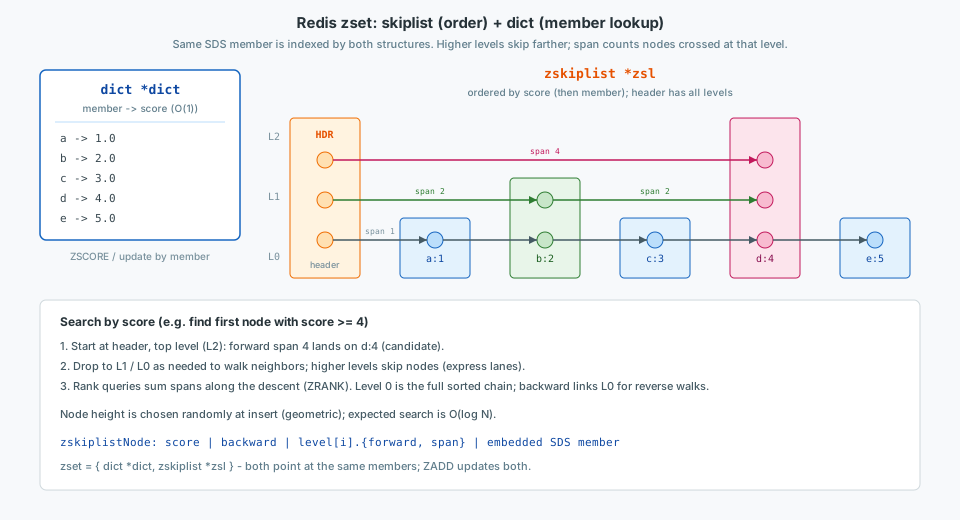
Level 0 is a doubly linked chain of every member in score order (forward / backward). Higher levels are sparse express lanes: each level[i].forward skips ahead, and level[i].span counts how many level-0 nodes that hop crosses (used for ZRANK). A new node’s height is chosen randomly at insert, so search and rank are expected O(log N).
/* server.h */
typedef struct zskiplistNode {
    double score;
    struct zskiplistNode *backward;
    struct zskiplistLevel {
        struct zskiplistNode *forward;
        unsigned long span;  /* elements skipped at this level */
    } level[];
    /* sds member embedded after level[] */
} zskiplistNode;

typedef struct zskiplist {
    struct zskiplistNode *header, *tail;
    unsigned long length;
    int level;
    size_t alloc_size;
} zskiplist;

typedef struct zset {
    dict *dict;      /* member -> score */
    zskiplist *zsl;  /* score order */
} zset;
Ordered operations are O(log N); score lookup by member is expected O(1) via the dictionary.
Add (ZADD)
Membership is checked in the dict first. A new member is inserted into the skiplist, then the node pointer is stored in the dict (the SDS member lives in the skiplist node):
/* t_zset.c — abbreviated SKIPLIST branch of zsetAdd */
zset *zs = zobj->ptr;
dictEntryLink bucket = NULL;
dictEntryLink link = dictFindLink(zs->dict, ele, &bucket);

if (link != NULL) {
    /* Member already present: maybe zslUpdateScore after NX/XX/GT/LT checks. */
    zskiplistNode *znode = dictGetKey(*link);
    /* ... */
} else if (!xx) {
    zskiplistNode *znode = zslInsert(zs->zsl, score, ele);
    dictSetKeyAtLink(zs->dict, znode, &bucket, 1);
}
zslInsert picks a random height, allocates the node, then zslInsertNode walks from the top level to find predecessors and rewires forward / span:
/* t_zset.c — abbreviated */
zskiplistNode *zslInsert(zskiplist *zsl, double score, sds ele) {
    int level = zslRandomLevel();
    zskiplistNode *node = zslCreateNode(zsl, level, score, ele);
    zslInsertNode(zsl, node);
    return node;
}

static void zslInsertNode(zskiplist *zsl, zskiplistNode *node) {
    zskiplistNode *update[ZSKIPLIST_MAXLEVEL];
    unsigned long rank[ZSKIPLIST_MAXLEVEL];
    zskiplistNode *x = zsl->header;
    double score = node->score;
    sds ele = zslGetNodeElement(node);
    int level = zslGetNodeInfo(node)->levels;
    int i;

    for (i = zsl->level - 1; i >= 0; i--) {
        rank[i] = i == (zsl->level - 1) ? 0 : rank[i + 1];
        while (zslCompareWithNode(score, ele, x->level[i].forward) > 0) {
            rank[i] += zslGetNodeSpanAtLevel(x, i);
            x = x->level[i].forward;
        }
        update[i] = x;
    }
    /* Raise skiplist height if needed, then splice node into each level
     * and adjust spans / backward / length. */
    /* ... */
}
Check / lookup
By member (ZSCORE, existence): use the dict, not a skiplist scan.
/* t_zset.c — abbreviated */
int zsetScore(robj *zobj, sds member, double *score) {
    if (zobj->encoding == OBJ_ENCODING_SKIPLIST) {
        zset *zs = zobj->ptr;
        dictEntry *de = dictFind(zs->dict, member);
        if (de == NULL) return C_ERR;
        zskiplistNode *znode = dictGetKey(de);
        *score = znode->score;
        return C_OK;
    }
    /* LISTPACK: zzlFind(...) */
}
By rank (ZRANGE by index / ZRANK path): walk spans from the header downward until the traversed rank matches.
/* t_zset.c — abbreviated */
static zskiplistNode *zslGetElementByRankFromNode(
        zskiplistNode *start_node, int start_level, unsigned long rank)
{
    zskiplistNode *x = start_node;
    unsigned long traversed = 0;
    int i;

    for (i = start_level; i >= 0; i--) {
        while (x->level[i].forward &&
               (traversed + zslGetNodeSpanAtLevel(x, i)) <= rank)
        {
            traversed += zslGetNodeSpanAtLevel(x, i);
            x = x->level[i].forward;
        }
        if (traversed == rank)
            return x;
    }
    return NULL;
}

zskiplistNode *zslGetElementByRank(zskiplist *zsl, unsigned long rank) {
    return zslGetElementByRankFromNode(zsl->header, zsl->level - 1, rank);
}
2.5 Hash
OBJ_HASH (t_hash.c). Client operations:
| Kind | Commands |
|---|---|
| Field write | HSET, HMSET, HSETNX, HINCRBY, HINCRBYFLOAT |
| Field read | HGET, HMGET, HGETALL, HKEYS, HVALS, HEXISTS, HLEN, HSTRLEN, HRANDFIELD, HSCAN |
| Field delete | HDEL |
| Field expiry | HEXPIRE, HPEXPIRE, HEXPIREAT, HPEXPIREAT, HTTL, HPTTL, HPERSIST, HGETEX, HSETEX |
| Encoding | Structure |
|---|---|
LISTPACK | Alternating field and value entries |
LISTPACK_EX | Listpack with per-field metadata |
HT | dict mapping field to value |
Promotion and limits:
| Config | Default | Effect |
|---|---|---|
hash-max-listpack-entries | 512 | Maximum field count in a hash listpack |
hash-max-listpack-value | 64 | Maximum field or value bytes in a hash listpack |
hashTypeConvert in t_hash.c converts listpack (or LISTPACK_EX) to HT when either limit is exceeded. The HT encoding reuses the dict structure defined in §1.1.5.
2.6 Stream
OBJ_STREAM / OBJ_ENCODING_STREAM (stream.h, t_stream.c). Client operations:
| Kind | Commands |
|---|---|
| Append / trim | XADD, XTRIM, XDEL, XLEN |
| Read | XRANGE, XREVRANGE, XREAD, XREADGROUP |
| Groups / consumers | XGROUP CREATE / DESTROY / CREATECONSUMER / DELCONSUMER / SETID, XINFO STREAM / GROUPS / CONSUMERS |
| Pending / claim | XPENDING, XACK, XCLAIM, XAUTOCLAIM |
| Misc | XSETID |
| Field | Role |
|---|---|
rax | Radix tree from stream IDs to listpacks of entries |
length | Current entry count |
first_id / last_id | ID bounds |
| Groups / PEL | Consumer-group state beside the entry tree |
Entries are keyed by a 128-bit streamID (millisecond timestamp and sequence) inside a radix tree. Each rax leaf packs many entries into a listpack. Consumer groups are indexed in separate rax trees:
/* stream.h — abbreviated */
typedef struct streamID {
    uint64_t ms;   /* Unix time in milliseconds */
    uint64_t seq;  /* sequence within the millisecond */
} streamID;

typedef struct stream {
    rax *rax;              /* radix tree: ID -> listpack of entries */
    uint64_t length;       /* current number of entries */
    streamID last_id;      /* last inserted ID */
    streamID first_id;     /* first non-tombstone entry */
    uint64_t entries_added;/* all-time inserts */
    rax *cgroups;          /* consumer groups: name -> streamCG */
    /* ... */
} stream;
Streams do not use a listpack→HT promotion path. Growth adds rax nodes and listpacks; there is no *-max-listpack-* threshold that switches the stream encoding itself.
2.7 Shared building blocks
| Structure | Files | Used by |
|---|---|---|
| SDS (Simple Dynamic String) | sds.h, sds.c | Binary-safe length-prefixed strings: keys, string values, zset members |
| listpack | listpack.h, listpack.c | Compact entry sequences (§2.2); also set/hash/zset encodings and stream leaves |
| quicklist | quicklist.c | List nodes (each node holds a listpack) |
| dict | dict.c | Hash and set HT; zset index; many maps |
| intset | intset.c | Integer sets |
| rax | rax.c | Stream IDs |
| skiplist | t_zset.c | Sorted-set order |
Listpack replaced ziplist for newly written data. RDB may still load legacy ziplist encodings and convert them on read.
3. Implementation map
3.1 Key files
| Concern | Files |
|---|---|
| Hash slots / ownership | cluster.h (keyHashSlot, CLUSTER_SLOTS), cluster_legacy.c (clusterAddSlot), redis-cli.c (create ranges), db.c (getKeySlot) |
| Database / keyspace | db.c, kvstore.c, server.h (redisDb) |
| Objects | object.h, object.c |
| Persistence | rdb.c, aof.c |
| Types | t_string.c, t_list.c, t_set.c, t_zset.c, t_hash.c, t_stream.c |
| Encodings | listpack.c, quicklist.c, dict.c, intset.c, rax.c |
| Limits | config.c (*-max-listpack-*, …) |
3.2 Creation and conversion
Factories in object.c establish the initial encoding (createStringObject, createHashObject, createZsetListpackObject, …). Type modules invoke *Convert* when a write exceeds compact limits, then continue through type-level helpers (listTypePush, hashTypeSet, zsetAdd, …).
3.3 Observability
CLUSTER KEYSLOT mykey
CLUSTER SLOTS
CLUSTER NODES
TYPE mykey
OBJECT ENCODING mykey
MEMORY USAGE mykey
INFO persistence
LASTSAVE
3.4 Scope
- Slot gossip, failure detection, and failover voting are covered in Cluster bus; §1.1.4 covers key→slot hashing and how ownership is recorded in
kvstore/clusterState.slots. - Geo commands store geohash scores in sorted sets; they do not introduce a separate
OBJ_*type. - Bitmaps and HyperLogLog are layered on strings or modules and lie outside the encoding matrix above.
- This source tree also defines
OBJ_ARRAYandOBJ_GCRA; those typed objects are outside the classic client types covered here.
| Topic | Summary |
|---|---|
| Architecture | Memory hierarchy (redisDb → kvstore / hash slots → kvobj); disk: RDB / AOF |
| Data types | Per-type encodings and promotion; stream rax; shared listpack, dict, and skiplist |
| Implementation | cluster / db / object / rdb / aof / t_*; inspect with CLUSTER KEYSLOT, TYPE, OBJECT ENCODING |