
Redis Internals: Cluster Bus Gossip Protocol
Redis Cluster keeps a second network plane beside client RESP: the cluster bus. Nodes use it to discover peers, share slot and epoch views, detect failures, vote on failovers, and propagate selected cluster events. This post covers architecture (planes and gossip mechanism), then implementation (protocol wire format and code paths) in git/redis (cluster_legacy.h, cluster_legacy.c).
Related: Network / command path, Data types and encodings, Pub/Sub, Build from source.
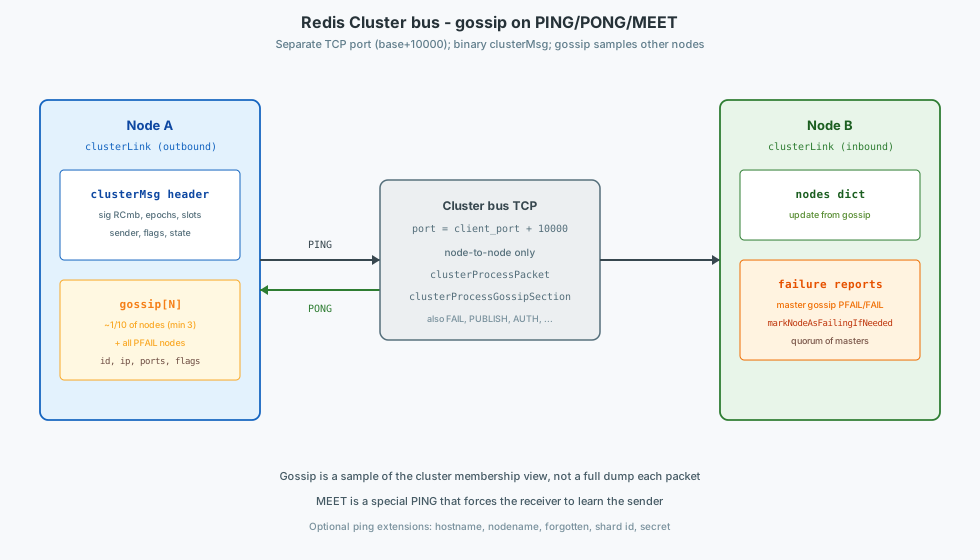
1. Architecture
Redis Cluster’s control architecture is a node-to-node mesh on a dedicated cluster bus port, separate from client RESP. Each node holds a local membership and slot view and exchanges binary clusterMsg packets—periodic gossip for liveness and topology, plus discrete messages for failure, failover, and selected events.
1.1 Two planes
Redis Cluster separates data traffic from control traffic. Clients stay on RESP; only Redis nodes speak the binary bus protocol.
| Plane | Port (typical) | Speakers | Role |
|---|---|---|---|
| Client / data | :6379 RESP | Apps, replication client | Commands, keys, replication stream |
| Cluster bus / control | :16379 (base+10000) binary | Redis nodes only | Membership, health, slots/epochs, votes, selected events |
/* cluster_legacy.h */
#define CLUSTER_PORT_INCR 10000 /* Cluster port = baseport + PORT_INCR */
 clients --RESP--> [ Redis node: data + slots ]
                        |
                        | bus TCP (clusterMsg)
                        v
                   peer ... peer
The bus does not carry ordinary key commands. Gossip scales membership and health without shipping a full node list on every packet.
1.2 Gossip mechanism
Gossip is how Redis Cluster spreads membership and health without shipping a full node list on every packet. It rides only on PING / PONG / MEET: the fixed header always describes the sender (epochs, myslots, flags, …); the body carries a sample of rumors about other nodes (clusterMsgDataGossip rows). Discrete types (FAIL, UPDATE, Pub/Sub, failover votes, …) are separate events on the same links—they are not the gossip sampler.
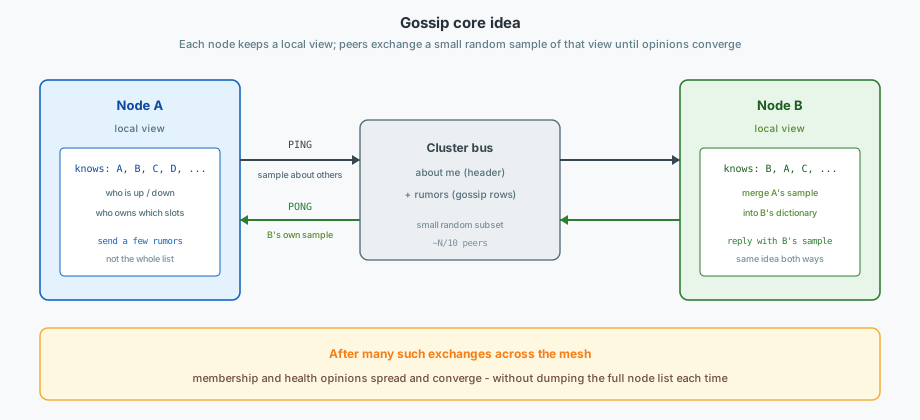
| Pattern | Types | Cadence | Purpose |
|---|---|---|---|
| Continuous gossip | PING, PONG, MEET | Periodic / on meet | Liveness, membership rumors, slot/epoch in header, failure flags in gossip rows |
| Discrete events | FAIL, FAILOVER_AUTH_*, UPDATE, PUBLISH / PUBLISHSHARD, MFSTART, MODULE | On demand | Explicit flood or unicast for one cluster action |
/* cluster_legacy.h — message type ids */
#define CLUSTERMSG_TYPE_PING 0
#define CLUSTERMSG_TYPE_PONG 1
#define CLUSTERMSG_TYPE_MEET 2
#define CLUSTERMSG_TYPE_FAIL 3
#define CLUSTERMSG_TYPE_PUBLISH 4
#define CLUSTERMSG_TYPE_FAILOVER_AUTH_REQUEST 5
#define CLUSTERMSG_TYPE_FAILOVER_AUTH_ACK 6
#define CLUSTERMSG_TYPE_UPDATE 7
#define CLUSTERMSG_TYPE_MFSTART 8
#define CLUSTERMSG_TYPE_MODULE 9
#define CLUSTERMSG_TYPE_PUBLISHSHARD 10
Wire layouts for those types are in §2.3.
1.2.1 Exchange
PING, PONG, and MEET share the same packet kind (data.ping). Semantics differ:
| Type | Role |
|---|---|
PING | Probe; receiver should answer with PONG |
PONG | Reply; completes the liveness round-trip and carries the receiver’s own gossip sample |
MEET | Like PING, but forces the receiver to add the sender if unknown |
Default frequency. clusterCron runs every 100 ms. Both outbound PING paths below execute inside that same function; PONG is not cron-driven. Timing uses cluster-node-timeout (default 15000 ms / 15 s in redis.conf / config.c):
| Path | Where in clusterCron | Default behavior |
|---|---|---|
| Random probe | Early: when iteration % 10 == 0 (~once per second) | Sample a few random peers; PING the connected one with the oldest pong_received (skip self, handshake, outstanding ping). |
| Per-peer refresh | Later: full iteration over nodes | If the link is up, there is no outstanding ping, and the last PONG is older than cluster-node-timeout / 2 (7500 ms by default), send a PING. Override with hidden cluster-ping-interval (ms) when non-zero. Manual-failover wait may PING the chosen replica every pass. |
PONG | Not in cron — clusterProcessPacket | Immediate reply to PING or MEET (same packet shape). |
Local PFAIL | Same per-peer loop as refresh | If an outstanding ping (or data gap) exceeds cluster-node-timeout, set local PFAIL on that peer. |
So under defaults, a healthy peer is typically re-pinged on the order of every ~7.5 s via per-peer refresh when its last pong ages out, and may also receive an extra random probe (~1/s toward the stalest among a small sample).
/* cluster_legacy.c — clusterCron: random probe (~1/s) */
if (!(iteration % 10)) {
    /* pick among a few random nodes; ping oldest pong_received */
    clusterSendPing(min_pong_node->link, CLUSTERMSG_TYPE_PING);
}

/* cluster_legacy.c — clusterCron: per-peer refresh (same function, later loop) */
mstime_t ping_interval = server.cluster_ping_interval ?
    server.cluster_ping_interval : server.cluster_node_timeout/2;
if (node->link &&
    node->ping_sent == 0 &&
    (now - node->pong_received) > ping_interval)
{
    clusterSendPing(node->link, CLUSTERMSG_TYPE_PING);
}
/* cluster_legacy.c — clusterProcessPacket: reply to PING / MEET */
clusterSendPing(link, CLUSTERMSG_TYPE_PONG);
Each successful exchange updates the sender from the peer’s header and merges the peer’s gossip rows into the local nodes dictionary.
1.2.2 Sampling
The body never lists the whole cluster. clusterSendPing builds a bounded random sample, then forces failure opinions into that sample:
| Step | Rule |
|---|---|
| Budget | wanted = max(3, floor(N / 10)), where N = dictSize(nodes) |
| Cap | At most freshnodes = N - 2 (exclude self and the packet’s receiver) |
| Draw | Pick eligible peers at random (skip handshake / no-addr cases the send loop rejects); use last_in_ping_gossip so the same node is not repeated in one ping wave |
| PFAIL bias | After the random draw, append every node the sender already marks PFAIL, even if that exceeds wanted |
| Wire | Set hdr->count to the number of gossip entries actually written |
Why ~1/10 (and at least three). Source comment on clusterSendPing: within about two cluster-node-timeout windows, nodes exchange several pings/pongs. With ~N/10 gossip slots per packet, the chance that a given master appears often enough in others’ samples is high enough that a node already in PFAIL can collect majority failure reports before reports expire—without paying full-membership bandwidth every round.
/* cluster_legacy.c — clusterSendPing */
wanted = floor(dictSize(server.cluster->nodes)/10);
if (wanted < 3) wanted = 3;
if (wanted > freshnodes) wanted = freshnodes;

/* Include all the nodes in PFAIL state, so that failure reports are
 * faster to propagate to go from PFAIL to FAIL state. */
int pfail_wanted = server.cluster->stats_pfail_nodes;
/* … random draw into gossipcount < wanted …
 * … then append every PFAIL node via clusterSetGossipEntry … */
hdr->count = htons(gossipcount);
What each sampled row carries. A rumor about one third party: id, coarse ping_sent / pong_received (seconds), IP and ports, and that peer’s flags as the sender sees them (MASTER / SLAVE / PFAIL / FAIL / NOADDR, …). Exact field sizes are under §2.3.1.
1.2.3 Merge
clusterProcessGossipSection applies each gossip row to the local nodes dictionary after validating node identifiers. Invalid identifiers cause rejection of the entire gossip section.
For each row the subject is the node named in the row; the sender is the peer that transmitted the packet:
- Subject unknown — if the sender is already a trusted member, the row is not
NOADDR, and the subject id is not blacklisted, insert a newclusterNode. - Subject is myself — ignore the row for state updates.
- Subject known and not myself — optionally record or clear a failure report when the sender is a master (rules below); may refresh
pong_receivedfrom the row’s pong time when the subject has no failure flags and no outstanding reports; if the subject is locallyPFAIL/FAILbut the row reports it reachable at a different address, update IP/ports and drop the old link.
Failure reports
A failure report is a local record that a given master recently advertised the subject as PFAIL or FAIL in gossip. Reports are not a bus message type and are not bits in clusterNode.flags. Each subject clusterNode holds a list fail_reports of clusterNodeFailReport entries {reporter, time} in this process only (server.cluster->nodes).
/* cluster_legacy.h */
typedef struct clusterNodeFailReport {
    clusterNode *node;  /* master that reported the failure */
    mstime_t time;      /* last refresh of this report */
} clusterNodeFailReport;
/* subject->fail_reports — list of reporters for that subject */
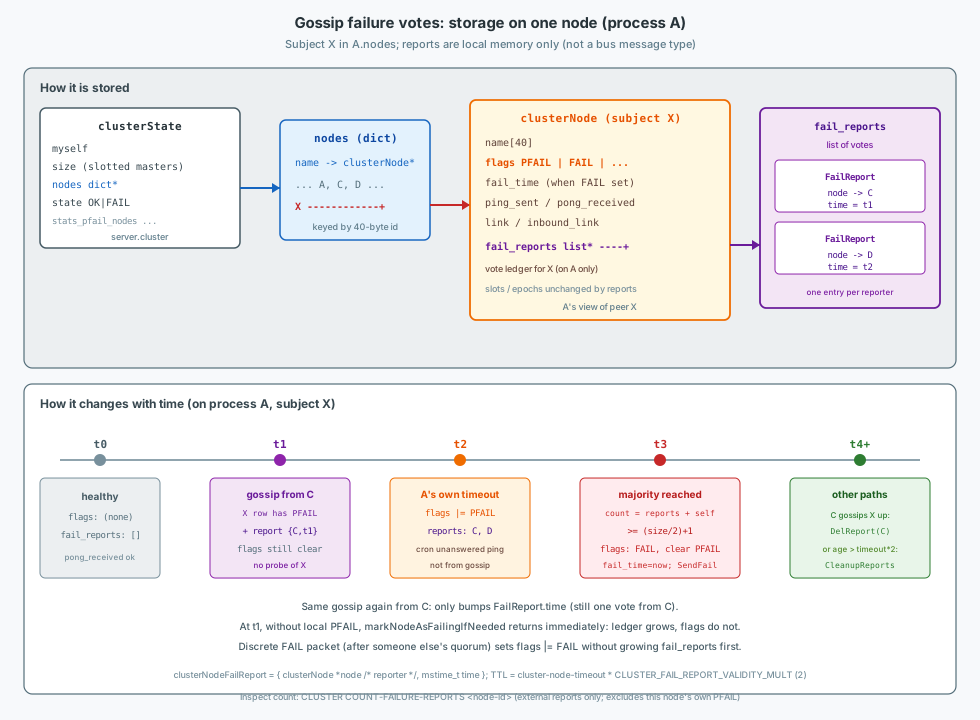
| Event (master sender) | Local update |
|---|---|
Gossip row with PFAIL or FAIL on the subject | clusterNodeAddFailureReport(subject, sender): insert or refresh time for that reporter. No probe of the subject. Then markNodeAsFailingIfNeeded(subject). |
| Gossip row without failure flags on the subject | clusterNodeDelFailureReport(subject, sender). |
| Gossip from a replica | Failure-report list unchanged (only masters contribute reports). |
Same reporter sends PFAIL/FAIL again | Only time is refreshed; still one report per reporter. |
Report age exceeds cluster-node-timeout × CLUSTER_FAIL_REPORT_VALIDITY_MULT (2) | Entry removed by cleanup when the list is counted or edited. |
| Field | Effect of a report add/refresh alone |
|---|---|
subject->fail_reports | Ledger grows or timestamps move. |
subject->flags (PFAIL, FAIL) | Unchanged. Local PFAIL is set only by this node’s unanswered ping / link delay in clusterCron. FAIL is set only by markNodeAsFailingIfNeeded (requires local PFAIL plus majority report count, including self if this node is a master) or by a discrete FAIL packet. |
Slot map, epochs, cluster_state | Unchanged by reports directly; they react after FAIL is set, after failover, or in clusterUpdateState. |
Gossip refresh of pong_received | Suppressed while any failure reports remain for the subject. |
/* cluster_legacy.c — clusterProcessGossipSection (known subject, master sender) */
if (sender && clusterNodeIsMaster(sender)) {
    if (flags & (CLUSTER_NODE_FAIL|CLUSTER_NODE_PFAIL)) {
        clusterNodeAddFailureReport(node, sender);
        markNodeAsFailingIfNeeded(node);
    } else {
        clusterNodeDelFailureReport(node, sender);
    }
}
/* cluster_legacy.c — markNodeAsFailingIfNeeded */
if (!nodeTimedOut(node)) return; /* local PFAIL required */
/* count reports (+ self if master); on quorum: set FAIL, clear PFAIL, clusterSendFail */
Invariants. Gossip PFAIL/FAIL rows record the sender’s opinion in fail_reports; they do not copy those flags onto the subject and do not schedule an immediate probe of the subject. Reachability for local PFAIL continues to follow the ordinary ping schedule in clusterCron. A discrete FAIL message, by contrast, sets FAIL on reachable receivers without requiring local PFAIL—that path runs after quorum has already been reached on some node.
Repeated merge of random samples with PFAIL bias converges membership and failure views with \(O(N)\) rumor bytes per packet rather than \(O(N^2)\) full dumps.
1.2.4 Failure detection (weak quorum)
Failure is a local opinion that becomes a cluster flag only with majority support among masters that serve slots. Gossip sampling is what spreads those opinions:
- If A cannot reach X within
cluster-node-timeout, A sets localPFAILon X (A’s own unanswered ping / link delay—not because gossip said so). - Masters advertise
PFAIL/FAILin gossip rows. Peers that receive those rows from masters record failure reports without probing X (see §1.2.3); they still do not set their ownPFAILon X from the rumor alone. PFAIL bias in §1.2.2 Sampling accelerates report collection. - If A already has
PFAILon X and reports from a majority of masters (quorum \((\mathit{cluster\_size}/2)+1\)), A setsFAIL, clearsPFAIL, and broadcasts a discreteFAILmessage (data.fail) so others can adopt the flag without waiting for another gossip round (and without each peer needing localPFAILfirst). - Reachability again can clear
FAILunder the recovery rules in §1.2.6.
/* cluster_legacy.c — clusterCron: local PFAIL */
if (node_delay > server.cluster_node_timeout) {
    if (!(node->flags & (CLUSTER_NODE_PFAIL|CLUSTER_NODE_FAIL))) {
        node->flags |= CLUSTER_NODE_PFAIL;
        /* … */
    }
}
/* cluster_legacy.c — markNodeAsFailingIfNeeded */
int needed_quorum = (server.cluster->size / 2) + 1;
if (!nodeTimedOut(node)) return;   /* need local PFAIL */
if (nodeFailed(node)) return;

failures = clusterNodeFailureReportsCount(node);
if (clusterNodeIsMaster(myself)) failures++;
if (failures < needed_quorum) return;

node->flags &= ~CLUSTER_NODE_PFAIL;
node->flags |= CLUSTER_NODE_FAIL;
node->fail_time = mstime();
clusterSendFail(node->name);       /* discrete FAIL flood */
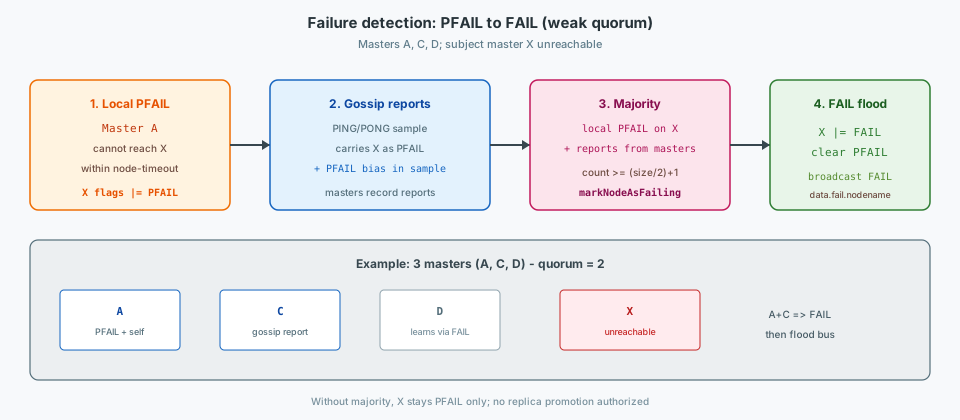
This agreement is intentionally weak and time-based: partitions may delay visibility, and without majority no replica promotion is authorized. How partitions interact with that majority is covered in §1.2.7.
1.2.5 Replica promotion (to master)
Once the failed master is FAIL, a replica of that master may try to take over on the same bus:
- Replica
RbroadcastsFAILOVER_AUTH_REQUEST(header carries epochs and claimedmyslots; body empty). For manual failover,MFSTARTruns first andFORCEACKmay be set on the request. - Slotted masters that accept the vote reply with unicast
FAILOVER_AUTH_ACK. - When
Rcollects enough acks (failover_auth_countreaches quorum), it promotes:SLAVE→MASTER, claims the former master’s slots, bumpsconfigEpoch. - Peers learn the new owner through subsequent gossip headers and optional
UPDATEpackets so clientMOVEDtargets point atR.
/* cluster_legacy.c — clusterHandleSlaveFailover (excerpt) */
int needed_quorum = (server.cluster->size / 2) + 1;
/* Preconditions: we are a replica; master is FAIL (or manual failover);
 * master still has slots; data not too stale per validity factor. */

if (server.cluster->failover_auth_sent == 0) {
    server.cluster->currentEpoch++;
    server.cluster->failover_auth_epoch = server.cluster->currentEpoch;
    clusterRequestFailoverAuth();   /* broadcast FAILOVER_AUTH_REQUEST */
    server.cluster->failover_auth_sent = 1;
    return;
}

if (server.cluster->failover_auth_count >= needed_quorum) {
    if (myself->configEpoch < server.cluster->failover_auth_epoch)
        myself->configEpoch = server.cluster->failover_auth_epoch;
    clusterFailoverReplaceYourMaster();
}
Masters that accept a request reply with FAILOVER_AUTH_ACK via clusterSendFailoverAuthIfNeeded (one vote per epoch, subject to the usual election rules).
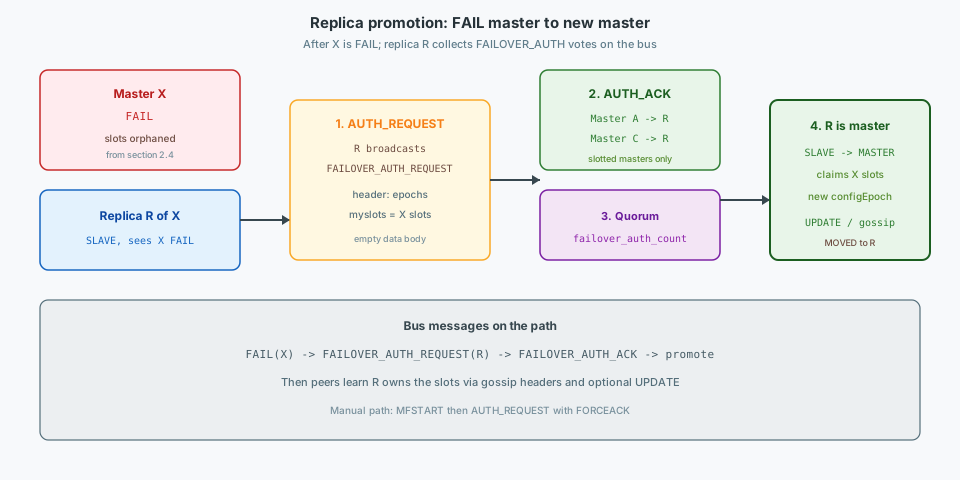
Wire layouts: §2.3.4–§2.3.6, §2.3.7.
1.2.6 Failure recovery
FAIL is mostly one-way: gossip can elevate PFAIL → FAIL, but clearing FAIL is deliberate and rare. When a node becomes reachable again, clearNodeFailureIfNeeded applies:
| Recovered node | When FAIL clears |
|---|---|
| Replica, or master with zero slots | As soon as it is reachable again (replicas are not failed over; slotless masters are not yet part of slot ownership). |
| Master that still owns slots locally | Only after fail_time is older than cluster-node-timeout × CLUSTER_FAIL_UNDO_TIME_MULT (mult = 2), and no promotion has taken the slots from this node’s point of view. |
/* cluster_legacy.h */
#define CLUSTER_FAIL_REPORT_VALIDITY_MULT 2
#define CLUSTER_FAIL_UNDO_TIME_MULT 2

/* cluster_legacy.c — clearNodeFailureIfNeeded */
if (nodeIsSlave(node) || node->numslots == 0) {
    node->flags &= ~CLUSTER_NODE_FAIL;
}
if (clusterNodeIsMaster(node) && node->numslots > 0 &&
    (now - node->fail_time) >
    (server.cluster_node_timeout * CLUSTER_FAIL_UNDO_TIME_MULT))
{
    node->flags &= ~CLUSTER_NODE_FAIL;
}
Failure reports themselves expire after cluster-node-timeout × CLUSTER_FAIL_REPORT_VALIDITY_MULT (also 2), so a stale minority PFAIL view stops contributing to quorum.
After a successful failover. The promoted replica owns the slots with a higher configEpoch. When the old master rejoins:
- Heartbeats still claim the old slots and the old epoch.
- Peers with the newer config reply with
UPDATE(or equivalent header-driven slot ownership), so the rejoining node loses those slots one by one. - When its last slot is gone, the node reconfigures as a replica of whoever stole that last slot (normally the promoted replica). Other replicas of the failed master do the same.
Cluster-level availability (clusterUpdateState): local cluster_state becomes ok only when (with default cluster-require-full-coverage) every slot has a non-FAIL owner and this node can see a majority of slotted masters as neither PFAIL nor FAIL. Otherwise the node reports fail and refuses writes (CLUSTERDOWN). A master that was in a minority partition delays returning to ok after heal by a bounded rejoin delay (clamped from cluster-node-timeout) so it can absorb config updates before accepting queries again.
/* cluster_legacy.c — clusterUpdateState (minority + rejoin delay) */
int needed_quorum = (server.cluster->size / 2) + 1;
if (reachable_masters < needed_quorum) {
    new_state = CLUSTER_FAIL;
    among_minority_time = mstime();
}
/* On heal to OK as a master: wait rejoin_delay (from node timeout,
 * clamped) after among_minority_time before accepting queries. */
1.2.7 Split-brain (partitions)
A network partition splits the bus into sides that cannot exchange gossip. Redis Cluster does not allow both sides to remain fully writable for the same slots; majority among slotted masters is the gate.
Majority side. Masters that can still reach each other form a quorum. They can elevate unreachable peers to FAIL, elect replicas, and keep serving slots that still have a reachable owner (or a successful promotion). Clients on this side continue after failover completes.
Minority side. Reachable masters are fewer than \((\mathit{cluster\_size}/2)+1\). That side cannot:
- collect enough failure reports to authorize a durable
FAILthat leads to promotion, or - gather enough
FAILOVER_AUTH_ACKvotes for an election.
clusterUpdateState therefore sets cluster_state to fail on the minority (snippet in §1.2.6). Writes stop after roughly NODE_TIMEOUT without majority contact, bounding how long minority-side acknowledged writes can be lost when the majority later fails those masters over.
Divergent FAIL views and convergence. Because FAIL agreement is weak and FAIL messages may not cross the cut, temporary disagreement is possible:
- Majority already marked
FAIL— gossip and chain effect eventually force the flag on the rest of the reachable cluster once the partition heals. - Only a minority marked
FAIL— no promotion is authorized (votes need majority votes). After the undo window with the node reachable again, nodes clearFAILper §1.2.6.
Epochs vs dual masters. Automatic failover requires majority votes and a unique bumped configEpoch, so two partitions cannot both complete a legitimate election for the same slots. If two masters ever claim the same configEpoch (for example after forced / admin paths), clusterHandleConfigEpochCollision breaks the tie by node id so conflicting masters do not keep identical epochs indefinitely—the design treats lasting dual writers for the same slots as the worst outcome.
/* cluster_legacy.c — clusterHandleConfigEpochCollision */
if (sender->configEpoch != myself->configEpoch ||
    !clusterNodeIsMaster(sender) || !clusterNodeIsMaster(myself)) return;
/* Smaller node id keeps its epoch; larger id bumps itself. */
if (memcmp(sender->name, myself->name, CLUSTER_NAMELEN) <= 0) return;
server.cluster->currentEpoch++;
myself->configEpoch = server.cluster->currentEpoch;
Client write safety (partition window). Writes on the majority side are retained with best effort; a short window of loss is still possible around failover because replication is asynchronous. Writes accepted on the minority before it goes CLUSTERDOWN can be discarded when the majority promotes a replica whose dataset never saw them.
1.2.8 Design properties (gossip)
| Property | Consequence |
|---|---|
| Sampled gossip + PFAIL bias | Bandwidth grows gently with \(N\); failures propagate faster than uniform random gossip |
Weak majority for FAIL | Avoids single-observer false failovers; still partition-sensitive |
Majority gate on elections + cluster_state | Minority partitions refuse writes; only one side can complete failover |
FAIL clear + epoch/UPDATE rejoin | False or stale failures unwind; old masters demote instead of fighting the new owner |
| Header + sample each ping | Topology and health refresh continuously without a full membership dump |
2. Implementation
2.1 Links and packet ingress
/* cluster_legacy.h */
typedef struct clusterLink {
    connection *conn;
    list *send_msg_queue;
    char *rcvbuf;
    clusterNode *node;   /* NULL until sender is known */
    int inbound;
    /* ... */
} clusterLink;
clusterCron (and related paths) open outbound links and schedule pings. Inbound data accumulates in rcvbuf until a full clusterMsg is present; clusterProcessPacket branches on type:
/* cluster_legacy.c — clusterProcessPacket (shape) */
uint16_t type = ntohs(hdr->type);
if (type == CLUSTERMSG_TYPE_PING || type == CLUSTERMSG_TYPE_MEET) {
    /* … MEET may create sender … */
    clusterSendPing(link, CLUSTERMSG_TYPE_PONG);
}
if (type == CLUSTERMSG_TYPE_PING || type == CLUSTERMSG_TYPE_PONG ||
    type == CLUSTERMSG_TYPE_MEET)
{
    /* apply header; then: */
    clusterProcessGossipSection(hdr, link);
} else if (type == CLUSTERMSG_TYPE_FAIL) {
    /* force FAIL on named node */
} else if (type == CLUSTERMSG_TYPE_FAILOVER_AUTH_REQUEST) {
    clusterSendFailoverAuthIfNeeded(sender, hdr);
} else if (type == CLUSTERMSG_TYPE_FAILOVER_AUTH_ACK) {
    /* count vote toward failover_auth_count */
}
/* UPDATE, PUBLISH*, MFSTART, MODULE, … */
2.2 Protocol design
2.2.1 Framing
Every bus packet is one binary clusterMsg: fixed header, then a type-specific data body. Signature RCmb, protocol version 1; field offsets are ABI-stable across upgrades.
- Header always describes the sender — id, IP, ports, flags, full slot bitmap (
myslots),currentEpoch/configEpoch, replication offset, cluster state. Receivers refresh the sender from the header even when they care mainly about the body. - Body is typed — gossip arrays for the ping family; failed node name for
FAIL; channel+payload for publish; slot config forUPDATE; module blob forMODULE; often empty for vote /MFSTART(meaning is intype+ header epochs/flags). - Trust boundary — unknown senders are ignored for sensitive types.
MEETis the intentional exception that creates knowledge of the sender.
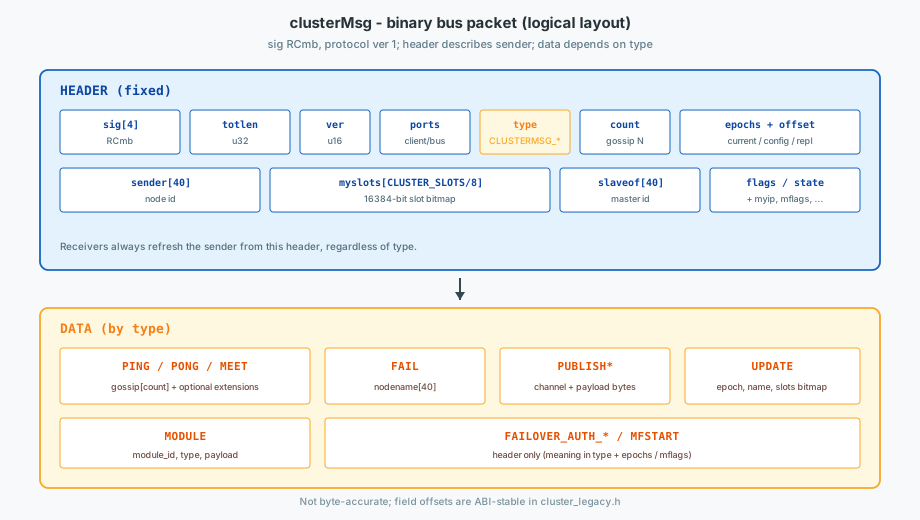
2.2.2 Header fields
The fixed header ends at offset 2256 (data begins there). Multi-byte integers are sent in network byte order. Offsets below are from static_assert in cluster_legacy.h.
| Field | Offset | Size | Meaning |
|---|---|---|---|
sig | 0 | 4 | Must be the ASCII bytes RCmb (Redis Cluster message bus). Used to reject non-bus data on the TCP stream. |
totlen | 4 | 4 | Total packet length in bytes, including this header and the typed data section. Receiver waits until rcvbuf holds at least totlen before calling clusterProcessPacket. |
ver | 8 | 2 | Wire protocol version; currently CLUSTER_PROTO_VER = 1. Nodes reject packets with an unsupported version. |
port | 10 | 2 | Sender’s primary client port (TCP or TLS, whichever is primary for that node). Used with myip / gossip to reach the peer for RESP. |
type | 12 | 2 | CLUSTERMSG_TYPE_* (0–10). Selects how data is interpreted; see §2.3. |
count | 14 | 2 | For PING / PONG / MEET: number of clusterMsgDataGossip entries in data.ping. Unused (typically 0) for other types. |
currentEpoch | 16 | 8 | Cluster epoch as known by the sender—the logical clock advanced on failover elections. Peers adopt a higher epoch when they see one. |
configEpoch | 24 | 8 | If the sender is a master: its own config epoch for the slots it claims. If a replica: the config epoch last advertised by its master. Drives which slot map wins on conflict. |
offset | 32 | 8 | If master: replication offset. If replica: offset processed from the master. Used in failover ranking and manual-failover catch-up (mf_master_offset path). |
sender | 40 | 40 | Sender node id (CLUSTER_NAMELEN), 40-byte hex SHA1-style name. Primary key in the receiver’s nodes dictionary. |
myslots | 80 | 2048 | Bitmap of 16384 slots (CLUSTER_SLOTS/8 bytes). Bit set ⇒ sender claims that slot (as master). Refreshed on every gossip packet so peers keep MOVED targets current. |
slaveof | 2128 | 40 | If the sender is a replica: master’s node id. If master: typically all zeros / null name. |
myip | 2168 | 46 | Sender IP string (NET_IP_STR_LEN), if not all zeroed. Peers may update the known address when this is present and trusted. |
extensions | 2214 | 2 | For ping-family packets with extension payloads: number of extension records after the gossip array. |
notused1 | 2216 | 30 | Reserved; must remain at this offset for ABI stability across upgrades. |
pport | 2246 | 2 | Secondary client port: if port is TCP, this is TLS (and the reverse). Zero when unused. |
cport | 2248 | 2 | Sender’s cluster bus TCP port (often port + 10000 unless announced otherwise). |
flags | 2250 | 2 | Sender’s CLUSTER_NODE_* flags (bitmask), e.g. MASTER, SLAVE, PFAIL, FAIL, HANDSHAKE, NOADDR, NOFAILOVER, … |
state | 2252 | 1 | Cluster state from the sender’s point of view: CLUSTER_OK (0) or CLUSTER_FAIL (1). |
mflags | 2253 | 3 | Per-message flags. Byte 0 (CLUSTERMSG_FLAG0_*): PAUSED (master paused for manual failover), FORCEACK (grant failover auth even if master is up), EXT_DATA (ping body includes extensions). Bytes 1–2 reserved. |
How receivers use the header. After validating sig, ver, and totlen, the node looks up or creates the clusterNode for sender, then copies reachability-related fields (ports, myip, flags, epochs, myslots, slaveof, offset, state) according to the processing rules for that type. Gossip rows in data describe other nodes; the header is always the sender’s self-description.
Flags worth recognizing on the wire.
| Bit | Name | Role |
|---|---|---|
| 1 | MASTER | Node is a master |
| 2 | SLAVE | Node is a replica |
| 4 | PFAIL | Suspected failure (local opinion) |
| 8 | FAIL | Failed after majority agreement |
| 16 | MYSELF | This process (local use) |
| 32 | HANDSHAKE | First exchange not finished |
| 64 | NOADDR | Address unknown |
| 128 | MEET | Pending MEET to this node |
| 512 | NOFAILOVER | Replica will not start failover |
| 1024 | EXTENSIONS_SUPPORTED | Peer understands ping extensions |
In the header, flags describe the sender (normally MASTER or SLAVE, plus capability bits). PFAIL / FAIL matter most in gossip rows (see §1.2), where they are the sender’s opinion about other nodes and feed failure reports.
2.3 Data by message type
hdr->type selects the union clusterMsgData arm. The fixed header (§2.2.2) is always present; only data (and how count / mflags / epochs are interpreted) changes.
| § | Type | Id | data arm |
|---|---|---|---|
| 2.3.1 | PING / PONG / MEET | 0–2 | data.ping |
| 2.3.2 | FAIL | 3 | data.fail |
| 2.3.3 | PUBLISH / PUBLISHSHARD | 4 / 10 | data.publish |
| 2.3.4 | FAILOVER_AUTH_REQUEST | 5 | (empty) |
| 2.3.5 | FAILOVER_AUTH_ACK | 6 | (empty) |
| 2.3.6 | UPDATE | 7 | data.update |
| 2.3.7 | MFSTART | 8 | (empty) |
| 2.3.8 | MODULE | 9 | data.module |
2.3.1 PING / PONG / MEET (0–2) — data.ping
Role. Continuous gossip: liveness round-trip plus membership rumors. MEET additionally inserts the sender if unknown.
Body layout.
data.ping
+------------------+-----+------------------+------------------------+
| gossip[0]        | ... | gossip[count-1]  | ping extensions (opt.) |
+------------------+-----+------------------+------------------------+
  sizeof(clusterMsgDataGossip) each           hdr->extensions records
hdr->count= number of gossip entries (see §1.2.2 Sampling).- Optional extensions follow
&gossip[count]whenmflags[0]hasCLUSTERMSG_FLAG0_EXT_DATA(getInitialPingExt).
Gossip entry (clusterMsgDataGossip) — rumor about a third node, filled by clusterSetGossipEntry:
| Field | Size | Content |
|---|---|---|
nodename | 40 | Subject node id |
ping_sent | 4 | Last ping to that node, seconds (n->ping_sent/1000) |
pong_received | 4 | Last pong from that node, seconds |
ip | 46 | Last known IP |
port | 2 | Primary client port (TCP/TLS per cluster mode) |
cport | 2 | Cluster bus port |
flags | 2 | Sender’s view of that node’s CLUSTER_NODE_* flags |
pport | 2 | Secondary client port |
notused1 | 2 | Reserved; 0 |
Extensions (after the array, 8-byte aligned):
| Ext type | Payload | Purpose |
|---|---|---|
HOSTNAME | NUL-terminated hostname | Announced hostname |
HUMAN_NODENAME | NUL-terminated name | Human-friendly node name |
FORGOTTEN_NODE | node id + TTL (s) | Temporary blacklist |
SHARDID | 40-byte shard id | Shard identity |
INTERNALSECRET | 40-byte secret | Shard internal secret |
Example (PING / PONG). A sends PING to B with count = 4 (three random peers + one PFAIL). B merges gossip, replies PONG with its own header and sample.
Example (MEET). Operator runs CLUSTER MEET 10.0.0.5 7000 on node A. A opens a bus TCP connection to 10.0.0.5:17000 (client port + 10000) and sends a packet with type = MEET, the same data.ping layout as a ping (header describes A, body is a gossip sample). New node N does not yet know A: because the type is MEET, it inserts A into nodes, then replies with PONG (same body shape). Later membership grows through ordinary PING/PONG gossip samples, not further MEET packets.
2.3.2 FAIL (3) — data.fail
Role. After local PFAIL plus majority master reports, broadcast so peers adopt FAIL quickly.
Body (clusterMsgDataFail):
| Field | Size | Content |
|---|---|---|
about.nodename | 40 | Node id to mark FAIL |
No gossip array; count unused.
Example. Master A promotes X to FAIL and broadcasts FAIL with about = X. Peer D adopts the flag from known sender A.
2.3.3 PUBLISH (4) / PUBLISHSHARD (10) — data.publish
Role. Cross-node Pub/Sub. PUBLISH is cluster-wide; PUBLISHSHARD goes only to other nodes in the sender’s shard.
Body (clusterMsgDataPublish; lengths in network order):
| Field | Size | Content |
|---|---|---|
channel_len | 4 | Channel byte length |
message_len | 4 | Payload byte length |
bulk_data | channel_len + message_len | Channel bytes, then message bytes (flexible; struct shows an 8-byte placeholder) |
Example. PUBLISH alerts "disk-full" on A → bus PUBLISH to all nodes. SPUBLISH → PUBLISHSHARD only within the shard.
2.3.4 FAILOVER_AUTH_REQUEST (5) — empty data
Role. Replica asks masters for votes to promote.
Body. None beyond the common header. Meaning is in:
| Header / flag | Use in this type |
|---|---|
currentEpoch / configEpoch | Candidate’s election / config epochs |
myslots | Slots the candidate claims |
mflags FORCEACK | Manual failover: vote even if master still up |
Broadcast; only slotted masters vote (clusterSendFailoverAuthIfNeeded).
Example. Replica R of failed master X broadcasts FAILOVER_AUTH_REQUEST with X’s former slots in myslots.
2.3.5 FAILOVER_AUTH_ACK (6) — empty data
Role. One master’s yes vote, unicast to the candidate.
Body. Empty. Validity is the sender being a slotted master and senderCurrentEpoch >= failover_auth_epoch. Candidate increments failover_auth_count.
Example. Master A sends FAILOVER_AUTH_ACK to R; at quorum, R promotes.
2.3.6 UPDATE (7) — data.update
Role. Push another node’s slot ownership when a peer’s view is stale.
Body (clusterMsgDataUpdate):
| Field | Size | Content |
|---|---|---|
configEpoch | 8 | Config epoch of the slots owner (network order) |
nodename | 40 | Node id that owns the bitmap |
slots | 2048 | Full 16384-bit slot bitmap for that node |
Example. After failover, an UPDATE about R with a higher epoch rewrites B’s slot map so MOVED targets R.
2.3.7 MFSTART (8) — empty data
Role. Replica asks its master to start manual failover (pause writes, set mf_end / mf_slave).
Body. Empty. Sent from a replica to its master to start manual failover (mf_end / mf_slave on the master side).
Example. R sends MFSTART to master M; M pauses clients and pings R with the offset for mf_can_start.
2.3.8 MODULE (9) — data.module
Role. Opaque module cluster API traffic.
Body (clusterMsgModule):
| Field | Size | Content |
|---|---|---|
module_id | 8 | Module id (endian-safe as stored) |
len | 4 | Payload length (network order) |
type | 1 | Module-defined type 0–255 |
bulk_data | len | Opaque payload (flexible; struct shows a 3-byte placeholder) |
Example. Module on A unicasts or broadcasts a typed blob; B dispatches to registered receivers.
2.4 Slots and epochs on the wire
Slot ownership and config freshness ride in every gossip header (myslots, configEpoch, currentEpoch). When a node learns a higher config epoch for a peer’s slots than it currently believes, an UPDATE packet’s body (§2.3.6) can push that peer’s name, epoch, and full slot bitmap so redirects stay correct after failover or resharding.
2.5 Design properties (wire)
| Property | Consequence |
|---|---|
| Separate bus port | Control traffic does not share the client connection pool or RESP parsers |
| Sender header on every packet | Peers continuously refresh reachability and claimed slots |
| Discrete types on same links | One mesh carries both rumor traffic and explicit cluster actions |
Gossip sampling and failure quorum are covered in §1.2.
2.6 Wire format: clusterMsg
Binary framing as designed in §2.2. Concrete header fields:
typedef struct {
    char sig[4];              /* "RCmb" */
    uint32_t totlen;
    uint16_t ver;
    uint16_t port;            /* primary client port */
    uint16_t type;            /* CLUSTERMSG_TYPE_* */
    uint16_t count;           /* gossip entries for ping family */
    uint64_t currentEpoch;
    uint64_t configEpoch;
    uint64_t offset;
    char sender[40];
    unsigned char myslots[CLUSTER_SLOTS/8];
    char slaveof[40];
    char myip[NET_IP_STR_LEN];
    uint16_t extensions;
    /* pport, cport, flags, state, mflags, ... */
    union clusterMsgData data;
} clusterMsg;
CLUSTERMSG_TYPE_* | Id | data content | Example |
|---|---|---|---|
PING / PONG / MEET | 0–2 | clusterMsgDataGossip gossip[count] (+ optional extensions) | §2.3.1 |
FAIL | 3 | failed node name (clusterMsgDataFail) | §2.3.2 |
PUBLISH / PUBLISHSHARD | 4 / 10 | channel + payload lengths and bytes | §2.3.3 |
FAILOVER_AUTH_REQUEST / ACK | 5 / 6 | empty beyond header (vote semantics in header/epochs) | §2.3.4 / §2.3.5 |
UPDATE | 7 | config epoch, node name, slots bitmap | §2.3.6 |
MFSTART | 8 | empty beyond header | §2.3.7 |
MODULE | 9 | module id, type, payload | §2.3.8 |
Gossip entry
typedef struct {
    char nodename[CLUSTER_NAMELEN];
    uint32_t ping_sent;
    uint32_t pong_received;
    char ip[NET_IP_STR_LEN];
    uint16_t port;
    uint16_t cport;
    uint16_t flags;
    uint16_t pport;
    uint16_t notused1;
} clusterMsgDataGossip;
Optional extensions (CLUSTERMSG_FLAG0_EXT_DATA): hostname, human nodename, forgotten-node TTL, shard id, internal secret—8-byte aligned after the gossip array.
2.7 Sending: clusterSendPing
Mechanism rules are in §1.2.2. Implementation highlights:
/* cluster_legacy.c — clusterSendPing (structure) */
if (!link->inbound && type == CLUSTERMSG_TYPE_PING)
    link->node->ping_sent = mstime();

wanted = floor(dictSize(server.cluster->nodes)/10);
if (wanted < 3) wanted = 3;
/* random eligible nodes → clusterSetGossipEntry;
 * then append every PFAIL node; finally: */
hdr->count = htons(gossipcount);
/* send msgblock on link */
| Implementation detail | Purpose |
|---|---|
wanted ≈ N/10 (min 3) | Probabilistic majority of failure reports within a few timeout windows (see source comment) |
last_in_ping_gossip | Avoid repeating the same node in one ping wave |
| PFAIL appended unconditionally | Faster PFAIL → FAIL propagation |
ping_sent stamped on outbound PING | Local liveness accounting for that peer |
2.8 Receiving: clusterProcessGossipSection
Called for ping-family packets after length validation. Mechanism steps: §1.2.3.
| Entry | Implementation effect |
|---|---|
| Corrupt node id | verifyGossipSectionNodeIds fails → reject the entire gossip section |
| Known node ≠ myself | Master sender + PFAIL/FAIL → unconditionally clusterNodeAddFailureReport (no ping of the subject); clear report if gossip says up; markNodeAsFailingIfNeeded (requires local PFAIL); may refresh pong_received or update address if a down node is reported reachable elsewhere |
| Unknown node | May createClusterNode / insert into server.cluster->nodes (membership growth via gossip/MEET) |
/* cluster_legacy.c — markNodeAsFailingIfNeeded (receive path) */
if (!nodeTimedOut(node)) return; /* gossip PFAIL did not set this */
failures = clusterNodeFailureReportsCount(node);
if (clusterNodeIsMaster(myself)) failures++;
if (failures < (server.cluster->size / 2) + 1) return;
node->flags &= ~CLUSTER_NODE_PFAIL;
node->flags |= CLUSTER_NODE_FAIL;
clusterSendFail(node->name);
2.9 Key files
| File | Role |
|---|---|
src/cluster_legacy.h | clusterMsg, gossip structs, link/node flags, type ids |
src/cluster_legacy.c | clusterSendPing, clusterProcessGossipSection, clusterProcessPacket, FAIL quorum |
src/cluster.h / cluster.c | Slots, redirection, exported cluster API |
redis.conf | cluster-enabled, cluster-node-timeout, bus announce options |
| Topic | Summary |
|---|---|
| Architecture | Planes; gossip mechanism with source excerpts (exchange, sampling, merge, failure, promotion, recovery, split-brain) (§1) |
| Implementation | Protocol design; wire structs; clusterProcessPacket / send/receive paths (§2) |