
Redis Internals: Network, Command Execution, Concurrency, and Expire
Redis stores keys in memory and serves RESP commands on a single-threaded event loop. This post covers four areas from the current source under git/redis: network (ae, networking.c), command execution (processCommand / call), concurrency control, and expire.
Related: Build Redis from source, Data types and encodings, Pub/Sub internals, Cluster bus gossip.
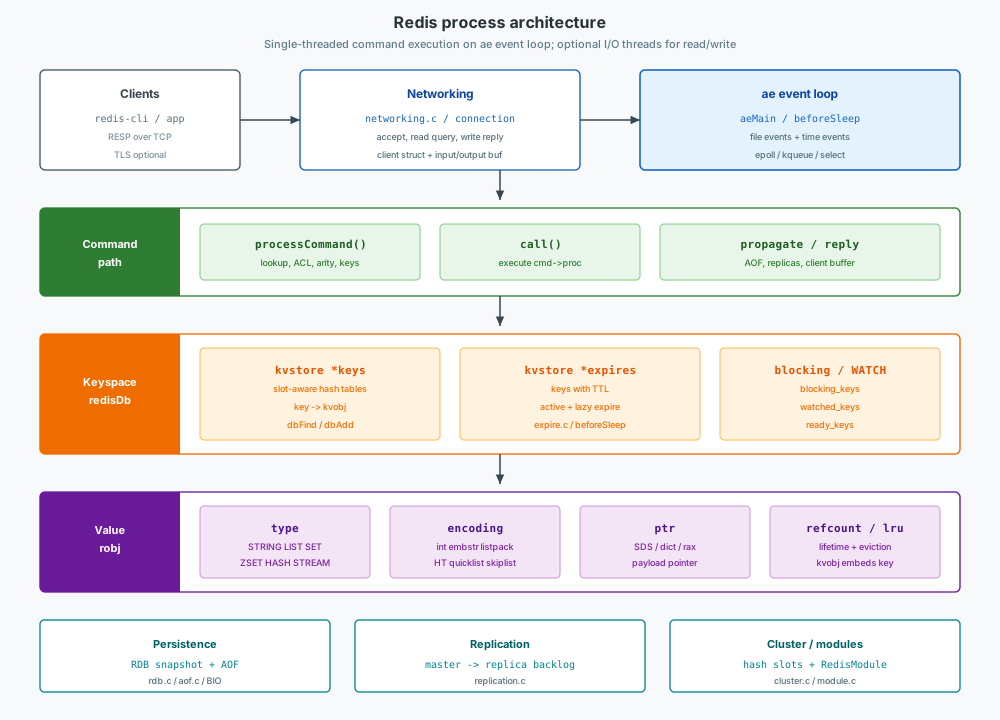
Process-wide state is one C struct:
/* server.h / server.c */
struct redisServer { /* … */ };
extern struct redisServer server;
struct redisServer server; /* Server global state */
1. Network
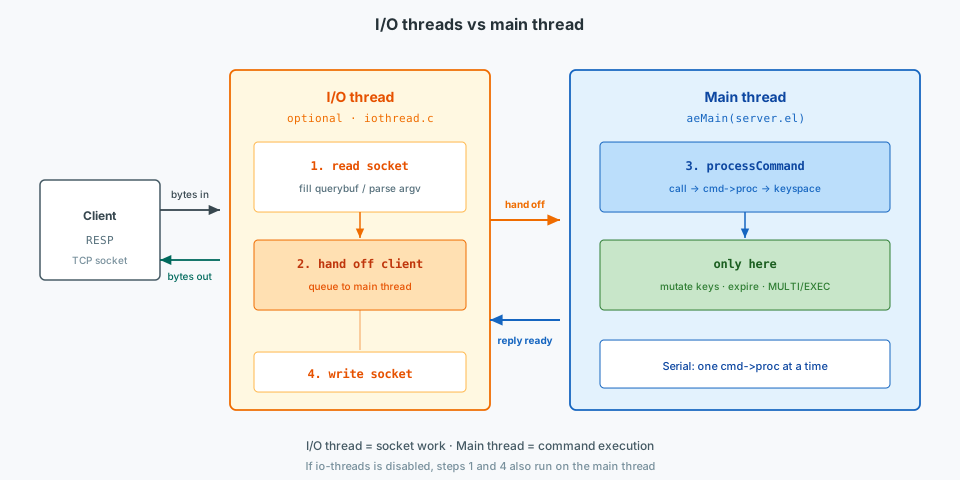
The network subsystem speaks RESP over TCP (or Unix/TLS), accepts connections, multiplexes file descriptors through one or more aeEventLoop instances, accumulates request bytes in client->querybuf, and emits RESP replies. Command execution (§2) begins only after a complete command has been parsed on the main thread.
1.1 RESP protocol
Redis client I/O sits on two layers:
| Layer | What Redis uses |
|---|---|
| Transport | TCP (default port 6379), Unix domain socket, or TLS over TCP |
| Application | RESP (REdis Serialization Protocol) — Redis’s own request/reply framing on the byte stream |
Clients do not send opaque binary opcodes at L4. They open a stream connection and exchange RESP messages. The server accumulates bytes in client->querybuf, parses a complete command into argc / argv, then runs processCommand (§2). Replies are written back as RESP into the client output buffer and flushed on AE_WRITABLE (often on an I/O thread when io-threads is enabled).
The cluster bus between nodes uses a separate Redis-defined binary gossip protocol; it is not client RESP.
Request forms
client.reqtype distinguishes how the current request is framed (server.h):
reqtype | Wire form | Typical client |
|---|---|---|
PROTO_REQ_MULTIBULK | Array of bulk strings (* / $) | redis-cli, hiredis, most drivers |
PROTO_REQ_INLINE | Space-separated line ending in \r\n | telnet / simple scripts |
Multibulk (RESP array) is the normal path. Example command SET k v:
*3\r\n
$3\r\n
SET\r\n
$1\r\n
k\r\n
$1\r\n
v\r\n
| Token | Meaning |
|---|---|
*3 | Array of 3 elements (command name + two arguments) |
$3 / SET | Bulk string length 3, then payload SET |
$1 / k, $1 / v | Remaining arguments |
After parse, that becomes argc = 3, argv = { SET, k, v } on the client.
Inline form of the same idea (less common in production drivers):
SET k v\r\n
Common RESP2 reply types
| Prefix | Type | Example |
|---|---|---|
+ | Simple string | +OK\r\n |
- | Error | -ERR unknown command\r\n |
: | Integer | :1\r\n |
$ | Bulk string | $5\r\nhello\r\n ($-1\r\n = null bulk) |
* | Array | *2\r\n$1\r\na\r\n$1\r\nb\r\n |
Server-side reply helpers (addReply*, addReplyBulk*, … in networking.c) encode these into the client buffer. Pipelining is multiple complete requests written back-to-back on one connection; Redis parses and executes them in order on that client.
RESP2 vs RESP3
| Version | Role |
|---|---|
| RESP2 | Default for most connections; types above |
| RESP3 | Negotiated with HELLO 3 (or client option); richer types (map, set, bool, double, push, …) |
client.resp records the negotiated version so reply encoding can differ (for example some commands emit nested structures in RESP3 and flattened arrays in RESP2).
Parse path in the server
socket read → client->querybuf
       → processInputBuffer
            → processInlineBuffer  or  processMultibulkBuffer
            → argv / argc ready
            → processCommand  (main thread; see §1.4 / §2)
Partial reads are normal: RESP lengths let the parser wait until $N bytes (plus CRLF) have arrived before finishing an argument. Large bulk arguments use PROTO_MBULK_BIG_ARG heuristics so the query buffer can align with the payload.
1.2 Structures
struct redisServer contains the main event loop pointer el (server.el) and the global client list. It does not embed I/O worker state. I/O workers are instances of IOThread stored in a file-static array in iothread.c. The server exposes only configuration fields (io_threads_num, io_threads_active, io_threads_do_reads).
redisServer
  el                    → aeEventLoop          (main thread)
  clients               → list of client*
  io_threads_num        (configuration)

iothread.c
  static IOThreads[]
    IOThreads[i].el     → aeEventLoop          (I/O pthread i)
    IOThreads[i].clients
    IOThreads[i].pending_clients_to_main_thread
Thread id 0 (IOTHREAD_MAIN_THREAD_ID) denotes the main thread. I/O workers use ids 1 .. io_threads_num-1.
@startuml
!option handwritten true
skinparam class {
    BackgroundColor White
    BorderColor Black
    ArrowColor Black
}

package "redisServer" {
  struct redisServer {
    +el : aeEventLoop*
    +clients : list*
    +io_threads_num : int
    +io_threads_active : int
  }
  struct "aeEventLoop (main)" as MainEL
  redisServer *-- MainEL : el
  redisServer o-- client : clients
}

package "iothread.c" {
  struct IOThread {
    +id : uint8_t
    +tid : pthread_t
    +el : aeEventLoop*
    +clients : list*
    +pending_clients_to_main_thread : list*
  }
  struct "aeEventLoop (I/O)" as IoEL
  IOThread *-- IoEL : el
}

struct client {
  +conn : connection*
  +tid : uint8_t
  +running_tid : uint8_t
  +querybuf : sds
  +argc : int
  +argv : robj**
  +reply : list*
}

redisServer ..> IOThread : io_threads_num
client --> IOThread : tid
IoEL ..> client : socket I/O
IOThread ..> MainEL : enqueue for processCommand
MainEL ..> client : processCommand
@enduml
/* server.h — type; instances are static in iothread.c */
typedef struct {
    uint8_t id;
    pthread_t tid;
    aeEventLoop *el;
    list *clients;
    list *pending_clients_to_main_thread;
    /* … */
} IOThread;

/* iothread.c */
static IOThread IOThreads[IO_THREADS_MAX_NUM];
| Object | Location | Responsibility |
|---|---|---|
server.el | redisServer | Main aeMain; processCommand; serverCron; expire hooks |
IOThreads[i] | iothread.c | Dedicated pthread and aeEventLoop for socket I/O |
server.clients | redisServer | Canonical list of all client objects |
1.3 Client object
Each accepted connection is represented by exactly one struct client, allocated once and linked from server.clients. I/O workers never allocate a second client for the same socket. Thread-local lists (IOThreads[i].clients, pending-transfer queues) hold that same pointer while work runs on a given loop.
| Field | Meaning |
|---|---|
conn | Socket / connection abstraction bound to at most one aeEventLoop at a time |
tid | Home thread id (0 = main, otherwise an I/O worker) |
running_tid | Thread currently handling the client |
querybuf | Accumulated RESP input |
argc / argv | Parsed command arguments (filled on I/O or main before processCommand) |
reply | Buffered reply awaiting write |
tid is set when the connection is assigned (assignClientToIOThread, or left on main). running_tid tracks temporary ownership during a transfer: it becomes 0 while the main thread executes the command, even if tid still names an I/O worker as home.
The payload for a command—bytes in querybuf, then argv—always travels inside this object. How I/O and main coordinate ownership of that object for command execution is the subject of §1.4.
1.4 Two event loops: I/O and main
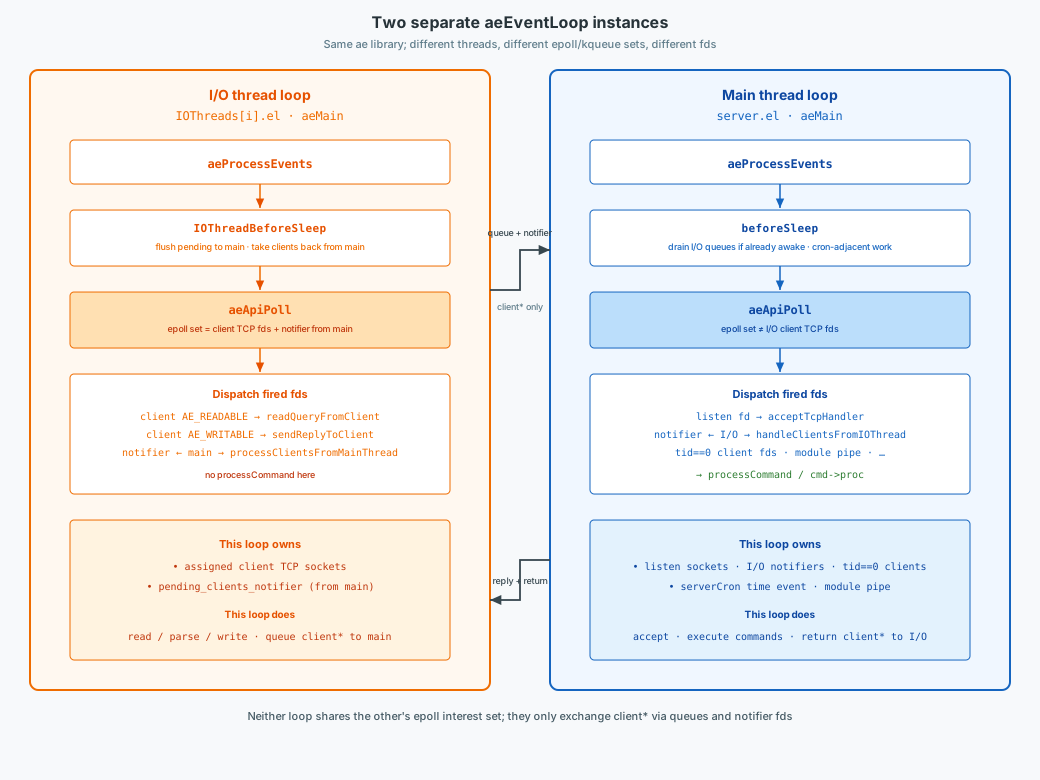
With io-threads enabled, Redis runs more than one aeEventLoop. Each is a full aeMain → aeProcessEvents → aeApiPoll cycle on its own thread, with its own epoll/kqueue interest set. They share the ae type and API (ae.h / ae.c); they do not share file-descriptor registrations.
| Loop | Pointer | Thread | Responsibility |
|---|---|---|---|
| I/O | IOThreads[i].el | I/O pthread i | Client TCP read/write and RESP parse for assigned clients |
| Main | server.el | Main thread | Accept, command execution, serverCron, process-global work |
Cross-thread coupling is only queues of client* plus notifier fds (eventfd / pipe), not shared listening on the same client socket.
/* ae.h — same type for both loops */
typedef struct aeEventLoop {
    aeFileEvent *events;
    aeFiredEvent *fired;
    aeTimeEvent *timeEventHead;
    aeBeforeSleepProc *beforesleep;
    aeBeforeSleepProc *aftersleep;
    /* … */
} aeEventLoop;
1.4.1 Accept on main; client I/O on an I/O thread
Listen sockets stay on server.el for the life of the process. I/O threads never call accept.
/* server.c — createSocketAcceptHandler */
for (j = 0; j < sfd->count; j++) {
    if (aeCreateFileEvent(server.el, sfd->fd[j], AE_READABLE,
                          accept_handler, sfd) == AE_ERR) {
        /* … rollback … */
        return C_ERR;
    }
}
/* socket.c — connSocketAcceptHandler (runs on main) */
acceptCommonHandler(connCreateAcceptedSocket(el, cfd, NULL), 0, cip);
/* el here is server.el */
After accept, main creates the client and, if I/O threads are enabled, assigns it to a worker. Steady-state design: main keeps the listen fd; the new connection’s read/write run on IOThreads[i].el.
/* networking.c — after client is created / accepted */
if (server.io_threads_num > 1) assignClientToIOThread(c);
createClient always installs a read handler on the connection’s current el (still server.el at this point), because the same helper is used when there is no I/O thread and the client must stay on main:
/* networking.c — createClient */
if (conn) {
    connSetReadHandler(conn, readQueryFromClient);  /* AE_READABLE on conn->el */
    connSetPrivateData(conn, c);
}
With I/O threads, that registration is immediately removed and the client* is queued to the chosen worker; the I/O loop later rebinds the fd and installs the read handler again:
/* iothread.c — assignClientToIOThread */
c->tid = min_id;   /* least-loaded I/O thread */
connUnbindEventLoop(c->conn);   /* clear AE_READABLE/WRITABLE from server.el */
c->io_flags &= ~(CLIENT_IO_READ_ENABLED | CLIENT_IO_WRITE_ENABLED);
enqueuePendingClienstToIOThreads(c);  /* main beforeSleep / notifier → I/O */
/* iothread.c — processClientsFromMainThread (on I/O loop) */
if (!connHasEventLoop(c->conn)) {
    connRebindEventLoop(c->conn, t->el);
    connSetReadHandler(c->conn, readQueryFromClient);
}
So: main’s permanent networking role for new connections is listen + accept + assign. The connUnbindEventLoop in assignClientToIOThread is not “moving listen interest”; it clears the temporary client-fd registration that createClient just put on server.el, so main does not perform that connection’s I/O.
1.4.2 I/O thread loop — IOThreads[i].el
Each I/O worker calls aeMain(IOThreads[i].el) with IOThreadBeforeSleep / IOThreadAfterSleep.
Fds in this loop’s poll set
| Fd | Handler | Purpose |
|---|---|---|
| Assigned client TCP | readQueryFromClient / sendReplyToClient | Socket I/O for tid == i |
pending_clients_notifier | handleClientsFromMainThread | Wake when main returns a client* for write / further I/O |
Registration of the I/O-side notifier (main → I/O):
/* iothread.c — initIOThreads */
t->pending_clients_notifier = createEventNotifier();
if (aeCreateFileEvent(t->el, getReadEventFd(t->pending_clients_notifier),
                      AE_READABLE, handleClientsFromMainThread, t) != AE_OK)
{
    /* fatal */
}
One iteration (conceptually)
IOThreadBeforeSleep—processClientsFromMainThread;sendPendingClientsToMainThreadIfNeeded(t, 0)(flush all pending to main before sleep).aeApiPollon this loop’s fds only.- Dispatch: readable client → read/parse; writable client → flush reply; notifier → take clients from main.
When a complete command is ready on an I/O thread, execution is deferred:
/* networking.c — processInputBuffer */
if (c->running_tid != IOTHREAD_MAIN_THREAD_ID) {
    c->io_flags |= CLIENT_IO_PENDING_COMMAND;
    enqueuePendingClientsToMainThread(c, 0);  /* unbind = 0 */
    break;
}
/* iothread.c — enqueuePendingClientsToMainThread */
if (unbind) connUnbindEventLoop(c->conn);
if (c->io_thread_client_list_node) {
    IOThread *t = &IOThreads[c->tid];
    sendPendingClientsToMainThreadIfNeeded(t, 1);
    c->io_flags &= ~(CLIENT_IO_READ_ENABLED | CLIENT_IO_WRITE_ENABLED);
    listUnlinkNode(t->clients, c->io_thread_client_list_node);
    listLinkNodeTail(t->pending_clients_to_main_thread,
                     c->io_thread_client_list_node);
    c->io_thread_client_list_node = NULL;
}
The client TCP fd stays registered on the I/O loop; enable flags gate further I/O until main finishes.
1.4.3 Main thread loop — server.el
The main thread calls aeMain(server.el) with Redis beforeSleep / afterSleep.
Fds in this loop’s poll set
| Fd | Handler | Purpose |
|---|---|---|
| Listen sockets | accept handler via createSocketAcceptHandler | New connections |
| Per–I/O-thread notifiers | handleClientsFromIOThread | Wake when I/O queued client* objects |
Clients with tid == 0 | readQueryFromClient / write handlers | Never offloaded (or keepClientInMainThread) |
| Module pipe / other | subsystem handlers | Modules and related I/O |
Time events: serverCron.
Registration of the main-side notifier (I/O → main), one per I/O thread id:
/* iothread.c — initIOThreads */
mainThreadPendingClientsNotifiers[i] = createEventNotifier();
if (aeCreateFileEvent(server.el,
                      getReadEventFd(mainThreadPendingClientsNotifiers[i]),
                      AE_READABLE, handleClientsFromIOThread, t) != AE_OK)
{
    /* fatal */
}
One iteration (conceptually)
beforeSleep— may drain queued clients without a notifier (see below).aeApiPollon this loop’s fds (not I/O-assigned client TCP sockets).- Dispatch — notifier →
handleClientsFromIOThread→processCommand; listen → accept; then time events.
1.4.4 Notifier mechanism (source)
A notifier is a wake-up channel, not the client socket. Implementation is eventfd when available, otherwise a pipe:
/* eventnotifier.c — createEventNotifier (sketch) */
#ifdef HAVE_EVENT_FD
    en->efd = eventfd(0, EFD_NONBLOCK | EFD_CLOEXEC);
#else
    anetPipe(en->pipefd, O_CLOEXEC|O_NONBLOCK, O_CLOEXEC|O_NONBLOCK);
#endif
/* eventnotifier.c — trigger / handle */
int triggerEventNotifier(struct eventNotifier *en) {
#ifdef HAVE_EVENT_FD
    uint64_t u = 1;
    write(en->efd, &u, sizeof(u));
#else
    char buf[1] = {'R'};
    write(en->pipefd[1], buf, 1);
#endif
    return EN_OK;
}

int handleEventNotifier(struct eventNotifier *en) {
#ifdef HAVE_EVENT_FD
    uint64_t u;
    read(en->efd, &u, sizeof(u));
#else
    char buf[1];
    read(en->pipefd[0], buf, 1);
#endif
    return EN_OK;
}
I/O → main: when is the notifier written?
Joining the I/O thread’s local pending list into the main-visible list optionally wakes main:
/* iothread.c — sendPendingClientsToMainThreadIfNeeded */
listJoin(mainThreadPendingClients[t->id], t->pending_clients_to_main_thread);
if (!pending) atomicGetWithSync(server.running, running);

/* Only notify if main is not running and had no pending clients —
 * otherwise main will see the queue in beforeSleep. */
if (!running && !pending) {
    triggerEventNotifier(mainThreadPendingClientsNotifiers[t->id]);
}
Main: file-event path after wake
/* iothread.c — handleClientsFromIOThread (AE_READABLE on notifier) */
handleEventNotifier(mainThreadPendingClientsNotifiers[t->id]);
processClientsFromIOThread(t);   /* → processCommand for pending clients */
Main: drain path without wake (beforeSleep)
If main was already busy (server.running == 1), I/O skips triggerEventNotifier. Those clients are still on mainThreadPendingClients and are picked up before the next poll:
/* server.c — beforeSleep (io_threads_num > 1) */
if (processClientsOfAllIOThreads() > 0) {
    dont_sleep = 1;
}
if (!dont_sleep) {
    atomicSetWithSync(server.running, 0);
    processClientsOfAllIOThreads();  /* catch races around going to sleep */
}
/* iothread.c */
int processClientsOfAllIOThreads(void) {
    int processed = 0;
    for (int i = 1; i < server.io_threads_num; i++)
        processed += processClientsFromIOThread(&IOThreads[i]);
    return processed;
}
| Main state | Mechanism |
|---|---|
Asleep in aeApiPoll (server.running == 0) | triggerEventNotifier → notifier readable → handleClientsFromIOThread |
Busy (server.running == 1) | Queue only → next beforeSleep → processClientsOfAllIOThreads |
1.4.5 Race: “main looks busy” then enters aeApiPoll
Judging server.running and choosing notify vs queue-only is not one atomic “read state and dispatch” instruction. The safety comes from a fixed order on both sides plus a second drain after publishing “I am going to sleep.”
server.running is redisAtomic and is read/written with atomicGetWithSync / atomicSetWithSync (memory_order_seq_cst in the C11 path) so the flag is visible across threads. The queue move uses a per–I/O-thread mutex.
Dangerous interleaving (what must not lose work)
- Main is in an event-loop turn (
server.running == 1) — e.g. still inbeforeSleep/ handlers, not yet blocked inaeApiPoll. - I/O joins
client*intomainThreadPendingClients[i], seesrunning == 1, skipstriggerEventNotifier. - Main then decides it has nothing left, sets
server.running = 0, and blocks inaeApiPollon listen/notifiers/timers.
If step 3 did not look at the queue again after clearing running, those clients would sit unprocessed until some other event woke main — a lost wake.
I/O side order (sendPendingClientsToMainThreadIfNeeded)
/* iothread.c — order matters */
pthread_mutex_lock(&mainThreadPendingClientsMutexes[t->id]);
pending = listLength(mainThreadPendingClients[t->id]);   /* before join */
listJoin(mainThreadPendingClients[t->id],
         t->pending_clients_to_main_thread);             /* publish clients first */
pthread_mutex_unlock(&mainThreadPendingClientsMutexes[t->id]);

if (!pending) atomicGetWithSync(server.running, running); /* then sample flag */

if (!running && !pending)
    triggerEventNotifier(mainThreadPendingClientsNotifiers[t->id]);
| Observation | Action |
|---|---|
pending != 0 before join | List was already non-empty — a prior send already notified (or main will drain); skip another write. |
running == 1 | Main is in a turn; it must drain in beforeSleep — skip notifier. |
running == 0 and list was empty | Main is (or is about to be) in aeApiPoll — write notifier. |
Clients are always on the shared list before the running sample, so a concurrent main that clears running and drains again can still see them.
Main side order (beforeSleep → then aeApiPoll)
/* server.c — beforeSleep */
if (processClientsOfAllIOThreads() > 0) {
    dont_sleep = 1;   /* keep running; more I/O traffic likely */
}
if (!dont_sleep) {
    atomicSetWithSync(server.running, 0);   /* publish “asleep soon” */
    /* Catch I/O that joined while we still looked busy and skipped notify. */
    processClientsOfAllIOThreads();
}
/* … later aeProcessEvents calls aeApiPoll … */

/* server.c — afterSleep (after poll returns) */
atomicSetWithSync(server.running, 1);
I/O thread                              Main thread
──────────                              ──────────
listJoin(clients) ──────────────────►   (queue visible)
atomicGet(running)==1
  → no notifier

                                        beforeSleep:
                                          drain #1
                                          running = 0     ◄── published
                                          drain #2        ◄── catches join above
                                          aeApiPoll(...)

listJoin(more) ─────────────────────►
atomicGet(running)==0
  → triggerEventNotifier ────────────►  poll wakes
                                        handleClientsFromIOThread
So the “atomic” property is a handshake, not a single CAS of state+action:
- Enqueue before sample on I/O — work is visible before the skip-notify decision.
- Clear
runningbefore the last drain on main — anything that skipped notify because main looked busy is taken beforeaeApiPoll. - Notifier after
running == 0— anything that arrives after the last drain wakes poll.
The same pattern is mirrored for main → I/O: each IOThread has t->running; IOThreadBeforeSleep sets it to 0 and calls processClientsFromMainThread again before that worker’s aeApiPoll.
The reverse direction (main → I/O after command execution) uses IOThreads[i].pending_clients_notifier and handleClientsFromMainThread symmetrically.
IOThreads[i].el                         server.el
────────────────                        ────────────────
aeApiPoll(client TCP, …)                aeApiPoll(listen, notifiers, …)
       │
AE_READABLE → read / parse
       │
disable CLIENT_IO_*_ENABLED
queue client*
[if main asleep] triggerEventNotifier ──write──► notifier AE_READABLE
       │                                 handleClientsFromIOThread
       │                                 / beforeSleep drain
       │                                       │
       │                                       ▼
       │                                 processCommand
       │                                       │
       │◄──── queue + I/O notifier ────────────┘
AE_WRITABLE / write path → reply
connUnbindEventLoop / rebind onto server.el is for permanent home changes (keepClientInMainThread) or teardown — not the normal per-command path. When io_threads_num <= 1, only server.el exists for client I/O and commands.
1.5 Example: SET k v through I/O thread then main thread
Assume io-threads is enabled and assignClientToIOThread has set client.tid = 1. The client sends:
*3\r\n$3\r\nSET\r\n$1\r\nk\r\n$1\r\nv\r\n
| Phase | Thread / loop | What happens for this SET |
|---|---|---|
| 1. Readable | I/O thread 1 (IOThreads[1].el) | AE_READABLE: append RESP to querybuf; may parse argv = { SET, k, v }. |
| 2. Hand off | I/O → main | CLIENT_IO_PENDING_COMMAND; disable I/O enable flags; enqueue client* (unbind = 0); sendPendingClientsToMainThreadIfNeeded may triggerEventNotifier. Fd stays on the I/O loop. |
| 3. Execute | Main (server.el) | handleClientsFromIOThread and/or beforeSleep → processClientsFromIOThread → processCommand → setCommand (§2); reply +OK buffered. |
| 4. Return | Main → I/O | Client returned to thread 1; flags re-enabled. |
| 5. Writable | I/O thread 1 | Write path / AE_WRITABLE flushes +OK\r\n. |
Source anchors: enqueuePendingClientsToMainThread(..., 0), sendPendingClientsToMainThreadIfNeeded, processClientsFromIOThread, setCommand, processClientsFromMainThread. Without I/O threads, the same steps run entirely on server.el (readQueryFromClient → processCommandAndResetClient → sendReplyToClient).
2. Command execution
A command is a RESP array (for example SET k v), already in client->argv / argc after RESP parse (§1.1) and any I/O→main hand-off (§1.4). There is no SQL planner: each command is a registered redisCommand.proc.
2.1 Structures
@startuml
!option handwritten true
skinparam class {
    BackgroundColor White
    BorderColor Black
    ArrowColor Black
}

struct redisServer {
  +db : redisDb*
  +commands : dict*
  +current_client : client*
  +executing_client : client*
}

struct client {
  +argc : int
  +argv : robj**
  +cmd : redisCommand*
  +db : redisDb*
  +flags : uint64_t
}

struct redisCommand {
  +declared_name : const char*
  +proc : redisCommandProc*
  +arity : int
  +flags : uint64_t
  +fullname : sds
}

struct redisDb {
  +keys : kvstore*
  +expires : kvstore*
  +blocking_keys : dict*
  +watched_keys : dict*
  +id : int
}

struct kvstore {
}

struct redisObject {
  +type : 4 bits
  +encoding : 4 bits
  +refcount
  +ptr : void*
}

redisServer "1" *-- "N" redisDb : db
redisServer ..> redisCommand : commands
client --> redisCommand : cmd
client --> redisDb : db
redisDb *-- kvstore : keys
kvstore --> redisObject : kvobj entries
redisCommand ..> redisDb : proc
@enduml
/* server.h */
typedef struct redisDb {
    kvstore *keys;
    kvstore *expires;
    estore *subexpires;
    dict *blocking_keys;
    dict *watched_keys;
    /* … */
    int id;
} redisDb;
2.2 processCommand and call
processInputBuffer
  → processCommandAndResetClient
    → processCommand
      → call
        → c->cmd->proc(c)
processCommand (server.c):
- Optional module command filters.
lookupCommand; reject unknown name, wrong arity, or disallowed internal commands.- Enforce ACL, memory limits, Cluster redirect, loading, busy script/module, client pause, Pub/Sub and replica rules.
- If
CLIENT_MULTIand the command is notEXEC/DISCARD/MULTI/WATCH(and related bookkeeping) →queueMultiCommand(§3). - Otherwise
call(c, flags): setserver.current_client/executing_client, invokec->cmd->proc(c), update stats, propagate writes (AOF / replicas), fill the reply buffer.
/* server.c — control structure */
int processCommand(client *c) {
    /* lookup, ACL, arity, cluster, loading, busy, pause, … */
    if (c->flags & CLIENT_MULTI && /* not EXEC / DISCARD / … */) {
        queueMultiCommand(c, cmd_flags);
        return C_OK;
    }
    call(c, flags);
    return C_OK;
}
2.3 Key access inside cmd->proc
Key commands use lookupKeyRead / lookupKeyWrite → lookupKey (db.c):
- Resolve the entry in
db->keys. - Call
expireIfNeeded(lazy expire; §4). - Update LRU/LFU and hit/miss counters unless flags suppress them.
Writes may update expires, call touchWatchedKey, and wake waiters on blocking_keys.
2.4 Blocking commands
BLPOP, XREAD BLOCK, and similar commands register the client in blocking_keys, set bstate, and return to the event loop. When data arrives, Redis marks keys ready and unblocks clients from beforeSleep / unblock helpers on the main thread.
3. Concurrency control
Redis does not use per-key locks for ordinary commands. Correctness follows from single-threaded execution of cmd->proc on the main aeEventLoop, plus MULTI/EXEC batching and WATCH optimistic CAS.
A single process exposes one command-executing loop (server.el). While cmd->proc runs, no other command runs, including commands on disjoint keys. Parallel execution across keys requires Cluster sharding or separate Redis processes.
3.1 Structures
@startuml
!option handwritten true
skinparam class {
    BackgroundColor White
    BorderColor Black
    ArrowColor Black
}

struct redisServer {
  +el : aeEventLoop*
  +io_threads_num : int
  +io_threads_active : int
  +in_exec : int
}

struct client {
  +flags : uint64_t
  +tid : uint8_t
  +mstate : multiState
  +bstate : blockingState
  +watched_keys : list*
  +db : redisDb*
}

struct multiState {
  +commands : pendingCommand**
  +count : int
  +cmd_flags : int
  +cmd_inv_flags : int
  +executing_cmd : int
}

struct blockingState {
  +btype : blocking_type
  +timeout : mstime_t
  +keys : dict*
}

struct IOThread {
  +id : uint8_t
  +tid : pthread_t
  +el : aeEventLoop*
  +clients : list*
  +pending_clients_to_main_thread : list*
  +pending_clients_mutex
}

struct redisDb {
  +blocking_keys : dict*
  +watched_keys : dict*
}

client *-- multiState : mstate
client *-- blockingState : bstate
client --> redisDb : db
redisServer ..> IOThread : io_threads_num
IOThread ..> client : socket I/O
IOThread ..> redisServer : enqueue for processCommand
@enduml
3.2 Main thread ownership
| Actor | Keyspace mutation |
|---|---|
Main thread (aeMain on server.el) | Yes — all cmd->proc, expire, related cron work |
| I/O threads | No — socket read/write and parse; hand off to main |
BIO / fork child | Persistence rewrite; not parallel command execution |
Commands are totally ordered on one process. Disjoint-key commands (for example concurrent INCR a and INCR b) execute sequentially and do not interleave mid-command. A long-running command blocks all other clients until it returns.
3.3 I/O threads
When io-threads is enabled (iothread.c), clients are assigned to an IOThread for socket I/O, transferred to the main thread for processCommand / call, and may be returned to the I/O thread for asynchronous write (§1.3–§1.4). This arrangement parallelizes socket work only; keyspace updates remain on the main thread.
3.4 MULTI / EXEC
MULTI
SET a 1
INCR b
EXEC
| Step | Behavior |
|---|---|
MULTI | Set CLIENT_MULTI; subsequent commands are queued in mstate |
| Queued commands | Not executed; flags accumulated in mstate.cmd_flags |
EXEC | execCommand runs the queue with server.in_exec = 1 |
| Queue-time error | CLIENT_DIRTY_EXEC → EXECABORT |
No other client interleaves between the first and last command of an EXEC on the same server. This is not MVCC: a runtime failure of one queued command does not roll back earlier commands in the same EXEC. Use WATCH to abort the batch on conflict.
3.5 WATCH
WATCHrecords keys indb->watched_keysandclient->watched_keys.- A write to a watched key calls
touchWatchedKey→ setsCLIENT_DIRTY_CASon watchers. - On
EXEC: expired watched key orCLIENT_DIRTY_CAS→ null array reply, queue discarded; otherwise run queue andunwatchAllKeys.
Writers are not blocked. Conflict is detected at EXEC time (optimistic CAS).
3.6 Pause and busy
| Mechanism | Effect in processCommand |
|---|---|
| Client pause | Postpone ordinary clients until pause ends |
| Busy script / module | Reject commands lacking CMD_ALLOW_BUSY with -BUSY |
4. Expire
TTL state lives in db->expires (key TTL) and subexpires (field TTL). A key may be past TTL yet still allocated until lazy or active expire deletes it.
4.1 Recording TTL
EXPIRE, PEXPIRE, SET … EX, and related commands store an absolute expire time and insert the key into expires. A non-positive TTL can delete the key immediately.
4.2 Lazy expire
lookupKey always consults expireIfNeeded:
/* db.c — structure */
kvobj *lookupKey(...) {
    kvobj *val = dbFindByLink(...);
    if (val) {
        if (expireIfNeeded(db, key, val, expire_flags) != KEY_VALID)
            val = NULL;
    }
    /* LRU/LFU, stats … */
    return val;
}
| Condition | Result |
|---|---|
| Not expired | KEY_VALID |
| Replica (typical read path) | Report expired; master synthesizes DEL (no local delete) |
| Expire paused | Report expired; do not delete |
| Master (normal) | deleteExpiredKeyAndPropagate → KEY_DELETED |
On a master, GET of an expired key returns nil and removes the key.
4.3 Active expire
Masters also sample expires in the background so untouched keys do not retain memory indefinitely.
| Cycle | Caller | Budget |
|---|---|---|
| Slow | databasesCron via serverCron (hz) | Fraction of the cron slice (ACTIVE_EXPIRE_CYCLE_SLOW_TIME_PERC, effort-scaled) |
| Fast | beforeSleep when stale ratio is high or the previous cycle hit its limit | Short microsecond cap (ACTIVE_EXPIRE_CYCLE_FAST_DURATION, effort-scaled) |
activeExpireCycle (expire.c):
- Advances a DB cursor across calls.
- Samples entries from
expires(ACTIVE_EXPIRE_CYCLE_KEYS_PER_LOOP, effort-scaled). - Deletes via
activeExpireCycleTryExpire→ same propagation path as lazy expire. - Stops when the time budget is exhausted.
- Drives hash field expiry through
subexpireswhen present.
Replicas use expireSlaveKeys rather than owning primary deletes.
4.4 Combined behavior
| Path | When |
|---|---|
| Lazy | Every lookupKey on an expired key (master deletes and propagates) |
| Active slow | serverCron → databasesCron |
| Active fast | beforeSleep when stale pressure is high |
| Property | Effect |
|---|---|
| Soft deadline for idle keys | Brief retention of logically expired keys |
active-expire-effort / hz | Trade CPU for lower stale memory |
| Pause expire | Avoid delete races during failover / migration |
| § | Mechanism |
|---|---|
| 1 Network | RESP over TCP; aeEventLoop; accept/read/write; I/O↔main hand-off |
| 2 Command execution | processCommand → call → cmd->proc |
| 3 Concurrency | One aeEventLoop serializes all commands (any keys); I/O threads; MULTI/WATCH |
| 4 Expire | Lazy expireIfNeeded; active slow/fast activeExpireCycle |