
CAP Theory and Raft implementation in TiDB placement driver
The CAP theorem states what a replicated store can guarantee when the network splits. Raft implements CAP’s CP choice via majority quorum. This post introduces that theory (C, A, P, partition trade-off, Raft as CP), the Raft log and term, then details TiDB Placement Driver (PD)’s embedded-etcd Raft. TiKV Region Multi-Raft is in TiKV; PD TSO / locate / schedule surfaces are in TiDB architecture.
1. Theory
On a network that can partition—messages between some replicas delayed or lost for an unbounded time—a shared-data system cannot simultaneously guarantee:
- linearizable reads and writes for the replicated object, and
- a non-error response from every non-failed node that receives a request.
That is the theorem. The design question under partition is which guarantee to keep: C or A. P is not optional on real multi-node deployments; partitions occur.
1.1 The three properties
| Property | Formal meaning in CAP |
|---|---|
| Consistency (C) | A successful read reflects the latest successful write (linearizability for that object): there is a single history all clients agree on. |
| Availability (A) | Every request to a non-failing node eventually receives a non-error response. The node must not wait forever for unreachable peers. |
| Partition tolerance (P) | The system continues to function under arbitrary message loss or delay between subsets of nodes. |
Precise distinctions that are often blurred:
- CAP C is not ACID “consistency” (constraints across rows or tables). It is the single-copy illusion for one replicated object.
- CAP A is not “three nines uptime.” A node that is up but returns
NotLeader/ timeout while waiting for quorum is unavailable in CAP’s sense for that request. - P is assumed once you deploy across failure domains; the interesting choice is CP vs AP when the cut happens.
1.2 The partition model
Split the replica set so no message crosses the cut for an unbounded time. Clients may still reach nodes inside each component.
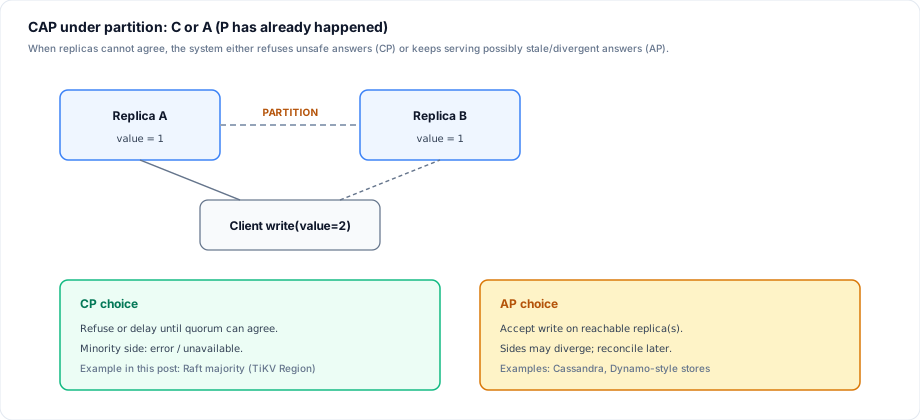
| Choice | Rule during the cut | Client on the minority side | Histories |
|---|---|---|---|
| CP | Commit only with a rule that preserves linearizability (typically a majority quorum of the original voter set). | Error, timeout, or “not leader” | One history; minority does not invent a second |
| AP | Accept locally without waiting for the other side. | Success | Histories may fork; repair later (LWW, vector clocks, CRDTs, …) |
There is no design that keeps linearizability for all clients and non-error answers on every live node for the whole duration of the partition. That impossibility is the theorem—not a product slogan.
Worked quorum (RF=3). Voters {A, B, C}; majority = 2. Cut isolates C from {A, B}.
| Side | Can elect / commit under CP (Raft-style majority)? | Under AP? |
|---|---|---|
| {A, B} | Yes (2 ≥ majority) | Yes (and may diverge from C) |
| {C} | No (1 < majority) → stall or error | Yes locally → fork possible |
1.3 Raft as a CP mechanism
CAP states the trade-off; it does not name an algorithm. Raft is one concrete CP answer for a single replicated log: commit only when a majority of voters have stored the entry, and allow at most one Leader per term so histories do not fork.
| CAP question | Raft answer |
|---|---|
| How to keep one history? | Commit only prefixes a majority has stored (commitIndex) |
| What happens on the minority side? | Cannot elect or commit → client error / stall |
| Split-brain? | One vote per term per peer + majority ⇒ at most one leader per term |
A Raft group of N voters has quorum size majority(N) = ⌊N/2⌋ + 1. For N = 3, majority is 2. Election and log commit use the same quorum—that shared rule is why Raft yields CAP’s CP outcome for the group.
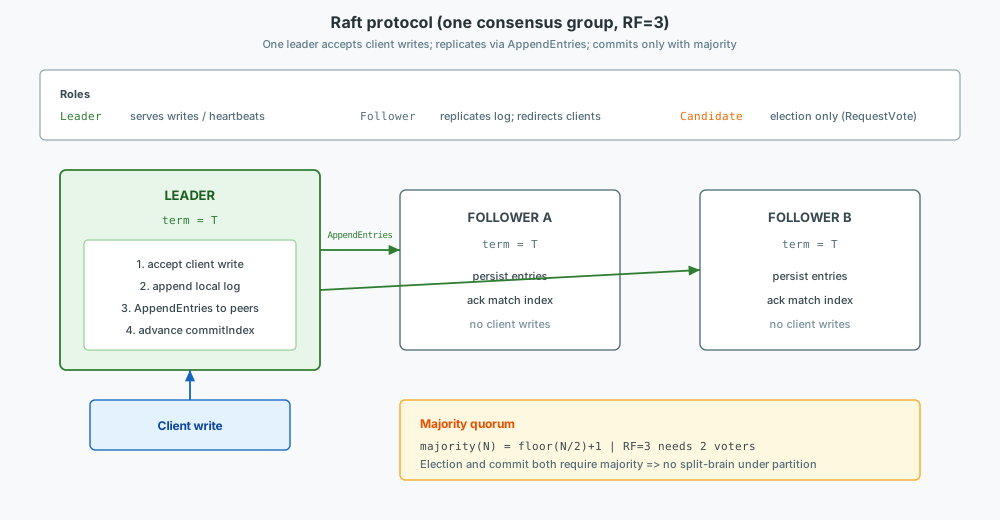
| Step | Who | What |
|---|---|---|
| Client write | Leader only | Append a new log entry locally |
| Replicate | Leader → followers | AppendEntries (also used as heartbeat) |
| Commit | Leader | Advance commitIndex when a majority of voters have matched that index |
| Redirect | Follower / old leader | Tell the client who the leader is (or that there is none during election) |
Election and liveness detection. The leader periodically sends AppendEntries (with new entries, or empty as a heartbeat). Each follower keeps a randomized election timeout. Receiving a valid AppendEntries from the current leader proves the leader is alive, so the follower resets that timer. Followers do not probe the leader; silence is the signal. If no valid AppendEntries arrives before the timeout—crash, long pause, or a partition that blocks heartbeats—the follower becomes a Candidate: increments currentTerm, votes for itself, sends RequestVote. A peer grants at most one vote per term, and only if the candidate’s log is at least as up-to-date. Majority votes ⇒ Leader.
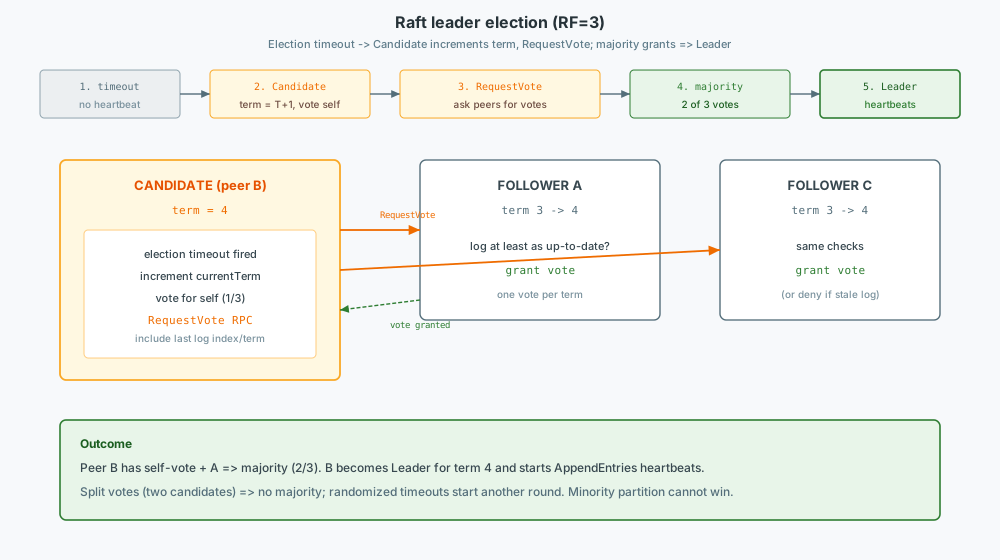
| Rule | Effect under partition |
|---|---|
| Majority of votes required | Minority component cannot elect |
| One vote per term per peer | At most one leader per term cluster-wide |
| Log up-to-date check | Prefers peers with longer committed history |
| Randomized timeouts | Breaks split votes (two candidates, no majority) |
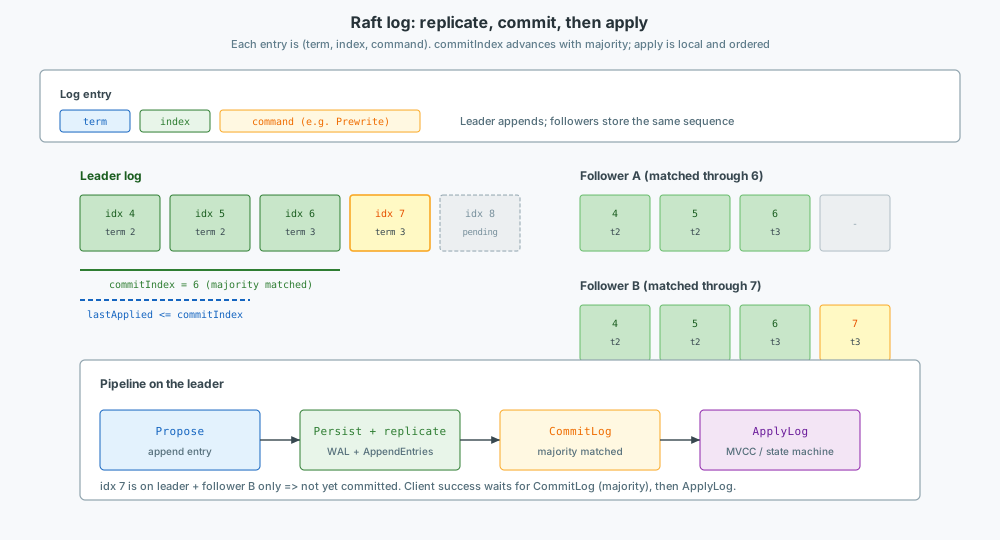
Pipeline: propose → persist + replicate → commit (majority) → apply (state machine). The majority wait on commit is CAP’s C cost on the write path; the minority’s inability to elect is CAP’s sacrificed A. Log layout, term / index, and conflict resolution are §1.4.
Raft is not CAP itself; it is a CP implementation of consensus for one replicated log. In a TiDB cluster that pattern appears twice with different libraries and objects: PD (§2, etcd Raft for control-plane meta) and TiKV Regions (TiKV post, raft-rs for row data).
1.4 Raft log structure and term
The replicated log is an ordered sequence of entries. Each entry is one unit of consensus: once a prefix is stored on a majority, that prefix is safe to commit and apply.
Entry fields
In the Raft paper and in libraries (etcd Raft, raft-rs), an entry looks like:
message Entry {
  EntryType entry_type = 1;  // normal command vs config change
  uint64 term = 2;           // election term when this entry was created
  uint64 index = 3;          // position in the log (monotone per peer’s log)
  bytes data = 4;            // opaque command bytes for the state machine
  bytes context = 6;         // optional app context (not part of safety)
}
| Field | Function |
|---|---|
index | The entry’s position in the log (1…). Leaders assign the next index when proposing. Followers must match (index, term) of the previous entry before appending (prevLogIndex / prevLogTerm on AppendEntries). Commit and apply advance by index (commitIndex, lastApplied). |
term | The election term in which this entry was created (the leader’s currentTerm at propose time). Fixed for the life of that log slot. Used for safety: if two logs disagree at the same index, the entry with the higher term (or the longer suffix after the common prefix) wins during election / conflict resolution. Distinct from currentTerm on the peer (who is campaigning or leading now). |
data | Opaque command bytes. Raft does not interpret them; after commit, the state machine applies data (in PD/etcd: meta KV ops; in TiKV: RaftCmdRequest). Empty data can still appear (no-op / heartbeat-driven commit advancement). |
entry_type | Discriminates a normal client command from a membership / config change entry (joint consensus). Config entries still carry term and index like normal ones. |
context | Optional side channel for the application (tracing, proposal id). Not required for Raft safety. |
A compact view of one log is a sequence of (term, index, data) cells:
index:  1        2        3        4
term:   1        1        2        2
data:   cmd_a    cmd_b    cmd_c    cmd_d
                 ^
            commitIndex = 2  (majority has stored through index 2)
| Pointer | Meaning |
|---|---|
commitIndex | Highest index stored on a majority — safe to apply |
lastApplied | Highest index applied to the local state machine (≤ commitIndex) |
| Match index | Per-follower: highest index the leader knows that follower has |
How term is generated
Each peer stores a durable integer currentTerm (part of HardState, persisted with the log). It is not a wall-clock time and not assigned by PD or a central service. Peers start at term 0 (or 1 depending on bootstrap); from then on the value only increases by local rules when the peer learns that a new election era has begun. New log entries copy the leader’s currentTerm into Entry.term at propose time—so entry terms are generated indirectly from that counter.
When currentTerm increases
| Situation | What happens |
|---|---|
Start election (MsgHup / election timeout) | Follower or Candidate sets currentTerm := currentTerm + 1, votes for self, sends RequestVote (or PreVote first) for that new term. This is the primary way terms advance. |
| Hear a higher term | Any RPC (AppendEntries, RequestVote, heartbeat, …) with Message.term > currentTerm → peer adopts that term (become_follower), clears its vote for the old term, and steps down if it was leader/candidate. |
| Vote / PreVote response with a higher term | Same adoption: the reply proves another peer already moved ahead. |
| Split vote → retry | No majority; candidate times out again → increments term again and starts a new election round. |
Terms do not increase on every heartbeat, every client write, or every tick. A stable leader can stay in the same term for a long time: many log indexes, one Entry.term value. The counter jumps only when leadership is contested or a peer observes that the cluster has moved to a newer election era.
t=0  bootstrap: currentTerm = 0 (or 1)
     …
t=1  first election timeout → Candidate: currentTerm = 1, win → Leader term 1
     (writes: Entry.term = 1 for indexes 1, 2, …)
t=2  leader silent / partition → some follower: currentTerm = 2, campaign
     if that candidate wins → Leader term 2 (new Entry.term = 2)
     if old leader later hears term 2 → steps down, adopts currentTerm = 2
PreVote (used by etcd/PD and TiKV) adds a dry-run vote without bumping currentTerm until a pre-vote majority succeeds; the actual term increment still happens when the real campaign starts. The safety property is unchanged: at most one leader per term, because each peer votes at most once per term number.
Same index, different term
index alone is not enough: after a leader change, a new leader may overwrite uncommitted slots at the same indexes with entries from a newer term. Comparing (index, term) decides whether two peers’ logs are consistent and which candidate is more up-to-date for RequestVote.
Example. Voters {A, B, C}, RF=3. Leader A in term 2 appends a client write at index 5 but crashes before a majority persists it. Only A has the entry locally; B and C still end at index 4. Later B wins term 3 and proposes a different client write, also at index 5:
Peer A (stale, was leader in term 2)     Peer B (new leader in term 3)
index:  …  4        5                     …  4        5
term:   …  2        2                     …  2        3
data:   …  cmd_x    cmd_OLD               …  cmd_x    cmd_NEW
Both logs claim an entry at index 5, but the terms differ (2 vs 3), so the commands are not the same consensus decision. When B replicates to C (and eventually to a recovered A), AppendEntries requires the follower’s entry at index 4 to match (index=4, term=2). For index 5, B sends (term=3, data=cmd_NEW). A’s old (index=5, term=2) conflicts: Raft deletes the divergent suffix and appends B’s entry. Only after a majority stores (5, term=3) does commitIndex reach 5—so cmd_NEW can apply and cmd_OLD never becomes committed history. If Raft looked only at index 5, it could not tell cmd_OLD from cmd_NEW; the term marks which leader era created that slot.
Committing only majority-matched prefixes of this log is how Raft keeps CAP C.
2. PD Raft implementation
Each PD member embeds etcd; the PD servers form one Raft group whose log holds control-plane state (membership, Region meta keys, leases). The library is Go go.etcd.io/etcd/raft, inside embedded etcd. PD does not call RequestVote / AppendEntries itself—those RPCs live in etcd. PD starts etcd, observes term / commit / apply, and layers a PD leader lease (/pd/{cluster}/leader) on top of that quorum.
| PD Raft (this section) | TiKV Raft (TiKV) | |
|---|---|---|
| Protects | PD membership and etcd-stored meta | Region data (KV commands in the Region log) |
| Library | Go etcd Raft | Rust raft-rs |
| Groups | One group for the PD members | One group per Region (Multi-Raft) |
| Peers | PD servers (odd set, typically 3 or 5) | TiKV stores |
| Client surface | PD leader (TSO / locate / schedule) | Region leader (NotLeader) |
Same CAP rule from §1.3: majority commit, minority cannot elect a second leader. Different object and different library.
2.1 Two leaders: etcd Raft leader vs PD leader
etcd runs its own Raft. PD embeds etcd (go.etcd.io/etcd); etcd’s consensus library (go.etcd.io/etcd/raft) forms one Raft group among the PD members. That group must elect a Raft leader—the peer that appends entries, sends MsgApp / MsgVote, and advances commitIndex. PD did not invent a second Raft for meta; it inherits etcd’s. “etcd Raft leader” means leader of etcd’s Raft group.
The PD leader is a separate application role. TiDB and TiKV need one PD process to serve TSO, Region locate, and schedule. PD records that primary with a lease and Put /pd/{cluster}/leader—a key inside etcd’s Raft-replicated KV, not another Raft implementation.
| etcd Raft leader | PD leader | |
|---|---|---|
| Why it exists | etcd’s Raft needs a leader to commit the meta log | PD’s API needs one serving primary |
| Chosen by | Raft inside etcd (MsgVote / PreVote → etcd.Server.Lead()) | App campaign: lease + Put /pd/{cluster}/leader (via that Raft log) |
| Owns | Consensus for meta keys in etcd | Control-plane API and in-memory cluster (createRaftCluster) |
| TiDB / TiKV see | Indirectly (meta must commit) | Directly (gRPC to the PD leader) |
Calling only “the leader” is ambiguous: Raft leadership ≠ “who answers Tso / GetRegion.” etcd Lead() answers the first; the PD leader key answers the second.
Why they usually sit on one machine. leaderLoop campaigns for the PD leader key only when GetEtcdLeader() == self, so the member that serves PD can commit etcd writes locally. If etcd leadership moves away, the PD leader resigns. You typically observe one host holding both titles; the mechanisms remain distinct (etcd’s Raft role vs PD’s lease/key).
PD-A (usual steady state)          PD-B / PD-C
+---------------------------+      +------------------+
| etcd Raft leader          |      | etcd follower    |
| PD leader (lease + key)   |      | watch /pd/.../leader
| serves TSO / locate       |      | no PD API primary|
+---------------------------+      +------------------+
         ^ writes meta via local etcd Lead()
2.2 Start embedded etcd
Server.Run → startEtcd boots one etcd peer per PD process (GenEmbedEtcdConfig sets tick / election intervals and PreVote). Raft peers then exchange votes and appends inside etcd—this elects the etcd Raft leader, not yet the PD leader.
// git/pd: server/server.go
func (s *Server) startEtcd(ctx context.Context) (retErr error) {
	etcd, err := embed.StartEtcd(s.etcdCfg)
	if err != nil {
		return errs.ErrStartEtcd.Wrap(err).GenWithStackByCause()
	}
	select {
	case <-etcd.Server.ReadyNotify():
	case <-newCtx.Done():
		return errs.ErrCancelStartEtcd.FastGenByArgs()
	}
	// startClient + initMember ...
	return nil
}
// git/pd: server/config/config.go — GenEmbedEtcdConfig (excerpt)
cfg := embed.NewConfig()
cfg.PreVote = c.PreVote
cfg.TickMs = uint(c.TickInterval.Duration / time.Millisecond)
cfg.ElectionMs = uint(c.ElectionInterval.Duration / time.Millisecond)
2.3 Election (align etcd leader, then campaign PD leader)
After §2.1: first become etcd Raft leader, then Campaign for the PD leader key. leaderLoop skips campaigning unless this member is etcd leader; otherwise it watches an existing PD leader or waits.
// git/pd: server/server.go — leaderLoop (simplified)
func (s *Server) leaderLoop() {
	for {
		leader, checkAgain := s.member.CheckLeader()
		if leader != nil {
			leader.Watch(s.serverLoopCtx) // block until PD leader changes
			continue
		}
		etcdLeader := s.member.GetEtcdLeader() // etcd.Server.Lead() — Raft role
		if etcdLeader != s.member.ID() {
			time.Sleep(200 * time.Millisecond)
			continue // do not Campaign PD leader on a non-etcd-leader
		}
		s.campaignLeader() // now seek PD leader lease + key
	}
}
// git/pd: pkg/member/member.go
func (m *Member) GetEtcdLeader() uint64 {
	return m.etcd.Server.Lead()
}
// git/pd: pkg/election/leadership.go — Campaign (excerpt)
func (ls *Leadership) Campaign(leaseTimeout int64, leaderData string, cmps ...clientv3.Cmp) error {
	if err := newLease.Grant(leaseTimeout); err != nil {
		return err
	}
	finalCmps = append(finalCmps, clientv3.Compare(clientv3.CreateRevision(ls.leaderKey), "=", 0))
	resp, err := kv.NewSlowLogTxn(ls.client).
		If(finalCmps...).
		Then(clientv3.OpPut(ls.leaderKey, leaderData, clientv3.WithLease(newLease.GetID()))).
		Commit()
	// Succeeded ⇒ Put entered the etcd Raft log and committed
	return nil
}
That OpPut is how PD leadership is recorded: the etcd Raft leader appends it, replicates with MsgApp (AppendEntries), and commits only with a majority—same CP rule as §1.3. Winning the key does not replace Raft; it depends on it.
2.4 Heartbeat and leadership keep-alive
Raft heartbeats (MsgApp with no new entries) are sent by the etcd Raft leader on its tick; PD never issues them.
PD leadership stays alive via an etcd lease renew loop after a successful campaign. If the lease expires, or etcd leadership moves away, the member steps down as PD leader—again keeping the two roles aligned.
// git/pd: server/server.go — campaignLeader (excerpt)
func (s *Server) campaignLeader() {
	if err := s.member.Campaign(s.ctx, s.cfg.LeaderLease); err != nil {
		return
	}
	s.member.GetLeadership().Keep(ctx) // renew lease until resign
	// createRaftCluster / enable TSO ... then serve while IsServing()
}
// git/pd: pkg/election/leadership.go
func (ls *Leadership) Keep(ctx context.Context) {
	ls.keepAliveCtx, ls.keepAliveCancelFunc = context.WithCancel(ctx)
	go ls.GetLease().KeepAlive(ls.keepAliveCtx) // KeepAliveOnce on an interval
}
Serving check (lease still valid and self is PD leader):
// git/pd: pkg/member/member.go
func (m *Member) IsServing() bool {
	return m.leadership.Check() && m.GetLeader().GetMemberId() == m.member.GetMemberId()
}
2.5 Raft log (commit and apply)
etcd owns the replicated log. A successful PD Campaign (or any other meta write) becomes one or more log entries; after majority match, CommittedIndex advances and the etcd state machine applies into its MVCC store (AppliedIndex). Sending the log and transferring state happen inside etcd’s Raft—PD only embeds the process and reads the indexes.
The figure below is a concrete cluster-714 slice: after pd1 becomes etcd leader it Puts /pd/714/leader (Campaign), persists /pd/714/timestamp (TSO window), and begins replicating Region 27 meta at /pd/714/raft/r/…027—real key shapes from git/pd pkg/utils/keypath.
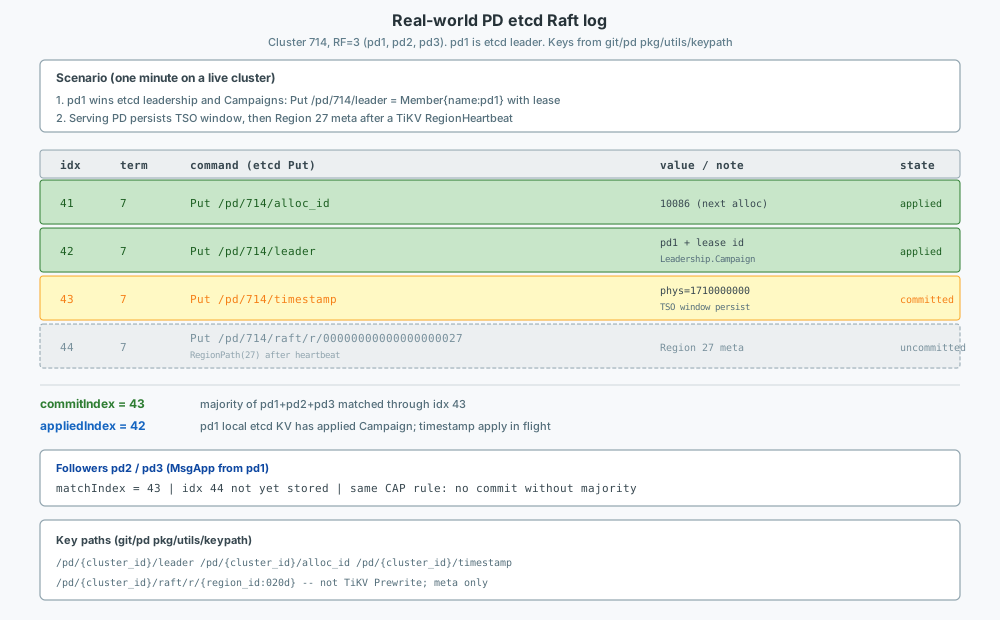
Send log entries (MsgApp) or snapshot (MsgSnap)
After a propose (e.g. PD’s OpPut /pd/714/leader), the etcd Raft leader replicates to each follower. bcastAppend walks progress; maybeSendAppend either ships log entries or, if the follower is too far behind to get entries from the leader’s log, ships a snapshot (full state transfer).
// go.etcd.io/etcd/raft: raft.go — leader replicates to all other peers
func (r *raft) bcastAppend() {
	r.prs.Visit(func(id uint64, _ *tracker.Progress) {
		if id == r.id {
			return
		}
		r.sendAppend(id)
	})
}

func (r *raft) maybeSendAppend(to uint64, sendIfEmpty bool) bool {
	pr := r.prs.Progress[to]
	term, errt := r.raftLog.term(pr.Next - 1)
	ents, erre := r.raftLog.entries(pr.Next, r.maxMsgSize)
	if errt != nil || erre != nil {
		// Follower is behind compacted log → state transfer via snapshot
		m.Type = pb.MsgSnap
		m.Snapshot = snapshot // from r.raftLog.snapshot()
		pr.BecomeSnapshot(sindex)
	} else {
		m.Type = pb.MsgApp // AppendEntries
		m.Index, m.LogTerm = pr.Next-1, term
		m.Entries, m.Commit = ents, r.raftLog.committed
	}
	r.send(m)
	return true
}
Empty MsgApp / MsgHeartbeat also carry an updated Commit so followers can advance commitIndex without new data.
Follower append and snapshot restore
// go.etcd.io/etcd/raft: raft.go — follower handles AppendEntries
func (r *raft) handleAppendEntries(m pb.Message) {
	if mlastIndex, ok := r.raftLog.maybeAppend(m.Index, m.LogTerm, m.Commit, m.Entries...); ok {
		r.send(pb.Message{To: m.From, Type: pb.MsgAppResp, Index: mlastIndex})
	} else {
		r.send(pb.Message{To: m.From, Type: pb.MsgAppResp, Index: m.Index, Reject: true, /* RejectHint */})
	}
}

// State transfer when MsgApp cannot catch up
func (r *raft) handleSnapshot(m pb.Message) {
	if r.restore(m.Snapshot) {
		r.send(pb.Message{To: m.From, Type: pb.MsgAppResp, Index: r.raftLog.lastIndex()})
	} else {
		r.send(pb.Message{To: m.From, Type: pb.MsgAppResp, Index: r.raftLog.committed})
	}
}
On MsgAppResp without reject, the leader updates match progress and may commit:
// go.etcd.io/etcd/raft: raft.go
func (r *raft) maybeCommit() bool {
	mci := r.prs.Committed() // highest index replicated to a majority
	return r.raftLog.maybeCommit(mci, r.Term)
}
// After commit advances: bcastAppend() again so followers learn the new Commit
Ready loop: network send + apply (state machine)
etcdserver’s raft node drains Ready(): persist hard state / entries, push committed entries (and optional snapshot) to the apply channel, and on the leader send outbound Raft messages on the wire.
// go.etcd.io/etcd/server/etcdserver: raft.go — raftNode.start (excerpt)
case rd := <-r.Ready():
	ap := apply{
		entries:  rd.CommittedEntries, // majority-committed → apply to etcd MVCC
		snapshot: rd.Snapshot,           // install if state was transferred
		notifyc:  notifyc,
	}
	updateCommittedIndex(&ap, rh)
	r.applyc <- ap
	if islead {
		r.transport.Send(r.processMessages(rd.Messages)) // MsgApp / MsgSnap / heartbeats
	}
Pipeline for the cluster-714 example: propose Put /pd/714/leader → leader MsgApp (or MsgSnap) → followers MsgAppResp → maybeCommit → CommittedEntries applied → PD’s AppliedIndex / CommittedIndex gauges move.
| Pointer (etcd API) | Meaning for PD |
|---|---|
Term() | Current Raft term of the embedded peer |
CommittedIndex() | Highest index replicated to a majority |
AppliedIndex() | Highest index applied to etcd’s local KV (≤ committed) |
Lead() | Current etcd Raft leader member ID |
PD surfaces those fields as Prometheus gauges (pd_server_etcd_state):
// git/pd: server/server.go
func (s *Server) collectEtcdStateMetrics() {
	etcdTermGauge.Set(float64(s.member.Etcd().Server.Term()))
	etcdAppliedIndexGauge.Set(float64(s.member.Etcd().Server.AppliedIndex()))
	etcdCommittedIndexGauge.Set(float64(s.member.Etcd().Server.CommittedIndex()))
}
Under partition, the minority PD side cannot advance this log or keep the PD lease. TiDB clients that need TSO or Region meta against a non-leader PD see not-leader and retry—CAP’s CP outcome for the control plane, independent of any TiKV Region’s Raft group.
PD Raft does not replicate row values. Losing PD majority stalls TSO and meta updates; existing TiKV Region majorities can still commit until the client needs a fresh TSO or cache fill from PD.
2.6 Key files (git/pd)
| Location | Role |
|---|---|
server/server.go | startEtcd, leaderLoop, campaignLeader, collectEtcdStateMetrics |
server/config/config.go | GenEmbedEtcdConfig, LeaderLease, election tick |
pkg/member/member.go | Campaign, GetEtcdLeader, IsServing, MoveEtcdLeader |
pkg/election/leadership.go | lease Campaign / Keep / Watch |
pkg/election/lease.go | Grant, KeepAlive / KeepAliveOnce |
Embedded etcd (go.etcd.io/etcd/raft) | bcastAppend / maybeSendAppend (MsgApp/MsgSnap), handleAppendEntries, handleSnapshot, maybeCommit |
Embedded etcd (go.etcd.io/etcd/server/etcdserver) | raftNode Ready loop: transport.Send, apply CommittedEntries |