
TiDB: cluster topology, TiDB server and Placement Driver
TiDB is a MySQL-compatible distributed SQL system. A deployment is a cluster of TiDB servers (compute), PD (control), TiKV (row store), and optionally TiFlash (columnar). This post orients cluster roles, follows one TiDB server in git/tidb (dispatch → execute), then shows how PD in git/pd owns Region key ranges (split/merge), TSO, locate, and scheduling. TiKV store, Region Raft, and 2PC are in TiKV; the LSM under TiKV is in RocksDB; CAP theory and PD etcd Raft are in CAP and Raft.
Related: TiKV: Multi-Raft Regions, peer Raft, and writes (MVCC / 2PC), RocksDB (TiKV fork), CAP and Raft.
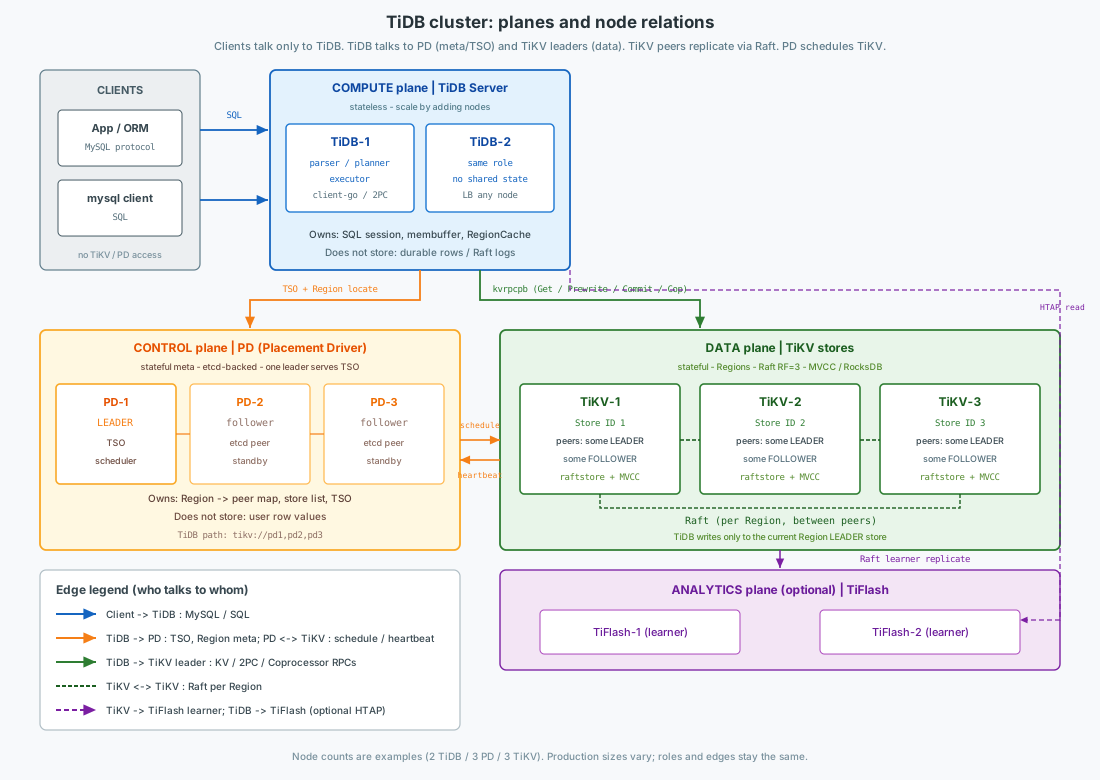
1. Overview
Clients speak the MySQL protocol only to TiDB. Durable rows live in TiKV. PD places Regions and issues timestamps. TiFlash is an optional analytics plane on the same keyspace.
What this post covers
- Overview — cluster roles and content map
- TiDB server — dispatch → execute, including cross-Region joins (
git/tidb) - PD — Region key ranges / split, TSO, locate, heartbeats (
git/pd)
Cluster roles
| Plane | Nodes | Role |
|---|---|---|
| Clients | apps / drivers | MySQL protocol |
| Compute | TiDB-1, TiDB-2, … | SQL + transaction client |
| Control | PD (odd set, one leader) | Region ranges / meta, schedule, TSO |
| Data | TiKV stores | Regions, Raft, MVCC, RocksDB |
| Analytics (optional) | TiFlash | Columnar Raft learners; MPP reads |
| Piece | Owns | Does not own |
|---|---|---|
| TiDB | SQL session, plan, membuffer, 2PC client, RegionCache | Durable rows, Raft logs |
| PD | Region meta, schedule, TSO | Row values |
| TiKV | Regions, Raft, MVCC, RocksDB | SQL parsing |
| TiFlash (optional) | Columnar learners / MPP | Transactional write authority |
| Edge | Carries |
|---|---|
| Client → TiDB | SQL / MySQL protocol |
| TiDB → PD | TSO, Region locate, store list |
| TiDB → TiKV leader | Get, Prewrite, Commit, Coprocessor, … |
| TiDB → TiFlash | Analytical / MPP queries (when chosen by the optimizer) |
| TiKV ↔ TiKV | Raft per Region |
| TiKV ↔ PD | Heartbeat / schedule |
| TiFlash ↔ TiKV | Learner replicate |
Clients never open TiKV or PD directly. TiDB nodes are interchangeable behind a load balancer. Store stack, Region Raft, and 2PC are in TiKV; CAP and PD etcd Raft are in CAP and Raft. How PD answers TSO and Region locate is §3.
2. TiDB server
A TiDB process accepts the MySQL protocol, parses SQL to AST, compiles a physical plan, builds executors, and talks to PD / TiKV (or TiFlash) over RPC. It does not run Raft or open RocksDB.
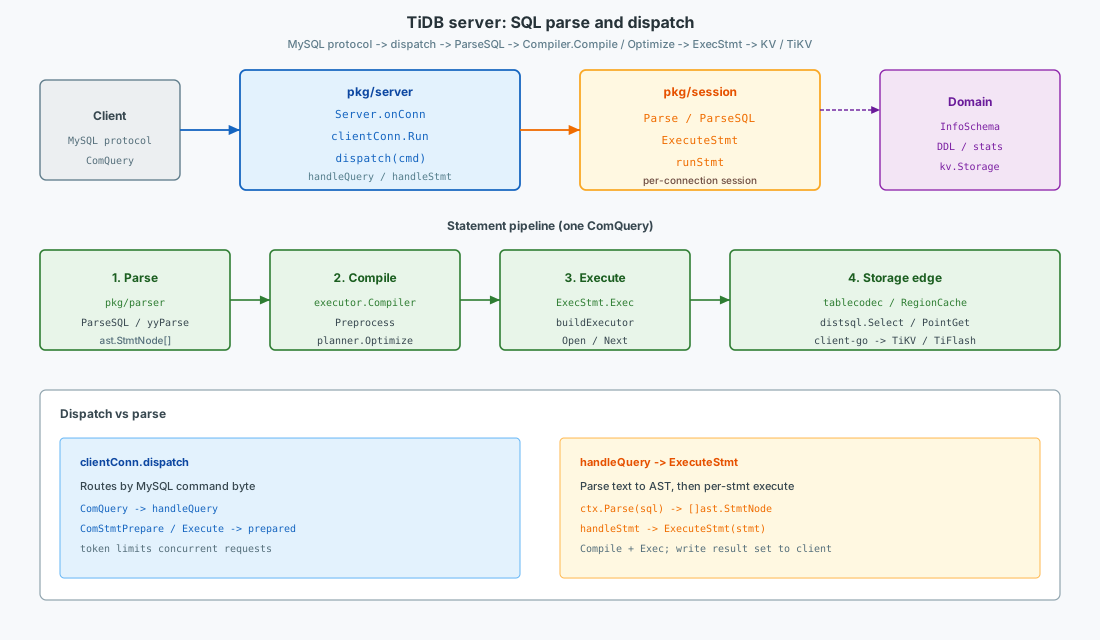
| Layer | Package | Responsibility |
|---|---|---|
| Protocol | pkg/server | Accept connections; dispatch by command; write result sets |
| Session | pkg/session | Per-connection state; Parse / ExecuteStmt / txn lifecycle |
| Parser | pkg/parser | Text → []ast.StmtNode (ParseSQL / yyParse) |
| Planner | pkg/planner | Preprocess + Optimize (logical → physical) |
| Executor | pkg/executor | Compiler.Compile, ExecStmt, executor tree |
| Domain | pkg/domain | Process-wide InfoSchema, DDL, stats, kv.Storage |
| Storage client | pkg/store, distsql, client-go | Region locate, Get / Coprocessor, 2PC |
Statement handling follows the source call order below: dispatch → parse → compile → execute.
2.1 Connection and command dispatch
Server.onConn runs one goroutine per client. After handshake and openSession, clientConn.Run reads packets and calls dispatch. The first byte is the protocol command; the hot path is ComQuery → handleQuery.
// git/tidb: pkg/server/conn.go — dispatch (simplified)
func (cc *clientConn) dispatch(ctx context.Context, data []byte) error {
	cmd := data[0]
	data = data[1:]
	dataStr := string(hack.String(data))
	switch cmd {
	case mysql.ComQuery: // Most frequently used command.
		return cc.handleQuery(ctx, /* trimmed sql */)
	case mysql.ComStmtPrepare:
		return cc.HandleStmtPrepare(ctx, dataStr)
	case mysql.ComStmtExecute:
		return cc.handleStmtExecute(ctx, data)
	// ComQuit, ComInitDB, ...
	}
}
handleQuery only routes into parse then per-statement execute; it does not plan or touch KV itself:
// git/tidb: pkg/server/conn.go — handleQuery (simplified)
func (cc *clientConn) handleQuery(ctx context.Context, sql string) (err error) {
	var stmts []ast.StmtNode
	if stmts, err = cc.ctx.Parse(ctx, sql); err != nil { // §2.2
		return err
	}
	for i, stmt := range stmts {
		_, err = cc.handleStmt(ctx, stmt, /* warns */, i == len(stmts)-1)
		// handleStmt → ExecuteStmt (§2.3–2.4) → writeResultSet / OK
	}
	return err
}
cc.ctx is a TiDBContext wrapping sessionapi.Session (pkg/server/driver_tidb.go). Prepared statements use ComStmtPrepare / ComStmtExecute; they still enter ExecuteStmt after bind/resolve.
2.2 Parse
session.Parse → ParseSQL takes a pooled in-tree parser (github.com/pingcap/tidb/pkg/parser → ./pkg/parser in go.mod), applies session SQL mode, and returns AST nodes.
// git/tidb: pkg/session/session.go — ParseSQL (core)
p := parserutil.GetParser()
defer parserutil.DestroyParser(p)
p.SetSQLMode(sqlMode)
p.SetParserConfig(s.sessionVars.BuildParserConfig())
tmp, warn, err := p.ParseSQL(sql, params...)
res := slices.Clone(tmp) // copy so the parser can be reused
return res, warn, err
// git/tidb: pkg/parser/yy_parser.go
func (parser *Parser) ParseSQL(sql string, params ...ParseParam) (stmt []ast.StmtNode, warns []error, err error) {
	parser.lexer.reset(sql)
	var l yyLexer = &parser.lexer
	yyParse(l, parser)
	// ... errors / warns ...
	for _, stmt := range parser.result {
		ast.SetFlag(stmt)
	}
	return parser.result, warns, nil
}
Output is []ast.StmtNode (for example *ast.SelectStmt, *ast.InsertStmt). No plan and no KV I/O yet.
2.3 Compile
handleStmt calls session.ExecuteStmt → executeStmtImpl. After PrepareTxnCtx and ResetContextOfStmt, the session builds an executor.Compiler and calls Compile: plannercore.Preprocess, then planner.Optimize, then wrap the physical plan in ExecStmt.
// git/tidb: pkg/executor/compiler.go — Compile (simplified)
func (c *Compiler) Compile(ctx context.Context, stmtNode ast.StmtNode) (*ExecStmt, error) {
	nodeW := resolve.NewNodeW(stmtNode)
	err := plannercore.Preprocess(ctx, c.Ctx, nodeW, /* ... */)
	is := sessiontxn.GetTxnManager(c.Ctx).GetTxnInfoSchema()
	finalPlan, names, err := planner.Optimize(ctx, c.Ctx, nodeW, is)
	stmt := &ExecStmt{Plan: finalPlan, StmtNode: stmtNode, Ctx: c.Ctx /* ... */}
	return stmt, nil
}
Optimize may hit plan cache or take a point-get fast path (TryFastPlan) before a full logical→physical search. Compile ends when an ExecStmt (or point-get plan handle) exists; it does not yet open executors or send RPCs.
Compile does not pick TiKV store addresses. For a predicate such as id >= 1, the optimizer turns access conditions into logical key ranges on the plan (PhysicalTableScan.Ranges as []*ranger.Range), via ranger.BuildTableRange / DetachCondAndBuildRangeForIndex (see PhysicalTableScan.ResolveCorrelatedColumns and path building during optimize). Those ranges are encoded later as kv.KeyRange bytes (tablecodec record prefix + handle bounds). The plan still does not list Region IDs or TiKV leader addresses—only “which key intervals to scan.” Which TiKV peers own those intervals is resolved at execute (§2.4) through RegionCache.
// git/tidb: pkg/planner/.../physical_table_scan.go — ranges on the plan (not store addrs)
// AccessCondition is used to calculate range.
AccessCondition []expression.Expression
Ranges          []*ranger.Range
// git/tidb: same file — rebuild ranges from access conditions (optimizer / correlated path)
p.Ranges, _, _, err = ranger.BuildTableRange(access, ctx.GetRangerCtx(), &pkTP, 0)
2.4 Execute
Still inside executeStmtImpl: if the compiled result is a point-get short path, stmt.PointGet runs; otherwise runStmt calls ExecStmt.Exec.
ExecStmt.Exec (pkg/executor/adapter.go):
buildExecutor—executorBuilder.build(plan)openExecutorhandleNoDelayfor DML, or return a record set whoseNextpulls chunks
TiKV targets are chosen here. TableReaderExecutor turns ranger.Range into []kv.KeyRange, then the coprocessor client (pkg/store/copr) splits those ranges by Region and looks up leaders:
- Encode logical ranges →
kv.KeyRange(tablecodecfort{tableID}_r…) RegionCache.BatchLocateKeyRanges/LocateKey— cache hit or PD Region locate- Build cop tasks per Region; send Coprocessor / KV RPCs to each Region leader store
// git/tidb: pkg/store/copr/region_cache.go — map key ranges → Region locations
locs, err := c.BatchLocateKeyRanges(bo.TiKVBackoffer(), kvRanges, opts...)
A single id >= 1 scan may therefore fan out to several TiKV leaders if the range crosses Region boundaries; compile only knew the key interval, not that fan-out. Cache misses go to PD; NotLeader / epoch errors refresh the cache and retry—see TiKV. SQL COMMIT becomes Prewrite/Commit via twoPhaseCommitter on the same locate path—see TiKV. After Exec returns, handleStmt writes the result set or OK packet to the client.
End-to-end (source order)
onConn → handshake → openSession → Run
  → dispatch(ComQuery) → handleQuery
  → Parse / ParseSQL → []ast.StmtNode
  → handleStmt → ExecuteStmt / executeStmtImpl
       → PrepareTxnCtx, ResetContextOfStmt
       → Compiler.Compile
            → Preprocess
            → planner.Optimize
                 → ranger ranges on PhysicalTableScan (logical keys only)
            → ExecStmt
       → runStmt → ExecStmt.Exec
            → buildExecutor → openExecutor → Next | handleNoDelay
            → kv.KeyRange + RegionCache.BatchLocateKeyRanges
            → Coprocessor / Get / Prewrite → Region leader TiKVs
  → writeResultSet / OK packet
2.5 Join across TiKV ranges
TiKV data is partitioned by Region key ranges owned by PD (§3.3). A Region leader only serves keys in its [start, end). There is no TiKV RPC that joins two tables across Regions. Cross-Region joins run in the TiDB process as volcano-style executors (Next returns a chunk.Chunk): a join operator pulls child readers; each reader already fans one logical scan into parallel Coprocessor RPCs to many Region leaders (§2.4). TiDB then joins those row streams in memory.
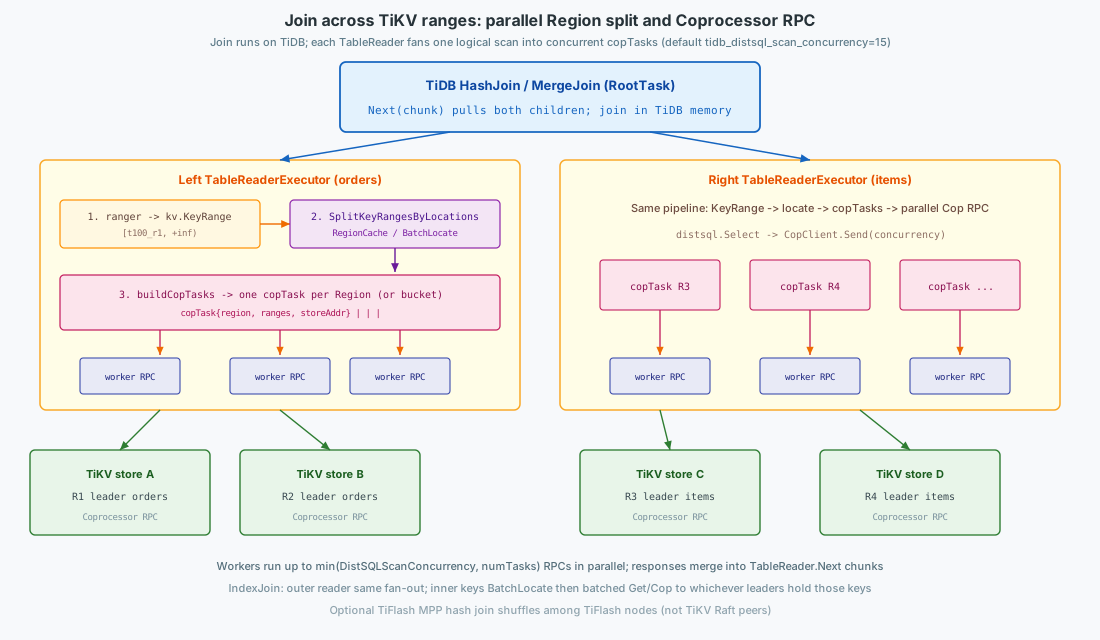
SELECT o.id, i.name
FROM orders o
JOIN items i ON o.item_id = i.id
WHERE o.id >= 1;
| Strategy | Where the join runs | How TiKV is used |
|---|---|---|
| HashJoin / MergeJoin | TiDB (HashJoinExec / MergeJoinExec) | Each side’s TableReader / IndexReader splits its ranges and runs concurrent cop tasks; TiDB builds/probes the join |
| IndexJoin (IndexLookUpJoin) | TiDB | Outer reader: multi-Region parallel scan; per outer chunk, encode inner keys, BatchLocate, batched Get / index lookup on the leaders that hold those keys |
| TiFlash MPP (optional) | TiFlash nodes | MPP hash join + exchange among TiFlash—still not a TiKV Raft-peer join |
Reader path: one scan → many parallel Region RPCs
For each join child (TableReaderExecutor / IndexReaderExecutor), DistSQL does not issue a single RPC for the whole table. It:
- Encodes the planner’s
rangerintervals as[]kv.KeyRange. RegionCache.SplitKeyRangesByLocations(viaBatchLocateKeyRanges) cuts those ranges at Region (or bucket) boundaries.buildCopTasksbuilds onecopTaskper location:{region, ranges, storeAddr}.CopClient.Sendstarts up tomin(tidb_distsql_scan_concurrency, len(tasks))workers (default concurrency 15) that each send a Coprocessor RPC to that Region’s leader; responses merge into the reader’sNextchunks.
// git/tidb: pkg/store/copr/region_cache.go
locs, err := c.BatchLocateKeyRanges(bo.TiKVBackoffer(), kvRanges, opts...)
// SplitKeyRangesByLocations → []*LocationKeyRanges

// git/tidb: pkg/store/copr/coprocessor.go
type copTask struct {
	region    tikv.RegionVerID
	ranges    *KeyRanges
	storeAddr string
	...
}
tasks, err := buildCopTasks(bo, ranges, opt)  // one task per Region/bucket
// then workers: for i := range concurrency { go handle copTask → TiKV RPC }
// git/tidb: pkg/distsql/distsql.go
func Select(...) (SelectResult, error) {
	...
	resp := dctx.Client.Send(ctx, kvReq, dctx.KVVars, option)  // CopClient, parallel tasks
So a join child is still an iterator leaf from HashJoin’s point of view; underneath, that leaf is a merge of concurrent Region RPCs, not a local TABLE buffer.
Join tree: children first, then join in TiDB
executorBuilder builds the join after its children, so each side’s multi-Region I/O is nested under the join:
// git/tidb: pkg/executor/builder.go — HashJoin
leftExec := b.build(v.Children()[0])  // TableReader → buildCopTasks → parallel leaders
rightExec := b.build(v.Children()[1])
return b.buildHashJoinFromChildExecs(leftExec, rightExec, v)
HashJoin.Next (TiDB memory)
  ├─ TableReader(orders).Next
  │     KeyRange → SplitKeyRangesByLocations → copTasks
  │     ├── worker ─ Cop RPC ─► store A (R1 leader)
  │     ├── worker ─ Cop RPC ─► store B (R2 leader)
  │     └── …  (capped by DistSQLScanConcurrency)
  └─ TableReader(items).Next   — same fan-out on items Regions

IndexJoin.Next
  ├─ Outer TableReader — parallel cop as above
  └─ per outer chunk: BatchLocate(inner keys) → batched Get/Cop to those leaders
“Join across multiple TiKV” therefore means: parallel range I/O to many leaders under each reader, join logic on TiDB (or MPP on TiFlash)—not a distributed join inside raftstore. RPC cost is overlapped by that concurrency and by chunked Next; it is not free for tiny lookups (see §2.4 locate path).
2.6 Worked example: SQL → keys → locate
Schema (table_id = 100, unique index idx_user = index_id = 1):
CREATE TABLE orders (
  id BIGINT PRIMARY KEY,
  user_id BIGINT NOT NULL,
  amount DECIMAL(10,2) NOT NULL,
  UNIQUE KEY idx_user (user_id)
);

INSERT INTO orders (id, user_id, amount) VALUES
  (1, 10, 19.90),
  (2, 20,  5.00);
| id | user_id | amount | Record key | Index key |
|---|---|---|---|---|
| 1 | 10 | 19.90 | t100_r1 | t100_i1_10 → 1 |
| 2 | 20 | 5.00 | t100_r2 | t100_i1_20 → 2 |
SELECT id, amount FROM orders WHERE id >= 1;
| id | amount |
|---|---|
| 1 | 19.90 |
| 2 | 5.00 |
| Step | Phase | Inside TiDB | Knows TiKV stores? |
|---|---|---|---|
| 1 | Dispatch | dispatch / handleQuery | No |
| 2 | Parse | ParseSQL → AST | No |
| 3 | Compile | Optimize → TableReader; ranger range ≈ [t100_r1, +∞) | No — logical key range only |
| 4 | Execute | Encode kv.KeyRange; BatchLocateKeyRanges → Region leader(s); Coprocessor scan | Yes — after RegionCache / PD |
2.7 Key files
| Path | Role |
|---|---|
git/tidb/pkg/server/server.go | Server, onConn |
git/tidb/pkg/server/conn.go | dispatch, handleQuery, handleStmt |
git/tidb/pkg/server/driver_tidb.go | TiDBDriver / TiDBContext |
git/tidb/pkg/session/session.go | ParseSQL, ExecuteStmt, runStmt |
git/tidb/pkg/parser/yy_parser.go | Parser.ParseSQL / yyParse |
git/tidb/pkg/executor/compiler.go | Compiler.Compile |
git/tidb/pkg/planner/optimize.go | Optimize |
git/tidb/pkg/util/ranger/... | Build logical key ranges from predicates |
git/tidb/pkg/executor/adapter.go | ExecStmt.Exec, buildExecutor |
git/tidb/pkg/executor/builder.go | buildHashJoin, buildIndexLookUpJoin, … |
git/tidb/pkg/executor/join/ | HashJoin / IndexJoin workers |
git/tidb/pkg/store/copr/region_cache.go | SplitKeyRangesByLocations / BatchLocateKeyRanges |
git/tidb/pkg/store/copr/coprocessor.go | buildCopTasks, parallel copTask workers / Cop RPC |
git/tidb/pkg/distsql/distsql.go | Select → CopClient.Send |
git/tidb/pkg/domain/domain.go | process-wide Domain |
git/tidb/pkg/tablecodec/tablecodec.go | Key encoding |
git/tidb/pkg/store/driver/tikv_driver.go | Open PD + KVStore |
3. PD
PD is the control plane in git/pd. An odd-sized PD membership elects one leader (etcd lease). That leader owns the Region keyspace map (ranges, split/merge), allocates TSO, answers Region locate, ingests TiKV heartbeats, and drives schedule operators. It never stores row values.
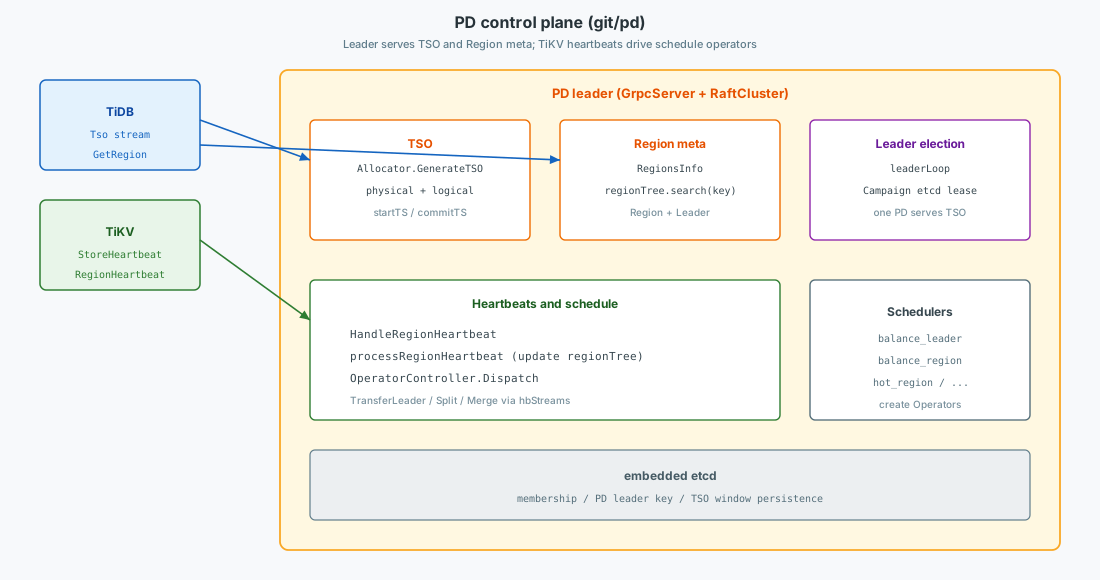
BOOT:  pd-server → CreateServer → embed etcd → startServer → leaderLoop
LEAD:  Campaign lease → Keep → createRaftCluster / Coordinator

TiDB:  Tso stream → Allocator.GenerateTSO
       GetRegion(key) → RegionsInfo.GetRegionByKey → regionTree.search

TiKV:  StoreHeartbeat / RegionHeartbeat → processRegionHeartbeat
       → OperatorController.Dispatch → cmds on hbStreams
3.1 Leader election
Server.Run starts etcd, then leaderLoop. Only the member that is also etcd leader campaigns for the PD leader key; followers watch until the lease changes.
// git/pd: server/server.go — leaderLoop (simplified)
leader, checkAgain := s.member.CheckLeader()
if leader != nil {
	leader.Watch(s.serverLoopCtx) // block until leader changes
	continue
}
etcdLeader := s.member.GetEtcdLeader()
if etcdLeader != s.member.ID() {
	time.Sleep(200 * time.Millisecond)
	continue
}
s.campaignLeader() // etcd lease Campaign + Keep; then createRaftCluster
TSO generation requires serving leadership (Allocator.isServing); otherwise clients see not-leader and retry against the current leader.
3.2 TSO
TiDB takes startTS / commitTS from a gRPC Tso stream. The leader’s tso.Allocator advances a physical (ms) + logical counter (GenerateTSO → timestampOracle.getTS). The allocation window is persisted so a new leader does not go backward.
// git/pd: server/grpc_service.go — Tso (core path)
ts, err := s.tsoAllocator.GenerateTSO(ctx, count)
response := &pdpb.TsoResponse{Timestamp: &ts, Count: count}
stream.Send(response)
// git/pd: pkg/tso/allocator.go
func (a *Allocator) GenerateTSO(ctx context.Context, count uint32) (pdpb.Timestamp, error) {
	if !a.isServing() {
		return pdpb.Timestamp{}, errs.ErrGenerateTimestamp.FastGenByArgs(/* not leader */)
	}
	return a.timestampOracle.getTS(ctx, count)
}
3.3 Keyspace and Region ranges
TiKV presents one global sorted keyspace, not one table per store. TiDB SQL tables and indexes are encoded into that keyspace (e.g. record keys t{table_id}_r…, index keys t{table_id}_i{index_id}_…). PD does not assign “table T → TiKV N.” It cuts the byte keyspace into Regions—half-open ranges [startKey, endKey)—and places each Region’s peers on TiKV stores (commonly RF=3).
Consequences:
- One TiKV store hosts many Region peers for whatever ranges PD placed there. Those ranges can cover fragments of many tables (and indexes), plus system keys—not a single table.
- One table is usually split into many Regions across many stores as it grows; a scan or join may hit several Region leaders (§2.4–2.5).
- Scheduling moves or splits Regions (key ranges), not whole tables.
Epoch bumps on split, merge, or membership change. That Region layout is what TiDB’s RegionCache and join/scan fan-out consume.
| Piece | Meaning |
|---|---|
| Range | [startKey, endKey) in the global keyspace |
| Peers | Copies on different stores; one leader serves client KV RPCs |
| Epoch | Version for split / merge / conf-change; stale cache must reload |
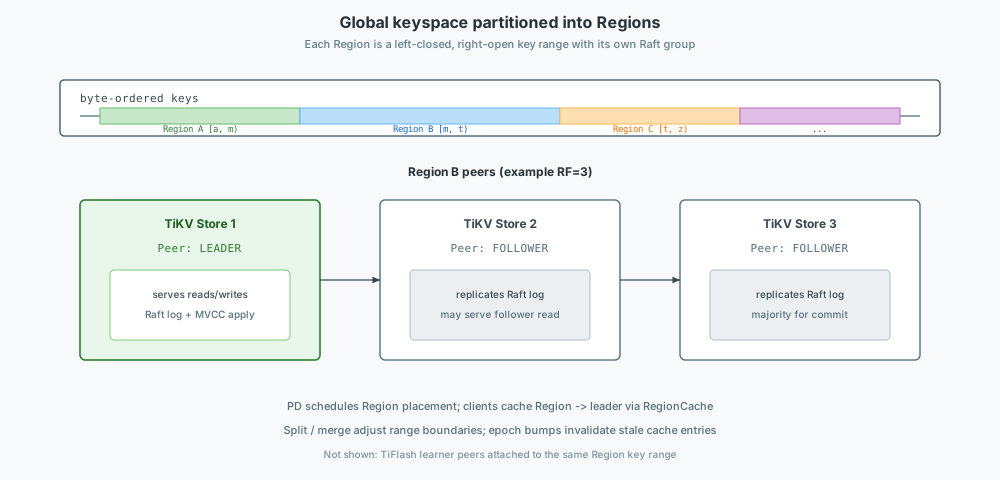
Example after splits for orders (table_id = 100)—still only key ranges, not “this TiKV owns orders”:
| Region | Range | Holds |
|---|---|---|
| R1 | [t100_r1, t100_r50) | early row keys |
| R2 | [t100_r50, t100_i1) | later rows |
| R3 | [t100_i1, t101) | idx_user |
R1–R3’s peers sit on different TiKV stores; another table’s keys (t101_…) are other ranges that may share those same stores. id >= 1 becomes a logical key range that may cover R1 and R2; execute locates each overlapping Region’s leader. How Raft replicates within one Region is in TiKV; CAP and PD etcd Raft are in CAP and Raft.
Split. When a Region grows too large or hot, PD (or TiKV via AskSplit) creates a split operator. The operator carries split keys; on the next heartbeat tick, TiKV applies the split and heartbeats report the new children—PD inserts them into regionTree.
// git/pd: pkg/schedule/operator/create_operator.go
func CreateSplitRegionOperator(desc string, region *core.RegionInfo, kind OpKind,
	policy pdpb.CheckPolicy, keys [][]byte) (*Operator, error) {
	step := SplitRegion{
		StartKey:  region.GetStartKey(),
		EndKey:    region.GetEndKey(),
		Policy:    policy,
		SplitKeys: keys,
	}
	brief := fmt.Sprintf("split: region %v use policy %s", region.GetID(), policy)
	op := NewOperator(desc, brief, region.GetID(), region.GetRegionEpoch(),
		kind, region.GetApproximateSize(), step)
	return op, nil
}
Merge is the inverse (CreateMergeRegionOperator). Transfer-leader moves which peer serves writes without changing the key range.
3.4 Region locate
TiDB’s RegionCache fills misses via PD GetRegion / scan RPCs. PD looks up the key in an in-memory region tree ordered by StartKey ([start, end)).
// git/pd: pkg/core/region.go
func (r *RegionsInfo) GetRegionByKey(regionKey []byte) *RegionInfo {
	return r.tree.search(regionKey)
}
// git/pd: pkg/utils/grpcutil/cluster.go — GetRegion helper
region := rc.GetRegionByKey(request.GetRegionKey())
return &pdpb.GetRegionResponse{
	Region: region.GetMeta(),
	Leader: region.GetLeader(),
	// DownPeers / PendingPeers / ...
}, nil
That is how execute-time BatchLocateKeyRanges (§2.4) learns Region leaders when the client cache misses.
3.5 Heartbeats and schedule
TiKV sends StoreHeartbeat and RegionHeartbeat. On each region heartbeat, RaftCluster.HandleRegionHeartbeat updates the region tree (processRegionHeartbeat), then OperatorController.Dispatch advances pending operators and may push TransferLeader / change-peer / split / merge commands back on the heartbeat stream.
// git/pd: server/cluster/cluster_worker.go
func (c *RaftCluster) HandleRegionHeartbeat(region *core.RegionInfo) error {
	if err := c.processRegionHeartbeat(ctx, region); err != nil {
		return err
	}
	c.coordinator.GetOperatorController().Dispatch(
		region, operator.DispatchFromHeartBeat, c.coordinator.RecordOpStepWithTTL)
	return nil
}
Schedulers and checkers (balance_leader, balance_region, split / merge checkers, …) create Operators; heartbeats are the tick that applies them. TiDB does not participate in that loop—it only consumes the resulting Region meta and TSO.
3.6 Key files (git/pd)
| Path | Role |
|---|---|
cmd/pd-server/main.go | process entry |
server/server.go | CreateServer, Run, leaderLoop, campaignLeader |
server/grpc_service.go | GrpcServer.Tso, GetRegion, heartbeats, AskSplit |
pkg/tso/allocator.go | GenerateTSO |
pkg/tso/tso.go | timestampOracle.getTS |
pkg/core/region.go | RegionsInfo.GetRegionByKey |
pkg/core/region_tree.go | B-tree search by start key |
server/cluster/cluster_worker.go | HandleRegionHeartbeat |
pkg/schedule/operator/create_operator.go | CreateSplitRegionOperator, merge / transfer-leader |
pkg/schedule/operator/operator_controller.go | Dispatch |
pkg/schedule/checker/split_checker.go | size / rule driven splits |
pkg/schedule/schedulers/ | balance / hot-region schedulers |