
MySQL query Internals - Volcano model
For many years, MySQL executed SQL queries using a deeply nested, monolithic executor loop. Functions like JOIN::exec() and evaluate_join_record() were responsible for traversing tables, checking search conditions, handling joins, and aggregating results. While functional, this monolithic architecture was notoriously difficult to maintain, optimize, or extend.
In MySQL 8.0, the engineering team undertook a massive architectural refactoring: migrating the query execution engine to the Volcano Iterator Model (also known as the Pipeline or Iterator Model, pioneered by Goetz Graefe in 1994).
In this post we examine the architecture of MySQL’s Volcano iterator model: how an AccessPath plan is compiled into a RowIterator tree; pull-based execution for SELECT, UPDATE/DELETE, and INSERT … SELECT; and a catalog of physical iterators with representative SQL examples.
1. The Volcano Iterator Architecture
The core philosophy of the Volcano model is composability. Instead of one monolithic function doing everything, execution is split into a tree of highly specialized, modular Iterators.
Each iterator represents a single physical execution step (e.g., scanning a table, filtering rows, performing a join, or sorting). Iterators are stacked in a parent-child relationship. The parent iterator pulls rows from its child iterators, processes them, and passes them up to its parent.
The RowIterator Base Class (sql/iterators/row_iterator.h)
Every execution iterator in modern MySQL inherits from the abstract base class RowIterator. It defines a remarkably simple and elegant interface:
class RowIterator {
 public:
  explicit RowIterator(THD *thd) : m_thd(thd) {}
  virtual ~RowIterator() = default;

  // Initialize or re-initialize the iterator (rewind or reposition)
  bool Init() {
    ++m_num_init_calls;
    return DoInit();
  }

  // Read a single row
  int Read() {
    const int error = DoRead();
    if (error == 0) {
      ++m_num_rows;
    } else if (error == -1) {
      ++m_num_full_reads;
    }
    return error;
  }

  virtual void SetNullRowFlag(bool is_null_row) = 0;
  virtual void UnlockRow() = 0;

 private:
  virtual bool DoInit() = 0; // Implemented by subclasses
  virtual int DoRead() = 0; // Implemented by subclasses
};
Key Design Choice: Buffer-Centric Row Retrieval
In a pure Volcano model, Read() might return a Row object or a tuple. In MySQL, however, Read() returns an integer error code (0 for OK, -1 for EOF, 1 for error).
So, where is the row data?
To avoid expensive copying, allocation, and serialization overhead, MySQL uses a buffer-centric design. When Read() returns 0, the row data is placed directly inside pre-allocated record buffers associated with the underlying tables (specifically, table->record[0]). Any parent iterator or expression-evaluation engine (e.g., a filter condition or projection) reads the columns directly from these in-place table buffers. This zero-copy design maximizes memory efficiency and cache friendliness.
2. From SQL statement to iterator tree
The Volcano compilation and execution pipeline applies to every statement whose run-time plan is represented by a Query_expression / JOIN rooted at an AccessPath: ordinary SELECT (and derived/source blocks), multi-table and hypergraph-optimized UPDATE / DELETE, and INSERT … SELECT. All such statements are lowered to a RowIterator tree and driven by the same Init() / Read() contract. Statement families differ in three places: the AccessPath root chosen by the optimizer, the attached Query_result, and whether mutation is performed inside a root mutation iterator or outside the iterator via send_data.
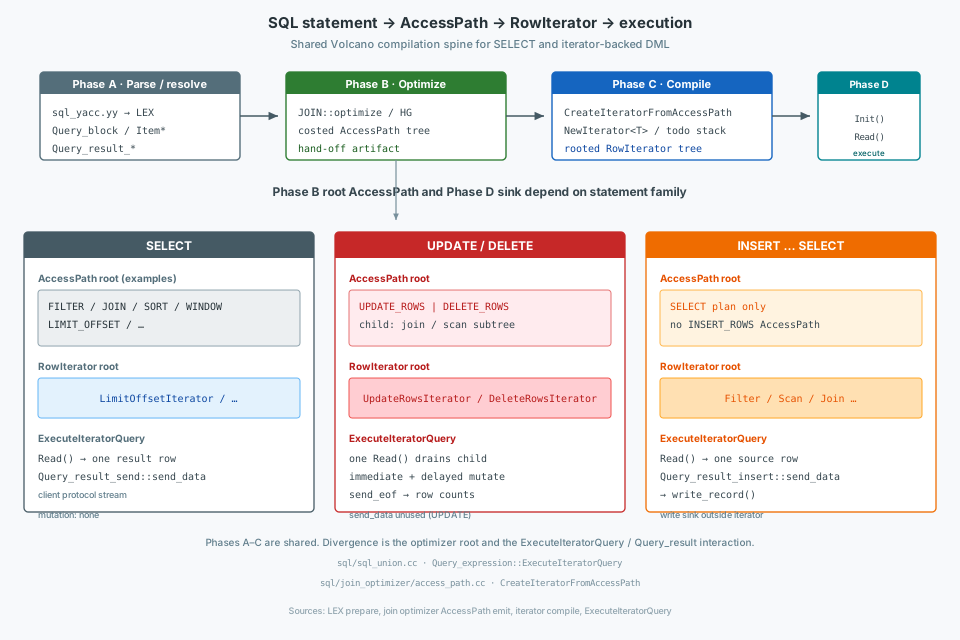
Phase A — Parsing and semantic resolution
| Concern | Primary artifacts |
|---|---|
| Grammar reduction | sql/sql_yacc.yy → LEX |
| Statement structure | Query_block, Query_expression |
| Expressions | Item trees |
| Result / mutation sink | Query_result_send, Query_result_update, Query_result_delete, Query_result_insert |
The parser produces an abstract syntax tree. Resolution binds identifiers, applies semantic constraints (including ONLY_FULL_GROUP_BY where applicable), and for DML prepares target field lists together with the matching Sql_cmd_* and Query_result_* objects. No RowIterator exists yet.
Phase B — Logical and physical optimization
JOIN::optimize() (classical planner) or the hypergraph optimizer enumerates join order, access methods, and costs. The durable product of this phase is an AccessPath tree (sql/join_optimizer/access_path.h), not iterator instances.
Common operator nodes include TABLE_SCAN, INDEX_RANGE_SCAN, FILTER, NESTED_LOOP_JOIN, HASH_JOIN, SORT, and WINDOW. For iterator-backed DML the planner may wrap the candidate-producing subtree:
| Statement family | Characteristic AccessPath root |
|---|---|
SELECT and derived sources | scan / join / sort / window / limit as required |
UPDATE | UPDATE_ROWS over the candidate subtree |
DELETE | DELETE_ROWS over the candidate subtree |
INSERT … SELECT | SELECT-style plan only (no INSERT_ROWS node) |
Phase C — Compilation to iterators
CreateIteratorFromAccessPath() (sql/join_optimizer/access_path.cc) walks the AccessPath graph and instantiates RowIterator subclasses via NewIterator<T>(). Deep plans are compiled with a MEM_ROOT-backed todo stack so that compilation does not rely on unbounded C++ recursion:
unique_ptr_destroy_only<RowIterator> CreateIteratorFromAccessPath(
THD *thd, MEM_ROOT *mem_root, AccessPath *top_path, JOIN *top_join,
bool top_eligible_for_batch_mode) {
unique_ptr_destroy_only<RowIterator> ret;
Mem_root_array<IteratorToBeCreated> todo(mem_root);
todo.push_back({top_path, top_join, top_eligible_for_batch_mode, &ret, {}});
while (!todo.empty()) {
IteratorToBeCreated job = todo.back();
todo.pop_back();
AccessPath *path = job.path;
unique_ptr_destroy_only<RowIterator> iterator;
// ...
switch (path->type) {
case AccessPath::TABLE_SCAN: {
const auto ¶m = path->table_scan();
iterator = NewIterator<TableScanIterator>(thd, mem_root, param.table, ...);
break;
}
case AccessPath::FILTER: {
// child compiled via the todo stack, then:
iterator = NewIterator<FilterIterator>(
thd, mem_root, std::move(child_iterator), path->filter().condition);
break;
}
case AccessPath::NESTED_LOOP_JOIN: {
iterator = NewIterator<NestedLoopIterator>(
thd, mem_root, std::move(outer_iterator),
std::move(inner_iterator), ...);
break;
}
case AccessPath::UPDATE_ROWS:
case AccessPath::DELETE_ROWS:
case AccessPath::WINDOW:
// … remaining AccessPath kinds …
break;
}
// ...
}
return ret; // ownership root of the nested iterator tree
}
The returned unique_ptr owns the full operator tree; releasing it reclaims the statement’s physical iterators.
Phase D — Pull-based execution
Volcano execution is demand-driven (pull-based). Control and data flow in opposite directions along the iterator edges:
  demand (Read)     ──────────────────────►   toward the leaves
  rows in buffers   ◄──────────────────────   toward the root

  ExecuteIteratorQuery
        │  Read()
        ▼
  [ root iterator ]
        │  Read()          only when the parent needs another unit
        ▼
  [ child iterators … ]
        │
        ▼
  [ leaf scan / lookup ]
No operator pushes a complete result set into its parent. A parent pulls by calling child->Read(); the child may pull further until it returns 0 (row ready in table buffers), -1 (EOF), or 1 (error). Leaves perform I/O only in response to those pulls. Early termination follows from refusing further pulls (for example LIMIT returning -1).
The shared driver is Query_expression::ExecuteIteratorQuery() (sql/sql_union.cc):
// sql/sql_union.cc — ExecuteIteratorQuery() (structure)
if (m_root_iterator->Init()) return true;
for (;;) {
  int error = m_root_iterator->Read();   // one demand at the root
  if (error > 0 || thd->is_error()) return true;
  else if (error < 0) break;             // EOF: stop pulling
  if (query_result->send_data(thd, *fields)) return true;
}
return query_result->send_eof(thd);
How often that loop runs, and what send_data does, differs sharply among SELECT, UPDATE/DELETE, and INSERT … SELECT. The subtree remains pull-based in all cases; the granularity of a root pull and the sink do not.
SELECT — one root pull per result row
ExecuteIteratorQuery loop
  Read(root) → 0     send_data → client      ⎫
  Read(root) → 0     send_data → client      ⎬  many iterations
  …                                          ⎭
  Read(root) → -1    break → send_eof
Each Read() == 0 means exactly one client-visible row is present in table buffers. Query_result_send::send_data streams that row. Demand is paced by the consumer (and by operators such as LimitOffsetIterator).
UPDATE / DELETE — one root pull runs the whole mutation
With an UPDATE_ROWS / DELETE_ROWS root, the mutation iterator’s DoRead() internally pulls the child join row by row, applies immediate updates/deletes (and buffers delayed row IDs), then runs delayed mutation and returns -1. From the driver’s point of view there is typically no per-row root loop:
ExecuteIteratorQuery loop
  Read(UpdateRowsIterator | DeleteRowsIterator)
        │
        │   inside DoRead():
        │     loop:  child->Read() → mutate / buffer this candidate
        │     DoDelayedUpdates / DoDelayedDeletes
        │     return -1
        ▼
  error == -1  →  break (send_data not used for UPDATE)
  send_eof()   →  found / updated / deleted counts
// UpdateRowsIterator::DoRead() — pull of the child is inside one root Read()
while (!local_error) {
  const int read_error = m_source->Read();   // per-candidate pull
  if (read_error < 0) break;
  local_error = DoImmediateUpdatesAndBufferRowIds(...);
}
DoDelayedUpdates(...);
return local_error ? 1 : -1;                 // EOF to ExecuteIteratorQuery
Query_result_update::send_data is unused (assert(false)). Row counts are taken from the mutation iterator in send_eof(). Thus UPDATE/DELETE are not “one root pull = one updated row” the way SELECT is one root pull per result row; pull applies inside the mutation operator.
INSERT … SELECT — one root pull per source row; write in send_data
There is no INSERT_ROWS iterator. The root is a SELECT-style tree. The driver again loops per row, but the sink inserts rather than returning tuples to the client:
ExecuteIteratorQuery loop
  Read(SELECT root) → 0    Query_result_insert::send_data → write_record()
  Read(SELECT root) → 0    send_data → write_record()
  …
  Read(SELECT root) → -1   break → send_eof
Granularity matches SELECT at the driver (one pull ↔ one buffered source row). The side effect is write_record() inside send_data, not projection to the protocol.
Comparison
SELECT | UPDATE / DELETE (mutation root) | INSERT … SELECT | |
|---|---|---|---|
| Root operator | Limit / join / scan / … | UpdateRowsIterator / DeleteRowsIterator | SELECT plan only |
Driver Read() count | One per result row | Typically one call that finishes mutation | One per source row |
| Where child rows are pulled | By parents as each result is demanded | Inside mutation DoRead()’s loop | By parents as each source row is demanded |
send_data | Protocol | Not used (UPDATE) | write_record() |
| Completes when | Root returns -1 (e.g. EOF / LIMIT) | Mutation DoRead() returns -1 after draining the child | Source root returns -1 |
Shared invariant: no child pushes; every lower Read() is caused by an upper demand. Distinct policy: SELECT and INSERT pace the driver per row; UPDATE/DELETE collapse candidate consumption into a single root pull.
Example — SELECT tree under pull evaluation
SELECT employees.name, departments.name
FROM employees
JOIN departments ON employees.department_id = departments.id
WHERE employees.salary > 50000
LIMIT 10;
After Phases B–C the AccessPath tree is compiled to a rooted RowIterator network of the following shape (operator choices may vary with statistics and indexes):
               [ LimitOffsetIterator ]     root: enforce LIMIT 10
                         │
                 [ FilterIterator ]        WHERE salary > 50000
                         │
               [ NestedLoopIterator ]      INNER JOIN
                /                  \
   [ TableScanIterator ]    [ EQRefIterator | RefIterator ]
     employees (outer)         departments (inner, on id)
Each client-visible row is one successful root pull; that demand recursively induces child pulls only along the path needed for that row:
- The driver calls
Read()onLimitOffsetIterator(one demand for one output row whileLIMITremains unsatisfied). LimitOffsetIteratorpulls once fromFilterIterator.FilterIteratorpulls fromNestedLoopIteratoruntilm_conditionaccepts a joined row; rejected combinations are unlocked and the filter pulls again.NestedLoopIterator, for each outeremployeesrow it pulled, re-Init()s the inner lookup withdepartment_idand pulls matchingdepartmentsrows.- On acceptance, buffers hold the row;
send_datastreams projections to the client. - After ten accepted root returns,
LimitOffsetIteratoranswers with-1. The driver stops; leaves are not pulled further—LIMITtruncates work because further demands never occur.
The same driver and edge discipline apply to UPDATE/DELETE and INSERT; only root granularity and the sink differ, as in the comparison above.
Phases A–C form a shared compilation spine. Phase D fixes evaluation as parents pull, children produce on demand, with statement-specific root pacing and Query_result behaviour.
3. Row iterators
CreateIteratorFromAccessPath() (sql/join_optimizer/access_path.cc) compiles each AccessPath node into a RowIterator. Generation always follows the same stack-driven pattern: push children onto a MEM_ROOT todo list, construct the operator with NewIterator<T>(…) (or a dedicated factory), then attach it as path->iterator.
// access_path.cc — shared compile skeleton
switch (path->type) {
  case AccessPath::…: {
    if (job.children.is_null()) {
      SetupJobsForChildren(...);  // compile inputs first
      continue;
    }
    iterator = NewIterator<ConcreteIterator>(thd, mem_root, ...);
    break;
  }
}
path->iterator = iterator.get();
Execution is always pull-based: DoInit() prepares state; each DoRead() returns 0 (row in buffers), -1 (EOF), or 1 (error). The subsections below keep that contract and, for every iterator, give usage SQL, the generation call, and the core of DoRead / DoInit.
3.1 Table-access leaves
Family generation. Leaves have no AccessPath children; the switch constructs the iterator directly from path->*() parameters (table, idx, ref, …).
TableScanIterator (TABLE_SCAN)
Full table (heap / clustered) scan via ha_rnd_next.
SELECT * FROM employees;
// Generation — access_path.cc
iterator = NewIterator<TableScanIterator>(
    thd, mem_root, param.table, path->num_output_rows(), examined_rows);
// Execution — basic_row_iterators.cc
int TableScanIterator::DoRead() {
  int tmp;
  while ((tmp = table()->file->ha_rnd_next(m_record))) {
    if (tmp == HA_ERR_RECORD_DELETED && !thd()->killed) continue;
    return HandleError(tmp);
  }
  if (m_examined_rows != nullptr) ++*m_examined_rows;
  return 0;
}
IndexScanIterator (INDEX_SCAN)
Full scan of one index (ha_index_first / ha_index_next), optionally ordered.
SELECT * FROM employees FORCE INDEX (idx_hired) ORDER BY hired_at;
iterator = NewIterator<IndexScanIterator</*reverse=*/false>>(
    thd, mem_root, param.table, param.idx, param.use_order,
    path->num_output_rows(), examined_rows);
int IndexScanIterator<false>::DoRead() {
  int error = m_first ? table()->file->ha_index_first(m_record)
                      : table()->file->ha_index_next(m_record);
  m_first = false;
  if (error) return HandleError(error);
  if (m_examined_rows != nullptr) ++*m_examined_rows;
  return 0;
}
IndexDistanceScanIterator (INDEX_DISTANCE_SCAN)
Index probe constrained by a distance / MBR style key range (e.g. vector or spatial distance plans).
-- plans that use vector / distance index access (engine-dependent)
SELECT id FROM embeddings
ORDER BY DISTANCE(vec, @q) LIMIT 10;
iterator = NewIterator<IndexDistanceScanIterator>(
    thd, mem_root, param.table, param.idx, param.range,
    path->num_output_rows(), examined_rows);
int IndexDistanceScanIterator::DoRead() {
  int error = m_first
      ? table()->file->ha_index_read_map(
            m_record, m_query_mbr->min_key, m_query_mbr->min_keypart_map,
            m_query_mbr->rkey_func_flag)
      : table()->file->ha_index_next_same(
            m_record, m_query_mbr->min_key, m_query_mbr->min_length);
  m_first = false;
  if (error) return HandleError(error);
  return 0;
}
RefIterator (REF)
Non-unique equality ref: ha_index_read_map(…, HA_READ_KEY_EXACT) then ha_index_next_same.
SELECT * FROM employees WHERE department_id = 7;
iterator = NewIterator<RefIterator</*reverse=*/false>>(
    thd, mem_root, param.table, param.ref, param.use_order,
    path->num_output_rows(), examined_rows);
int RefIterator<false>::DoRead() {
  if (m_first_record_since_init) {
    m_first_record_since_init = false;
    if (construct_lookup(thd(), table(), m_ref)) return -1;
    int error = table()->file->ha_index_read_map(
        table()->record[0], key_buff, key_part_map, HA_READ_KEY_EXACT);
    if (error) return HandleError(error);
  } else {
    int error = table()->file->ha_index_next_same(
        table()->record[0], m_ref->key_buff, m_ref->key_length);
    if (error) return HandleError(error);
  }
  return 0;
}
EQRefIterator (EQ_REF)
Unique / PK equality; at most one row per Init/Read cycle (often caches the key).
SELECT * FROM employees WHERE id = 42;
iterator = NewIterator<EQRefIterator>(thd, mem_root, param.table, param.ref,
                                      examined_rows);
int EQRefIterator::DoRead() {
  if (!m_first_record_since_init) return -1;  // already returned the unique row
  m_first_record_since_init = false;
  m_ref->key_err = construct_lookup(thd(), table(), m_ref);
  if (m_ref->key_err) return -1;
  // ha_index_read_map(..., HA_READ_KEY_EXACT) when the key changed or uncached
  return 0;
}
RefOrNullIterator (REF_OR_NULL)
Matches ref keys, then retries with the NULL key part set (OR … IS NULL strategy).
SELECT * FROM employees WHERE manager_id = 5 OR manager_id IS NULL;
iterator = NewIterator<RefOrNullIterator>(
    thd, mem_root, param.table, param.ref, param.use_order,
    path->num_output_rows(), examined_rows);
int RefOrNullIterator::DoRead() {
  // first: ha_index_read_map exact; then ha_index_next_same
  // on EOF, if null key not yet tried: set *null_ref_key and recurse Read()
}
PushedJoinRefIterator (PUSHED_JOIN_REF)
Ref lookup pushed into an engine that supports multi-table pushed joins (ha_index_read_pushed / ha_index_next_pushed).
-- when the SE accepts a pushed join ref (e.g. NDB-style pushdown)
SELECT e.*, d.* FROM employees e JOIN departments d ON e.department_id = d.id;
iterator = NewIterator<PushedJoinRefIterator>(
    thd, mem_root, param.table, param.ref, param.use_order, param.is_unique,
    examined_rows);
int PushedJoinRefIterator::DoRead() {
  if (m_first_record_since_init) {
    construct_lookup(thd(), table(), m_ref);
    int error = table()->file->ha_index_read_pushed(...);
    if (error) return HandleError(error);
  } else if (!m_is_unique) {
    int error = table()->file->ha_index_next_pushed(table()->record[0]);
    if (error) return HandleError(error);
  } else return -1;
  return 0;
}
FullTextSearchIterator (FULL_TEXT_SEARCH)
SELECT * FROM docs WHERE MATCH(body) AGAINST ('volcano' IN NATURAL LANGUAGE MODE);
iterator = NewIterator<FullTextSearchIterator>(
    thd, mem_root, param.table, param.ref, param.ft_func, param.use_order,
    examined_rows);
int FullTextSearchIterator::DoRead() {
  int error = table()->file->ha_ft_read(table()->record[0]);
  if (error) return HandleError(error);
  return 0;
}
ConstIterator (CONST_TABLE)
One const row already resolved; a single successful Read() then EOF.
SELECT * FROM employees WHERE id = 1; -- may be optimized to const table access
iterator = NewIterator<ConstIterator>(thd, mem_root, param.table, param.ref,
                                      examined_rows);
int ConstIterator::DoRead() {
  if (!m_first_record_since_init) return -1;
  m_first_record_since_init = false;
  int err = read_const(table(), m_ref);
  table()->const_table = true;
  return err;
}
FollowTailIterator (FOLLOW_TAIL)
Reads newly appended rows of a working table (recursive CTE / seed-worktable iteration) without overrunning SE EOF.
WITH RECURSIVE tree AS (
  SELECT id, parent_id FROM org WHERE parent_id IS NULL
  UNION ALL
  SELECT o.id, o.parent_id FROM org o JOIN tree t ON o.parent_id = t.id
)
SELECT * FROM tree;
iterator = NewIterator<FollowTailIterator>(
    thd, mem_root, param.table, path->num_output_rows(), examined_rows);
int FollowTailIterator::DoRead() {
  if (m_read_rows == *m_stored_rows) return -1;
  int err = table()->file->ha_rnd_next(m_record);
  if (err) return HandleError(err);
  ++m_read_rows;
  return 0;
}
SAMPLE_SCAN
Handled only in a secondary engine; the primary CreateIteratorFromAccessPath path asserts and does not build a server-side sample iterator.
3.2 Range, MRR, and row-id combination
Family generation. Range trees often nest quick-select objects; MRR paths are also wired under BKA_JOIN by discovering the child’s AccessPath::MRR node.
IndexRangeScanIterator (INDEX_RANGE_SCAN)
(Also ReverseIndexRangeScanIterator, GeometryIndexRangeScanIterator.)
SELECT * FROM employees WHERE hired_at BETWEEN '2020-01-01' AND '2020-12-31';
iterator = NewIterator<IndexRangeScanIterator>(
    thd, mem_root, param.table, ..., examined_rows);
int IndexRangeScanIterator::DoRead() {
  char *dummy;
  int result = file->ha_multi_range_read_next(&dummy);
  if (result == 0) {
    if (m_examined_rows != nullptr) ++*m_examined_rows;
    return 0;
  }
  return HandleError(result);
}
MultiRangeRowIterator (MRR)
Inner reader for BKA: ha_multi_range_read_next, then load matching outer buffers.
-- appears under BKA_JOIN plans
SELECT o.*, c.name FROM orders o STRAIGHT_JOIN customers c
  ON o.customer_id = c.id;
iterator = NewIterator<MultiRangeRowIterator>(...); // from AccessPath::MRR
int MultiRangeRowIterator::DoRead() {
  BufferRow *rec_ptr = nullptr;
  int error = m_file->ha_multi_range_read_next(pointer_cast<char **>(&rec_ptr));
  if (error != 0) return HandleError(error);
  LoadIntoTableBuffers(m_outer_input_tables, ...);
  return 0;
}
DynamicRangeIterator (DYNAMIC_INDEX_RANGE_SCAN)
DoInit rebuilds a range (or falls back) from the current outer row; DoRead delegates.
SELECT * FROM departments d
WHERE EXISTS (
  SELECT 1 FROM employees e
  WHERE e.department_id = d.id
    AND e.salary BETWEEN d.min_pay AND d.max_pay
);
iterator = NewIterator<DynamicRangeIterator>(
    thd, mem_root, param.table, param.qep_tab, examined_rows);
int DynamicRangeIterator::DoRead() {
  if (m_iterator == nullptr) return -1;
  return m_iterator->Read();  // child range or table scan rebuilt in DoInit
}
IndexMergeIterator (INDEX_MERGE)
SELECT * FROM employees
WHERE department_id = 1 OR last_name = 'Smith';
iterator = NewIterator<IndexMergeIterator>(...);
int IndexMergeIterator::DoRead() {
  if (doing_pk_scan) return pk_quick_select->Read();
  int result = read_record->Read();
  if (result == -1 && pk_quick_select) {
    doing_pk_scan = true;
    if (pk_quick_select->Init()) return 1;
    return pk_quick_select->Read();
  }
  return result;
}
RowIDIntersectionIterator / RowIDUnionIterator (ROWID_INTERSECTION / ROWID_UNION)
-- index_merge intersection / union style plans
SELECT * FROM t WHERE a = 1 AND b = 2;  -- may intersect two range streams
SELECT * FROM t WHERE a = 1 OR b = 2;   -- may union row-id streams
iterator = NewIterator<RowIDIntersectionIterator>(...);
iterator = NewIterator<RowIDUnionIterator>(...);
// Intersection: advance children until rowids match
int RowIDIntersectionIterator::DoRead() {
  for (;;) {
    if (int error = m_children[current_child_idx]->Read(); error != 0)
      return error;
    // compare / align rowids across children; unlock mismatches
  }
}
IndexSkipScanIterator (INDEX_SKIP_SCAN)
SELECT DISTINCT department_id FROM employees; -- loose index scan / skip scan
iterator = NewIterator<IndexSkipScanIterator>(...);
int IndexSkipScanIterator::DoRead() {
  // ha_index_first / index_next_different over distinct prefix,
  // then scan within the prefix range
}
GroupIndexSkipScanIterator (GROUP_INDEX_SKIP_SCAN)
SELECT department_id, MIN(salary), MAX(salary)
FROM employees GROUP BY department_id;
iterator = NewIterator<GroupIndexSkipScanIterator>(...);
int GroupIndexSkipScanIterator::DoRead() {
  if (m_seen_eof) return -1;
  result = next_prefix();
  reset_group();
  while (!append_next_infix()) { /* accumulate MIN/MAX for the group */ }
  return 0;
}
3.3 Synthetic and empty producers
TableValueConstructorIterator (TABLE_VALUE_CONSTRUCTOR)
SELECT * FROM (VALUES ROW(1, 'a'), ROW(2, 'b')) AS v(id, name);
iterator = NewIterator<TableValueConstructorIterator>(
    thd, mem_root, examined_rows, *query_block->row_value_list,
    path->table_value_constructor().output_refs);
int TableValueConstructorIterator::DoRead() {
  if (m_row_it == m_row_value_list.end()) return -1;
  if (m_output_refs != nullptr) {
    for (const Item *value : **m_row_it)
      ref->set_value(const_cast<Item *>(value));
  }
  ++m_row_it;
  return 0;
}
FakeSingleRowIterator (FAKE_SINGLE_ROW)
-- scaffolding for scalar / dual-style one-row projections in subplans
SELECT (SELECT COUNT(*) FROM employees WHERE department_id = d.id)
FROM departments d;
iterator = NewIterator<FakeSingleRowIterator>(thd, mem_root, examined_rows);
int FakeSingleRowIterator::DoRead() {
  if (m_has_row) { m_has_row = false; return 0; }
  return -1;
}
ZeroRowsIterator (ZERO_ROWS)
SELECT * FROM employees WHERE 1 = 0;
iterator = NewIterator<ZeroRowsIterator>(thd, mem_root, CollectTables(thd, path));
int ZeroRowsIterator::DoRead() override { return -1; }
ZeroRowsAggregatedIterator (ZERO_ROWS_AGGREGATED)
SELECT COUNT(*) FROM employees WHERE 1 = 0; -- one row: 0
iterator = NewIterator<ZeroRowsAggregatedIterator>(thd, mem_root, join, examined_rows);
int ZeroRowsAggregatedIterator::DoRead() {
  if (!m_has_row) return -1;
  for (Item *item : *m_join->fields) item->no_rows_in_result();
  m_has_row = false;
  return 0;
}
UnqualifiedCountIterator (UNQUALIFIED_COUNT)
SELECT COUNT(*) FROM employees;
iterator = NewIterator<UnqualifiedCountIterator>(thd, mem_root, join);
int UnqualifiedCountIterator::DoRead() {
  if (!m_has_row) return -1;
  // Item_sum_count::make_const(get_exact_record_count(...))
  m_has_row = false;
  return 0;
}
MaterializedTableFunctionIterator (MATERIALIZED_TABLE_FUNCTION)
SELECT * FROM JSON_TABLE('[{"a":1},{"a":2}]', '$[*]'
  COLUMNS (a INT PATH '$.a')) AS jt;
iterator = NewIterator<MaterializedTableFunctionIterator>(
    thd, mem_root, param.table_function, param.table, std::move(child));
bool MaterializedTableFunctionIterator::DoInit() {
  if (m_table_function->fill_result_table()) return true;
  return m_table_iterator->Init();
}
int DoRead() { return m_table_iterator->Read(); }
3.4 Joins
Join iterators compile from an AccessPath with two children (outer, inner). Join type and predicates come from the AccessPath / JoinPredicate. The important contract for every join in this executor is not a fused “joined row” object: each side keeps its own TABLE::record[0], and a successful Read() means both buffers currently hold a matching pair. The SELECT list (fields) does not receive that pair as a new structure; it is a list of fixed pointers into those buffers, bound once at resolve time.
Two table buffers, one SELECT list of pointers
For a two-table nested loop, the outer leaf writes employees.record[0] and the inner leaf writes departments.record[0]. NestedLoopIterator::DoRead returns 0 only when both sides have a current row (or a null-complemented inner for outer join). RowIterator::Read documents that row data is never returned from the call; it is left in the table record buffer(s):
// sql/iterators/row_iterator.h
  /**
    Read a single row. The row data is not actually returned from the function;
    it is put in the table's (or tables', in case of a join) record buffer, ie.,
    table->records[0].
      0   OK
      -1   End of records
      1   Error
   */
  int Read() {
    const int error = DoRead();
    ...
    return error;
  }
  employees.record[0]          departments.record[0]
  ┌──────────────────┐         ┌──────────────────┐
  │ current outer row│         │ current inner row│
  └────────▲─────────┘         └────────▲─────────┘
           │  Field::ptr                │  Field::ptr
           │                            │
  Item_field (e.name) ──────────┐       │
  Item_field (d.name) ──────────┼───────┘
                                │
                         JOIN::fields  (== Query_block::fields)
                                │
                    send_data(thd, *fields)   // same list every iteration
At table open, each Field is positioned into that table’s record[0]. At resolve, each SELECT Item_field stores that Field* once via set_field. At execute, get_field_list() returns JOIN::fields (alias of Query_block::fields) once before the pull loop. Each iteration only overwrites the two buffers; the Item* / Field* pointers stay the same, so the next send_data sees the new values through the old pointers.
// sql/table.cc — Field::ptr into TABLE::record[0]
    outparam->record[0] = record;
    // make all new fields' pointers point into the new TABLE's record[0]
    new_field->move_field_offset(move_offset);

// sql/item.cc — bound once at resolve
  field = result_field = field_par;

// sql/sql_optimizer.cc — JOIN::JOIN
      fields(&select->fields),

// sql/sql_union.cc — ExecuteIteratorQuery
  mem_root_deque<Item *> *fields = get_field_list();  // once
  ...
    for (;;) {
      int error = m_root_iterator->Read();   // fills outer + inner record[0]
      ...
      if (query_result->send_data(thd, *fields)) {  // same Item* list
Leaf iterators write the buffers the pointers already address:
// outer scan — sql/iterators/basic_row_iterators.cc
      m_record(table->record[0]),
    while ((tmp = table()->file->ha_rnd_next(m_record))) {

// inner eq_ref — sql/iterators/ref_row_iterators.cc
    int error = table()->file->ha_index_read_map(
        table()->record[0], key_buff_and_map.first, key_buff_and_map.second,
Projection walks those fixed Item_fields:
// sql/item.cc
bool Item_field::send(Protocol *protocol, String *) {
  return protocol->store_field(field);  // Field::ptr → current record[0]
}
NestedLoopIterator (NESTED_LOOP_JOIN)
SELECT e.name, d.name
FROM employees e
JOIN departments d ON e.department_id = d.id;
iterator = NewIterator<NestedLoopIterator>(
    thd, mem_root, std::move(outer), std::move(inner),
    param.join_type, param.pfs_batch_mode);
DoRead only coordinates the two children. When it returns 0, outer and inner record[0] already hold the current pair; it does not assemble a joined tuple for fields.
Where the ON / residual conditions actually run:
| Kind of predicate | Where it is checked |
|---|---|
Equijoin usable as ref / eq_ref (e.g. e.department_id = d.id) | Pushed into the inner access path. Outer values are bound when m_source_inner->Init() runs; the inner RefIterator / EQRefIterator only returns matching keys. Nested loop never re-tests that equality. |
| Residual join / WHERE predicates not pushed into the inner lookup | FilterIterator (or a filter on a child path) above or beside the join—m_condition->val_int() after pulling a joined pair. Rejected pairs call UnlockRow() and pull again. |
| Outer / anti / semi cardinality | Inside NestedLoopIterator via m_join_type only (null-complement, stop after first match, skip matches)—still no boolean join Item. |
int NestedLoopIterator::DoRead() {
  for (;;) {
    if (m_state == NEEDS_OUTER_ROW) {
      int err = m_source_outer->Read();
      if (err == -1) { m_state = END_OF_ROWS; return -1; }
      // Bind outer columns into the inner lookup (ref/eq_ref), then scan matches.
      if (m_source_inner->Init()) return 1;
      m_state = READING_FIRST_INNER_ROW;
    }
    int err = m_source_inner->Read();
    if (err == -1) {
      // No (more) inner rows for this outer.
      if (m_join_type == JoinType::OUTER && m_state == READING_FIRST_INNER_ROW) {
        m_source_inner->SetNullRowFlag(true);  // LEFT JOIN null-extend
        m_state = NEEDS_OUTER_ROW;
        return 0;  // one output row: outer + NULLs
      }
      m_state = NEEDS_OUTER_ROW;
      continue;
    }
    // Both TABLE::record[0] buffers hold the current pair.
    if (m_join_type == JoinType::ANTI) { m_state = NEEDS_OUTER_ROW; continue; }
    if (m_join_type == JoinType::SEMI) m_state = NEEDS_OUTER_ROW;
    else m_state = READING_INNER_ROWS;
    return 0;
  }
}
Residual / WHERE predicates sit in a parent FilterIterator, not in the join:
int FilterIterator::DoRead() {
  for (;;) {
    int err = m_source->Read();  // often NestedLoopIterator
    if (err != 0) return err;
    if (!m_condition->val_int()) {
      m_source->UnlockRow();
      continue;
    }
    return 0;
  }
}
NestedLoopSemiJoinWithDuplicateRemovalIterator
SELECT * FROM departments d
WHERE EXISTS (
  SELECT 1 FROM employees e WHERE e.department_id = d.id AND e.active = 1
);
iterator = NewIterator<NestedLoopSemiJoinWithDuplicateRemovalIterator>(
    thd, mem_root, std::move(outer), std::move(inner),
    param.table, param.key, param.key_len);
int NestedLoopSemiJoinWithDuplicateRemovalIterator::DoRead() {
  for (;;) {
    // skip outer rows with the same join key as the previous emission
    int err = m_source_outer->Read();
    if (m_source_inner->Init()) return 1;
    err = m_source_inner->Read();
    if (err == -1) continue;          // no match
    key_copy(m_key_buf, ...);         // remember outer key
    return 0;                         // first match only → up to send_data
  }
}
HashJoinIterator (HASH_JOIN)
When it fits. Hash join is the executor’s replacement for classical block nested-loop (BNL) join buffering. In ConnectJoins, UseHashJoin(qep_tab) is true when qep_tab->op_type == OT_BNL. That op type is set when join buffering is enabled for an inner table whose access method is a scan without a usable join-key lookup: JT_ALL, JT_INDEX_SCAN, JT_RANGE, or JT_INDEX_MERGE, and block_nested_loop / BNL hint is on (setup_join_buffering in sql/sql_optimizer.cc). Equijoin predicates become hash keys; residual predicates stay as filters after the join. With the hypergraph optimizer, HASH_JOIN is also proposed when its cost beats nested loop for the same edge.
It does not fit the ordinary PK lookup. If the join is orders.customer_id = customers.id and customers.id is PRIMARY KEY, the plan is almost always nested loop + eq_ref, not hash join.
Hash join fits a normal equijoin when the join columns are not indexed (or no usable index exists for that lookup), so the inner access stays JT_ALL / scan and BNL → HASH_JOIN:
-- No index on either join column → HashJoinIterator (not NestedLoop + eq_ref)
CREATE TABLE t1 (id INT PRIMARY KEY, val INT);
CREATE TABLE t2 (id INT PRIMARY KEY, val INT);
-- join is on val, not on the primary keys
SELECT t1.id, t2.id
FROM t1 JOIN t2 ON t1.val = t2.val;
// sql/sql_executor.cc — ConnectJoins chooses hash join for OT_BNL
static bool UseHashJoin(QEP_TAB *qep_tab) {
  return qep_tab->op_type == QEP_TAB::OT_BNL;
}
...
          path = CreateHashJoinAccessPath(...);  // AccessPath::HASH_JOIN

// sql/sql_optimizer.cc — setup_join_buffering (BNL → later HashJoinIterator)
  switch (tab->type()) {
    case JT_ALL:
    case JT_INDEX_SCAN:
    case JT_RANGE:
    case JT_INDEX_MERGE:
      if (!bnl_on) goto no_join_cache;
      tab->set_use_join_cache(JOIN_CACHE::ALG_BNL);
// sql/join_optimizer/access_path.cc
iterator = NewIterator<HashJoinIterator>(
    thd, mem_root, std::move(outer), std::move(inner),
    /*build=*/inner estimate, conditions, extra_conditions, join_type, ...);
How it is implemented
Files: sql/iterators/hash_join_iterator.{h,cc}, hash_join_buffer.{h,cc}, hash_join_chunk.{h,cc}. The header states the in-memory algorithm: designate build vs probe, load the build side into an in-memory map keyed by equijoin attributes (size limited by join_buffer_size), then for each probe row look up matches and restore the stored build row into its TABLE::record[0]. If the build side does not fit, the iterator spills into on-disk chunk partitions (HashJoinChunk) and continues chunk-pair by chunk-pair.
  probe input ──Read()──► ConstructJoinKey ──find()──► hash map
                                                         │
  build input ──Read()──► StoreRow (key + packed row) ───┘
                                                         │
                              LoadImmutableStringIntoTableBuffers(build)
                              probe already in its record[0]
                              → return 0 (same fields pointers as NLJ)
1. Build — fill HashJoinRowBuffer. InitHashTable() calls BuildHashTable(), which pulls the build iterator and stores each row:
// sql/iterators/hash_join_iterator.cc
bool HashJoinIterator::BuildHashTable() {
  ...
  if (InitRowBuffer()) return true;
  ...
  for (;;) {
    int res = m_build_input->Read();
    if (res == 1) return true;
    if (res == -1) {
      m_build_iterator_has_more_rows = false;
      ...
      SetReadingProbeRowState();
      return false;
    }
    m_build_input_tables.RequestRowId();
    const hash_join_buffer::StoreRowResult store_row_result =
        m_row_buffer.StoreRow(thd(), reject_duplicate_keys);
    switch (store_row_result) {
      case hash_join_buffer::StoreRowResult::ROW_STORED:
        break;
      case hash_join_buffer::StoreRowResult::BUFFER_FULL:
        // spill to chunk files if m_allow_spill_to_disk, else probe what fits
        ...
StoreRow builds the hash key from equijoin Items, packs the build-side row bytes, and inserts into an unordered_dense map (ImmutableStringWithLength → linked list of packed rows for duplicate keys):
// sql/iterators/hash_join_buffer.cc
StoreRowResult HashJoinRowBuffer::StoreRow(THD *thd,
                                           bool reject_duplicate_keys) {
  m_buffer.length(0);
  for (const HashJoinCondition &hash_join_condition : m_join_conditions) {
    bool null_in_join_condition =
        hash_join_condition.join_condition()->append_join_key_for_hash_join(
            thd, m_tables.tables_bitmap(), hash_join_condition,
            m_join_conditions.size() > 1, &m_buffer);
    if (null_in_join_condition)
      return StoreRowResult::ROW_STORED;  // skip; NULL = never matches
  }
  ...
  key_it_and_inserted =
      m_hash_map->emplace(key, LinkedImmutableString{nullptr});
  // pack TABLE record[0] bytes after the key; may return BUFFER_FULL
2. Probe — one row, then look up. After the build phase, DoRead enters READING_ROW_FROM_PROBE_ITERATOR. Each successful probe Read() calls LookupProbeRowInHashTable():
// sql/iterators/hash_join_iterator.cc
bool HashJoinIterator::ReadRowFromProbeIterator() {
  ...
  result = m_probe_input->Read();
  ...
  if (result == 0) {
    m_probe_input_tables.RequestRowId();
    LookupProbeRowInHashTable();
    return false;
  }
  ...
}

void HashJoinIterator::LookupProbeRowInHashTable() {
  bool null_in_join_key = ConstructJoinKey(
      thd(), m_join_conditions, m_probe_input_tables.tables_bitmap(),
      &m_temporary_row_and_join_key_buffer);
  ...
  hash_join_buffer::Key key{m_temporary_row_and_join_key_buffer.ptr(),
                            m_temporary_row_and_join_key_buffer.length()};
  m_current_row =
      m_row_buffer.find(key).value_or(LinkedImmutableString{nullptr});
  m_state = State::READING_FIRST_ROW_FROM_HASH_TABLE;
}
3. Emit — restore build row into its table buffer. Matches walk the linked list for that key; each hit unpacks into the build tables’ record[0]. The probe row is already in the probe tables’ buffers. Residual (non-equijoin) predicates run as m_extra_condition:
int HashJoinIterator::ReadJoinedRow() {
  if (m_current_row == nullptr) return -1;
  LoadImmutableStringIntoTableBuffers(m_build_input_tables, m_current_row);
  return 0;
}

int HashJoinIterator::ReadNextJoinedRowFromHashTable() {
  ...
  res = ReadJoinedRow();
  if (res == 0) {
    passes_extra_conditions = JoinedRowPassesExtraConditions();
    if (!passes_extra_conditions)
      m_current_row = m_current_row.Decode().next;  // next build row for key
  }
  ...
}
4. Driver state machine. DoRead only returns 0 when a joined pair is ready in the two sides’ buffers (same fields pointer model as nested loop):
int HashJoinIterator::DoRead() {
  for (;;) {
    switch (m_state) {
      case State::LOADING_NEXT_CHUNK_PAIR:
        if (ReadNextHashJoinChunk()) return 1;   // on-disk: rebuild map from chunk
        break;
      case State::READING_ROW_FROM_PROBE_ITERATOR:
        if (ReadRowFromProbeIterator()) return 1;
        break;
      case State::READING_ROW_FROM_PROBE_CHUNK_FILE:
        if (ReadRowFromProbeChunkFile()) return 1;
        break;
      case State::READING_FIRST_ROW_FROM_HASH_TABLE:
      case State::READING_FROM_HASH_TABLE: {
        const int res = ReadNextJoinedRowFromHashTable();
        if (res == 0) return 0;   // build + probe record[0] co-positioned
        if (res == -1) continue;  // next probe row
        return res;
      }
      case State::END_OF_ROWS:
        return -1;
    }
  }
}
Same two-buffer rule as nested loop: probe stays in its TABLE::record[0]; each match reloads the build side from the hash map into the build record[0]. fields remain fixed Item_field → Field* pointers into those buffers. The hash map stores packed copies of build rows so the build iterator can move on; it is not a third “joined row” object for send_data.
BKAIterator (BKA_JOIN)
When it fits. Batched Key Access is join buffering for the opposite access pattern: the inner table does have a usable index lookup (JT_REF, JT_EQ_REF, also JT_SYSTEM / JT_CONST in the same switch), and batched_key_access / BKA hint is on. setup_join_buffering then sets JOIN_CACHE::ALG_BKA only if the storage engine’s MRR interface accepts the multi-range plan (not HA_MRR_USE_DEFAULT_IMPL, not HA_MRR_NO_ASSOCIATION). ConnectJoins maps that to CreateBKAAccessPath when UseBKA(qep_tab) (op_type == OT_BKA). BKA is skipped for materializable derived tables, guarded IN-subquery refs, and some multi-table outer-join shapes that would not stay left-deep.
Typical shape: many outer keys, index on the inner join column, engine can batch MRR (e.g. InnoDB). Outer rows are buffered; keys are handed to MultiRangeRowIterator; matched inner rows stream back with association to the buffered outers.
Example that suits BKA (index nested-loop candidate, with batching enabled). Default plan for this SQL is plain nested loop + eq_ref. BKA only appears after turning on batched_key_access (off by default) or using the BKA hint:
CREATE TABLE customers (
  id   INT NOT NULL PRIMARY KEY,
  name VARCHAR(64) NOT NULL
) ENGINE=InnoDB;

CREATE TABLE orders (
  id          INT NOT NULL PRIMARY KEY,
  customer_id INT NOT NULL,
  amount      DECIMAL(10, 2) NOT NULL,
  KEY idx_orders_customer_id (customer_id)
) ENGINE=InnoDB;

-- Default: NestedLoopIterator + eq_ref on customers PRIMARY
SELECT o.id, c.name
FROM orders o
JOIN customers c ON o.customer_id = c.id;

-- Enable BKA (session), then the same join can use BKAIterator + MRR
SET SESSION optimizer_switch = 'batched_key_access=on,mrr=on,mrr_cost_based=off';

EXPLAIN FORMAT=TREE
SELECT /*+ BKA(c) */ o.id, c.name
FROM orders o
JOIN customers c ON o.customer_id = c.id;
-- Expect: Batched key access / BKA join; inner Multi-Range Read on customers
Contrast with hash join: that path needs no usable join-key index (JT_ALL). BKA needs the opposite — a real ref/eq_ref into customers.id, plus MRR that can associate ranges back to buffered outer rows.
// sql/sql_executor.cc
static bool UseBKA(QEP_TAB *qep_tab) {
  if (qep_tab->op_type != QEP_TAB::OT_BKA) return false;
  ...
  return true;
}

// sql/sql_optimizer.cc — setup_join_buffering
    case JT_SYSTEM:
    case JT_CONST:
    case JT_REF:
    case JT_EQ_REF:
      if (!bka_on) goto no_join_cache;
      if (tab->table_ref->uses_materialization()) goto no_join_cache;
      if (tab->has_guarded_conds()) goto no_join_cache;
      rows = tab->table()->file->multi_range_read_info(...);
      if ((rows == HA_POS_ERROR) ||
          (join_cache_flags & HA_MRR_USE_DEFAULT_IMPL) ||
          (join_cache_flags & HA_MRR_NO_ASSOCIATION))
        goto no_join_cache;
      tab->set_use_join_cache(JOIN_CACHE::ALG_BKA);
iterator = NewIterator<BKAIterator>(
    thd, mem_root, std::move(outer), outer_tables, std::move(inner),
    join_buff_size, ..., mrr_iterator, param.join_type);
int BKAIterator::DoRead() {
  for (;;) {
    switch (m_state) {
      case State::NEED_OUTER_ROWS:
        if (int err = ReadOuterRows(); err != 0) return err;  // fill buffer + MRR
        break;
      case State::RETURNING_JOINED_ROWS: {
        int err = m_inner_input->Read();  // MultiRangeRowIterator
        if (err != -1) return err;
        BatchFinished();
        break;
      }
    }
  }
}
| Algorithm | Inner access | Optimizer switch / hint | Executor |
|---|---|---|---|
| Nested loop (plain) | ref / eq_ref without BKA | default when buffering off | NestedLoopIterator |
| Hash join | ALL / index scan / range (BNL) | block_nested_loop / BNL | HashJoinIterator |
| BKA | ref / eq_ref + real MRR | batched_key_access / BKA | BKAIterator + MRR |
3.5 Filter, sort, aggregate, limit
FilterIterator (FILTER)
SELECT * FROM employees WHERE salary > 50000;
iterator = NewIterator<FilterIterator>(
    thd, mem_root, std::move(child), path->filter().condition);
int FilterIterator::DoRead() {
  for (;;) {
    int err = m_source->Read();
    if (err != 0) return err;
    if (!m_condition->val_int()) { m_source->UnlockRow(); continue; }
    return 0;
  }
}
SortingIterator (SORT)
SELECT * FROM employees ORDER BY last_name, first_name;
iterator = NewIterator<SortingIterator>(
    thd, mem_root, std::move(child), param.filesort, ...);
bool SortingIterator::DoInit() {
  if (DoSort()) return true;           // filesort into buffer/file
  // build SortBufferIterator / SortFileIterator as m_result_iterator
  return m_result_iterator->Init();
}
int SortingIterator::DoRead() { return m_result_iterator->Read(); }
AggregateIterator (AGGREGATE)
SELECT department_id, AVG(salary) FROM employees GROUP BY department_id;
iterator = NewIterator<AggregateIterator>(
    thd, mem_root, std::move(child), join, ...);
int AggregateIterator::DoRead() {
  switch (m_state) {
    case READING_FIRST_ROW: {
      int err = m_source->Read();
      // start new group / emit aggregated row when group key changes
      ...
    }
  }
}
Temptable aggregate (TEMPTABLE_AGGREGATE)
SELECT department_id, COUNT(*) FROM employees GROUP BY department_id;
-- may materialize groups in a temp table when streaming aggregation is not used
iterator = temptable_aggregate_iterator::CreateIterator(
    thd, mem_root, std::move(child), ...);
Execution: materialize aggregated rows into a temporary table during DoInit / first read cycle, then scan that table on subsequent DoRead pulls (same pattern as materialize-then-scan).
LimitOffsetIterator (LIMIT_OFFSET)
SELECT * FROM employees ORDER BY hired_at DESC LIMIT 10 OFFSET 20;
iterator = NewIterator<LimitOffsetIterator>(
    thd, mem_root, std::move(child), limit, offset, ...);
int LimitOffsetIterator::DoRead() {
  // skip OFFSET rows (UnlockRow), then
  if (m_seen_rows >= m_limit) return -1;
  return m_source->Read();
}
3.6 Materialization, stream, append, information schema
MaterializeIterator (MATERIALIZE)
SELECT * FROM (
  SELECT department_id, COUNT(*) AS c FROM employees GROUP BY department_id
) AS t WHERE t.c > 10;
iterator = materialize_iterator::CreateIterator(
    thd, mem_root, std::move(operands), ..., std::move(table_iterator), ...);
bool MaterializeIterator::DoInit() {
  // rematerialize operands into the temporary table if needed
  return m_table_iterator->Init();
}
int MaterializeIterator::DoRead() { return m_table_iterator->Read(); }
StreamingIterator (STREAM)
-- streaming into a temp table / window / distinct spill without a full barrier
SELECT DISTINCT last_name FROM employees;
iterator = NewIterator<StreamingIterator>(
    thd, mem_root, std::move(child), join, temp_table_param, ...);
int StreamingIterator::DoRead() {
  int error = m_subquery_iterator->Read();
  if (error != 0) return error;
  if (copy_funcs(m_temp_table_param, thd())) return 1;
  return 0;
}
AppendIterator (APPEND)
SELECT id FROM employees
UNION ALL
SELECT id FROM contractors;
iterator = NewIterator<AppendIterator>(thd, mem_root, std::move(children));
int AppendIterator::DoRead() {
  if (m_current_iterator_index >= m_sub_iterators.size()) return -1;
  int err = m_sub_iterators[m_current_iterator_index]->Read();
  if (err != -1) return err;
  if (++m_current_iterator_index >= m_sub_iterators.size()) return -1;
  if (m_sub_iterators[m_current_iterator_index]->Init()) return 1;
  return Read();
}
MaterializeInformationSchemaTableIterator
SELECT * FROM information_schema.tables WHERE table_schema = 'app';
iterator = NewIterator<MaterializeInformationSchemaTableIterator>(
    thd, mem_root, std::move(table_iterator), table_list, condition);
bool MaterializeInformationSchemaTableIterator::DoInit() {
  if (!m_table_list->schema_table_filled) {
    do_fill_information_schema_table(thd(), m_table_list, m_condition);
    m_table_list->schema_table_filled = true;
  }
  return m_table_iterator->Init();
}
int DoRead() { return m_table_iterator->Read(); }
3.7 Windows and duplicate elimination
WindowIterator (WINDOW, needs_buffering = false)
SELECT department_id, name, salary,
       ROW_NUMBER() OVER (PARTITION BY department_id ORDER BY salary DESC) AS rn
FROM employees;
iterator = NewIterator<WindowIterator>(
    thd, mem_root, std::move(child), param.temp_table_param, join, param.ref_slice);
int WindowIterator::DoRead() {
  int err = m_source->Read();
  if (err != 0) return err;
  if (copy_funcs(m_temp_table_param, thd(), CFT_HAS_NO_WF)) return 1;
  m_window->check_partition_boundary();
  if (copy_funcs(m_temp_table_param, thd(), CFT_WF)) return 1;
  return 0;
}
BufferingWindowIterator (WINDOW, needs_buffering = true)
SELECT department_id, salary,
       AVG(salary) OVER (
         PARTITION BY department_id ORDER BY salary
         ROWS BETWEEN 1 PRECEDING AND 1 FOLLOWING) AS local_avg
FROM employees;
iterator = NewIterator<BufferingWindowIterator>(
    thd, mem_root, std::move(child), param.temp_table_param, join, param.ref_slice);
int BufferingWindowIterator::DoRead() {
  // emit already-buffered frame rows, else pull source,
  // buffer_windowing_record(), on partition/EOF process_buffered_windowing_record()
  // and bring_back_frame_row()
}
WeedoutIterator (WEEDOUT)
SELECT * FROM departments d
WHERE d.id IN (SELECT department_id FROM employees WHERE active = 1);
iterator = NewIterator<WeedoutIterator>(
    thd, mem_root, std::move(child), param.weedout_table,
    param.tables_to_get_rowid_for);
int WeedoutIterator::DoRead() {
  for (;;) {
    int ret = m_source->Read();
    if (ret != 0) return ret;
    ret = do_sj_dups_weedout(thd(), m_sj);
    if (ret == 0) return 0;   // first time this row-id set is seen
  }
}
RemoveDuplicatesIterator (REMOVE_DUPLICATES)
SELECT DISTINCT last_name FROM employees;
iterator = NewIterator<RemoveDuplicatesIterator>(
    thd, mem_root, std::move(child), join, ...);
int RemoveDuplicatesIterator::DoRead() {
  for (;;) {
    int err = m_source->Read();
    if (err != 0) return err;
    bool any_changed = false;
    for (Cached_item *cache : m_caches) any_changed |= cache->cmp();
    if (m_first_row || any_changed) { m_first_row = false; return 0; }
  }
}
RemoveDuplicatesOnIndexIterator (REMOVE_DUPLICATES_ON_INDEX)
SELECT DISTINCT department_id FROM employees FORCE INDEX (idx_dept);
iterator = NewIterator<RemoveDuplicatesOnIndexIterator>(
    thd, mem_root, std::move(child), table, key, key_len);
int RemoveDuplicatesOnIndexIterator::DoRead() {
  for (;;) {
    int err = m_source->Read();
    if (err != 0) return err;
    if (!m_first_row && key_cmp(m_key->key_part, m_key_buf, m_key_len, false) == 0)
      continue;
    key_copy(m_key_buf, m_table->record[0], m_key, m_key_len);
    return 0;
  }
}
3.8 Alternative plans and cache invalidation
AlternativeIterator (ALTERNATIVE)
SELECT * FROM employees WHERE email = 'a@example.com';
-- EXPLAIN may show Alternative plans (ref vs table scan guards)
iterator = NewIterator<AlternativeIterator>(
    thd, mem_root, table, std::move(child0), std::move(child1), used_ref);
bool AlternativeIterator::DoInit() {
  m_iterator = m_source_iterator.get();
  for (bool *cond_guard : m_applicable_cond_guards)
    if (!*cond_guard) { m_iterator = m_table_scan_iterator.get(); break; }
  return m_iterator->Init();
}
int DoRead() { return m_iterator->Read(); }
CacheInvalidatorIterator (CACHE_INVALIDATOR)
SELECT * FROM departments d
WHERE EXISTS (
  SELECT 1 FROM employees e
  WHERE e.department_id = d.id AND e.salary > d.budget
);
iterator = NewIterator<CacheInvalidatorIterator>(
    thd, mem_root, std::move(child), param.name);
bool CacheInvalidatorIterator::DoInit() {
  ++m_generation;                 // invalidate named join cache
  return m_source_iterator->Init();
}
int DoRead() {
  ++m_generation;
  return m_source_iterator->Read();
}
3.9 DML mutation iterators and the INSERT sink
UpdateRowsIterator (UPDATE_ROWS)
UPDATE employees e
JOIN departments d ON e.department_id = d.id
SET e.salary = e.salary * 1.05
WHERE d.name = 'Engineering';
iterator = CreateUpdateRowsIterator(thd, mem_root, join, std::move(child));
// → NewIterator<UpdateRowsIterator>(..., source, immediate_table, ...)
int UpdateRowsIterator::DoRead() {
  while (!local_error) {
    const int read_error = m_source->Read();
    if (read_error < 0) break;
    local_error = DoImmediateUpdatesAndBufferRowIds(...);
  }
  DoDelayedUpdates(...);
  return local_error ? 1 : -1;   // one root pull completes the statement
}
DeleteRowsIterator (DELETE_ROWS)
DELETE e FROM employees e
JOIN departments d ON e.department_id = d.id
WHERE d.name = 'Legacy';
iterator = NewIterator<DeleteRowsIterator>(
    thd, mem_root, std::move(child), join,
    param.tables_to_delete_from, param.immediate_tables);
int DeleteRowsIterator::DoRead() {
  while (true) {
    const int read_error = m_source->Read();
    if (read_error < 0) break;
    if (DoImmediateDeletesAndBufferRowIds()) { local_error = true; break; }
  }
  if (m_has_delayed_deletes) DoDelayedDeletes();
  return local_error ? 1 : -1;
}
Query_result_insert (no INSERT_ROWS AccessPath)
INSERT INTO archive_employees (id, name, department_id)
SELECT id, name, department_id FROM employees
WHERE hired_at < '2020-01-01';
Generation: prepare installs Query_result_insert; the SELECT plan is compiled normally. Execution uses the Phase D per-row pull loop:
// ExecuteIteratorQuery
for (;;) {
  int error = m_root_iterator->Read();     // SELECT iterators
  if (error < 0) break;
  if (query_result->send_data(thd, *fields)) return true;
}
// Query_result_insert::send_data → store_values → write_record()
4. Design consequences
The iterator factorization yields several operational properties:
- Composition. New physical operators are added as
RowIteratorsubclasses wired fromAccessPath(as withHashJoinIterator,UpdateRowsIterator, andDeleteRowsIterator) without rewriting theExecuteIteratorQuerydriver. - Pull-based early termination. Ancestors such as
LimitOffsetIteratorstop callingRead()on their children once quotas are met, so leaf I/O ceases for that statement. - Per-operator profiling.
TimingIterator(and related wrappers) can decorate any subtree forEXPLAIN ANALYZEwithout changing operator semantics.
Summary
Section 3 enumerates the AccessPath → RowIterator map with SQL examples. Wrapper iterators used for instrumentation (notably TimingIterator for EXPLAIN ANALYZE) decorate those operators without introducing a separate AccessPath kind.
The Volcano iterator model is a modular, pull-based execution framework: AccessPath plans compile to RowIterator trees shared by read queries and iterator-backed DML, with statement-specific root pacing and Query_result sinks as described in §2 Phase D.