
MySQL Storage Engine Internals - InnoDB
This article introduces the internal architecture and implementation details of MySQL’s default storage engine, InnoDB, exploring its memory structures, on-disk storage layouts, physical row formats, and Multi-Version Concurrency Control (MVCC) visibility rules.
In MySQL’s pluggable architecture, the Storage Engine is the component responsible for the physical storage, indexing, retrieval, and lock management of relational data.
handlerClass: The primary abstract C++ interface through which the SQL Server layer communicates with storage engines. Specific engine drivers inherit from it (e.g.,ha_innobasefor InnoDB). It defines interface methods likeha_rnd_next()(scan next row) andindex_read()(lookup index).handlerton: A singleton structure—one instance per storage engine—providing global hook registration for engine startup, shutdown, transaction coordination, and log flushes.Transaction_ctx: Server-layer transaction coordinator associated with a thread/session’sTHD.Ha_trx_info: Thread-specific transaction state structures registering an active storage engine inside a transaction.
struct Table {
  handler *file
}

class handler {
  TABLE_SHARE *table_share
  TABLE *table
  handlerton *ht
  uchar *ref
  uchar *dup_ref
  Table_flags cached_table_flags
  uint active_index
  store_lock()
  ha_rnd_next()
}
struct handlerton {
uint slot
}


class ha_innobase extends handler {

}


class Open_tables_state {
  TABLE *open_tables
  TABLE *temporary_tables
  MYSQL_LOCK *lock
  MYSQL_LOCK *extra_lock
}


class THD extends Query_arena,Open_tables_state {
  MDL_context mdl_context
  Locked_tables_list locked_tables_list
  Ha_data[] ha_data
  Transaction_ctx m_transaction
}

struct  Ha_data {
  void *ha_ptr
  Ha_trx_info ha_info[2]
}


class Transaction_ctx {
  SAVEPOINT *m_savepoints
  THD_TRANS m_scope_info[]
  int64 sequence_number
}


struct THD_TRANS {
  Ha_trx_info *m_ha_list
}

class Ha_trx_info {
  Ha_trx_info *m_next
  handlerton *m_ht

}


THD o-- Table
THD o- Ha_data
THD *-- Transaction_ctx

Table *-- handler
handler *- handlerton

Transaction_ctx *-- THD_TRANS
THD_TRANS *-- Ha_trx_info
InnoDB Architecture Overview
InnoDB is a general-purpose transactional storage engine that balances high reliability with peak execution performance. It is the default storage engine in modern MySQL.
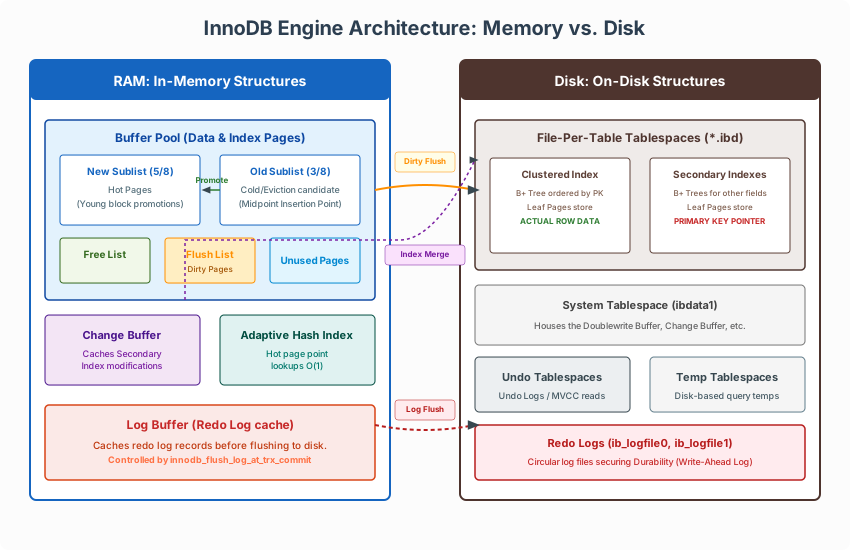
1. In-Memory Structures
To minimize latency caused by slow disk I/O, InnoDB operates a large, highly structured pool of memory:
A. The Buffer Pool
The Buffer Pool is the heart of InnoDB. It caches table and index pages (with a default page size of 16KB)—and undo pages when they are read or dirtied—directly in memory, allowing read and write operations to happen at RAM speeds. It is managed via three primary linked lists:
- Free List: Keeps track of unused/empty memory pages ready to be allocated.
- Flush List: Tracks “dirty pages” (pages modified in-memory whose changes have not yet been written to the physical tablespace files).
- LRU (Least Recently Used) List: Implements the page eviction policy when the buffer pool becomes full.
- Midpoint Insertion Strategy: To prevent large, sequential table scans (e.g.,
SELECT * FROM table) from completely flushing out hot/frequently accessed pages, InnoDB splits the LRU list into two sublists: New (Young) (5/8 of the list) and Old (3/8 of the list). - Newly fetched pages are initially inserted at the “midpoint” (the boundary between old and young). A page is only promoted to the Young sublist if it is accessed again after a configurable time duration (
innodb_old_blocks_time), effectively buffering hot pages from sequential scan pollution.
- Midpoint Insertion Strategy: To prevent large, sequential table scans (e.g.,
B. The Change Buffer
Caches insert, update, and delete changes to secondary indexes when the corresponding index pages are not currently cached in the Buffer Pool. This avoids expensive random disk reads.
- When secondary index pages are eventually read into the Buffer Pool for subsequent queries, the cached changes are physically merged.
- The Change Buffer is itself a physical B+ Tree stored inside the System Tablespace.
C. The Adaptive Hash Index (AHI)
InnoDB monitors search profiles on index B+ Trees. If it detects that certain leaf pages are queried repeatedly with exact matches (point lookups), it automatically builds a memory-based hash table on top of those leaf nodes.
- This shifts point lookup speeds from $O(\log N)$ B-Tree traversals to direct $O(1)$ memory hash retrievals.
D. The Log Buffer
Stores transactional log records (Redo Logs) in memory before flushing them to disk tablespace logs.
- Its flushing behavior is governed by the critical parameter
innodb_flush_log_at_trx_commit:1(Default): Redo log is written to files and flushed/synced to disk at every transaction commit. Guaranteed ACID durability.0: Redo log is written and synced to disk once per second. High speed, but up to 1 second of transaction data can be lost in a crash.2: Redo log is written to the OS file cache at commit, but flushed/synced to disk once per second. Safely survives amysqldcrash, but data can be lost during an OS/power failure.
E. Undo (memory objects, not a redo-style buffer)
Unlike redo, InnoDB does not keep a dedicated circular “undo log buffer.” Undo pages are ordinary pages: written through the Buffer Pool and persisted in undo tablespaces. What lives as first-class RAM objects are:
trx_t::rsegs(trx_rsegs_t): durable undo viam_redo, temp viam_noredo; each is atrx_undo_ptr_tholdingrseg,insert_undo,update_undo.trx_undo_t: one assigned undo log (hdr_page_no,top_page_no,top_offset,guess_blockinto the Buffer Pool).trx_rseg_t: rollback-segment mirror with update/insert undo lists and cached reusable undo logs, plus the history list used by purge.
Physical undo layout and how DB_ROLL_PTR addresses a record are in §4.
2. On-Disk Structures
2.1. Tablespaces & Storage Units
Relational data inside InnoDB is organized into logical tablespace structures containing pages, extents, and segments:
- System Tablespace: Stores the doublewrite buffer pages, change buffer pages, and historical system data.
- File-Per-Table Tablespaces: If
innodb_file_per_tableis enabled (default), each table and its associated indexes are stored on the file system in an independent.ibdfile. - Undo Tablespaces: Durable home of undo log pages—rollback segment headers, undo slots, and undo log segments used for rollback and MVCC. In-memory counterparts are
trx_rseg_t/trx_undo_t(§1.E, §4); page frames may also sit in the Buffer Pool when hot. - Temporary Tablespaces: Dedicated tablespace files utilized for temporary tables generated during complex aggregations (like
TemptableAggregateIteratoroutputs).
2.2. Index Structures & Physical Storage
InnoDB tables are stored as Index-Organized Tables using B+ Trees:
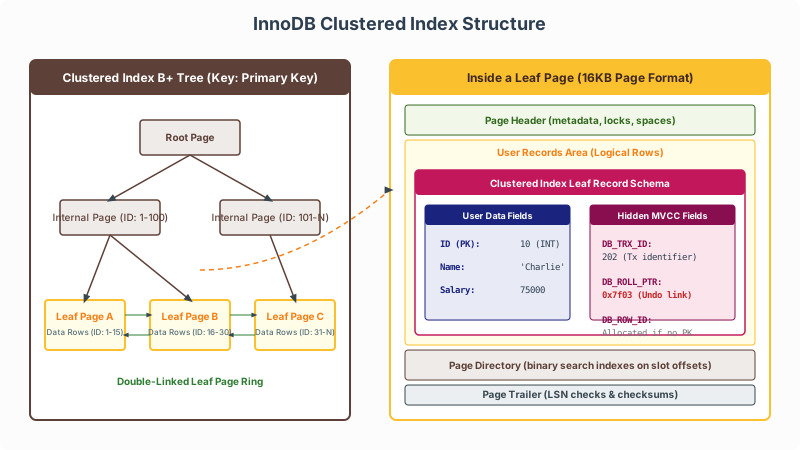
- Clustered Index: The table itself. Relational row data is stored physically inside the leaf pages of the B+ Tree, sorted by the Primary Key. If no primary key is defined, InnoDB automatically allocates a hidden 6-byte row ID (
DB_ROW_ID) to organize the cluster index.
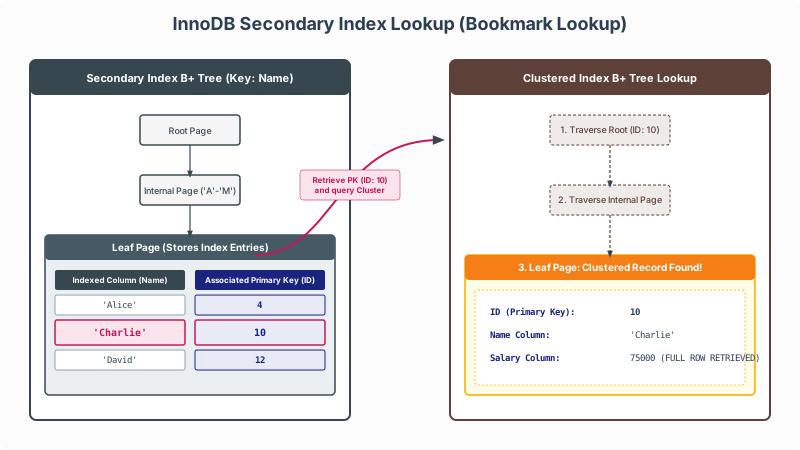
- Secondary Index: Auxiliary B+ Trees built on non-primary columns. Unlike clustered indexes, secondary index leaf pages do not store actual data rows; instead, they store the value of the indexed columns along with the corresponding Primary Key value. Finding a row via a secondary index requires a secondary lookup (bookmark lookup) in the clustered index.
- Index page frame (on-disk / buffer-pool image). A leaf or non-leaf index page is a fixed-size byte array (commonly 16 KiB). Its durable layout comprises the file-page header (
FIL_PAGE_*), the index page header (PAGE_*), the record heap (infimum, supremum, user records addressed byheap_no), the page directory, and the file trailer. Representative header fields include:
| Field | Role |
|---|---|
PAGE_N_DIR_SLOTS | Number of page-directory slots |
PAGE_HEAP_TOP | Offset of the free space boundary in the heap |
PAGE_N_HEAP | Number of records allocated in the heap (including system records) |
PAGE_N_RECS | Number of user records currently in the page |
PAGE_LEVEL / PAGE_INDEX_ID | B+tree level and owning index identity |
The page header and record heap describe physical layout and index keys only. They do not contain record locks, gap locks, next-key locks, or insert-intention locks. There is no lock bitmap, wait queue, or lock_t payload in the .ibd page image.
Where concurrency locks reside. Explicit InnoDB row locks are process-memory objects (
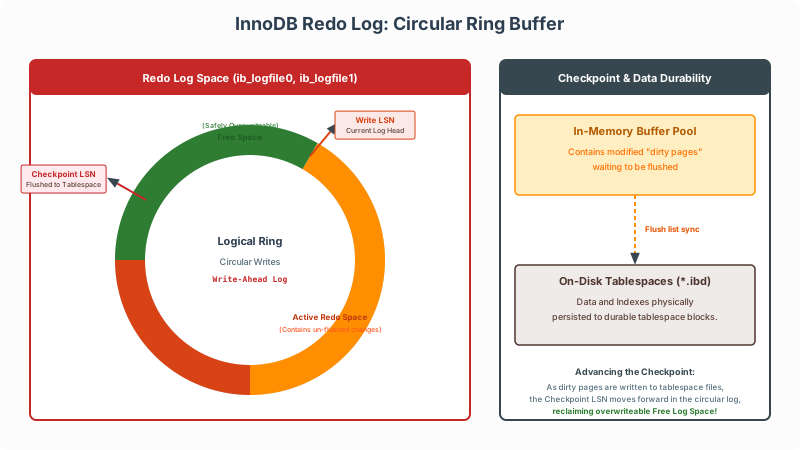
lock_t) allocated from the owning transaction’s lock heap (trx_t::lock.lock_heap, or a fixedrec_poolentry) and indexed bylock_sys->rec_hashunderpage_id. For a record lock, a bitmap packed immediately after thelock_theader marks whichheap_noslots on that page the request covers;type_modeencodes shared/exclusive strength and gap versus record-only versus next-key versus insert-intention semantics. Those structures are discarded when the transaction releases its locks; they are not written by page flush or recovery redo for ordinary DML. (See MySQL DML Internals §3.4 for identity(page_id, heap_no)and bitmap placement.)Redo Logs: A Write-Ahead Log (WAL) structure ensuring transactional durability (D of ACID). It resides physically on disk as circular ring files (
ib_logfile0,ib_logfile1). The circular buffer operates using a Checkpoint pointer (representing page changes already flushed from RAM to disk tablespace blocks) and a Write pointer (the current active logging head). The active space between checkpoint and write pointers represents logs that must not be overwritten.
2.3. Key InnoDB Source Code Descriptors
At the C++ source code level, InnoDB structures are represented by these key classes:
ha_innobase: The primary C++ handler class implementing the server’s abstracthandlerinterface for InnoDB operations.innodb_session_t: Stores session-specific cached transactional states insideTHDconnection descriptors.row_prebuilt_t: A highly cached, per-open table structure prebuilt by InnoDB to accelerate repeated index lookups and row cursoring.dict_table_t&dict_index_t: Logical descriptors representing tables and index schemas.dtuple_t: Represents a logical database row tuple.btr_pcur_t: A persistent B-Tree cursor used to hold positions on index leaf nodes across transactional operations.
struct Table {
  handler *file
}

class handler {
  TABLE_SHARE *table_share
  TABLE *table
  handlerton *ht
  uchar *ref
  uchar *dup_ref
  Table_flags cached_table_flags
  uint active_index
  Record_buffer *m_record_buffer
  store_lock()
  ha_rnd_next()
}
struct handlerton {
uint slot
}

class ha_innobase extends handler {
  row_prebuilt_t *m_prebuilt
  THD *m_user_thd
  INNOBASE_SHARE *m_share
  rnd_next()
}


class Open_tables_state {
  TABLE *open_tables
  TABLE *temporary_tables
  MYSQL_LOCK *lock
  MYSQL_LOCK *extra_lock
}


class THD extends Query_arena,Open_tables_state {
  MDL_context mdl_context
  Locked_tables_list locked_tables_list
  Ha_data[] ha_data
  Transaction_ctx m_transaction
}

struct  Ha_data {
  void *ha_ptr
  Ha_trx_info ha_info[2]
}

class innodb_session_t {
 trx_t *m_trx
 table_cache_t m_open_tables
 Tablespace *m_usr_temp_tblsp
 Tablespace *m_intrinsic_temp_tblsp
}

struct  row_prebuilt_t {
  dict_table_t *table
  dict_index_t *index
  trx_t *trx
  ha_innobase *m_mysql_handler
  dtuple_t *search_tuple
  dtuple_t *m_stop_tuple
  ulint select_lock_type
  mysql_row_templ_t *mysql_template
  ins_node_t *ins_node
  btr_pcur_t *pcur
}

struct btr_pcur_t {
  btr_cur_t m_btr_cur

}
row_prebuilt_t *-- btr_pcur_t


struct trx_t {
  trx_id_t id
  trx_state_t state
  ReadView *read_view
  ut_list_node trx_list
  trx_lock_t lock
  isolation_level_t isolation_level
  THD *mysql_thd
  undo_no_t undo_no
  trx_savept_t last_sql_stat_start
  trx_rsegs_t rsegs
  trx_mod_tables_t mod_tables
}

struct trx_rsegs_t {
  trx_undo_ptr_t m_redo
  trx_undo_ptr_t m_noredo
}

struct trx_undo_ptr_t {
  trx_rseg_t *rseg
  trx_undo_t *insert_undo
  trx_undo_t *update_undo
}

struct trx_undo_t {
  trx_rseg_t *rseg
  space_id_t space
  page_no_t hdr_page_no
  page_no_t top_page_no
  ulint top_offset
  undo_no_t top_undo_no
  buf_block_t *guess_block
}

struct trx_rseg_t {
  size_t id
  space_id_t space_id
  page_no_t page_no
  Undo_list update_undo_list
  Undo_list insert_undo_list
  Undo_list update_undo_cached
  Undo_list insert_undo_cached
}

class Transaction_ctx {
  SAVEPOINT *m_savepoints
  THD_TRANS m_scope_info[]
  int64 sequence_number
}


struct THD_TRANS {
  Ha_trx_info *m_ha_list
}

class Ha_trx_info {
  Ha_trx_info *m_next
  handlerton *m_ht

}
struct dict_table_t {
  mem_heap_t *heap
  table_name_t name
  char *data_dir_path
  id_name_t tablespace
  dict_col_t *cols
  List<dict_index_t> indexes
}

struct dict_index_t {
space_index_t id
mem_heap_t *heap
id_name_t name
dict_table_t *table
dict_field_t *fields
rw_lock_t lock
}


THD o-- Table
THD o-- Ha_data
THD *-- Transaction_ctx
Ha_data *-- innodb_session_t
innodb_session_t *-- trx_t
Table *-- handler
handler *- handlerton
ha_innobase *-- row_prebuilt_t
row_prebuilt_t *-- dict_table_t
row_prebuilt_t *-- dict_index_t
row_prebuilt_t *-- trx_t
dict_table_t o- dict_index_t
Transaction_ctx *-- THD_TRANS
THD_TRANS *-- Ha_trx_info
trx_t *-- trx_rsegs_t : rsegs
trx_rsegs_t *-- trx_undo_ptr_t : m_redo
trx_rsegs_t *-- trx_undo_ptr_t : m_noredo
trx_undo_ptr_t o-- trx_rseg_t : rseg
trx_undo_ptr_t o-- trx_undo_t : insert_undo
trx_undo_ptr_t o-- trx_undo_t : update_undo
trx_undo_t o-- trx_rseg_t : rseg
trx_rseg_t o-- trx_undo_t : undo lists
3. Physical Row Formats & BLOB Off-Page Storage
InnoDB supports multiple physical row storage formats: Compact, Redundant, Dynamic, and Compressed.
In modern MySQL, the default format is Dynamic.
The Dynamic Row Format & Off-Page Storage
When columns are exceptionally large (such as text, large VARCHAR, or binary BLOB fields), storing them inline inside a B+ Tree leaf page can severely reduce index density, forcing more page splits and increasing the B+ Tree height.
- To combat this, the Dynamic row format uses Off-Page Storage:
- If a row’s size exceeds physical page restrictions, InnoDB stores only a 20-byte pointer inline inside the leaf node.
- This 20-byte descriptor contains the Tablespace ID, Page Number, and Offset pointing directly to external off-page tablespace allocation blocks containing the raw BLOB data.
- This ensures that B+ Tree leaf pages remain densely populated, keeping search times for key columns exceptionally fast.
4. Multi-Version Concurrency Control (MVCC)
MVCC is the architectural framework used by InnoDB to handle simultaneous, high-throughput transactions without the massive performance penalty of locking entire tables (non-blocking reads).
To implement MVCC, InnoDB appends three hidden metadata fields to every clustered index record:
DB_TRX_ID(6 bytes): Tracks the transaction identifier of the last transaction that modified (inserted or updated) this row.DB_ROLL_PTR(7 bytes): The rollback pointer. Points directly to the undo log record containing the previous state of the row.DB_ROW_ID(6 bytes): The row ID used to uniquely organize clustered records if no primary key was specified.
Undo log: memory and physical layout
The architecture overview shows undo on both sides of the Memory/Disk split for a reason: control objects live in process memory; bytes live in undo tablespace pages (often cached in the Buffer Pool).
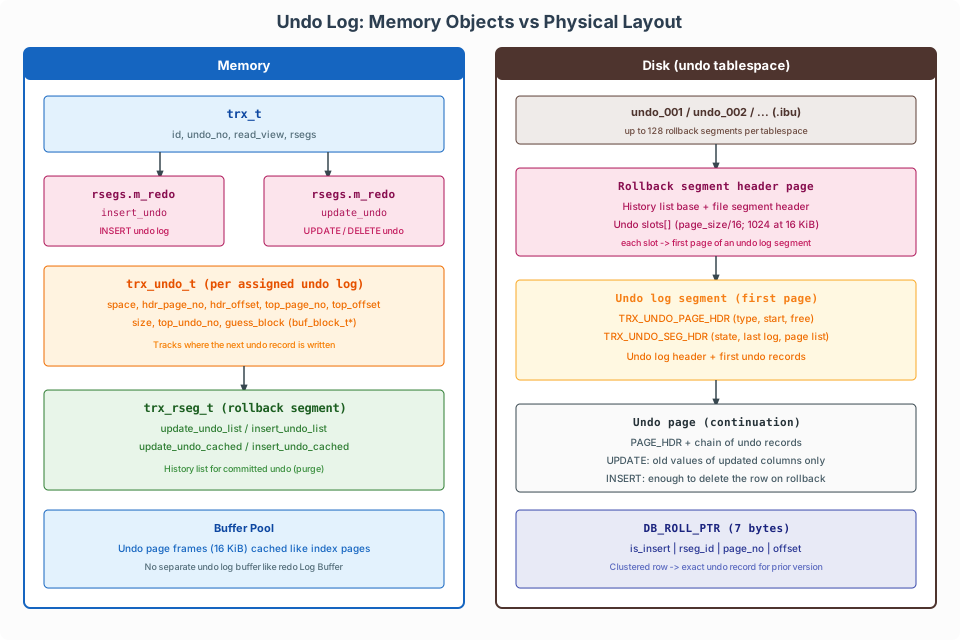
Memory. A read-write trx_t is assigned undo from a rollback segment:
| Object | Role |
|---|---|
trx_t::rsegs | m_redo / m_noredo: assigned rollback segment + undo logs for durable / temp tables |
trx_undo_ptr_t | rseg, insert_undo, update_undo |
trx_undo_t | In-memory description of one undo log: tablespace, header page/offset, current top page/offset, size, optional guess_block |
trx_rseg_t | Rollback segment: active and cached insert/update undo lists; history list of committed undo for purge |
There is no redo-like dedicated undo buffer. Appending an undo record dirties an undo page in the Buffer Pool; durability of that page change is covered by redo, same as index pages.
Physical (undo tablespace). On disk (e.g. undo_001):
- Rollback segment header page — history-list metadata and an array of undo slots (
page_size / 16slots; 1024 at the default 16 KiB page). Each non-empty slot points at the first page of an undo log segment. - Undo log segment first page —
TRX_UNDO_PAGE_HDR, thenTRX_UNDO_SEG_HDR(segment state, last log, page list), then undo log header and early records. - Continuation undo pages — page header plus undo records. An update record stores old
DB_TRX_ID/DB_ROLL_PTR, the primary key, and old values of columns in the update vector only (not a full prior row). An insert record stores enough to undo the insert.
DB_ROLL_PTR packs whether the undo is insert-type, which rollback segment, and the page number + offset of the undo record. Following that pointer is how MVCC walks older versions.
What an update undo record actually stores (from trx_undo_page_report_modify on the clustered index record before the in-place change):
- Type (
TRX_UNDO_UPD_EXIST_REC/ delete-mark variants),undo_no,table_id - Old record
info_bits, oldDB_TRX_ID, oldDB_ROLL_PTR - Clustered unique key columns (to find the row)
n_updated, then for each entry in the update vector: field number + old column value copied from the still-unmodified record (/* Save the old value of field */)
It does not store a full previous row image. Unchanged columns (e.g. Name when only Salary is updated) are omitted. MVCC rebuilds an older version by starting from the current clustered record and overlaying those old column values from the undo chain (trx_undo_prev_version_build). INSERT undo is a different record type: enough information to remove the inserted row on rollback.
(LOB columns may additionally record partial binary patches via trx_undo_report_blob_update; ordinary in-row columns are whole old values, not byte diffs.)
Worked example. Same row as §5 / the version-chain figure: transaction 202 runs
UPDATE employees SET salary = 75000 WHERE id = 10;
Before the statement, the clustered leaf holds (10, 'Charlie', 70000) with DB_TRX_ID = 198. InnoDB appends an update undo record with the old Salary, then rewrites the leaf.
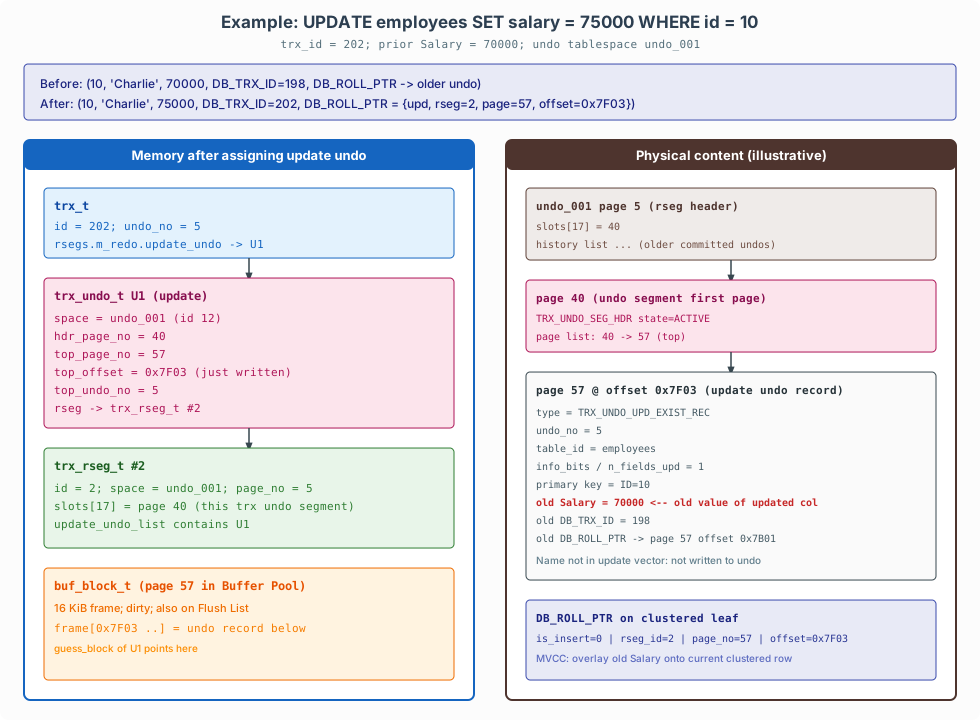
Concrete bindings after the undo append (illustrative addresses):
| Location | Content |
|---|---|
trx_t | id = 202, rsegs.m_redo.update_undo → U1 |
trx_undo_t U1 | space = undo_001, hdr_page_no = 40, top_page_no = 57, top_offset = 0x7F03, top_undo_no = 5, rseg = #2 |
trx_rseg_t #2 | header page 5; slots[17] = 40; U1 on update_undo_list |
| Buffer Pool / disk page 57 | at 0x7F03: TRX_UNDO_UPD_EXIST_REC, PK ID=10, old Salary = 70000, old DB_TRX_ID = 198, old roll pointer; Name not present |
| Clustered leaf | Salary = 75000, DB_TRX_ID = 202, DB_ROLL_PTR = {update, rseg 2, page 57, offset 0x7F03} |
An INSERT undo for the original row (version-chain figure at 0x6A05) is a separate insert_undo log and stores what is needed to undo the insert, not an update-style column vector. Page/slot numbers above are pedagogical; the field set matches the source writer.
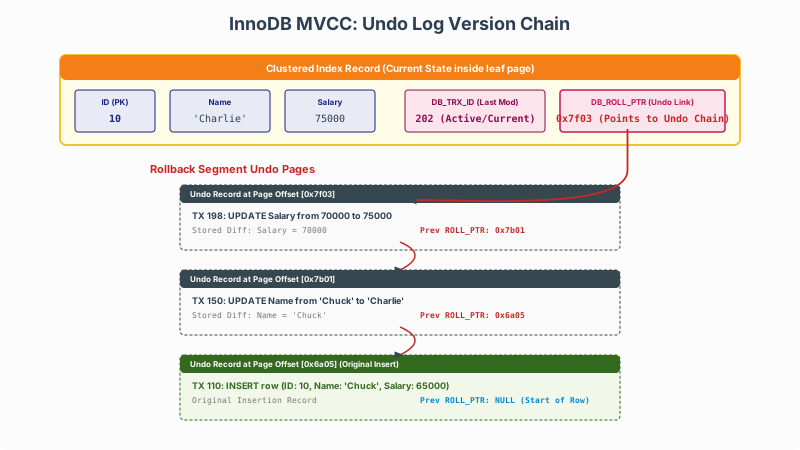
Version chain (logical view)
The ReadView Visibility Logic
When a transaction starts a consistent read query (under REPEATABLE READ or READ COMMITTED isolation levels), InnoDB instantiates a ReadView descriptor. The ReadView is a snapshot of the transaction landscape at a precise point in time.
The ReadView contains four critical variables:
m_ids: A list of all active (running, uncommitted) transaction IDs at the time of view creation.m_up_limit_id: The lower bound of active transactions. Any transaction withtrx_id < m_up_limit_idwas already committed before theReadViewwas created and is always visible.m_low_limit_id: The upper limit of allocated transaction IDs. Any transaction withtrx_id >= m_low_limit_idstarted after theReadViewwas created and is always invisible.m_creator_trx_id: The ID of the transaction that created this view. Modifications made by the creator transaction are always visible to itself.
The Transaction Visibility Algorithm:
For any record in the clustered index with metadata DB_TRX_ID = trx_id:
               ReadView Created (Landscape snapshot)
  ───────────┼─────────────────────────────────────────────┼───────────>
             │             Active List [m_ids]             │
   trx_id <  │                                             │  trx_id >=
m_up_limit_id│       m_up_limit_id <= trx_id <             │m_low_limit_id
             │             m_low_limit_id                  │
             │                                             │
   VISIBLE   │   In m_ids? ──► YES ──> INVISIBLE           │  INVISIBLE
             │             └──► NO  ──> VISIBLE            │
- Self-Visibility: If
trx_id == m_creator_trx_id, the change is visible. - Committed Before ReadView: If
trx_id < m_up_limit_id, the transaction was committed before this view was created. The change is visible. - Started After ReadView: If
trx_id >= m_low_limit_id, the transaction started after the view’s creation. The change is invisible. - Active Transaction Window: If
m_up_limit_id <= trx_id < m_low_limit_id:- If
trx_idis present in the active listm_ids, the transaction was still running and had not committed when the view was created. The change is invisible. - Otherwise, the transaction committed before the view was created. The change is visible.
- If
Reconstructing Historical Row States
If the visibility algorithm determines that a record version is invisible, InnoDB follows the rollback pointer DB_ROLL_PTR to locate the corresponding undo log block. It reconstructs the previous version of the row, retrieves its DB_TRX_ID, and runs the visibility evaluation again.
This recursive reconstruction continues down the undo log chain until a visible version of the row is located. If it reaches the end of the undo chain (meaning the row did not exist yet when the ReadView was created), the record is treated as non-existent (filtered out of the query result).
struct trx_t {
  trx_id_t id
  trx_state_t state
  ReadView *read_view
  ut_list_node trx_list
  trx_lock_t lock
  isolation_level_t isolation_level
  THD *mysql_thd
  undo_no_t undo_no
  trx_savept_t last_sql_stat_start
  trx_rsegs_t rsegs
  trx_mod_tables_t mod_tables
}

struct trx_rsegs_t {
  trx_undo_ptr_t m_redo
  trx_undo_ptr_t m_noredo
}

struct trx_undo_ptr_t {
  trx_rseg_t *rseg
  trx_undo_t *insert_undo
  trx_undo_t *update_undo
}

class ReadView {
  ids_t m_ids
  node_t m_view_list
  trx_id_t m_low_limit_id
  trx_id_t m_up_limit_id
  trx_id_t m_creator_trx_id
}

struct trx_sys_t {
  MVCC *mvcc
  trx_id_t next_trx_id_or_no
  Trx_shard shards[TRX_SHARDS_N]
  trx_ids_t rw_trx_ids
}


struct  row_prebuilt_t {
  dict_table_t *table
  dict_index_t *index
  trx_t *trx
  ha_innobase *m_mysql_handler
  dtuple_t *search_tuple
  dtuple_t *m_stop_tuple
  ulint select_lock_type
  mysql_row_templ_t *mysql_template
  ins_node_t *ins_node
  btr_pcur_t *pcur
}

struct btr_pcur_t {
  btr_cur_t m_btr_cur

}
struct btr_cur_t {
dict_index_t *index
page_cur_t page_cur
}

row_prebuilt_t *-- btr_pcur_t
btr_pcur_t *-- btr_cur_t

row_prebuilt_t *-- trx_t
trx_t *-- ReadView
trx_t *-- trx_rsegs_t : rsegs
trx_rsegs_t *-- trx_undo_ptr_t : m_redo
trx_undo_ptr_t o-- trx_undo_t : update_undo
trx_sys_t -> trx_t
5. End-to-End SQL Write Lifecycle
To see how InnoDB coordinates clustered indexes, secondary indexes, undo logs, redo logs, and the Buffer Pool in a single unified flow, let’s trace the execution of a concrete SQL query:
UPDATE employees SET salary = 75000 WHERE name = 'Charlie';
When this statement is processed under transaction Tx 202, InnoDB coordinates across its subcomponents through the following step-by-step lifecycle:
 1. Index Lookup ──> 2. Bookmark Lookup ──> 3. Create Undo Record ──> 4. Redo Log (WAL)
 (Name='Charlie')     (Get ID=10 Row)        (Save Salary=70000)      (Log modifications)
                                                                             │
 8. Async Flush   <── 7. Commit & Redo  <── 6. Modify Memory  <── 5. Lock & Update view
 (Checkpoint LSN)      (ib_logfile Write)   (Mark page Dirty)         (DB_TRX_ID, ROLL_PTR)
- Secondary Index Lookup:
- The optimizer recognizes that
namehas a secondary index. InnoDB traverses the secondary B+ Tree index onnamefor'Charlie'. - It finds the secondary index leaf entry containing the key value
'Charlie'and retrieves the primary key value:ID = 10.
- The optimizer recognizes that
- Clustered Index Bookmark Lookup:
- Using
ID = 10, InnoDB queries its Clustered Index. It traverses the main table B+ Tree to find the leaf page holding the actual row record forID = 10. - If the target leaf page is not in the Buffer Pool memory, it issues a synchronous disk read to load the page from the
.ibdtablespace file, placing it inside the Buffer Pool LRU list.
- Using
- Generate Undo Log Record (MVCC Setup):
- Before updating the row, InnoDB must back up the current state of the row. It constructs an Undo Log Record containing the column state to be overwritten (
Salary = 70000). - It writes this record to the Undo log buffer/tablespace at page offset
0x7f03.
- Before updating the row, InnoDB must back up the current state of the row. It constructs an Undo Log Record containing the column state to be overwritten (
- Write Redo Log (Write-Ahead Logging):
- InnoDB writes a physical Redo Log record to the Log Buffer in memory, describing the exact byte modifications about to be made on the physical Clustered index leaf page (securing Durability).
- Modify Record Inline (Buffer Pool Update):
- In the Buffer Pool memory, InnoDB updates the record’s user column:
Salary = 75000. - It updates the record’s hidden metadata columns:
- Sets
DB_TRX_ID = 202(flagging this active transaction). - Sets
DB_ROLL_PTR = 0x7f03(linking the active record to the Undo Log version chain).
- Sets
- The leaf page is now flagged as Dirty and linked to the Buffer Pool Flush List.
- In the Buffer Pool memory, InnoDB updates the record’s user column:
- Transaction Commit & Redo Flush:
- When the client issues
COMMIT, the SQL layer executes the two-phase commit. - Under Phase 2, the Log Buffer contents representing the page write are flushed and synchronized to disk
ib_logfile0orib_logfile1(governed byinnodb_flush_log_at_trx_commit = 1), advancing theWrite LSN. The transaction is now legally durable.
- When the client issues
- Asynchronous Dirty Page Flushing (Page Sync):
- Later, an asynchronous InnoDB background thread sweeps the Flush List. It writes the dirty page containing
Salary = 75000to the physical.ibdfile on disk. - Once the dirty page is safely flushed, InnoDB pushes the
Checkpoint LSNforward in the Redo circular ring, reclaiming that log sector as overwriteable Free Space.
- Later, an asynchronous InnoDB background thread sweeps the Flush List. It writes the dirty page containing