
MySQL DML Internals — INSERT / UPDATE, Locks & Transactions
This article examines MySQL INSERT and UPDATE from the SQL command layer through table and metadata locking into InnoDB record locking, undo generation, and commit, with emphasis on concurrency control, lock modes, and transaction boundaries. It complements query processing (SELECT pipeline) and InnoDB storage (MVCC, pages, redo/undo layout). Source citations refer to the checked-out mysql-server tree.
1. Architecture
A modifying statement follows the same Sql_cmd_dml prepare / open / lock / execute skeleton as SELECT, and diverges where rows are written:
- SQL layer — parse to
Sql_cmd_update/Sql_cmd_insert_*, open tables, acquire MDL andMYSQL_LOCK, then either a specialized write loop (single-table UPDATE, INSERT VALUES) or an iterator plan that sinks rows intoQuery_result_update/Query_result_insert. - Handler boundary —
ha_write_row/ha_update_row/ha_delete_rowonha_innobase. - InnoDB — table intention locks (
LOCK_IX), record / gap / next-key / insert-intention locks, undo for rollback and MVCC, redo for durability, then group commit with the binary log.
flowchart TB
  subgraph SQL["SQL layer"]
    Parse[PT_insert / PT_update]
    Cmd[Sql_cmd_dml subclass]
    Open[open_tables_for_query]
    Lock[lock_tables / mysql_lock_tables]
    Exec[execute_inner]
    Parse --> Cmd --> Open --> Lock --> Exec
  end
  subgraph Handler["Handler"]
    WR[ha_write_row]
    UR[ha_update_row]
  end
  subgraph InnoDB["InnoDB"]
    IX[lock_table LOCK_IX]
    Rec[lock_rec_* / insert intention]
    Undo[trx_undo_report_row_operation]
    Btr[btr_cur_* physical change]
    Cmt[trx_commit + binlog ordered_commit]
    IX --> Rec --> Undo --> Btr --> Cmt
  end
  Exec --> WR
  Exec --> UR
  WR --> IX
  UR --> Rec
Key source directories
| Path | Role |
|---|---|
sql/sql_cmd_dml.h, sql/sql_select.cc | Shared DML prepare / execute pipeline |
sql/sql_update.cc, sql/sql_insert.cc | UPDATE / INSERT command execution |
sql/sql_base.cc, sql/lock.cc | Open tables, MDL, MYSQL_LOCK |
sql/transaction.cc, sql/handler.cc, sql/binlog.cc | Statement / session commit and 2PC |
storage/innobase/handler/ha_innodb.cc | Handler writes, external_lock, commit hooks |
storage/innobase/row/row0ins.cc, row0upd.cc, row0sel.cc | Insert / update / locking-read graphs |
storage/innobase/lock/lock0lock.cc | Record, gap, next-key, insert-intention locks |
storage/innobase/trx/trx0rec.cc, trx0trx.cc | Undo records and transaction commit |
2. SQL-layer DML pipeline
2.1 Shared Sql_cmd_dml path
Sql_cmd_dml is the common base class for SELECT and data-changing statements. is_data_change_stmt() defaults to true; SELECT overrides it to false. Preparation and execution proceed as follows:
- Open tables (
open_tables_for_query), which also acquires MDL. - Lock tables (
lock_tables→mysql_lock_tables), invoking THR_LOCK and the engine’sexternal_lock. - Invoke
execute_inner().
@startuml
class Sql_cmd {
  + execute(THD*)
  + prepare(THD*)
}

class Sql_cmd_dml {
  + is_data_change_stmt() : bool
  + prepare(THD*)
  + execute(THD*)
  # prepare_inner(THD*)
  # execute_inner(THD*)
}

class Sql_cmd_select
class Sql_cmd_update {
  - update_single_table(THD*)
  # execute_inner(THD*)
}

class Sql_cmd_insert_base
class Sql_cmd_insert_values {
  # execute_inner(THD*)
}
class Sql_cmd_insert_select

Sql_cmd <|-- Sql_cmd_dml
Sql_cmd_dml <|-- Sql_cmd_select
Sql_cmd_dml <|-- Sql_cmd_update
Sql_cmd_dml <|-- Sql_cmd_insert_base
Sql_cmd_insert_base <|-- Sql_cmd_insert_values
Sql_cmd_insert_base <|-- Sql_cmd_insert_select
@enduml
The default execute_inner() implements the query-expression path shared by SELECT, INSERT … SELECT, and multi-table UPDATE:
unit->optimize() → create_iterators() → execute()
Single-table UPDATE and INSERT VALUES override execute_inner() with specialized write loops that ultimately call the same handler entry points.
2.2 UPDATE
Sql_cmd_update::execute_inner() selects an execution path according to the number of target tables:
multitable ? Sql_cmd_dml::execute_inner(thd)   // iterators + Query_result_update
           : update_single_table(thd)
Single-table UPDATE performs a locking read under InnoDB for each qualifying row, then applies:
table->file->ha_update_row(table->record[1], table->record[0])
record[1] holds the pre-update image; record[0] holds the post-SET image.
Multi-table UPDATE attaches Query_result_update as the sink. That sink does not return rows to the client (send_data asserts). Eligible targets are updated immediately, or row identifiers are buffered for deferred update when join order or self-join safety requires it (UpdateRowsIterator).
The parser initially marks all listed tables for write locking; prepare_inner() may downgrade non-target tables so that concurrent readers of those tables are not excluded unnecessarily.
2.3 INSERT
| Class | Execution |
|---|---|
Sql_cmd_insert_values | Specialized execute_inner(): iterate value lists → write_record() |
Sql_cmd_insert_select | Base Sql_cmd_dml::execute_inner(); SELECT delivers rows to Query_result_insert::send_data() → write_record() |
write_record() implements duplicate-key disposition for all INSERT variants:
| Mode | Behavior |
|---|---|
| Normal INSERT | ha_write_row() |
ON DUPLICATE KEY UPDATE | On duplicate-key error: ha_update_row() |
REPLACE | Delete then re-insert, or update in place, according to engine return codes |
@startuml
participant "Sql_cmd_insert_*" as Cmd
participant write_record
participant handler
participant ha_innobase

Cmd -> write_record : fill record / triggers
write_record -> handler : ha_write_row
handler -> ha_innobase : write_row
ha_innobase -> ha_innobase : row_insert_for_mysql

alt DUPLICATE KEY + UPDATE
  write_record -> handler : ha_update_row
else REPLACE path
  write_record -> handler : ha_delete_row / retry write
end
@enduml
3. Concurrency control layers
MySQL applies several locking mechanisms during DML. The mechanisms operate at distinct granularities and must be distinguished: equating them yields incorrect conclusions—for example, that READ COMMITTED eliminates all gap locking. Each mechanism answers a different question: whether DDL may change table metadata, how the storage engine is notified of statement intent, and whether another transaction may modify a given index record or the gap that precedes it.
Unless noted otherwise, the examples below assume InnoDB under the default REPEATABLE READ isolation level and the schema:
CREATE TABLE t (
  id   INT PRIMARY KEY,
  c    INT NOT NULL,
  KEY  idx_c (c)
) ENGINE=InnoDB;

INSERT INTO t VALUES (10, 10), (20, 20), (30, 30);
| Layer | Protected resource | Typical acquisition under DML |
|---|---|---|
| MDL | Table (and related) metadata against DDL | Target tables: MDL_SHARED_WRITE; read-only sources: MDL_SHARED_READ |
THR_LOCK / MYSQL_LOCK | Server-layer table-lock compatibility among handlers | Write-oriented thr_lock_type values; for InnoDB, lock_count() is 0, so THR_LOCK is not the row-concurrency mechanism |
| InnoDB table lock | Table-level intention prior to record locks | LOCK_IX or LOCK_IS for DML and locking reads |
| InnoDB record locks | Index records and intervening gaps | LOCK_S / LOCK_X combined with LOCK_REC_NOT_GAP, LOCK_GAP, LOCK_ORDINARY, or LOCK_INSERT_INTENTION |
| Page latches / mtr | Physical B-tree page mutation | Short-duration latches; not transactional locks |
Data Structure
The structures below attach either to the SQL session (THD) or to the InnoDB transaction (trx_t). Edges in the diagram denote ownership or association; they do not depict call order.
@startuml
skinparam classAttributeIconSize 0
skinparam packageStyle rectangle

package "SQL session" {
  class THD {
    MDL_context mdl_context
    MYSQL_LOCK *lock
    Transaction_ctx m_transaction
    Ha_data ha_data[]
  }

  class Ha_data {
    void *ha_ptr
    void *ha_ptr_backup
    Ha_trx_info ha_info[2]
  }

  class MDL_context {
    MDL_ticket_store m_ticket_store
    + acquire_lock(MDL_request*)
    + release_transactional_locks()
    + mdl_savepoint()
  }

  class MDL_request {
    enum_mdl_type type
    enum_mdl_duration duration
    MDL_key key
    MDL_ticket *ticket
  }

  class MDL_ticket {
    enum_mdl_type m_type
    MDL_lock *m_lock
    MDL_context *m_ctx
  }

  class MDL_key {
    enum_mdl_namespace
    db + name
  }

  class MYSQL_LOCK {
    TABLE **table
    uint table_count
    uint lock_count
    THR_LOCK_DATA **locks
  }

  class TABLE {
    handler *file
    thr_lock_type lock_type
  }

  class Transaction_ctx {
    THD_TRANS m_scope_info[]
  }

  class THD_TRANS {
    Ha_trx_info *m_ha_list
  }

  class Ha_trx_info {
    handlerton *m_ht
    Ha_trx_info *m_next
  }
}

package "InnoDB per-connection / per-open-table" {
  class innodb_session_t {
    trx_t *m_trx
    table_cache_t m_open_tables
    Tablespace *m_usr_temp_tblsp
    Tablespace *m_intrinsic_temp_tblsp
  }

  class ha_innobase {
    row_prebuilt_t *m_prebuilt
    + store_lock()
    + external_lock()
    + write_row()
    + update_row()
  }

  class row_prebuilt_t {
    trx_t *trx
    ulint select_lock_type
    select_mode select_mode
    ulint row_read_type
  }
}

package "InnoDB transaction + lock sys" {
  class trx_t {
    trx_id_t id
    trx_state_t state
    isolation_level_t isolation_level
    trx_lock_t lock
    THD *mysql_thd
    ReadView *read_view
  }

  class trx_lock_t {
    trx_lock_list_t trx_locks
    lock_t *wait_lock
    trx_t *blocking_trx
    uint32_t wait_lock_type
    que_thr_t *wait_thr
    mem_heap_t *lock_heap
  }

  class lock_t {
    trx_t *trx
    dict_index_t *index
    uint32_t type_mode
    lock_table_t tab_lock
    lock_rec_t rec_lock
    + is_waiting()
    + is_gap()
    + is_record_not_gap()
  }

  class lock_table_t {
    dict_table_t *table
  }

  class lock_rec_t {
    page_id_t page_id
    uint32_t n_bits
  }

  enum lock_mode <<enumeration>> {
    LOCK_IS
    LOCK_IX
    LOCK_S
    LOCK_X
    LOCK_AUTO_INC
    LOCK_NONE
  }

  note right of lock_t
    type_mode =
      lock_mode
      | LOCK_TABLE / LOCK_REC
      | LOCK_WAIT
      | LOCK_GAP / LOCK_REC_NOT_GAP / LOCK_ORDINARY
      | LOCK_INSERT_INTENTION
  end note
}

package "Short-lived physical latch" {
  class mtr_t {
    + mtr_start()
    + mtr_commit()
  }
}

THD *-- MDL_context
THD *-- MYSQL_LOCK
THD *-- Transaction_ctx
THD *-- Ha_data : ha_data[hton.slot]
Ha_data --> innodb_session_t : ha_ptr
innodb_session_t *-- trx_t : m_trx
Transaction_ctx *-- THD_TRANS
THD_TRANS o-- Ha_trx_info
Ha_data *-- Ha_trx_info : ha_info[0|1]
MDL_context o-- MDL_ticket
MDL_request --> MDL_ticket : granted as
MDL_request *-- MDL_key
MDL_ticket --> MDL_key : via MDL_lock
MYSQL_LOCK o-- TABLE
TABLE --> ha_innobase : file
ha_innobase *-- row_prebuilt_t
row_prebuilt_t --> trx_t
trx_t --> THD : mysql_thd
trx_t *-- trx_lock_t
trx_lock_t o-- lock_t : trx_locks
lock_t *-- lock_table_t
lock_t *-- lock_rec_t
lock_t ..> lock_mode : type_mode & MASK
trx_lock_t --> lock_t : wait_lock
ha_innobase ..> mtr_t : around B-tree ops
@enduml
How THD maintains InnoDB session and transaction state
A connection’s InnoDB state is not stored on TABLE and is not a process-global singleton. It is maintained through two complementary associations on THD:
- Engine-private session object —
THD::ha_data[innodb_hton->slot].ha_ptrreferences aninnodb_session_t, which owns the session’strx_t *m_trx. - SQL transaction coordinator lists —
THD::m_transaction(Transaction_ctx) records which storage engines participate in the statement and session scopes, so thatCOMMIT/ROLLBACK/ 2PC can invoke each registeredhandlerton.
THD
├── ha_data[innodb_slot].ha_ptr ──► innodb_session_t
│                                      └── m_trx ──► trx_t ──► mysql_thd ──► THD
│                                      └── m_open_tables / temp tablespaces …
├── ha_data[innodb_slot].ha_info[0]   // statement-scope Ha_trx_info (via register)
├── ha_data[innodb_slot].ha_info[1]   // transaction-scope Ha_trx_info
└── m_transaction (Transaction_ctx)
     ├── THD_TRANS[statement].m_ha_list  ──► Ha_trx_info … (engines in this stmt)
     └── THD_TRANS[session].m_ha_list    ──► Ha_trx_info … (engines in this trx)
Slot lookup. Each handlerton has a stable slot. thd_ha_data(thd, innodb_hton) returns &thd->ha_data[slot].ha_ptr. InnoDB casts that pointer to innodb_session_t **:
// storage/innobase/handler/ha_innodb.cc
innodb_session_t *&thd_to_innodb_session(THD *thd) {
  innodb_session_t *&innodb_session =
      *(innodb_session_t **)thd_ha_data(thd, innodb_hton_ptr);
  if (innodb_session != nullptr)
    return innodb_session;
  innodb_session = ut::new_withkey<innodb_session_t>(...);
  return innodb_session;
}

trx_t *&thd_to_trx(THD *thd) {
  return thd_to_innodb_session(thd)->m_trx;
}
Deferred trx_t allocation. The first InnoDB operation on a connection invokes check_trx_exists(thd), which resolves thd_to_trx(thd) and, if the pointer is null, allocates a transaction via innobase_trx_allocate(thd) (trx_allocate_for_mysql(), assigns trx->mysql_thd = thd, and initialises isolation and read-only flags). Later store_lock, external_lock, and DML paths reuse that trx_t for the connection (unless XA detach/reattach replaces it).
trx_t *check_trx_exists(THD *thd) {
  trx_t *&trx = thd_to_trx(thd);
  if (trx == nullptr) {
    trx = innobase_trx_allocate(thd);
  } else {
    innobase_trx_init(thd, trx);
  }
  return trx;
}
Binding open-table handlers to that trx_t. Each TABLE::file (ha_innobase) holds a private row_prebuilt_t. external_lock() / update_thd() assign m_prebuilt->trx to the session’s thd_to_trx(thd). Consequently, multiple open handlers in one statement share a single trx_t, while each retains its own select_lock_type and cursor state.
SQL-layer registration (innobase_register_trx). Possession of a trx_t alone does not enroll the engine in server-side commit. During external_lock / start_stmt, InnoDB invokes:
void innobase_register_trx(handlerton *hton, THD *thd, trx_t *trx) {
  trans_register_ha(thd, /*all=*/false, hton, &trx_id);  // statement list
  if (!trx_is_registered_for_2pc(trx) &&
      thd_test_options(thd, OPTION_NOT_AUTOCOMMIT | OPTION_BEGIN)) {
    trans_register_ha(thd, /*all=*/true, hton, &trx_id);   // session list
  }
  trx_register_for_2pc(trx);
}
trans_register_ha inserts or reuses the corresponding Ha_trx_info in Transaction_ctx’s statement and/or all-transaction m_ha_list. ha_commit_trans / ha_rollback_trans subsequently traverse those lists. Ha_data::ha_info[0] spans one statement (or the entire transaction under autocommit); ha_info[1] spans one explicit transaction.
| Object | Lifetime | Role |
|---|---|---|
innodb_session_t in ha_data[].ha_ptr | Connection | InnoDB-private session cache; holds m_trx |
trx_t (m_trx) | Until free / XA detach | InnoDB transaction id, locks, undo, read view |
row_prebuilt_t on ha_innobase | Open TABLE instance | Per-table cursor + locking-read mode; points at shared trx_t |
Ha_trx_info on statement/session lists | Stmt / trx | SQL coordinator membership for commit/rollback/2PC |
Per-connection isolation. Each THD owns a distinct ha_data array and therefore a distinct innodb_session_t / trx_t. Handlers for different tables within one connection share that session’s trx_t; they do not share innodb_session_t with another connection.
Correspondence of layers to types:
| Layer | Primary types |
|---|---|
InnoDB session / trx on THD | ha_data[slot].ha_ptr → innodb_session_t → trx_t; Transaction_ctx / Ha_trx_info for commit coordination |
| MDL | THD::mdl_context → MDL_request / MDL_ticket / MDL_key |
| SQL table-lock handshake | THD::lock (MYSQL_LOCK) → TABLE → ha_innobase::{store,external}_lock |
| Statement locking-read mode | row_prebuilt_t::select_lock_type (LOCK_NONE / LOCK_S / LOCK_X) |
| InnoDB transactional locks | trx_t::lock (trx_lock_t) owns trx_locks; wait state in wait_lock / blocking_trx |
| Table versus record | lock_t discriminant: lock_table_t (e.g. IS/IX) or lock_rec_t (page identifier and bit map) |
| Page latch | mtr_t — not linked into trx_locks |
3.1 Metadata locks (MDL)
Mechanism. A metadata lock is a server-wide lock on a dictionary object, identified by MDL_key and held in THD::mdl_context. Lock modes are defined in sql/mdl.h. For DML, the requested mode is derived from the SQL-layer table lock type:
// sql/table.h — mdl_type_for_dml()
inline enum enum_mdl_type mdl_type_for_dml(enum thr_lock_type lock_type) {
  return lock_type >= TL_WRITE_ALLOW_WRITE
             ? (lock_type == TL_WRITE_LOW_PRIORITY ? MDL_SHARED_WRITE_LOW_PRIO
                                                   : MDL_SHARED_WRITE)
             : MDL_SHARED_READ;
}
Acquisition is coupled to table opening. open_tables_for_query() establishes a DML prelocking strategy and records an MDL savepoint so that a failed open releases only tickets acquired during that attempt:
// sql/sql_base.cc — open_tables_for_query()
bool open_tables_for_query(THD *thd, Table_ref *tables, uint flags) {
  DML_prelocking_strategy prelocking_strategy;
  MDL_savepoint mdl_savepoint = thd->mdl_context.mdl_savepoint();
  if (open_tables(thd, &tables, &thd->lex->table_count, flags,
                  &prelocking_strategy))
    goto end;
  // ...
}
Within open_tables(), each Table_ref carries an MDL_request. The context grants the request through thd->mdl_context.acquire_lock() or acquire_locks(). Compatible shared modes permit concurrent DML on the same table. Exclusive modes required by DDL wait until all conflicting shared holders have released their tickets.
Scope. MDL does not serialize concurrent UPDATE (or other DML) statements that modify distinct rows. Row-level mutual exclusion is the responsibility of InnoDB.
Example — DML precludes DDL, not concurrent DML:
-- Session A
BEGIN;
UPDATE t SET c = c + 1 WHERE id = 10;   -- holds MDL_SHARED_WRITE on t
-- do not COMMIT yet

-- Session B (concurrent DML: proceeds)
UPDATE t SET c = c + 1 WHERE id = 20;   -- also MDL_SHARED_WRITE
COMMIT;

-- Session C (DDL: waits)
ALTER TABLE t ADD COLUMN d INT;         -- exclusive MDL; blocked until A commits
Example — non-locking SELECT versus DDL:
-- Session A
BEGIN;
SELECT * FROM t WHERE id = 10;          -- MDL_SHARED_READ
-- Session B
DROP TABLE t;                           -- waits until A's MDL is released
Pending metadata locks may be observed through performance_schema.metadata_locks or sys.schema_table_lock_waits.
3.2 THR_LOCK / MYSQL_LOCK and InnoDB store_lock / external_lock
Mechanism. After tables have been opened, lock_tables() constructs a MYSQL_LOCK and invokes mysql_lock_tables(). For engines that participate in THR_LOCK, this path acquires table-level read/write exclusion. InnoDB does not: ha_innobase::lock_count() returns 0, so thr_multi_lock() receives an empty lock array. The SQL layer nonetheless invokes InnoDB’s store_lock(), external_lock(), and (under LOCK TABLES) start_stmt(). Those three entry points convey statement intent and statement boundaries to InnoDB; they do not serialize row access.
// sql/lock.cc — mysql_lock_tables() (structure)
if (!(sql_lock = get_lock_data(thd, tables, count, GET_LOCK_STORE_LOCKS)))
  return nullptr;
// get_lock_data → handler::store_lock() per TABLE

if (sql_lock->table_count &&
    lock_external(thd, sql_lock->table, sql_lock->table_count)) {
  // → handler::external_lock(thd, F_RDLCK | F_WRLCK) per TABLE
  reset_lock_data_and_free(&sql_lock);
  goto end;
}

rc = thr_lock_errno_to_mysql[(int)thr_multi_lock(
    sql_lock->locks + sql_lock->lock_count, sql_lock->lock_count,
    &thd->lock_info, timeout)];
// For InnoDB, lock_count == 0 → thr_multi_lock is a no-op
lock_tables()
  → mysql_lock_tables()
      → get_lock_data(..., GET_LOCK_STORE_LOCKS)
            → ha_innobase::store_lock(thd, to, thr_lock_type)   // phase 1: intent
      → lock_external()
            → ha_innobase::external_lock(thd, F_RDLCK|F_WRLCK) // phase 2: start stmt
      → thr_multi_lock()   // empty for InnoDB
...
unlock / statement end
  → ha_innobase::external_lock(thd, F_UNLCK)                   // phase 3: end stmt
The handler documentation states the design explicitly: InnoDB relies on MDL (DDL / LOCK TABLES) together with its own record/table lock subsystem; store_lock / external_lock / start_stmt remain solely as the SQL↔engine control channel.
Phase 1 — store_lock(): declare locking-read intent
store_lock() is invoked once per table while MYSQL_LOCK is assembled. Because lock_count() is 0, the returned THR_LOCK_DATA ** is unused for queuing. The function’s effect is to initialise or adjust row_prebuilt_t fields that later govern row_search_mvcc():
- Ensure a
trx_texists (check_trx_exists(thd)). Note thatm_prebuilt->trxmay not yet equal thistrx;external_lock()later callsupdate_thd()to bind them. - On the first table of a statement (
n_mysql_tables_in_use == 0), copy the session isolation level intotrx->isolation_level. At READ COMMITTED / READ UNCOMMITTED, an active consistent-read view is closed so the next read can open a fresh snapshot. - Map
thr_lock_type(+ SQL command) onto a preliminaryselect_lock_type, stored in bothm_prebuilt->select_lock_typeandm_stored_select_lock_type. - Record
SELECT … FOR UPDATE/SHAREwait policy (SELECT_ORDINARY/SELECT_SKIP_LOCKED/SELECT_NOWAIT) from the table-list lock descriptor. - Increment
trx->will_lockwhen a locking read is anticipated, so the transaction is not classified as a non-locking autocommit select.
The preliminary lock-mode decision (simplified from the source) is:
| Condition | Preliminary select_lock_type |
|---|---|
Plain SELECT (TL_READ, not under LOCK TABLES) | LOCK_NONE |
SELECT … FOR SHARE / TL_READ_WITH_SHARED_LOCKS, or non-SELECT DML at this stage | LOCK_S (may later strengthen to LOCK_X) |
INSERT…SELECT / UPDATE…(SELECT…) / CREATE…SELECT under RC/RU without FOR UPDATE/FOR SHARE | LOCK_NONE (consistent read of the source) |
SELECT … FOR UPDATE (still TL_WRITE* at store_lock time) | left as LOCK_NONE here; external_lock(F_WRLCK) raises it to LOCK_X |
// storage/innobase/handler/ha_innodb.cc — store_lock() (core branches)
if (lock_type != TL_IGNORE && trx->n_mysql_tables_in_use == 0) {
  trx->isolation_level =
      innobase_trx_map_isolation_level(thd_get_trx_isolation(thd));
  // RC/RU: close active read_view so the next consistent read gets a new snapshot
}

if (/* FOR SHARE, LOCK TABLES READ, or non-SELECT … */) {
  if (/* RC/RU source SELECT inside INSERT/UPDATE/CREATE SELECT */) {
    m_prebuilt->select_lock_type = LOCK_NONE;
  } else {
    m_prebuilt->select_lock_type = LOCK_S;   // may strengthen later
  }
  m_stored_select_lock_type = m_prebuilt->select_lock_type;
} else if (lock_type != TL_IGNORE) {
  /* SELECT … FOR UPDATE: LOCK_X is deferred to external_lock */
  m_prebuilt->select_lock_type = LOCK_NONE;
  m_stored_select_lock_type = LOCK_NONE;
}
Thus store_lock answers: will this table’s scans be consistent reads, shared locking reads, or (pending) exclusive locking reads? It does not yet place InnoDB locks.
Phase 2 — external_lock(F_RDLCK|F_WRLCK): start the statement on this table
lock_external() then calls external_lock once per table with POSIX-style F_RDLCK (read) or F_WRLCK (write). This is the statement-entry barrier:
update_thd(thd)bindsm_prebuilt->trxto the current session transaction.- Reset statement-local cursor state (
sql_stat_start = true, clear fetch template). - Strengthen lock mode for write intent:
// ha_innodb.cc — external_lock()
if (lock_type == F_WRLCK) {
  /* UPDATE / DELETE / SELECT … FOR UPDATE / write side of DML */
  m_prebuilt->select_lock_type = LOCK_X;
  m_stored_select_lock_type = LOCK_X;
}
- For
F_RDLCK, retain the value established bystore_lock, subject to SERIALIZABLE (plainSELECTin an explicit transaction becomesLOCK_S) and special cases for data-dictionary / ACL tables (LOCK_NONEwhenno_read_lockingis set). innobase_register_trxlinks InnoDB intoTransaction_ctx/Ha_trx_infoso commit and rollback include this engine.- Optionally take a true InnoDB table lock for
LOCK TABLESwheninnodb_table_locksis enabled and autocommit is off (row_lock_table). - Increment
trx->n_mysql_tables_in_use, setm_mysql_has_locked, possibly incrementwill_lock, and callTrxInInnoDB::begin_stmt(trx)— establishing the statement savepoint used for statement-level rollback.
The resulting locking-read matrix (from the handler’s own documentation) is:
| Statement class | Isolation < SERIALIZABLE | SERIALIZABLE (explicit trx) |
|---|---|---|
Non-locking SELECT | LOCK_NONE | LOCK_S |
SELECT … FOR SHARE | LOCK_S | LOCK_S |
SELECT … FOR UPDATE / DML write path | LOCK_X | LOCK_X |
LOCK_NONE denotes a consistent read via ReadView. LOCK_S / LOCK_X cause row_search_mvcc() to invoke sel_set_rec_lock before returning a row. Therefore the search phase of UPDATE already takes exclusive record locks before ha_update_row() runs.
Phase 3 — external_lock(F_UNLCK): end the statement on this table
When the SQL layer releases table locks, it calls external_lock(F_UNLCK) per table:
TrxInInnoDB::end_stmt(trx)closes the statement scope.- Decrement
n_mysql_tables_in_use. - When the count reaches 0, the current SQL statement has finished using all InnoDB tables. Under autocommit (no open
BEGIN), InnoDB may theninnobase_committhe transaction; under an explicit transaction, locks and undo remain untilCOMMIT/ROLLBACK.
start_stmt() — the LOCK TABLES exception
Under LOCK TABLES, MySQL may retain tables locked across statements and invoke start_stmt() instead of a full external_lock acquire for a subsequent statement on an already-locked handle. start_stmt() restores select_lock_type from m_stored_select_lock_type, re-registers the transaction, and begins a new statement savepoint. Temporary tables created inside LOCK TABLES (where external_lock was not previously invoked) force LOCK_X so that subsequent updates remain correctly configured.
Division of labour
| Call | Timing | Effect on InnoDB concurrency |
|---|---|---|
store_lock(thr_lock_type) | Building MYSQL_LOCK | Sets isolation; proposes select_lock_type / select_mode; bumps will_lock |
external_lock(F_WRLCK|F_RDLCK) | After store, before execution | Binds trx; may raise mode to LOCK_X; registers engine; begin_stmt; counts tables in use |
external_lock(F_UNLCK) | Unlock / statement end | end_stmt; last table may autocommit |
start_stmt | Next stmt under LOCK TABLES | Restores stored mode; new statement savepoint |
row_search_mvcc / lock_rec_* | During execution | Places actual record / gap / next-key locks |
store_lock / external_lock therefore configure how subsequent scans request locks; they do not themselves enqueue lock_t objects on index records.
Example — identical handshake, distinct InnoDB lock modes:
-- store_lock(TL_READ) → LOCK_NONE; external_lock(F_RDLCK) retains NONE
SELECT * FROM t WHERE id = 10;

-- store_lock(TL_READ_WITH_SHARED_LOCKS) → LOCK_S; external_lock(F_RDLCK) retains S
SELECT * FROM t WHERE id = 10 FOR SHARE;

-- store_lock(TL_WRITE*) → provisional NONE; external_lock(F_WRLCK) → LOCK_X
SELECT * FROM t WHERE id = 10 FOR UPDATE;
UPDATE t SET c = 11 WHERE id = 10;
Example — RC source select inside INSERT … SELECT:
SET TRANSACTION ISOLATION LEVEL READ COMMITTED;
INSERT INTO t SELECT * FROM src WHERE …;
-- store_lock on src: LOCK_NONE (consistent read of the source)
-- store_lock / external_lock on t: write path → LOCK_X for the insert target
Example — explicit table locks:
LOCK TABLES t WRITE;     -- MDL + optional InnoDB table lock; subsequent stmts use start_stmt
UPDATE t SET c = 1 WHERE id = 10;
UNLOCK TABLES;           -- external_lock(F_UNLCK) releases statement/table state
Under ordinary transactional DML, InnoDB record locks (§3.3–3.4) provide concurrency control; LOCK TABLES is a coarser SQL-layer alternative.
3.3 InnoDB table intention locks (LOCK_IS / LOCK_IX)
Mechanism. Before any record lock is granted, InnoDB acquires a table-level intention lock so that full-table LOCK_S / LOCK_X remain compatible with fine-grained record locking. The mode occupies the low-order bits of lock_t::type_mode:
// storage/innobase/include/lock0types.h
enum lock_mode {
  LOCK_IS = 0,   /* intention shared */
  LOCK_IX,       /* intention exclusive */
  LOCK_S,        /* shared */
  LOCK_X,        /* exclusive */
  LOCK_AUTO_INC,
  LOCK_NONE,     /* consistent read — not a lock */
  // ...
};
// storage/innobase/include/lock0lock.h
dberr_t lock_table(ulint flags, dict_table_t *table,
                   lock_mode mode, que_thr_t *thr);
| Mode | Interpretation | Typical acquisition |
|---|---|---|
LOCK_IS | Intention to place shared record locks | SELECT … FOR SHARE; certain foreign-key checks |
LOCK_IX | Intention to place exclusive record locks | UPDATE / DELETE / INSERT / SELECT … FOR UPDATE |
LOCK_S / LOCK_X | Full-table shared / exclusive | Uncommon for ordinary DML; appears on some LOCK TABLES paths |
The insert execution graph acquires LOCK_IX when the statement first references the table:
// storage/innobase/row/row0ins.cc — row_ins()
if (node->state == INS_NODE_SET_IX_LOCK) {
  node->state = INS_NODE_ALLOC_ROW_ID;
  if (trx->id == node->trx_id) {
    goto same_trx;   // already IX-locked in this trx
  }
  err = lock_table(0, node->table, LOCK_IX, thr);
  // ...
  node->trx_id = trx->id;
}
Record-lock helpers require that the corresponding intention already be held (LOCK_X implies LOCK_IX; LOCK_S implies LOCK_IS):
// storage/innobase/lock/lock0lock.cc — lock_clust_rec_read_check_and_lock()
ut_ad(mode != LOCK_X ||
      lock_table_has(thr_get_trx(thr), index->table, LOCK_IX));
ut_ad(mode != LOCK_S ||
      lock_table_has(thr_get_trx(thr), index->table, LOCK_IS));

err = lock_rec_lock(false, sel_mode, mode | gap_mode, block, heap_no, index, thr);
Intention locks are mutually compatible (LOCK_IS coexists with LOCK_IX). They conflict with opposing full-table locks.
Example:
-- Session A
BEGIN;
UPDATE t SET c = 11 WHERE id = 10;   -- table IX + record X on id = 10

-- Session B
BEGIN;
UPDATE t SET c = 21 WHERE id = 20;   -- table IX compatible; distinct row X succeeds
COMMIT;

-- Session C
BEGIN;
SELECT * FROM t WHERE id = 10 FOR SHARE;  -- table IS; waits while A holds X on id = 10
Table intention locks appear as LOCK_TABLE entries with mode IX or IS in SHOW ENGINE INNODB STATUS and performance_schema.data_locks.
3.4 InnoDB record lock modes
A record lock is attached to an index record (clustered or secondary), not to an abstract SQL-row identity. Its effective mode is the composition of:
- Strength:
LOCK_SorLOCK_X(low nibble underLOCK_MODE_MASK); - Gap coverage: precise-mode bits ORed into
type_mode; - Insert waiting:
LOCK_INSERT_INTENTIONwhen an insert must wait on a protected gap.
// storage/innobase/include/lock0lock.h — precise modes
constexpr uint32_t LOCK_WAIT = 256;
constexpr uint32_t LOCK_ORDINARY = 0;          // next-key: record + preceding gap
constexpr uint32_t LOCK_GAP = 512;             // gap only
constexpr uint32_t LOCK_REC_NOT_GAP = 1024;    // record only
constexpr uint32_t LOCK_INSERT_INTENTION = 2048;
Locking reads encode strength and gap coverage in a single lock_rec_lock invocation:
// lock0lock.cc — lock_clust_rec_read_check_and_lock()
err = lock_rec_lock(false, sel_mode, mode | gap_mode, block, heap_no, index, thr);
// e.g. LOCK_X | LOCK_ORDINARY, LOCK_X | LOCK_REC_NOT_GAP, LOCK_S | LOCK_GAP, ...
For a locking index scan, row_search_mvcc() selects the gap mode from the cursor’s relation to the search range:
// storage/innobase/row/row0sel.cc
if (prebuilt->select_lock_type != LOCK_NONE) {
  auto rel = row_compare_row_to_range(...);
  ulint lock_type;
  if (rel.row_can_be_in_range) {
    lock_type = rel.gap_can_intersect_range ? LOCK_ORDINARY
                                            : LOCK_REC_NOT_GAP;
  } else {
    lock_type = rel.gap_can_intersect_range ? LOCK_GAP
                                            : /* not found */;
  }
  err = sel_set_rec_lock(..., prebuilt->select_lock_type, lock_type, ...);
}
Index B-tree page layout and lock attachment
Record and gap locks are not represented as key intervals (low_key, high_key). Each explicit lock request addresses a leaf-page record slot by the triple (space_id, page_no, heap_no), with conflict semantics encoded in lock_t::type_mode. The attachment therefore depends on the index leaf-page layout.
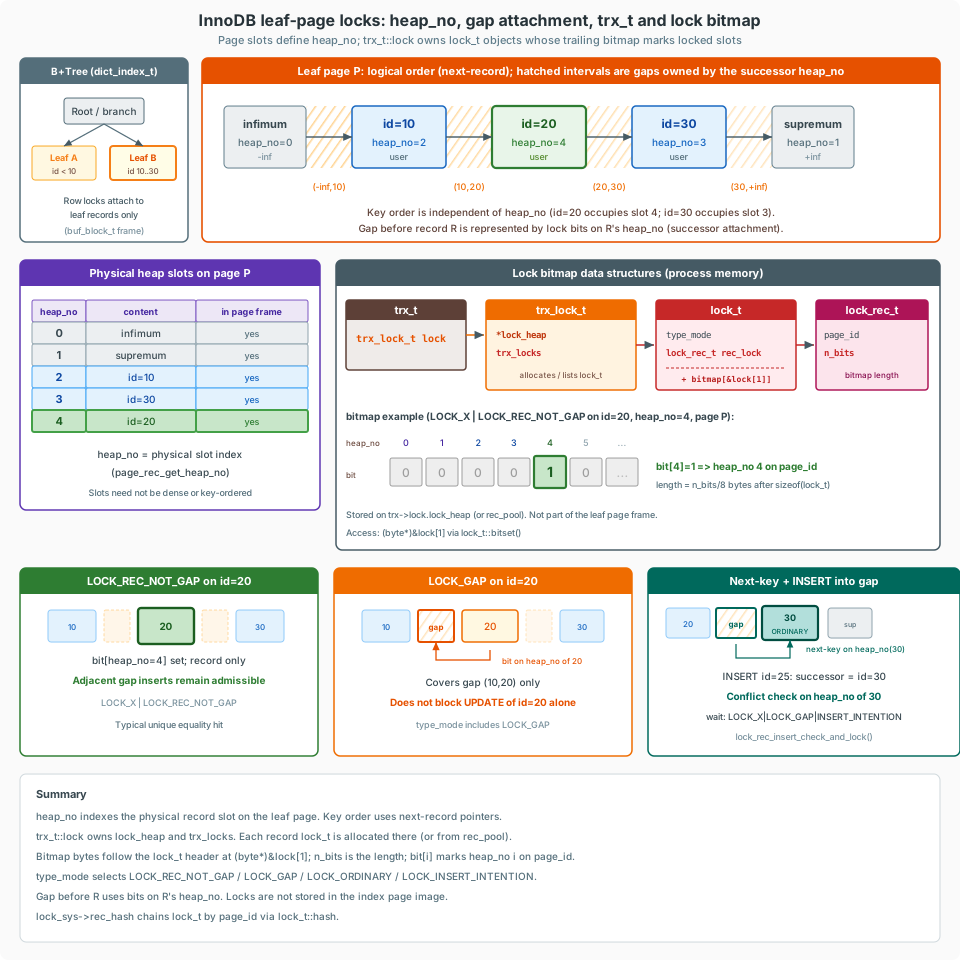
From dict_index_t to a leaf page
A clustered or secondary index (dict_index_t) is organized as a B+tree. Concurrent DML resolves row identity, uniqueness checks, and gap protection on leaf pages. A leaf page cached in the buffer pool is a buf_block_t whose frame contains the page header together with the linked sequence of index records.
Records on one leaf page
Every leaf page allocates two system records at fixed heap numbers, followed by user records:
| Slot | heap_no | Role |
|---|---|---|
| Infimum | PAGE_HEAP_NO_INFIMUM (0) | Pseudo-record denoting −∞; first in the page’s logical order |
| Supremum | PAGE_HEAP_NO_SUPREMUM (1) | Pseudo-record denoting +∞; last in logical order; receives locks that cover the final gap after the last user record |
| User records | ≥ 2 | Index entries; heap_no identifies the physical heap slot, not the SQL key value |
Definition of heap_no. heap_no is the index of a record within the page’s physical record heap (page_rec_get_heap_no). Infimum and supremum occupy 0 and 1 permanently. User records receive successive free heap slots at insertion time. Deletions may leave unused slots; consequently heap numbers need not form a dense sequence and are not ordered by key value.
Logical order on the page is defined by next-record pointers, independent of heap_no numeric order:
infimum → [id=10, heap_no=2] → [id=20, heap_no=4] → [id=30, heap_no=3] → supremum
              ↑                      ↑                      ↑
         gap locks attach to the successor record’s heap_no (see diagram)
A single leaf page therefore admits two distinct orderings: key order, used by range predicates and cursor scans; and heap_no order, used by lock-sys as a stable slot address within (space_id, page_no).
How lock_t encodes a record or gap on that page
Explicit record-lock state is not stored in the leaf-page frame. The page contains only the index records (and thereby their heap_no slots). Each granted or waiting record lock is an in-memory lock_t owned by the transaction:
@startuml
skinparam classAttributeIconSize 0
skinparam shadowing false

class trx_t {
  trx_id_t id
  trx_state_t state
  trx_lock_t lock
  THD *mysql_thd
}

class trx_lock_t {
  mem_heap_t *lock_heap
  trx_lock_list_t trx_locks
  lock_pool_t rec_pool
  lock_t *wait_lock
}

class lock_t {
  trx_t *trx
  UT_LIST_NODE trx_locks
  dict_index_t *index
  lock_t *hash
  uint32_t type_mode
  lock_rec_t rec_lock
  --
  byte bitmap[n_bits/8]
}

class lock_rec_t {
  page_id_t page_id
  uint32_t n_bits
}

note right of lock_t
  Bitmap is not a named C++ member.
  It is allocated immediately after
  sizeof(lock_t): (byte*)&lock[1]
  Length = rec_lock.n_bits / 8.
  bit[i] => heap_no i on page_id.
end note

note bottom of trx_lock_t
  Storage: lock_heap (or rec_pool).
  Not written into the .ibd page.
end note

trx_t *-- trx_lock_t : lock
trx_lock_t o-- lock_t : trx_locks / lock_heap
lock_t *-- lock_rec_t : rec_lock
@enduml
// storage/innobase/include/lock0priv.h
struct lock_rec_t {
  page_id_t page_id;   // leaf page addressed by this bitmap
  uint32_t n_bits;     // bitmap length in bits (multiple of 8)
  // NOTE: the lock bitmap is placed immediately after the lock struct
};
// lock_t::type_mode = LOCK_S|LOCK_X | LOCK_GAP|LOCK_REC_NOT_GAP|LOCK_ORDINARY | ...
Storage. A record lock_t is variable-length: fixed header + n_bits / 8 trailing bitmap bytes (sizeof(lock_t) + bitmap_bytes from trx->lock.lock_heap, or a rec_pool slot). Access: (const byte *)&lock[1] via lock_t::bitset(). rec_lock.n_bits is length only; bit i denotes heap_no == i on rec_lock.page_id. The object is hashed into lock_sys->rec_hash via lock_t::hash. It is never persisted in the tablespace page image.
How conflicts are found across transactions. Ownership is per connection (trx_t::lock.trx_locks), but conflict detection does not iterate every trx_t. Lock-sys maintains a process-global hash lock_sys->rec_hash keyed by page_id. Every record lock_t, regardless of which transaction allocated it, is chained into that hash via lock_t::hash. Checking a lock on (page_id, heap_no) thus:
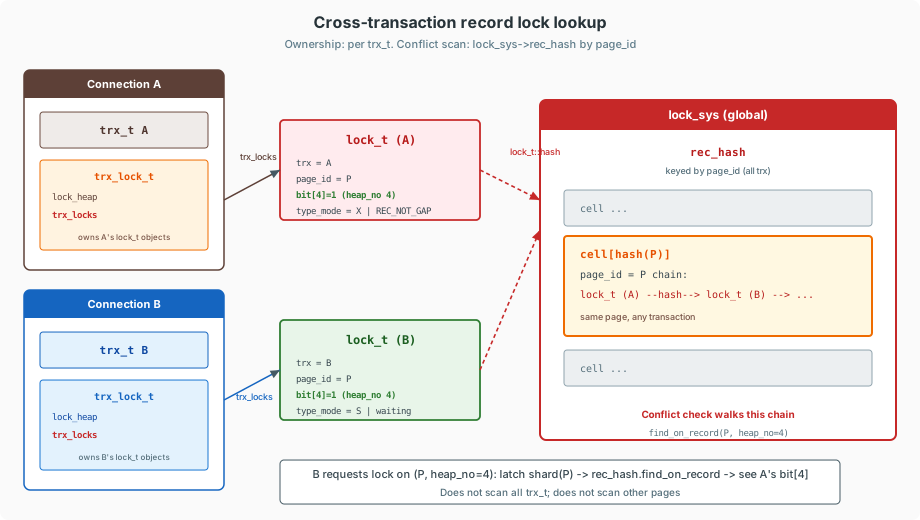
- Latch the lock-sys shard for that
page_id. - Probe
rec_hashfor the cell ofpage_idand walk the chain (Locks_hashtable::find_on_record/find_on_page). - For each
lock_twhose bitmap has bitheap_noset, comparetype_modewith the requester (locksys::rec_lock_check_conflict); skip the requester’s own locks.
// lock0lock.cc — lock_rec_other_has_conflicting()
RecID rec_id{block, heap_no};
const lock_t *wait_for =
    lock_sys->rec_hash.find_on_record(rec_id, [&](const lock_t *lock) {
      return locksys::rec_lock_check_conflict(
                 trx, mode, lock, is_supremum, trx_locks_cache) ==
             locksys::Conflict::HAS_TO_WAIT;
    });
So: storage and lifetime follow the owning trx_t; lookup for “who else locked this slot?” is global, by page, through rec_hash. Cross-connection and cross-statement contention on the same leaf page meet in that hash cell, not via a table-wide or session-wide lock list.
Mode bits on heap_no of record R | Coverage |
|---|---|
LOCK_REC_NOT_GAP | Index record R only |
LOCK_GAP | Open gap preceding R (between the predecessor and R) |
LOCK_ORDINARY (next-key) | R together with the gap preceding R |
LOCK_GAP | LOCK_INSERT_INTENTION | Waiting request to insert into the gap preceding R |
There is no separate gap object in lock-sys: the gap preceding R is represented by lock bits on R’s heap_no (or on supremum for the final gap of the page).
Insert: locating the gap by the successor
An insert between two leaf records obtains the physical neighbors from the B-tree search. Gap conflict is evaluated exclusively against the successor record:
// lock0lock.cc — lock_rec_insert_check_and_lock()
const rec_t *next_rec = page_rec_get_next_const(rec);  // right neighbor / supremum
ulint heap_no = page_rec_get_heap_no(next_rec);

const ulint type_mode = LOCK_X | LOCK_GAP | LOCK_INSERT_INTENTION;
auto conflicting =
    lock_rec_other_has_conflicting(type_mode, block, heap_no, trx);
insert key 25 between id=20 and id=30
  → predecessor = record id=20
  → successor   = record id=30   (next_rec)
  → examine locks whose bitmap has heap_no(id=30) set on this page_id
  → if another transaction holds GAP or next-key there → wait (insert intention)
Modification of an existing index entry addresses that entry’s own heap_no (lock_clust_rec_modify_check_and_lock, or a locking scan positioned on the cursor record). Gap locks on neighboring records alone do not conflict with that update unless a next-key lock also covers the modified record.
Relation to the modes below
Subsections 3.4.1–3.4.4 instantiate the same storage mechanism with distinct type_mode bits on a common (page_id, heap_no) identity:
| Subsection | Typical attachment |
|---|---|
LOCK_REC_NOT_GAP | bit on the matched user heap_no only |
LOCK_GAP | bit on the boundary / next / supremum heap_no, with the gap flag set |
LOCK_ORDINARY | bit on the scanned heap_no, covering the record and the preceding gap |
LOCK_INSERT_INTENTION | waiting bit on the successor heap_no of the insert position |
When gap locks are triggered
A gap lock is not installed merely because a predicate mentions a range. InnoDB places LOCK_GAP or next-key (LOCK_ORDINARY, which includes the preceding gap) only when all of the following hold in substance: the statement is a locking read or write path (select_lock_type != LOCK_NONE, or an insert uniqueness / foreign-key probe), the transaction isolation level still permits gap locking, and the cursor decides that the gap preceding the current leaf record can intersect the search range (or that a uniqueness probe must close the gap before the first unequal / supremum record). Ordinary consistent reads never take these locks.
Gate: isolation and skip_gap_locks()
trx_t::skip_gap_locks() is the primary switch for ordinary locking scans. It is true under READ UNCOMMITTED and READ COMMITTED, and false under REPEATABLE READ and SERIALIZABLE:
// storage/innobase/include/trx0trx.h
bool skip_gap_locks() const {
  switch (isolation_level) {
    case READ_UNCOMMITTED:
    case READ_COMMITTED:
      return (true);
    case REPEATABLE_READ:
    case SERIALIZABLE:
      return (false);
  }
  // ...
}
When the flag is true, row_compare_row_to_range() forces gap_can_intersect_range = false, so the locking scan falls through to LOCK_REC_NOT_GAP rather than LOCK_GAP / LOCK_ORDINARY:
// storage/innobase/row/row0sel.cc — row_compare_row_to_range()
if (!set_also_gap_locks || trx->skip_gap_locks() ||
    (unique_search && !rec_get_deleted_flag(rec, comp)) ||
    dict_index_is_spatial(index) ||
    (index == clust_index && mode == PAGE_CUR_GE && direction == 0 &&
     /* … exact PK GE hit … */)) {
  row_to_range_relation.gap_can_intersect_range = false;
  return (row_to_range_relation);
}
Thus under READ COMMITTED an UPDATE … WHERE id > 20 still locks matching records, but does not, on this path, lock the open gaps that RR would protect against phantoms.
Locking index scan: LOCK_GAP versus next-key versus record-only
After the range relation is computed, row_search_mvcc() maps it to a precise mode and calls sel_set_rec_lock():
// storage/innobase/row/row0sel.cc — row_search_mvcc()
if (prebuilt->select_lock_type != LOCK_NONE) {
  auto row_to_range_relation = row_compare_row_to_range(...);
  ulint lock_type;
  if (row_to_range_relation.row_can_be_in_range) {
    lock_type = row_to_range_relation.gap_can_intersect_range
                    ? LOCK_ORDINARY      // record + preceding gap (next-key)
                    : LOCK_REC_NOT_GAP;  // unique equality-style hit
  } else {
    lock_type = row_to_range_relation.gap_can_intersect_range
                    ? LOCK_GAP           // gap only (e.g. past end of range)
                    : /* not found */;
  }
  err = sel_set_rec_lock(..., prebuilt->select_lock_type, lock_type, ...);
}
| Condition on the current leaf record | Precise mode | Typical SQL situation |
|---|---|---|
| Row may match; gap may meet the range | LOCK_ORDINARY | RR range scan of matching keys (id > 20 on visited rows) |
| Row may match; gap need not be locked | LOCK_REC_NOT_GAP | Unique equality hit; RC ordinary scan |
| Row cannot match; gap may meet the range | LOCK_GAP | Boundary / first record after the locked interval |
| Neither | no lock; search ends | Cursor past a stop tuple with no residual gap |
Pure LOCK_GAP (without the record) is therefore the case where the engine still needs to close an open interval but does not claim the boundary row itself—for example a record beyond end_range, or the first unequal key during certain insert probes.
Additional explicit LOCK_GAP placements appear when scanning downward (to block phantoms for ORDER BY … DESC) and when locking the supremum gap at the end of a leaf while the range still extends:
// row0sel.cc — after open, descending locking scan
if (!moves_up && !page_rec_is_supremum(rec) && set_also_gap_locks &&
    !trx->skip_gap_locks() && prebuilt->select_lock_type != LOCK_NONE &&
    !dict_index_is_spatial(index)) {
  const rec_t *next_rec = page_rec_get_next_const(rec);
  err = sel_set_rec_lock(..., next_rec, ..., LOCK_GAP, thr, &mtr);
}
// row0sel.cc — supremum encountered while moving up on a locking scan
if (set_also_gap_locks && !trx->skip_gap_locks() &&
    prebuilt->select_lock_type != LOCK_NONE &&
    !dict_index_is_spatial(index)) {
  err = sel_set_rec_lock(..., rec /* supremum */, ..., LOCK_ORDINARY, thr, &mtr);
  // LOCK_ORDINARY on supremum is gap coverage for (+∞ on this page)
}
Transactional gap / next-key bits attach only to leaf heap slots (user records or supremum). Internal B+tree pages are protected solely by short page latches inside mini-transactions, not by these lock_t modes.
Insert uniqueness probe
A plain INSERT that checks a unique index also takes gap / next-key locks so that a concurrent inserter cannot create a duplicate in an adjacent gap before the first transaction commits. On the first unequal (“next”) record the probe requests gap only; equal keys take next-key:
// storage/innobase/row/row0ins.cc — duplicate-key scan
} else if (is_supremum) {
  /* Equivalent to LOCK_GAP on the final open gap. */
  lock_type = LOCK_ORDINARY;
} else if (is_next) {
  /* Only gap lock is required on next record. */
  lock_type = LOCK_GAP;
} else {
  /* Next key lock for all equal keys. */
  lock_type = LOCK_ORDINARY;
}
err = row_ins_set_rec_lock(LOCK_S, lock_type, block, rec, index, offsets, thr);
For data-dictionary / SDI tables, dict_table_t::skip_gap_locks() forces record-only behaviour on this probe (MDL already serializes DD changes). That table-level helper is distinct from trx_t::skip_gap_locks().
When gap locks are not taken
| Situation | Outcome |
|---|---|
Plain SELECT (consistent read, LOCK_NONE) | No record or gap locks |
RC / RU ordinary locking scan (trx->skip_gap_locks()) | Record locks without gap / next-key on this path |
| Unique equality on a live clustered row under RR | Often LOCK_REC_NOT_GAP (gap bit cleared in row_compare_row_to_range) |
| Spatial indexes | Predicate / page locks instead of ordinary gap heuristics |
Inserts that later wait on an already protected gap enqueue LOCK_GAP | LOCK_INSERT_INTENTION on the successor (§3.4.4); that wait mode is triggered by a prior gap or next-key holder, not by the insert’s own range scan.
Example — trigger under RR versus skip under RC:
-- Session A
SET TRANSACTION ISOLATION LEVEL REPEATABLE READ;
BEGIN;
SELECT * FROM t WHERE id > 20 FOR UPDATE;
-- locking scan: LOCK_ORDINARY / LOCK_GAP on visited leaf slots and supremums
-- → INSERT id=25 in Session B waits

-- Session A′ (same statement under READ COMMITTED)
SET TRANSACTION ISOLATION LEVEL READ COMMITTED;
BEGIN;
SELECT * FROM t WHERE id > 20 FOR UPDATE;
-- skip_gap_locks(): LOCK_REC_NOT_GAP on matching rows only
-- → INSERT id=25 in Session B typically proceeds (no phantom gap held)
3.4.1 Record lock only — LOCK_REC_NOT_GAP
Mechanism. The lock covers the index record and excludes the preceding gap. Concurrent inserts into adjacent gaps remain admissible. InnoDB employs this mode when the conflict domain is confined to a single existing record—typically a unique equality lookup that locates a non-deleted row (row_can_be_in_range && !gap_can_intersect_range in the decision above).
The clustered-index modify path reasserts record-only exclusive locking immediately before undo generation:
// storage/innobase/lock/lock0lock.cc — lock_clust_rec_modify_check_and_lock()
lock_rec_convert_impl_to_expl(block, rec, index, offsets);
{
  locksys::Shard_latch_guard guard{UT_LOCATION_HERE, block->get_page_id()};
  ut_ad(lock_table_has(thr_get_trx(thr), index->table, LOCK_IX));
  err = lock_rec_lock(true, SELECT_ORDINARY, LOCK_X | LOCK_REC_NOT_GAP,
                      block, heap_no, index, thr);
}
Example — unique primary-key locking read:
-- Session A (RR)
BEGIN;
SELECT * FROM t WHERE id = 20 FOR UPDATE;
-- InnoDB: LOCK_X | LOCK_REC_NOT_GAP on clustered record id = 20
-- (unique equality hit; adjacent gaps (10,20) and (20,30) are not locked)

-- Session B: blocked on the same record
UPDATE t SET c = 99 WHERE id = 20;          -- waits

-- Session C: insert into a neighboring gap remains admissible
INSERT INTO t VALUES (25, 25);                 -- succeeds while A holds id = 20
COMMIT;
3.4.2 Gap lock — LOCK_GAP
Mechanism. The lock covers only the open interval preceding an index record (or the supremum gap). It does not lock the boundary record. Its purpose is to prevent phantom inserts into that interval, not to exclude updates of the existing boundary row. The conditions under which InnoDB selects LOCK_GAP (versus next-key or record-only) are detailed in When gap locks are triggered above; this subsection focuses on the semantics once that mode is chosen.
Under REPEATABLE READ, pure gap locks arise when !row_can_be_in_range && gap_can_intersect_range in the scan decision, and during uniqueness probes on the first unequal (“next”) record:
// storage/innobase/row/row0ins.cc — duplicate-key scan (plain INSERT)
} else if (is_next) {
  /* Only gap lock is required on next record. */
  lock_type = LOCK_GAP;
} else {
  /* Next key lock for all equal keys. */
  lock_type = LOCK_ORDINARY;
}
err = row_ins_set_rec_lock(LOCK_S, lock_type, block, rec, index, offsets, thr);
Under READ COMMITTED, trx_t::skip_gap_locks() is true and ordinary locking scans omit most gap locks. Duplicate-key and foreign-key paths may still request them where correctness requires; when the table-level dict_table_t::skip_gap_locks() applies (DD / SDI), the insert probe forces LOCK_REC_NOT_GAP instead of gap coverage.
Example — range-boundary gaps under REPEATABLE READ:
-- Session A (RR)
BEGIN;
SELECT * FROM t WHERE id > 20 FOR UPDATE;
-- Acquires next-key / gap locks along (20, 30] and (30, +inf) as the scan proceeds;
-- inserts with id in (20, +inf) must wait.

-- Session B
INSERT INTO t VALUES (25, 25);   -- waits (gap within the locked range)
INSERT INTO t VALUES (15, 15);   -- succeeds (outside the locked gaps)

-- Session C: a pure gap does not, by itself, block updates of an uncovered record
UPDATE t SET c = 10 WHERE id = 10;  -- succeeds
A LOCK_GAP attached at id = 30 precludes INSERT … (25) yet does not, by itself, preclude UPDATE … WHERE id = 30. Next-key locking (§3.4.3) combines both effects.
3.4.3 Next-key lock — LOCK_ORDINARY
Mechanism. A next-key lock covers the index record together with its preceding gap (LOCK_S or LOCK_X with precise mode LOCK_ORDINARY == 0). Under REPEATABLE READ it is the principal instrument against phantoms on locking range scans: neither an update of the matched record nor an insert into the preceding gap may proceed concurrently.
row_search_mvcc() selects LOCK_ORDINARY when both row_can_be_in_range and gap_can_intersect_range hold, and passes that value as gap_mode to lock_rec_lock(mode | LOCK_ORDINARY).
Example — range UPDATE under REPEATABLE READ:
-- Session A (RR)
BEGIN;
UPDATE t SET c = c + 1 WHERE id BETWEEN 10 AND 20;
-- Next-key exclusive locks on scanned index positions covering the range
-- (attachment depends on the access path; a primary-key range scan
-- typically acquires next-key locks at successive leaf records).

-- Session B
UPDATE t SET c = 0 WHERE id = 10;     -- waits (record covered)
INSERT INTO t VALUES (15, 15);          -- waits (gap covered)
INSERT INTO t VALUES (35, 35);          -- succeeds if outside locked gaps
COMMIT;  -- after A commits
Example — READ COMMITTED weakens gap coverage on ordinary scans:
-- Session A
SET TRANSACTION ISOLATION LEVEL READ COMMITTED;
BEGIN;
UPDATE t SET c = c + 1 WHERE id BETWEEN 10 AND 20;
-- Matching rows retain record X; gaps are generally not retained for the scan.

-- Session B
INSERT INTO t VALUES (15, 15);   -- typically succeeds under READ COMMITTED
COMMIT;
3.4.4 Insert-intention lock — LOCK_INSERT_INTENTION
Mechanism. When the gap that would receive a new index entry is already held by another transaction’s gap or next-key lock, the inserting transaction does not request a conflicting ordinary gap lock—doing so would deadlock concurrent inserters. Prior to clustered undo and physical insert, btr_cur_ins_lock_and_undo() invokes lock_rec_insert_check_and_lock(), which enqueues a waiting insert-intention lock:
// storage/innobase/btr/btr0cur.cc — btr_cur_ins_lock_and_undo()
err = lock_rec_insert_check_and_lock(
    flags, rec, btr_cur_get_block(cursor), index, thr, mtr, inherit);
// ...
err = trx_undo_report_row_operation(flags, TRX_UNDO_INSERT_OP, ...);
// storage/innobase/lock/lock0lock.cc — lock_rec_insert_check_and_lock()
const ulint type_mode = LOCK_X | LOCK_GAP | LOCK_INSERT_INTENTION;

const auto conflicting =
    lock_rec_other_has_conflicting(type_mode, block, heap_no, trx);

if (conflicting.wait_for != nullptr) {
  RecLock rec_lock(thr, index, block, heap_no, type_mode);
  err = rec_lock.add_to_waitq(conflicting.wait_for);
}
Insert-intention requests in the same gap are not treated as mutually conflicting; the implementation comment cites avoidance of spurious deadlocks among concurrent inserts.
Example:
-- Session A (RR)
BEGIN;
SELECT * FROM t WHERE id > 20 FOR UPDATE;  -- retains gaps in (20, +inf)

-- Session B
BEGIN;
INSERT INTO t VALUES (25, 25);
-- Observes a conflicting gap/next-key lock → waits with INSERT_INTENTION

-- Session C
BEGIN;
INSERT INTO t VALUES (27, 27);
-- Likewise INSERT_INTENTION on the same gap; does not conflict with B

-- Session A
COMMIT;   -- releases gap locks → B and C proceed (subject to uniqueness checks)
3.4.5 Shared versus exclusive strength (LOCK_S / LOCK_X)
Mechanism. Independently of gap coverage, lock strength is LOCK_S or LOCK_X—the mode argument to lock_rec_lock and row_ins_set_rec_lock:
| SQL construct | Typical strength | Source indication |
|---|---|---|
SELECT … FOR SHARE | LOCK_S | select_lock_type = LOCK_S from store_lock |
SELECT … FOR UPDATE, UPDATE, DELETE | LOCK_X | external_lock(F_WRLCK) / select_lock_type = LOCK_X |
Plain INSERT duplicate probe | LOCK_S | row_ins_set_rec_lock(LOCK_S, …) |
INSERT … ON DUPLICATE KEY UPDATE / REPLACE | LOCK_X on duplicate candidates | row_ins_set_rec_lock(LOCK_X, …) |
// storage/innobase/row/row0ins.cc — duplicate scan
if (/* REPLACE / ON DUPLICATE KEY UPDATE */) {
  err = row_ins_set_rec_lock(LOCK_X, lock_type, block, rec, index, offsets, thr);
} else {
  err = row_ins_set_rec_lock(LOCK_S, lock_type, block, rec, index, offsets, thr);
}
Example — shared versus exclusive conflict:
-- Session A
BEGIN;
SELECT * FROM t WHERE id = 10 FOR SHARE;   -- LOCK_S on the record

-- Session B
SELECT * FROM t WHERE id = 10 FOR SHARE;   -- LOCK_S; compatible
SELECT * FROM t WHERE id = 10 FOR UPDATE;  -- LOCK_X; waits for A
UPDATE t SET c = 1 WHERE id = 10;         -- LOCK_X; waits for A
Example — duplicate-key locking on INSERT:
-- Session A
BEGIN;
INSERT INTO t VALUES (40, 40);   -- succeeds; implicit X via DB_TRX_ID on the new row
-- not committed

-- Session B
INSERT INTO t VALUES (40, 40);   -- uniqueness check locks the duplicate site; waits
-- or, with ON DUPLICATE KEY UPDATE:
INSERT INTO t VALUES (40, 40) AS n
  ON DUPLICATE KEY UPDATE c = n.c;  -- LOCK_X on the duplicate, then the update path
3.5 Page latches and mini-transactions
Mechanism. During B-tree search or modification, InnoDB holds page latches within an mtr (mini-transaction) for a brief critical section: the page is latched, the change is applied, redo is recorded in the mini-transaction, and mtr_commit() releases the latches. These latches are neither transactional locks nor retained until COMMIT.
// storage/innobase/btr/btr0cur.cc — typical search/modify framing
mtr_start(&mtr);
btr_cur_search_to_nth_level(index, 0, tuple, mode, ..., &mtr);
// ... lock_rec_* / undo / page update under page latches ...
mtr_commit(&mtr);   // releases page latches; transactional locks remain
Transactional locks (§3.3–3.4) outlive the latch: once the page latch is released, other transactions remain constrained by the logical lock until commit or rollback. Lock-system shard latches (locksys::Shard_latch_guard in the snippets above) protect lock-hash structures only for the duration of lock_rec_lock and are likewise short-lived.
Page latches are not expressible in SQL. Contention manifests as brief stalls or buffer-pool wait instrumentation, not as InnoDB lock-wait timeouts on a particular primary-key value.
3.6 Layer composition for a single statement
BEGIN;
UPDATE t SET c = 100 WHERE id BETWEEN 10 AND 20;
-- 1) MDL_SHARED_WRITE on t                         (§3.1)
--      open_tables → mdl_context.acquire_lock
-- 2) mysql_lock_tables → external_lock(F_WRLCK)
--      → select_lock_type = LOCK_X                 (§3.2)
-- 3) InnoDB table LOCK_IX via lock_table()         (§3.3)
-- 4) Per index record: lock_rec_lock(
--      LOCK_X | LOCK_ORDINARY / LOCK_REC_NOT_GAP) (§3.4)
-- 5) Transient mtr page latches around B-tree I/O  (§3.5)
COMMIT;  -- releases (3)–(4); MDL is released when tables are closed
         -- or transactional MDL duration ends, as applicable
Overlapping ranges: serialization without a range-lock object
Consider two concurrent locking statements under REPEATABLE READ:
-- A
BEGIN;
UPDATE t SET c = 1 WHERE id BETWEEN 10 AND 20;  -- holds X next-key on 10..20
-- not committed

-- B
BEGIN;
UPDATE t SET c = 2 WHERE id BETWEEN 15 AND 25;
-- waits on first conflict with A's bits in [15,20]
-- after A COMMITs, proceeds to lock and update 21..25
The predicates intersect on [15, 20]. InnoDB still has no lock object that represents an interval [low, high]. Each transaction walks leaf records that match its predicate and, for each visit, requests a precise lock on a single (page_id, heap_no) (§3.4). Serialization of the intersection follows from wait queues on those shared slots, not from promoting the work to a table or page exclusive lock.
A scans id ∈ [10,20]     B scans id ∈ [15,25]
        │                         │
        ▼                         ▼
  lock_rec_lock(X|ORDINARY)  lock_rec_lock(X|ORDINARY)
  on each visited leaf slot  on each visited leaf slot
        │                         │
        └──── same heap_no in [15,20]? ────┘
                    │
                    ▼
         lock_sys->rec_hash lookup
         rec_lock_check_conflict()
                    │
         ┌──────────┴──────────┐
         │ compatible          │ HAS_TO_WAIT
         │ (distinct rows,     │ (same row X vs X,
         │  or gap rules)      │  or insert vs gap)
         ▼                     ▼
      grant bit            enqueue WAIT
                           on that heap_no
                           B blocks until A COMMITs
How “one by one” appears. Suppose A has already locked the clustered records for id = 10…20 (next-key: record plus preceding gap). When B’s cursor reaches the first index record that A already holds incompatibly—commonly id = 15 if both update that row—lock_rec_other_has_conflicting() returns a waiter requirement and B suspends on that one lock_t bit. B does not need to “own [15,25] as a unit” first; it stops at the first conflicting acquisition. After A commits, the wait is granted and B continues locking further rows (21…25) that A never claimed. Concurrent progress remains possible outside the contested slots (for example another transaction on id = 30).
// lock0lock.cc — conflict on one (page, heap_no), not on a key interval
RecID rec_id{block, heap_no};
const lock_t *wait_for =
    lock_sys->rec_hash.find_on_record(rec_id, [&](const lock_t *lock) {
      return locksys::rec_lock_check_conflict(
                 trx, mode, lock, is_supremum, trx_locks_cache) ==
             locksys::Conflict::HAS_TO_WAIT;
    });
Why per-row locks are enough. Overlapping SQL ranges are dense sets of leaf slots. Whoever first installs an incompatible bit on a slot in the intersection forces later acquirers of that same slot to wait. The intersection {15,16,…,20} is thereby executed under mutual exclusion slot by slot, which is exactly the rows both statements must touch. Gaps in the intersection block inserts into those open intervals (insert-intention vs gap / next-key); they do not, by themselves, make two pure gap holders wait for each other:
// lock0lock.cc — rec_lock_check_conflict() (gap / gap rule)
if ((lock_is_on_supremum || (type_mode & LOCK_GAP)) &&
    !(type_mode & LOCK_INSERT_INTENTION)) {
  /* Gap locks without INSERT_INTENTION do not wait for anything. */
  return Conflict::NO_CONFLICT;
}
For these two UPDATEs, the decisive conflict is ordinarily X next-key / record versus X on the shared matching rows, not “range object A versus range object B.”
Deadlock. If A and B lock overlapping key sets in opposite physical orders (or via different indexes), each may hold part of the intersection and wait for the other → deadlock detector aborts one transaction. That is still row-lock wait-graph scheduling, not range-lock scheduling.
| What the SQL suggests | What InnoDB does |
|---|---|
Lock range [10,20] as one resource | Many leaf lock_t bits along visited pages |
| Serialize intersecting ranges atomically | Wait on the first conflicting (page_id, heap_no) |
| Exclude only the other range transaction | Exclude any trx needing an incompatible mode on those bits |
READ COMMITTED changes the picture for ordinary scans (skip_gap_locks()): B may avoid waiting on gaps A would have held under RR, but X versus X on the same matched row still serializes updates of that row.
4. UPDATE concurrency path
4.1 Call chain
Sql_cmd_update::execute_inner
  → update_single_table  (or Query_result_update iterators)
      → row_search_mvcc          // LOCK_X locking read
      → sel_set_rec_lock
      → lock_clust/sec_rec_read_check_and_lock
      → ha_update_row
          → ha_innobase::update_row
          → row_update_for_mysql
          → row_upd_clust_step
          → lock_clust_rec_modify_check_and_lock   // X | LOCK_REC_NOT_GAP
          → trx_undo_report_row_operation(TRX_UNDO_MODIFY_OP)
          → clustered + secondary index updates
4.2 Choosing record vs gap vs next-key
During the locking scan, row_search_mvcc() maps the cursor position relative to the search range:
// row0sel.cc — simplified structure of the decision
if (prebuilt->select_lock_type != LOCK_NONE) {
  auto rel = row_compare_row_to_range(...);
  ulint lock_type;
  if (rel.row_can_be_in_range) {
    lock_type = rel.gap_can_intersect_range ? LOCK_ORDINARY : LOCK_REC_NOT_GAP;
  } else {
    lock_type = rel.gap_can_intersect_range ? LOCK_GAP : /* not found */;
  }
  err = sel_set_rec_lock(..., prebuilt->select_lock_type, lock_type, ...);
}
Under REPEATABLE READ:
- A unique equality lookup that locates an existing clustered record may acquire record-only exclusive locking.
- Range and non-unique scans acquire next-key exclusive locks (and gap locks at boundaries) so that phantoms cannot appear in the locked range before commit.
- The modify step reasserts X | LOCK_REC_NOT_GAP on the clustered record before writing undo and mutating the page.
Under READ COMMITTED:
trx_t::skip_gap_locks()is true, so ordinary UPDATE scans omit gap and next-key locks where the implementation permits.- Matching rows retain record X until commit.
- Locks acquired on rows that fail the WHERE predicate may be released (
releases_non_matching_rows()/try_unlock). - Semi-consistent read may observe the last committed version of a locked row, evaluate the predicate, and re-read under a lock if the row still qualifies.
4.3 UPDATE versus SELECT … FOR UPDATE
Both paths set select_lock_type = LOCK_X and share the locking-read machinery. Differences:
SELECT … FOR UPDATE | UPDATE | |
|---|---|---|
| After lock | Return the row | ha_update_row, undo, and index maintenance |
| Predicate miss (RC) | Non-matching locks may be released | Same semi-consistent / unlock path |
| Binlog / triggers | No row-change events | Full write side effects |
5. INSERT concurrency path
5.1 Call chain
Sql_cmd_insert_values::execute_inner
  → write_record
      → ha_write_row
          → ha_innobase::write_row
          → row_insert_for_mysql
          → lock_table(..., LOCK_IX, ...)
          → unique / FK checks (S or X locks on conflicting keys)
          → btr_cur_ins_lock_and_undo
              → lock_rec_insert_check_and_lock   // may wait INSERT_INTENTION
              → trx_undo_report_row_operation(TRX_UNDO_INSERT_OP)
              → insert clustered + secondary records
The newly inserted clustered record carries an implicit exclusive lock identified by DB_TRX_ID. A concurrent transaction that must wait converts that implicit lock into an explicit lock_t entry.
5.2 Insert-intention locks
When the gap preceding the insert position is held by another transaction’s gap or next-key lock, the inserting transaction does not request a conflicting ordinary gap lock. It enqueues:
// lock0lock.cc — lock_rec_insert_check_and_lock()
const ulint type_mode = LOCK_X | LOCK_GAP | LOCK_INSERT_INTENTION;
// wait on conflicting.wait_for if present
The request denotes intent to insert at that position without treating concurrent insert-intention requests in the same gap as mutually conflicting. After the holder of the protective gap or next-key lock commits or rolls back, the insert proceeds and gap inheritance follows the page’s updated record layout.
5.3 Duplicate-key and FK locking
Unique-index duplicate checking traverses equal keys and locks candidate conflict sites. Strength depends on statement intent:
// row0ins.cc — duplicate scan (conceptual)
if (will_update_or_replace_duplicate) {
  err = row_ins_set_rec_lock(LOCK_X, lock_type, ...);  // REPLACE / ON DUP UPDATE
} else {
  // plain INSERT: S locks; under RR often LOCK_ORDINARY / GAP on neighbors
  err = row_ins_set_rec_lock(LOCK_S, lock_type, ...);
}
Under RC, gap locks on supremum / “next” records are skipped where safe, but duplicate-key and foreign-key paths still take the locks required for correctness. Isolation level does not mean “no gap locks ever.”
Foreign-key checks place S record/gap locks on parent or child index entries so the referenced relationship cannot disappear mid-statement.
6. Transactions
6.1 From THD to trx_t
Session binding (ha_data → innodb_session_t → trx_t) and SQL-layer registration (Transaction_ctx / Ha_trx_info) are detailed under Data Structure. In brief:
check_trx_exists(thd)
  → thd_to_trx(thd)                 // via innodb_session_t in ha_data[slot]
  → innobase_trx_allocate(thd)      // if m_trx still null
external_lock / start_stmt
  → update_thd → m_prebuilt->trx = session trx
  → innobase_register_trx → trans_register_ha (stmt ± session lists)
The first modifying operation calls trx_start_if_not_started_xa(). Isolation level is copied from the session into trx_t during lock setup; helpers such as skip_gap_locks() and releases_non_matching_rows() are derived from that field.
6.2 Undo for INSERT and UPDATE
Undo is generated on the clustered index path; secondary indexes are maintained/rolled back from clustered history.
| Operation | Undo type | Role |
|---|---|---|
| INSERT | TRX_UNDO_INSERT_OP | Identify new row for rollback deletion |
| UPDATE / DELETE | TRX_UNDO_MODIFY_OP | Before-image + system columns for rollback and MVCC |
btr_cur_ins_lock_and_undo
  → trx_undo_report_row_operation(..., TRX_UNDO_INSERT_OP, ...)

btr_cur_upd_lock_and_undo
  → lock_clust_rec_modify_check_and_lock
  → trx_undo_report_row_operation(..., TRX_UNDO_MODIFY_OP, ...)
The returned roll pointer is stored in DB_ROLL_PTR on the clustered record. Concurrent consistent reads reconstruct older versions by following that chain (see the InnoDB MVCC article). Writers still require locks: MVCC does not eliminate locking for UPDATE or INSERT.
6.3 Statement versus session commit
After a successful statement:
mysql_execute_command cleanup
  → trans_commit_stmt(thd)     // or trans_rollback_stmt on error
      → ha_commit_trans(thd, all=false, ...)
- Autocommit ON: statement commit is the transaction commit.
- Explicit transaction: statement commit ends the statement scope; locks and undo remain until
COMMIT/ROLLBACK.
Explicit commit:
trans_commit(thd)
  → ha_commit_trans(thd, all=true, ...)
      → tc_log->prepare()          // if multi-engine 2PC
      → MYSQL_BIN_LOG::commit()
      → ordered_commit()           // group commit
      → ha_commit_low()
          → handlerton::commit → innobase_commit
              → trx_commit_for_mysql → trx_commit_in_memory
              → trx_commit_complete_for_mysql  // redo flush policy
innobase_commit() records the binlog file and offset on trx_t, may defer redo flush for group commit, and releases InnoDB locks when the transaction becomes committed in memory.
7. Isolation summary for DML
| Behavior | READ COMMITTED | REPEATABLE READ (default) |
|---|---|---|
| Gap locks on ordinary UPDATE range scan | Generally omitted | Next-key / gap as required |
| Locks on non-matching scanned rows | May be released | Retained until transaction end |
| Semi-consistent read on UPDATE | Permitted | Not used |
| Duplicate-key / FK gap locks | Still possible | Acquired |
| INSERT against a held next-key on the gap | Waits (INSERT_INTENTION) | Same |
| Consistent-read snapshot | Per statement | Per transaction (usual RR) |
Summary. READ COMMITTED weakens range protection on writers’ ordinary scans; it does not eliminate gap locking required for uniqueness checks and referential integrity.
8. End-to-end sequences
8.1 Single-table UPDATE under RR
@startuml
actor Client
participant Sql_cmd_update
participant lock_cc as "lock.cc"
participant InnoDB
participant Binlog

Client -> Sql_cmd_update : UPDATE t SET ... WHERE range
Sql_cmd_update -> Sql_cmd_update : open_tables (MDL_SHARED_WRITE)
Sql_cmd_update -> lock_cc : mysql_lock_tables
lock_cc -> InnoDB : external_lock(F_WRLCK) → select_lock_type=LOCK_X
loop qualifying rows
  Sql_cmd_update -> InnoDB : row_search_mvcc + X next-key / record locks
  Sql_cmd_update -> InnoDB : ha_update_row → undo + B-tree update
end
Sql_cmd_update -> Binlog : trans_commit_stmt / COMMIT
Binlog -> InnoDB : ordered_commit → trx_commit (release locks)
@enduml
8.2 INSERT VALUES colliding with a held gap
@startuml
participant "Trx A (UPDATE range)" as A
participant "Trx B (INSERT)" as B
participant LockSys

A -> LockSys : X next-key on scanned range (holds gap)
B -> LockSys : lock_table(IX)
B -> LockSys : lock_rec_insert_check_and_lock
LockSys -> B : wait LOCK_INSERT_INTENTION
A -> LockSys : COMMIT (release next-key)
LockSys -> B : wake
B -> LockSys : insert row + insert undo
B -> LockSys : COMMIT
@enduml
9. Design takeaways
- Shared command pipeline. DML follows the SELECT prepare / open / lock path until the write sink: specialized loops or
Query_result_*invokeha_write_row/ha_update_row. - Distinct lock layers. MDL protects schema change; SQL-layer table locks convey statement intent to the engine; InnoDB record, gap, next-key, and insert-intention locks serialize row access. Row serializability does not depend on THR_LOCK for InnoDB.
- UPDATE locking stages. A locking read first acquires exclusive coverage of candidate records; the clustered modify path then reasserts record-only X and reports undo before the physical change.
- INSERT and gaps. An insert that enters a protected gap waits with insert-intention; uniqueness and foreign-key checks may additionally acquire shared or exclusive locks on conflicting records.
- Commit coordination. Statement versus session scope, binlog ordered / group commit, and InnoDB
trx_commitjointly release locks and apply the configured flush policy.
For the read-side iterator/optimizer path, see MySQL Query Processing Internals. For page format, undo chains, and ReadView visibility, see InnoDB Storage Engine Internals.