
Concurrency Synchronization
On shared-memory machines, threads communicate by reading and writing shared data structures. Simple updates use hardware atomics; larger critical sections use synchronization constructs — either blocking (deschedule the waiter) or busy-wait (spin until a condition holds). This post covers the busy-wait building blocks: spin locks for mutual exclusion and barriers for rendezvous.
1. Architecture
Threads coordinate through two broad classes of construct:
| Class | Behavior | Typical use |
|---|---|---|
| Blocking | Waiter is descheduled (park, futex, kernel mutex) | Long or unknown wait; fair scheduling |
| Busy-wait | Waiter spins, repeatedly testing shared state | Short, bounded critical sections; low latency |
Within busy-wait synchronization, two primitives cover most patterns:
| Construct | Purpose |
|---|---|
| Spin lock | Mutual exclusion — at most one thread in a critical section |
| Barrier | Rendezvous — no thread proceeds past a point until all have arrived |
Spin locks are the low-level building block for richer semantics (semaphores, monitors, Java AbstractQueuedSynchronizer). Barriers appear in parallel loops, phased algorithms, and fork/join style pipelines.
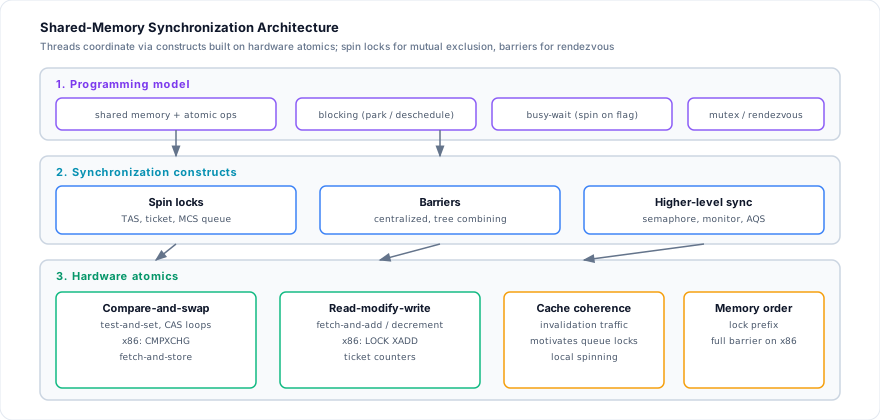
1.1 Design overview
- Acquire / release — a lock acquire spins (or blocks) until exclusive access is granted; release clears the flag and may wake waiters.
- Cache coherence cost — naïve test-and-set on one word causes every waiter to invalidate the same cache line on each failed attempt. Scalable locks spread waiters across lines (ticket, array, queue).
- Barrier sense-reversing — processors flip a private
local_senseand poll a sharedsenseuntil all arrivals are counted; avoids resetting a global counter under contention. - Hardware mapping — spin loops compile to atomic RMW instructions (
CMPXCHG,LOCK XADDon x86) with full memory ordering on the locked line.
2. Implementation
2.1 Spin locks
A spin lock causes a thread trying to acquire it to wait in a loop while checking whether the lock is available. The thread stays runnable but does no useful work — appropriate only when hold time is short and contention is moderate.
| Lock type | Idea | Scalability |
|---|---|---|
| Test-and-set | Single shared flag; CAS or atomic exchange | Poor under contention (cache line bouncing) |
| Ticket | FIFO ticket counter + serving counter | Fair; waiters mostly read now_serving |
| Array-based queue | Each thread spins on its own slot | Reduces invalidation vs single word |
| MCS queue | Linked queue; spin on local locked flag | Best locality; O(1) acquire/release amortized |
Test-and-set
The simplest spin lock atomically sets a flag and spins while it was already set:
// shared: lock := false

acquire():
    repeat
        while test_and_set(&lock) == true   // or CAS loop with backoff
            // optional: pause, exponential backoff

release():
    lock := false
Backoff (random or exponential delay between attempts) reduces bus traffic when the lock is held for non-trivial periods.
Ticket lock
Threads take a ticket and spin until their number is served — FIFO fairness and waiters probe now_serving with ordinary reads instead of hammering the lock word:
// shared: next_ticket, now_serving := 0

acquire():
    my := fetch_and_increment(&next_ticket)
    while my != now_serving
        // spin (read-only on now_serving)

release():
    now_serving := now_serving + 1
On cache-coherent machines, spinning on now_serving generates far fewer invalidations than a single shared TAS word.
Array-based queuing lock
Each processor (or slot index) has a dedicated location to spin on. Thread i waits on flag[i] while thread i−1 holds the lock, forming a logical queue without a linked structure:
@startuml
left to right direction
state "Thread 1\n(running)" as T1
state "Thread 2\n(spin flag[2])" as T2
state "Thread 3\n(spin flag[3])" as T3
T1 --> T2
T2 --> T3
@enduml
Release clears the caller’s flag and sets the successor’s flag, passing the lock down the array.
MCS queue lock
The Mellor-Crummey and Scott (MCS) lock queues waiters in a linked list. Each waiter spins on its own qnode.locked field — the successor is local to the waiting core, minimizing coherence traffic.
type qnode = record
    next: qnode
    locked: boolean

type lock = qnode*    // points to tail of queue

// I: qnode allocated in memory local to this processor
acquire(L, I):
    I.next := nil
    I.locked := false
    pred := fetch_and_store(L, I)      // enqueue self as new tail
    if pred != nil then
        I.locked := true
        pred.next := I
        while I.locked                    // spin on LOCAL flag
            ;

release(L, I):
    if I.next == nil then                 // no successor yet
        if compare_and_swap(L, I, nil) then
            return
        repeat while I.next == nil        // wait for successor to link
    I.next.locked := false                // hand off to successor
The last arriver may need to CAS the tail to nil or wait until a successor links — the classic MCS release race.
2.2 Barriers
A barrier for a group of threads means: no thread may proceed until all have reached the barrier. Used at phase boundaries in parallel loops (e.g. before reading results written by peers in the previous iteration).
Centralized barrier
One shared counter and a sense-reversing flag. Each thread toggles its private local_sense, decrements count, and either resets the counter (last arrival) or spins until sense == local_sense:
// shared: count := p, sense := true
// private per processor: local_sense := true

central_barrier():
    local_sense := not local_sense
    if fetch_and_decrement(&count) == 1 then
        count := p
        sense := local_sense          // release everyone
    else
        repeat until sense = local_sense
The last arriver publishes the new sense; others observe it without further writes to count until the next round.
Software combining tree barrier
For large p, a flat centralized counter becomes a hotspot. A tree barrier assigns each processor a leaf node; arrivals combine upward (increment parent counts) so most threads touch only nearby nodes. Depth is $O(\log p)$; only the root sees global contention.
type node = record
    k: integer              // fan-in degree
    count: integer
    sense: boolean
    parent: node

// shared nodes[0..p-1] arranged as tree
// private: mynode, local_sense
Each thread waits on its leaf’s sense, then propagates arrival to ancestors — details vary by fan-in and whether combining is synchronous or asynchronous.
2.3 Hardware atomics (x86)
Spin locks and barriers compile down to a small set of atomic instructions:
| Instruction | Role |
|---|---|
CMPXCHG | Compare-and-exchange — test-and-set, CAS loops, MCS tail update |
LOCK XADD | Atomic fetch-and-add — ticket next_ticket, barrier count decrement |
The LOCK prefix provides full barrier semantics on the modified cache line: prior loads/stores complete before the RMW, and the RMW is visible before subsequent memory ops. Higher-level runtimes (java.util.concurrent, pthread mutexes) build blocking synchronizers on these same primitives plus OS wait queues.
2.4 Relation to Java and higher-level sync
Busy-wait locks are rarely used directly in application Java code — synchronized, ReentrantLock, and AbstractQueuedSynchronizer block threads after failed try-acquire. Under the hood, short spins (onSpinWait, adaptive spinning in HotSpot) still borrow the same ideas before parking. See Synchronizer Framework for the Java layer built on LockSupport and CAS state.