
Random Number Generation in the JDK: Lineages and Algorithms
The JDK does not define a single random-number subsystem. It exposes distinct APIs in java.util, java.util.concurrent, java.security, and, since Java 17, java.util.random. This post gives an overview of those API lineages, then the generator mechanisms behind each type, and finally a lineage selection procedure with invocation patterns. Pseudorandom generation is not encryption; cryptographic protocols obtain secret material from the JCA SecureRandom path.
Related: Cryptographic Primitives: Encoding, Hashing, and Encryption.
1. Overview
OpenJDK provides three lineages. They share only the abstract function of producing bit strings; packages, threat models, and algorithms differ.
| Lineage | Primary types | Function |
|---|---|---|
| General PRNG | java.util.Random, ThreadLocalRandom, Math.random() | Non-cryptographic draws for ordinary application logic |
| Stream / split PRNG | SplittableRandom; splittable RandomGenerator factories | Statistically independent streams for parallel computation |
| JCA CSPRNG | SecureRandom and registered security providers | Bits that must remain unpredictable to an adversary |
java.util.random.RandomGenerator (Java 17+) standardizes the invocation interface for generators, including optional wrappers around older types. It does not subsume the JCA security boundary and does not remove the pre-existing types already used throughout the ecosystem.
1.1 Historical origin of the lineages
| Design pressure | Resulting API |
|---|---|
Seeded PRNG for libraries and Math | java.util.Random |
Contention on a shared Random under concurrency | ThreadLocalRandom |
| Fork-join and parallel streams requiring split streams | SplittableRandom |
| Provider-based cryptography and operating-system entropy | SecureRandom (JCA) |
| Uniform interface over multiple PRNG algorithms | RandomGenerator / RandomGeneratorFactory (Java 17+) |
Type inheritance is not a reliable guide to mechanism: ThreadLocalRandom extends Random, yet OpenJDK does not implement it with Random’s 48-bit LCG.
1.2 Guarantees and non-guarantees by lineage
| Lineage | Provided | Not provided |
|---|---|---|
| General / stream PRNG | Deterministic state transition; statistical quality adequate for simulation | Unpredictability under attack; identical algorithm identity for every subtype across all future JDK releases |
JCA SecureRandom | Provider CSPRNG (operating-system generator and/or NIST DRBG) suitable for secret material when correctly configured | A fixed algorithm name on every platform; non-blocking completion for every getInstanceStrong() resolution |
1.3 Type inventory (OpenJDK)
| Type | Role |
|---|---|
java.util.Random | 48-bit LCG PRNG |
java.util.concurrent.ThreadLocalRandom | Per-thread SplitMix-family PRNG |
java.util.SplittableRandom | SplitMix64 with split / mixGamma |
java.security.SecureRandom | CSPRNG via JCA providers |
java.util.random.RandomGenerator | Uniform generator interface (Java 17+) |
java.util.random.RandomGeneratorFactory | Discovery and construction by algorithm name |
2. Generator mechanisms
A pseudorandom number generator (PRNG) maintains finite state \(S\) and a transition \(S_{n+1}=f(S_n)\); each draw extracts bits from \(S\) or from a function of \(S\). A cryptographically secure PRNG (CSPRNG) must remain unpredictable given knowledge of prior outputs. The JDK types differ in \(f\), state size, and whether adversarial unpredictability is required. The descriptions below follow OpenJDK; algorithm bindings may differ by release and provider configuration.
2.1 Random: 48-bit linear congruential generator
OpenJDK implements Random (and the generator underlying Math.random()) as a linear congruential generator with a 48-bit seed held in an AtomicLong.
State transition (Random.next(int bits)):
| Constant | Value | Role |
|---|---|---|
| Multiplier \(a\) | 0x5DEECE66DL | Multiplier in the historical drand48 family |
| Addend \(c\) | 0xBL | Additive constant selected for full period under LCG constraints |
| Modulus | \(2^{48}\) | Enforced by masking with ((1L << 48) - 1) |
Output extraction. After the transition, the implementation returns the most significant bits of the 48-bit seed:
nextInt() requests 32 bits. nextLong() concatenates two 32-bit results. nextDouble() constructs a value in \([0,1)\) from 53 bits of significand material.
Seeding. The constructor and setSeed transform the caller-supplied seed by XOR with the multiplier and reduction to 48 bits, so nearby user seeds are not adjacent in the LCG orbit. The transformation does not confer cryptographic strength.
Properties.
- Maximum period \(2^{48}\).
- The sequence is determined by the 48-bit seed; sufficiently many observed outputs permit state recovery.
- Concurrent use of a single instance synchronizes within
next, which motivatesThreadLocalRandomon contended paths.
2.2 ThreadLocalRandom: per-thread SplitMix-family generator
Although ThreadLocalRandom subclasses Random, modern OpenJDK does not use the 48-bit LCG. The implementation follows the SplitMix family used by SplittableRandom: per-thread state, without a public split() operation.
Per-thread state. Each Thread stores threadLocalRandomSeed. A process-wide seeder derives distinct initial seeds from currentTimeMillis and nanoTime, or, when java.util.secureRandomSeed is true, from eight bytes obtained via SecureRandom.getSeed.
State advance (Weyl sequence). Each draw adds an odd increment so that the walk has maximal period over 64-bit words. OpenJDK uses:
\[ seed \leftarrow seed + \bigl(2\cdot\textit{threadId} + \gamma\bigr) \]with
\[ \gamma = \mathtt{GOLDEN\_GAMMA} = \mathtt{0x9e3779b97f4a7c15L} \approx 2^{64}/\varphi. \]The thread identifier term yields an odd, thread-distinct step while retaining bit transitions contributed by \(\gamma\).
Output mixing. The advanced seed is not emitted directly. It is passed through a 64-bit avalanche function \(\mathrm{mix64}\) (Stafford / Murmur-style finalizer). nextInt and nextLong take bits from the mixed value, suppressing the linear structure of the additive walk for ordinary statistical tests.
Properties.
- Documented period \(2^{64}\) for the additive component.
- The common path is unsynchronized; callers must invoke
ThreadLocalRandom.current()on the thread that consumes the values. - The generator is not a CSPRNG and must not supply keys or tokens.
2.3 SplittableRandom: SplitMix64
SplittableRandom is OpenJDK’s SplitMix64 generator for fork-join and parallel streams.
State. Two 64-bit fields:
| Field | Meaning |
|---|---|
seed | Position on an arithmetic progression |
gamma | Odd Weyl step size; must remain odd |
The default gamma for an unsplit instance is \(\mathtt{GOLDEN\_GAMMA} = \mathtt{0x9e3779b97f4a7c15L}\).
Next output.
- \(seed \leftarrow seed + gamma\)
- \(z \leftarrow \mathrm{mix64}(seed)\)
- Return selected bits of \(z\)
OpenJDK’s mix64 is Stafford variant 13:
z ^= z >>> 30;  z *= 0xbf58476d1ce4e5b9L;
z ^= z >>> 27;  z *= 0x94d049bb133111ebL;
z ^= z >>> 31;
return z;
mix32 performs the corresponding extraction for nextInt.
split(). Constructs a child generator intended to avoid statistical collision with the parent:
- Obtain mixed values from the parent for the child’s initial seed and a candidate gamma.
- Derive child
gammawithmixGamma: MurmurHash3 64-bit mix constants, force odd parity (| 1), and if the number of 01/10 transitions is below 24 (Long.bitCount(z ^ (z >>> 1)) < 24), XOR with0xaaaaaaaaaaaaaaaaL.
Each child therefore receives a distinct gamma (a distinct Weyl stride), which is the essential property of the Steele, Lea, and Flood splittable construction.
Properties.
- Deterministic given
(seed, gamma). - Suitable for Monte Carlo workloads that require independent streams; not a CSPRNG.
2.4 SecureRandom: provider-backed CSRNGs
SecureRandom is a JCA engine. The algorithm name selects a SecureRandomSpi from a registered provider. The Java language specification does not prescribe a unique PRNG algorithm.
NativePRNG and NativePRNGBlocking on Linux
NativePRNGreads from/dev/urandom(non-blocking kernel entropy pool). Some JDK releases additionally maintain a Java-side digest forsetSeedand supplemental input; the entropy source remains the operating-system CSPRNG.NativePRNGBlockingmay read/dev/random, which can block when the kernel entropy estimate is insufficient.
Modern Linux kernels typically implement the CSPRNG with ChaCha20; earlier kernels used other constructions. From the Java caller’s perspective, nextBytes returns operating-system-backed unpredictable output.
Windows-PRNG
Delegates to the Windows cryptographic RNG (CryptGenRandom or BCryptGenRandom, depending on JDK and provider).
DRBG under NIST SP 800-90A
A deterministic random bit generator constructed from an approved primitive and reseeded from entropy:
| Mechanism | Construction |
|---|---|
| Hash_DRBG | State updated with a hash function (for example SHA-256); output derived by hashing state |
| HMAC_DRBG | State updated with HMAC; output derived from an HMAC chain |
| CTR_DRBG | State comprises a key and counter; output from a block cipher in counter mode (for example AES-CTR) |
Configuration through securerandom.drbg.config or SecureRandom.getInstance("DRBG", params) selects the mechanism, security strength (for example 128, 192, or 256 bits), prediction resistance, and optional personalization. When so configured, the DRBG reseeds from entropy after producing a bounded volume of output.
SHA1PRNG (legacy Sun provider)
A Java-implemented generator based on SHA-1: internal digest state yields each output block; state is then updated, typically by incorporating prior output. Prefer an operating-system CSPRNG or an SP 800-90A DRBG for new deployments.
SecureRandom.getInstanceStrong() resolves securerandom.strongAlgorithms in java.security (for example NativePRNGBlocking:SUN,DRBG:SUN) and returns the first available algorithm. Blocking native algorithms may impose latency; selection must match operational constraints.
2.5 RandomGenerator algorithm families (Java 17+)
RandomGenerator and RandomGeneratorFactory expose named algorithms. Non-cryptographic factories share large state, an efficient transition, and optional leap or split operations.
LXM family
The Steele and Vigna LXM construction combines, at each step:
- L — an LCG of width \(p\) (for example 64 bits): \(s \leftarrow a\cdot s + c \bmod 2^{p}\)
- X — an xor-based generator (XBG) of width \(q\) (for example 128-bit xoroshiro-like state)
- M — a mixer that combines the L and X contributions into the returned value
The name L64X128MixRandom denotes a 64-bit LCG, a 128-bit XBG, and a mixer. For full-period parameters the period is on the order of \(2^{p+q}\). Selected LXM instances support split or jump for parallel streams.
Xoroshiro and Xoshiro families
State comprises several long words updated by rotates, shifts, and exclusive-or operations (Blackman and Vigna). The PlusPlus output function applies addition, rotation, and addition to state words. Periods are \(2^{128}-1\) or \(2^{256}-1\), excluding the all-zero state. These generators are not CSRNGs.
Factory wrappers of earlier types
| Factory name | Mechanism |
|---|---|
Random | 48-bit LCG (§2.1) |
SplittableRandom | SplitMix64 (§2.3) |
SecureRandom | Provider CSPRNG (§2.4) |
2.6 Algorithm comparison by API
| API | Core algorithm | Approximate state | CSPRNG |
|---|---|---|---|
Random | 48-bit LCG | 48 bits | No |
ThreadLocalRandom | SplitMix-family (per-thread seed and mix64) | 64-bit seed per thread | No |
SplittableRandom | SplitMix64 with mixGamma on split | seed and gamma (~128 bits) | No |
| LXM / Xoroshiro factories | LCG+XBG+mix, or xor/rotate permutations | 128–256+ bits | No |
SecureRandom | Operating-system CSPRNG and/or NIST DRBG; legacy SHA1PRNG | Provider-defined | Yes, when a suitable provider algorithm is used |
3. Lineage selection
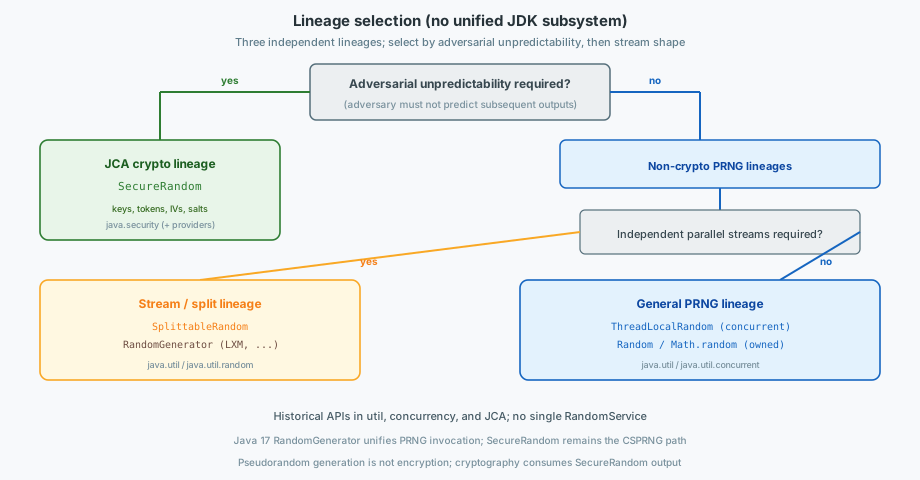
After the mechanisms above, selection is a mapping from requirements onto lineages. Evaluate requirements in order; do not choose a type by method convenience alone.
3.1 Selection by requirement
- Cryptographic secret material (keys, tokens, salts, IVs, nonces):
SecureRandomexclusively. - Non-cryptographic draws under concurrency:
ThreadLocalRandom.current(). - Non-cryptographic draws with a prescribed seed and reproducible sequence: a constructed
Random(or other seedable generator). - Independent streams for parallel or fork-join tasks:
SplittableRandom.split()or a splittableRandomGenerator. - Selection of a named non-cryptographic algorithm (Java 17+):
RandomGeneratorFactory.
3.2 Selection procedure
- Adversarial unpredictability. If an adversary must not be able to predict subsequent outputs from prior outputs or public state, select the JCA lineage (
SecureRandom) and terminate the procedure. - Stream independence. If distinct tasks require streams that are intended to be statistically independent (for example parallel Monte Carlo with
split), select the stream / split lineage. - Otherwise select the general PRNG lineage. Prefer
ThreadLocalRandomwhen no explicit seed is required. Construct a seededRandom,SplittableRandom, or seedableRandomGeneratorwhen bit-identical reproducibility is required.
| Requirement | Lineage | Representative type |
|---|---|---|
| Adversarial unpredictability | JCA | SecureRandom |
| Concurrent non-cryptographic draws | General PRNG | ThreadLocalRandom |
| Seeded reproducibility | General or stream PRNG | Seeded Random / SplittableRandom |
| Independent parallel streams | Stream / split | SplittableRandom, LXM factories |
| Named algorithm catalog (Java 17+) | Stream / split (and wrappers) | RandomGeneratorFactory |
Incorrect lineage selection includes using Random for authentication tokens, and using SecureRandom for high-volume simulation when unpredictability is not required (correct for security, often disproportionate in cost).
3.3 Non-cryptographic generation
import java.util.concurrent.ThreadLocalRandom;

int n = ThreadLocalRandom.current().nextInt(100);       // [0, 100)
long id = ThreadLocalRandom.current().nextLong();
double u = ThreadLocalRandom.current().nextDouble();    // [0.0, 1.0)
Seeded Random when a reproducible sequence is required:
import java.util.Random;

Random r = new Random(42L);
int a = r.nextInt(10);
int b = r.nextInt(10);
3.4 Splittable stream construction
import java.util.SplittableRandom;
import java.util.stream.IntStream;

SplittableRandom root = new SplittableRandom(12345L);
IntStream.range(0, 4).parallel().forEach(i -> {
    SplittableRandom local = root.split();
    System.out.println(local.nextInt());
});
3.5 Cryptographic byte generation
import java.security.SecureRandom;

SecureRandom sr = new SecureRandom();
// SecureRandom sr = SecureRandom.getInstanceStrong();

byte[] key = new byte[16];    // e.g. AES-128 key material
sr.nextBytes(key);

byte[] token = new byte[32];
sr.nextBytes(token);
Do not derive tokens from Random.nextInt encodings. Do not initialize SecureRandom for production secrets with low-entropy material such as wall-clock time or process identifiers alone.
3.6 Named RandomGenerator construction (Java 17+)
import java.util.random.RandomGenerator;
import java.util.random.RandomGeneratorFactory;

RandomGenerator g = RandomGeneratorFactory.of("L64X128MixRandom").create();
long x = g.nextLong();

RandomGeneratorFactory.all()
    .map(RandomGeneratorFactory::name)
    .sorted()
    .forEach(System.out::println);
| Topic | Summary |
|---|---|
| Overview | Three API lineages; historical origin; guarantees; type inventory |
| Generator mechanisms | LCG; SplitMix (ThreadLocalRandom, SplittableRandom); LXM / Xoroshiro; OS CSPRNG and NIST DRBG |
| Lineage selection | Requirement mapping, selection procedure, then invocation patterns |