
Cryptographic Primitives: Encoding, Hashing, and Encryption
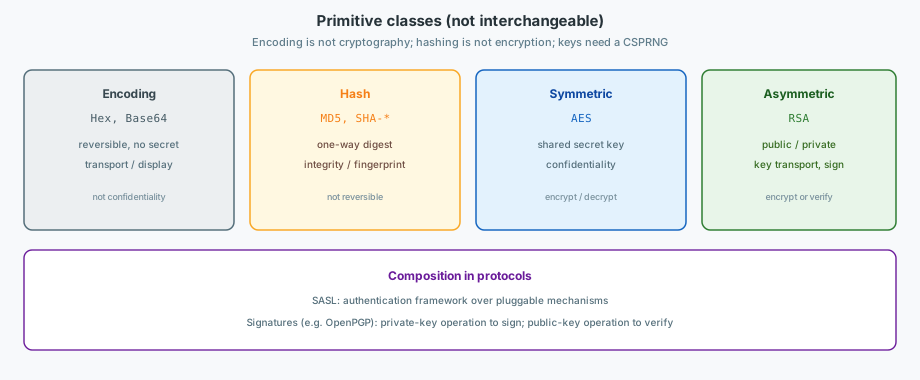
Cryptography in networked systems combines several primitive classes that are often conflated: encoding, hashing, symmetric encryption, and public-key operations. This post gives an overview of those classes, then the mechanisms of common algorithms—including elliptic-curve group law, ECDHE, ECDSA, AEAD, and HKDF—and finally protocol-level composition (TLS sessions, SASL, OpenPGP-style signatures) with tool examples. Encoding is not encryption. Hashing is not encryption. Secret keys must come from a CSPRNG; see Random Number Generation in the JDK.
Related: Random Number Generation in the JDK.
1. Overview
| Class | Secret required? | Reversible? | Primary purpose |
|---|---|---|---|
| Encoding (Hex, Base64) | No | Yes | Represent binary as text |
| Cryptographic hash (MD5, SHA-*) | No | No (one-way) | Integrity fingerprint; password hashing needs a KDF, not a bare hash |
| Symmetric cipher (AES, ChaCha20-Poly1305) | Shared key | Yes, with key | Confidentiality of bulk data (AEAD also authenticates) |
| Public-key cryptosystem (RSA, ECDSA) | Key pair | Yes, with matching key | Key transport, digital signatures |
| Key agreement (ECDHE) | Ephemeral key pairs | Shared secret (not a ciphertext) | Forward-secret shared secrets |
1.1 Usage
- Display or transport binary in ASCII protocols: Hex or Base64 (not a security control).
- Detect accidental corruption or build content digests: a modern hash (prefer SHA-256 or stronger; avoid MD5/SHA-1 for security).
- Encrypt large payloads with a shared secret: AES in an authenticated mode (for example AES-GCM).
- Exchange keys or sign messages without a pre-shared secret: RSA or elliptic-curve schemes (ECDHE, ECDSA; §2.7).
- Generate AES keys and nonces: a CSPRNG (
openssl rand,SecureRandom), never a general-purpose PRNG. - Protect HTTP on the public Internet: HTTPS (HTTP over TLS); composition and suites in §3.1.
1.2 Guarantees and non-guarantees
| Primitive | Provides | Does not provide |
|---|---|---|
| Hex / Base64 | Lossless binary↔text mapping | Confidentiality or authenticity |
| Hash | Fixed-length digest; collision resistance only if the algorithm remains unbroken | Encryption; password storage by itself |
| AES (correct mode + key) | Confidentiality (and authenticity if AEAD) | Key distribution |
| RSA encryption | Confidentiality of short messages under the public key | Efficient bulk encryption of large files |
| RSA signature | Integrity and origin under the private key | Confidentiality of the signed payload |
2. Mechanisms
2.1 Hex encoding
Hexadecimal encoding maps each octet to two characters from 0–9 and A–F (or a–f). One byte becomes two hex digits; the expansion factor is \(2\times\) relative to the raw binary length. Decoding is exact. Hex is used for dumps, fingerprints, and configuration literals—not for secrecy.
2.2 Base64 encoding
Base64 is a binary-to-text encoding that consumes input six bits at a time and maps each 6-bit value to one of 64 printable characters. Every three octets (24 bits) become four Base64 characters. When the input length is not a multiple of three, = padding completes the final quartet.
Relative to Hex, Base64 is denser (4 characters per 3 bytes versus 6 hex digits per 3 bytes). Like Hex, it is reversible without a key and confers no confidentiality.
2.3 AES (symmetric encryption)
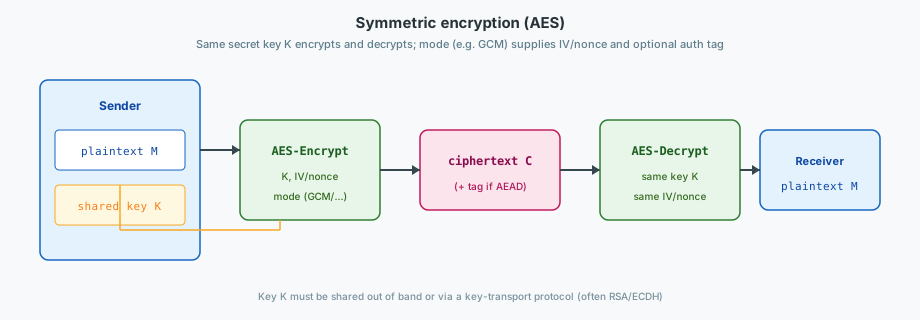
The Advanced Encryption Standard (FIPS 197, 2001) is a block cipher that superseded DES for most new designs. It is a symmetric-key algorithm: the same secret key encrypts and decrypts.
| Property | Value |
|---|---|
| Block size | 128 bits |
| Key sizes | 128, 192, or 256 bits (AES-128 / AES-192 / AES-256) |
| Structure | Substitution–permutation network (Rijndael) |
A bare block cipher must be used with a mode of operation. ECB must not be used for structured data.
AES-GCM (Galois/Counter Mode) is a common AEAD for bulk data. Counter mode encrypts by XORing the plaintext with an AES keystream keyed by (key, nonce, counter). Independently, a GHASH authenticator over \(GF(2^{128})\) covers ciphertext and associated data and yields a tag. Decryption recomputes the tag and rejects the record on mismatch. Nonces must never repeat under the same key.
Keys and IVs/nonces must be unpredictable; generate them with a CSPRNG:
openssl rand -out aes.key 16 # 128-bit key
2.4 MD5 (hash)
MD5 (Message-Digest Algorithm 5) is a cryptographic hash: arbitrary-length input maps to a 128-bit digest. It is one-way under normal use (the digest does not reveal the preimage by design).
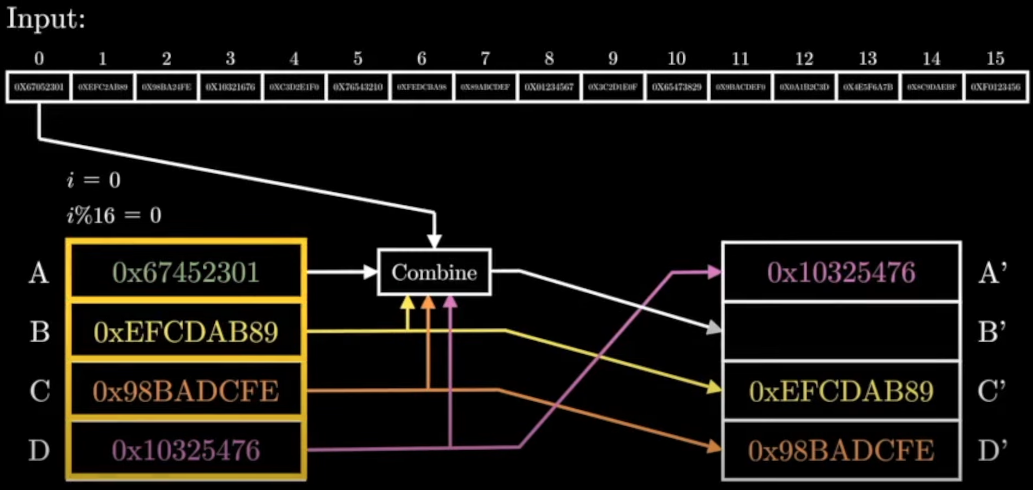
Compression structure (summary). Input is processed in 512-bit blocks. Each block is treated as sixteen 32-bit words. The algorithm maintains a 128-bit chaining state, initialized to fixed constants, and updates that state through four rounds of nonlinear functions and modular additions per block. The final chaining value is the digest.
Security status. MD5 is broken for collision resistance and must not be used for certificates, code signing, or other adversary-facing integrity. It may still appear as a non-cryptographic checksum. Prefer SHA-256 or stronger for security digests; prefer a password-based KDF (for example Argon2, scrypt, PBKDF2) for password storage.
2.5 SHA family (hash)
SHA denotes the NIST Secure Hash Algorithm family. Like MD5, members are one-way digests used for integrity and as building blocks in HMAC, signatures, and KDFs.
| Family | Typical digests | Notes |
|---|---|---|
| SHA-1 | 160 bits | Deprecated for signatures and certificates; collision attacks are practical |
| SHA-2 | 224 / 256 / 384 / 512 bits | Current default for many protocols (SHA-256, SHA-512) |
| SHA-3 | 224 / 256 / 384 / 512 bits | Keccak sponge construction; distinct from SHA-2 |
SHA-2 and SHA-3 are not “similar to MD5” in security margin; they are the replacements for MD5/SHA-1 in modern designs. SHA-256 and SHA-384 are the usual hashes inside HMAC, signatures, and HKDF (§2.9).
2.6 RSA (public-key cryptosystem)
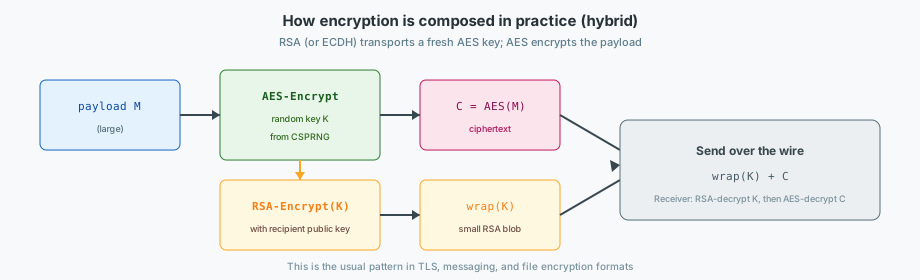
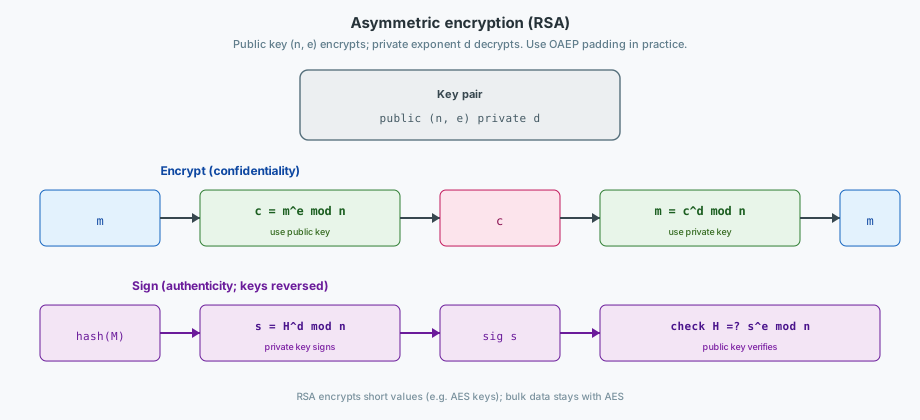
RSA (Rivest–Shamir–Adleman, 1977) is a public-key cryptosystem. A public key encrypts or verifies; a private key decrypts or signs. Practical systems use RSA for small payloads (session keys, signatures) and symmetric ciphers for bulk data.
Key generation
- Choose large secret primes \(p\) and \(q\).
- Compute modulus \(n = pq\). Publish \(n\) as part of the public key.
- Compute Carmichael’s totient \(\lambda(n) = \operatorname{lcm}(p-1, q-1)\). Keep \(\lambda(n)\) secret (equivalently, many texts use \(\varphi(n)=(p-1)(q-1)\)).
- Choose public exponent \(e\) with \(1 < e < \lambda(n)\) and \(\gcd(e, \lambda(n)) = 1\) (common choice: \(e = 65537\)).
- Compute private exponent \(d\) such that \[ d e \equiv 1 \pmod{\lambda(n)}. \]
- Public key: \((n, e)\). Private key: \(d\) (with \(n\)), plus \(p, q\) in implementations that use CRT acceleration.
Encryption and decryption
For message representative \(m\) with \(0 \le m < n\):
\[ c \equiv m^{e} \pmod{n} \qquad m \equiv c^{d} \pmod{n} \]Padding schemes (for example OAEP for encryption, PSS for signatures) are mandatory in real systems; textbook RSA without padding is insecure.
Signatures (direction reversed)
A digital signature applies the private exponent to a hash of the message; verification applies the public exponent. OpenPGP-style signing follows that pattern: sign with \(d\), verify with \((n, e)\). This authenticates origin and integrity; it does not encrypt the payload.
2.7 Elliptic-curve cryptography
Elliptic-curve schemes build public-key operations from a group of points on a curve. The pictures below use real coordinates for intuition; deployed cryptosystems use the same group law over a large finite field \(\mathbb{F}_p\).
2.7.1 Curve and group
A short Weierstrass curve has the form
\[ E:\quad y^{2} = x^{3} + a x + b \]with fixed coefficients \(a, b\). Over the reals the set of solutions is a smooth curve (plus a formal point at infinity \(\mathcal{O}\)). The figures in this section all use the same example
\[ E:\quad y^{2} = x^{3} + 13. \]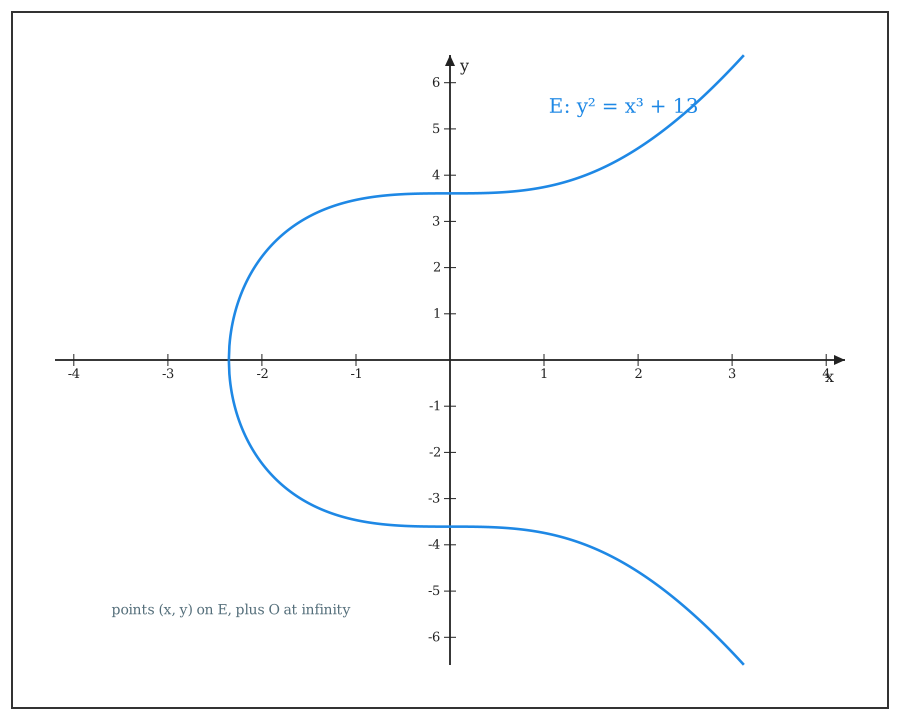
Over \(\mathbb{F}_p\) (NIST P-256 / P-384 style), the equation is the same with arithmetic modulo a prime \(p\). Points are pairs \((x, y) \in \mathbb{F}_p^{2}\) on \(E\), together with \(\mathcal{O}\) as the group identity.
Group law: third point, then flip. Take any two points \(P\) and \(Q\) on the curve (if \(P = Q\), use the tangent at \(P\) instead of a chord). A line meets a cubic in three places, so that line hits the curve again at a unique third point. Reflect that third point across the \(x\)-axis to obtain the sum \(R = P + Q\). Equivalently, if \(P \cdot Q\) denotes the third intersection,
\[ P + Q = -(P \cdot Q). \]On the same curve \(E\): the red chord through \(P\) and \(Q\) meets \(E\) a third time; the vertical red segment drops to \(R\) on the lower branch.
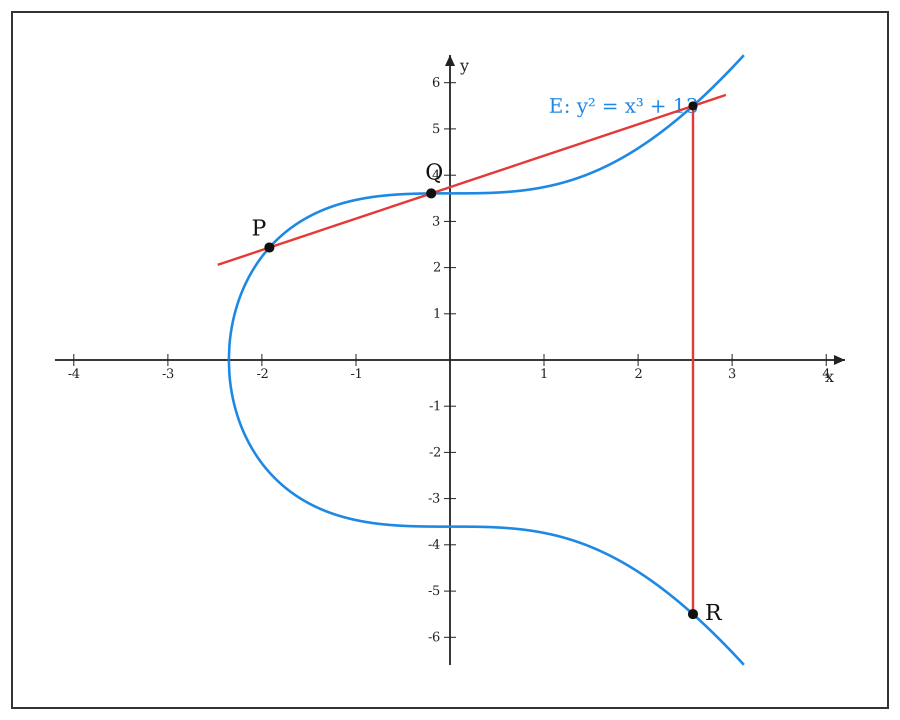
The resulting \(+\) is associative and commutative; \(\mathcal{O}\) (the point at infinity) is the identity—vertical lines are said to meet the curve “again” at \(\mathcal{O}\). Implementations never draw lines; they evaluate the same rule with modular formulas on coordinates.
Scalar multiplication and keys. For an integer \(k\) and a point \(P\),
\[ k P = \underbrace{P + P + \cdots + P}_{k\ \mathrm{times}}, \]computed by repeating the group law (often via double-and-add). On the curve:
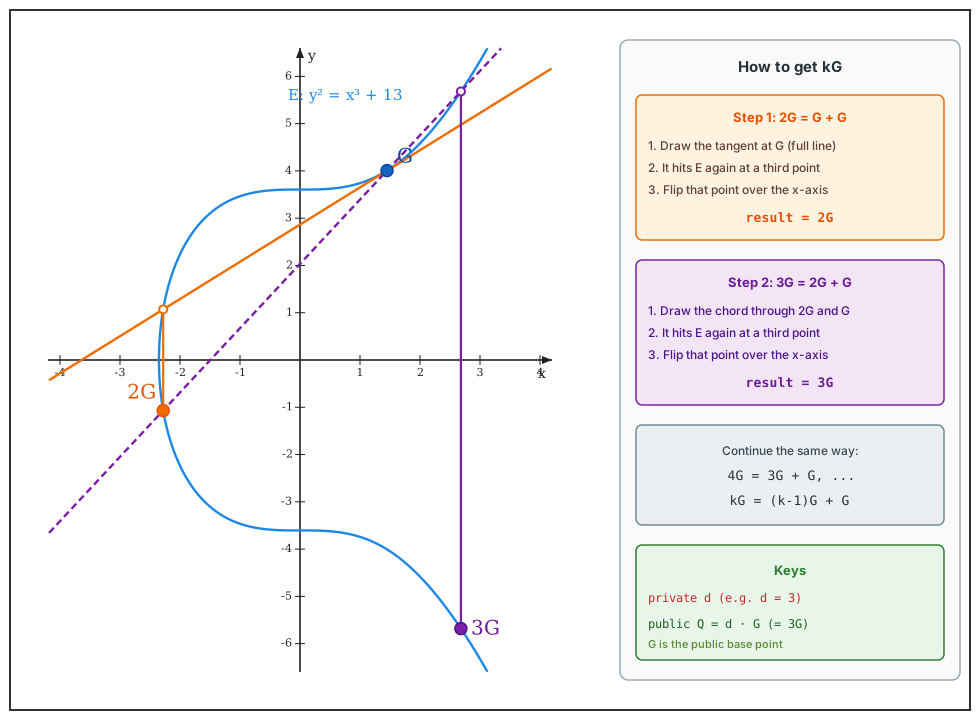
- \(2G = G + G\) — draw the tangent at \(G\); it meets \(E\) again at a third point; flip that point over the \(x\)-axis to get \(2G\).
- \(3G = 2G + G\) — draw the chord through \(2G\) and \(G\); again take the third intersection and flip to get \(3G\).
- Continue: \(4G = 3G + G\), and so on, until \(kG\).
Domain parameters publish a base point \(G\) of large prime order \(n\). The ECC key pair is:
| Symbol | What it is | Kept secret? | |
|---|---|---|---|
| Private key | \(d\) | Random integer in \(\{1,\ldots,n-1\}\) | Yes |
| Public key | \(Q = d\, G\) | Point obtained by the scalar walk above | No (published) |
| Base point | \(G\) | Fixed domain parameter | No (public) |
In the figure, orange is the tangent step to \(2G\); purple is the chord step to \(3G\). If the private key were \(d = 3\), the public key would be the point \(Q = 3G\).
Hard problem. Recovering the private key \(d\) from the public pair \((G, Q)\) is the elliptic-curve discrete logarithm problem (ECDLP). For curves with a large prime order and no weak structure, that problem is believed intractable for classical computers at the sizes used in practice (for example 256-bit NIST curves, or Curve25519).
| Curve | Field / form | Typical algorithms |
|---|---|---|
P-256 (secp256r1) | Prime field, short Weierstrass | ECDH, ECDSA |
P-384 (secp384r1) | Prime field, short Weierstrass | ECDH, ECDSA |
| Curve25519 | Prime field, Montgomery | X25519 (ECDH only) |
2.7.2 ECDH and ECDHE (key agreement)
Elliptic-curve Diffie–Hellman (ECDH) builds a shared secret from scalar multiplication. Each party’s private key is a secret scalar; the matching public key is that scalar times \(G\).
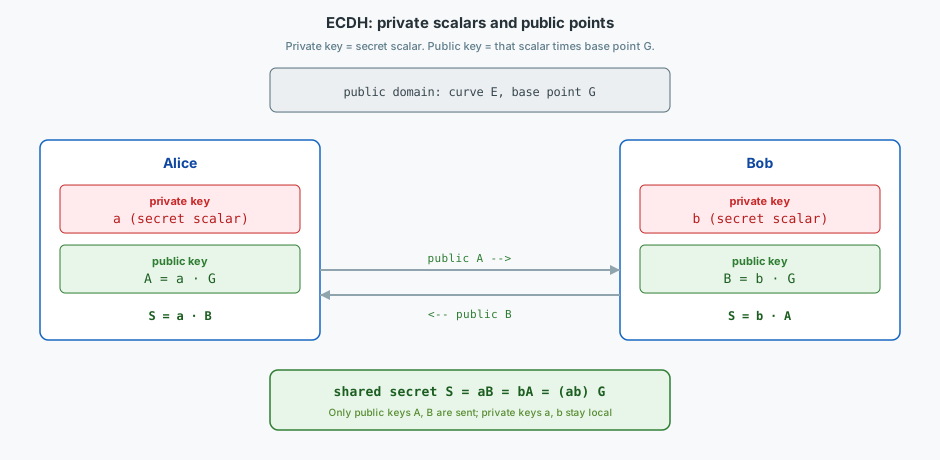
- Domain parameters \((E, G, n)\) are public.
- Alice’s private key is scalar \(a\); her public key is \(A = a G\).
- Bob’s private key is scalar \(b\); his public key is \(B = b G\).
- They exchange only the public keys. Alice computes \(S = a B = (ab)G\); Bob computes \(S = b A = (ba)G\).
An eavesdropper who sees \(A\) and \(B\) but not \(a\) or \(b\) cannot compute \(S\) without solving ECDLP (or a related CDH assumption).
ECDHE (“E” for ephemeral) uses fresh \(a\) and \(b\) for each run. Compromising a long-term signing key later does not recover past \(S\) values (forward secrecy). The shared point (or a coordinate of it) is not used raw as a bulk cipher key; it is passed through a KDF such as HKDF (§2.9).
X25519 is ECDH on Curve25519 using only the Montgomery \(u\)-coordinate. Private scalars are 32-byte strings that are clamped (clear low bits, set a high bit) so every scalar yields a valid, constant-time ladder multiplication. Public keys and the shared secret are 32-byte \(u\)-coordinates. X25519 is key agreement only, not a signature scheme.
2.7.3 ECDSA (signatures)
ECDSA signs with the private key scalar \(d\) and verifies with the public key point \(Q = d G\) on a Weierstrass group (typically P-256 or P-384).
Let \(H(m)\) be a SHA-2 digest of the message, interpreted as an integer modulo \(n\) (the order of \(G\)).
Sign (signer knows \(d\)):
- Choose a fresh secret nonce \(k \in \{1,\ldots,n-1\}\) (must be uniform and never reused).
- Compute \(R = k G\) and set \(r = R_x \bmod n\). If \(r = 0\), retry with a new \(k\).
- Compute \[ s \equiv k^{-1}\bigl(H(m) + r\, d\bigr) \pmod{n}. \] If \(s = 0\), retry.
- The signature is the pair \((r, s)\).
Verify (verifier knows \(Q\)):
- Reject if \(r\) or \(s\) is not in \(\{1,\ldots,n-1\}\).
- Compute \(w \equiv s^{-1} \pmod{n}\), then \[ u_{1} \equiv H(m)\, w \pmod{n}, \qquad u_{2} \equiv r\, w \pmod{n}. \]
- Compute point \(X = u_{1} G + u_{2} Q\). Accept iff \(X \ne \mathcal{O}\) and \(X_x \bmod n = r\).
Correctness follows because \(u_{1} G + u_{2} Q = k G\) when \((r,s)\) was produced honestly. Reusing or leaking \(k\) recovers \(d\); \(k\) must come from a CSPRNG (or deterministic derandomization such as RFC 6979). ECDSA authenticates a digest; it does not encrypt.
2.8 ChaCha20-Poly1305 (AEAD)
ChaCha20 is a stream cipher built from ARX operations (add, rotate, XOR) on a \(4\times 4\) matrix of 32-bit words. The state is initialized from a 256-bit key, a 96-bit nonce, a 32-bit block counter, and fixed constants. Twenty rounds of quarter-rounds mix the state; the result is added to the initial state to produce a 64-byte keystream block. Plaintext is XORed with the keystream. Decryption is the same XOR.
Poly1305 is a one-time authenticator: it evaluates a polynomial over the field \(\mathbb{F}_{2^{130}-5}\) with a secret key derived for the message, then adds a secret pad. The 16-byte tag authenticates the ciphertext (and any associated data).
ChaCha20-Poly1305 (RFC 8439) combines them into an AEAD: encrypt with ChaCha20, then MAC the ciphertext with Poly1305 under a one-time key taken from the ChaCha20 keystream. As with AES-GCM, a nonce must never repeat under the same key.
2.9 HKDF (key derivation)
HKDF (RFC 5869) turns input keying material into cryptographically separated keys using HMAC with a hash \(H\) (commonly SHA-256 or SHA-384).
- Extract: \(\mathrm{PRK} = \mathrm{HMAC}(\mathit{salt}, \mathit{IKM})\). For ECDH, \(\mathit{IKM}\) is (derived from) the shared secret \(S\); salt may be a prior secret or zeros.
- Expand: iteratively apply HMAC to produce as many output bytes as needed: \[ T_{0} = \varepsilon,\quad T_{i} = \mathrm{HMAC}(\mathrm{PRK},\, T_{i-1} \,\|\, \mathit{info} \,\|\, i),\quad \mathrm{OKM} = T_{1} \,\|\, T_{2} \,\|\, \cdots \] truncated to the required length. The \(\mathit{info}\) string labels the purpose of each derived key.
3. Protocol mechanisms and practice
3.1 HTTPS and TLS
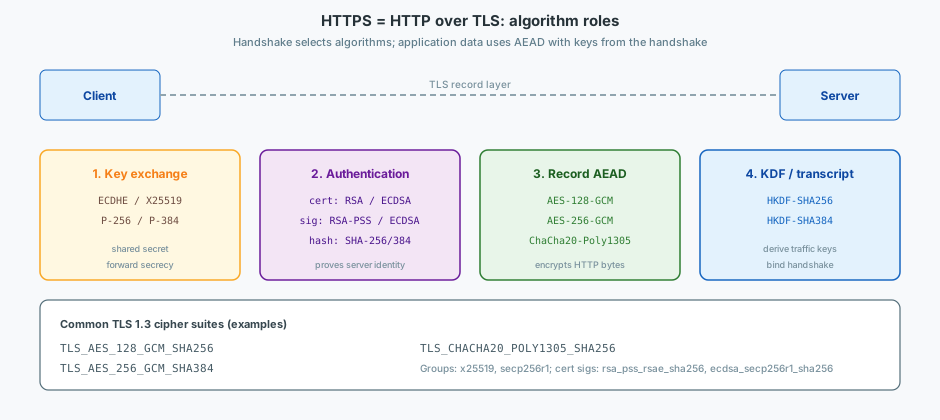
HTTPS is HTTP carried inside a TLS session. TLS does not invent new ciphers; it negotiates and composes the primitives in §2 into four roles: ephemeral key exchange, certificate authentication, AEAD protection of application records, and a hash/KDF for traffic secrets and the handshake transcript.
| Role | Purpose | Algorithms commonly deployed |
|---|---|---|
| Key exchange | Shared secret with forward secrecy | ECDHE on X25519, P-256, P-384 (§2.7.2) |
| Authentication | Bind handshake to a certificate key | Cert keys: RSA or ECDSA. Signatures: RSA-PSS + SHA-256/384, or ECDSA + SHA-256/384 (§2.6, §2.7.3) |
| Record AEAD | Encrypt and authenticate HTTP bytes | AES-128-GCM, AES-256-GCM, ChaCha20-Poly1305 (§2.3, §2.8) |
| Transcript / KDF | Derive traffic secrets; bind transcript | HKDF with SHA-256 or SHA-384 (§2.9) |
Hybrid pattern: asymmetric cryptography and ECDHE only in the handshake; bulk HTTP confidentiality is AEAD.
Negotiation outcome (TLS 1.3)
| Negotiated item | Typical choice |
|---|---|
| Named group | x25519 or secp256r1 |
| Certificate / signature | RSA-PSS-SHA256 or ECDSA-P256-SHA256 |
| Cipher suite | TLS_AES_128_GCM_SHA256 or TLS_CHACHA20_POLY1305_SHA256 |
TLS 1.3 cipher suite names list only AEAD + HKDF hash. Named groups and signature algorithms are separate extensions. TLS 1.2 suite names still concatenate all four roles, for example TLS_ECDHE_RSA_WITH_AES_128_GCM_SHA256.
Still observed on TLS 1.2
TLS_ECDHE_RSA_WITH_AES_128_GCM_SHA256TLS_ECDHE_ECDSA_WITH_AES_256_GCM_SHA384TLS_ECDHE_RSA_WITH_CHACHA20_POLY1305_SHA256
ECDHE_* provides forward secrecy. Suites that encrypt the premaster secret with static RSA alone (TLS_RSA_WITH_AES_...) lack forward secrecy and are obsolete on modern clients. CBC suites and RC4 must not be used.
Inspection
# Negotiated TLS version, cipher, and peer certificate algorithms
openssl s_client -connect example.com:443 -servername example.com </dev/null 2>/dev/null \
  | openssl x509 -noout -subject -issuer -dates
In the s_client handshake trace, look for Protocol, Cipher, and the certificate Public Key Algorithm / signature lines.
3.2 SASL
Simple Authentication and Security Layer (SASL) is a framework that separates authentication mechanisms from application protocols (SMTP, LDAP, XMPP, and others). The application negotiates a mechanism name; the mechanism performs the challenge–response or credential exchange. SASL itself is not a cipher; concrete mechanisms may use hashes, passwords, or GSS-API/Kerberos underneath.
3.3 OpenPGP-style signing with RSA
Relative to RSA encryption:
| Operation | Key used | Goal |
|---|---|---|
| Encrypt (confidentiality) | Recipient public \((n, e)\) | Only holder of \(d\) can read |
| Sign (authenticity) | Signer private \(d\) | Anyone with \((n, e)\) can verify |
| Verify | Signer public \((n, e)\) | Accept or reject signature |
3.4 Tooling notes
# 128-bit AES key material (CSPRNG)
openssl rand -out aes.key 16

# SHA-256 digest of a file
openssl dgst -sha256 payload.bin

# Avoid for security digests
# openssl dgst -md5 payload.bin

# HTTPS/TLS: see also openssl s_client in §3.1
Java applications that need secret bits for AES keys or nonces must use SecureRandom (or an equivalent CSPRNG), not java.util.Random. Details: Random Number Generation in the JDK.
| Topic | Summary |
|---|---|
| Overview | Encoding, hash, symmetric, and asymmetric classes; usage and limits |
| Mechanisms | Hex, Base64, AES-GCM, MD5, SHA, RSA; elliptic-curve group law, ECDHE, ECDSA; ChaCha20-Poly1305; HKDF |
| Practice | TLS/HTTPS composition and suites; SASL; OpenPGP-style sign; OpenSSL |